Stem Cell Breakthrough Paves the Way for Woolly Mammoth De-Extinction

Colossal Biosciences has announced a significant breakthrough in stem cell research that could propel efforts to resurrect long-extinct woolly mammoths. According to a statement shared with Live Science, Colossal’s Woolly Mammoth team has successfully derived induced pluripotent stem cells (iPSCs) from Asian elephants (Elephas maximus). iPSCs, capable of transforming into any cell type in the body, provide researchers with a crucial tool to explore the genetic makeup and unique adaptations of woolly mammoths.

Eriona Hysolli, head of biological sciences and mammoth lead at Colossal Biosciences, emphasized the significance of this achievement in understanding the genetic and cellular mechanisms behind the distinctive features of woolly mammoths. iPSCs offer insights into traits such as shaggy hair, curved tusks, fat deposits, and cranial morphology that enabled mammoths to thrive in Arctic environments. Moreover, iPSCs pave the way for generating elephant sperm and egg cells in the lab, circumventing the challenges of harvesting cells from endangered Asian elephants.

Continue reading… “Stem Cell Breakthrough Paves the Way for Woolly Mammoth De-Extinction”

Unveiling the “Ceiling” of Human Lifespan: Dutch Researchers’ Groundbreaking Discovery

In a groundbreaking revelation, Dutch researchers believe they’ve reached a significant milestone in understanding the upper limits of human lifespan. Amidst the backdrop of increasing life expectancy due to advancements in various domains, including nutrition and healthcare, the quest to unravel the ultimate boundaries of human longevity has intensified.

Drawing from a comprehensive dataset spanning approximately three decades and encompassing the precise ages at death for around 75,000 Dutch individuals, expert statisticians from Tilburg and Erasmus universities in Rotterdam have proposed a maximum age limit for women at a remarkable 115.7 years. Intriguingly, the male counterpart closely follows at 114.1 years. This unprecedented insight provides a robust foundation for their findings.

Continue reading… “Unveiling the “Ceiling” of Human Lifespan: Dutch Researchers’ Groundbreaking Discovery”

Deciphering Chicken Clucks: Humans Can Detect Emotions in Chicken Vocalizations

A study led by the University of Queensland has unveiled a fascinating ability in humans – the capability to discern whether chickens are excited or displeased based solely on the sounds of their clucks. Professor Joerg Henning, hailing from UQ’s School of Veterinary Science, spearheaded the research, which delved into whether humans could accurately interpret the context of calls or clucking sounds produced by domestic chickens, one of the world’s most widely farmed species.

Study Methodology and Key Findings

Professor Henning explained the study’s methodology, saying, “In this study, we used recordings of chickens vocalizing in all different scenarios from a previous experiment.” The researchers identified four distinct call types, each associated with specific contexts:

Continue reading… “Deciphering Chicken Clucks: Humans Can Detect Emotions in Chicken Vocalizations”

See-Through Wood: A Sustainable Future Material

Three decades ago, German botanist Siegfried Fink pioneered a revolutionary concept: creating transparent wood by bleaching plant cells. His breakthrough technique, published in a 1992 wood technology journal, remained dormant until materials scientist Lars Berglund stumbled upon it, sparking a renewed interest in transparent wood. Collaborating with researchers at the University of Maryland, Berglund and his counterparts at KTH Royal Institute of Technology in Sweden have now harnessed the potential of transparent wood for various applications.

Wood’s intricate structure consists of vertical channels resembling bundled straws held together by glue called lignin. To achieve transparency, researchers remove or modify lignin, leaving a milky-white skeleton of hollow cells. By filling these cells with a substance like epoxy resin that bends light similarly to cell walls, transparent wood is created. Despite its thin profile, transparent wood exhibits remarkable strength, outperforming plastic and glass in fracture and pressure tests.

Continue reading… “See-Through Wood: A Sustainable Future Material”

China’s Mengxiang Takes on the Abyss: A Pioneering Expedition to Earth’s Mantle

In a groundbreaking initiative that has eluded scientists since the 1960s, China’s cutting-edge ocean drilling vessel, the Mengxiang, is poised to achieve the unprecedented feat of reaching the Earth’s mantle. Representing a remarkable testament to China’s burgeoning influence and capabilities in marine sciences, this monumental mission entails drilling approximately 7,000 meters beneath the ocean floor.

Distinguishing itself as a symbol of China’s technological prowess, the Mengxiang surpasses its counterparts, such as the American vessel JOIDES Resolution and Japan’s Chikyu, in advanced capabilities. A recent successful trial of the Mengxiang’s propulsion system marked a pivotal milestone in its journey. With the ability to operate in unlimited navigational areas worldwide, this remarkable ship has the potential to drill as deep as 11,000 meters into the sea.

Continue reading… “China’s Mengxiang Takes on the Abyss: A Pioneering Expedition to Earth’s Mantle”

Harnessing Limitless Energy: Artificial Photosynthesis Breakthrough

For years, the global scientific community has sought ways to unlock a sustainable, boundless energy source. The quest has explored everything from Moon crystals to boundary-defying molecules. However, recent groundbreaking research suggests that we may have discovered a means to harness energy generation, inspired by the incredible efficiency of plant photosynthesis.

This breakthrough came to light through innovative research where scientists successfully replicated the natural process of photosynthesis to create methane. This high-energy-density fuel is generated using only water, carbon dioxide, and sunlight. Their findings are documented in a newly published paper in ACS Engineering. If scaled up, this new process could revolutionize the energy landscape, potentially replacing solar panels as a primary source of clean, infinite energy—something researchers have been striving to achieve for decades.

Continue reading… “Harnessing Limitless Energy: Artificial Photosynthesis Breakthrough”

Soil Emerges as Earth’s Most Biodiverse Habitat, Aiding in Biodiversity and Climate Crises

Study Reveals Soil as Earth’s Premier Biodiversity Hotspot

A groundbreaking study has unveiled a stunning revelation: more than half of all species on Earth inhabit the soil, making it the most biodiverse habitat on our planet. This revelation significantly surpasses previous estimates from 2006, which suggested that 25% of life had a soil-based foundation.

Published in Proceedings of the National Academy of Sciences, the research marks a turning point in our understanding of biodiversity. Soil, often overlooked in discussions of nature protection due to its enigmatic complexity, is now recognized as the epicenter of life’s rich diversity.

Continue reading… “Soil Emerges as Earth’s Most Biodiverse Habitat, Aiding in Biodiversity and Climate Crises”

Scientists reproduced a gravity field- 1,000 times stronger than Earth’s gravity

The study overcomes the effects of Earth’s gravity, replicating conditions on other planets, stars.

A recent discovery has shed new light on one of the most intriguing phenomena in the universe. Astronomers have found an incredibly strong gravity field, approximately 1,000 times more potent than Earth’s gravity, surrounding a rare type of neutron star known as a magnetar.

The magnetar in question is located approximately 30,000 light-years away from Earth and was discovered by a team of scientists from the University of Amsterdam and the University of Cambridge. The researchers used observations from the European Space Agency’s XMM-Newton satellite to measure the strength of the magnetar’s gravity field.

Continue reading… “Scientists reproduced a gravity field- 1,000 times stronger than Earth’s gravity”

‘Mind-boggling’ alloy is Earth’s toughest material, even at extreme temperatures

Microscopy images showing the path of a fracture and crystal structure deformation in a cobalt, chromium and nickel alloy during stress testing at -424 degrees F. 

By Robert Lea

A metallic alloy of chromium, cobalt, and nickel is over 100 times tougher than graphene and gets even more resistant to damage at extremely low temperatures.

Researchers have proven that a metallic alloy of chromium, cobalt and nickel is officially the toughest material on Earth — more than 100 times tougher than the wonder material graphene.

In a new study published Dec. 1 in the journal Science, researchers subjected the ultra-tough alloy to extremely cold temperatures, in order to test how fracture-resistant the material is. Scientists have known for years that this alloy is one tough cookie — however, to the team’s surprise, the alloy only became tougher and more resistant to cracks as temperatures plummeted. 

This super-resistance to fracture is in stark contrast to most materials, which only become more brittle in freezing temperatures, according to the study authors.

“People talk about the toughness of graphene, and that is measured at just 4 megapascals per meter,” study co-author Robert Ritchie), a professor of engineering at the University of California Berkeley and senior faculty scientist at the Lawrence Berkeley National Laboratory, told Live Science. “The toughness of aluminum alloys used in aircraft is 35 megapascals per meter. This material has a toughness of 450 to 500 megapascals per meter… these are mind-boggling numbers.” 

The potential applications of such a tough material range from space infrastructure to fracture-resistant containers for clean energy uses here on Earth. However, Ritchie noted, two of the alloy’s three elements (nickel and cobalt) are prohibitively expensive, limiting the alloy’s usefulness to the laboratory for the foreseeable future.

Continue reading… “‘Mind-boggling’ alloy is Earth’s toughest material, even at extreme temperatures”

Physicists Discover a Remarkable New Type of Sound Wave

By City University of Hong Kong on Dec 10, 2021

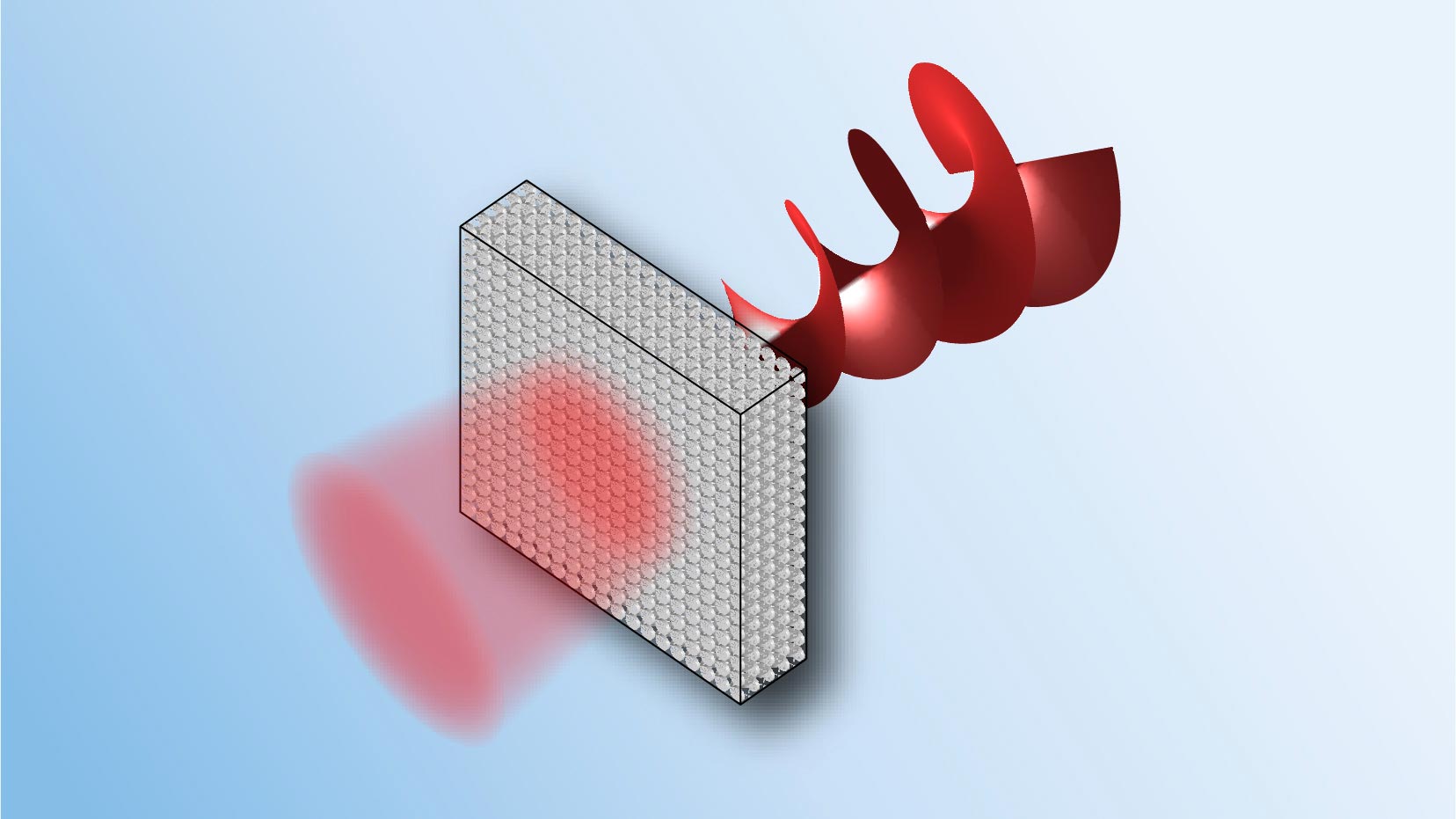
Sound vortex generation enabled by the spin-orbit interaction in real space.

Can you imagine sound travels in the same way as light does? A research team at City University of Hong Kong (CityU) discovered a new type of sound wave: the airborne sound wave vibrates transversely and carries both spin and orbital angular momentum like light does. The findings shattered scientists’ previous beliefs about the sound wave, opening an avenue to the development of novel applications in acoustic communications, acoustic sensing, and imaging.

The research was initiated and co-led by Dr. Wang Shubo, Assistant Professor in the Department of Physics at CityU, and conducted in collaboration with scientists from Hong Kong Baptist University (HKBU) and the Hong Kong University of Science and Technology (HKUST). It was published in Nature Communications, titled “Spin-orbit interactions of transverse sound.”

Continue reading… “Physicists Discover a Remarkable New Type of Sound Wave”

‘Bogolons’ make graphene superconducting

Graphene can be made to superconduct by placing it next to a Bose-Einstein condensate – a form of matter in which all the atoms are in the same quantum state. According to the theorists who discovered it, this new type of superconductivity stems from interactions between the electrons in graphene and quasiparticles called “bogolons” in the condensate. If demonstrated experimentally, the work could make it possible to develop new types of hybrid superconducting devices for applications in quantum sensing and quantum computing.

Conventional superconductivity occurs when phonons – quasiparticles that arise from vibrations in a material’s crystal lattice – cause electrons in the material to pair up despite their mutual electromagnetic repulsion. If the material is cooled to sufficiently low temperatures, these paired electrons (known as Cooper pairs) can travel through it without any resistance.

Continue reading… “‘Bogolons’ make graphene superconducting”

Cities Have Unique Microbial ‘Fingerprints’, First Study of Its Kind Reveals

PETER DOCKRILL

Each city is populated by a unique host of microbial organisms, and this microbial ‘fingerprint’ is so distinctive, the DNA on your shoe is likely enough to identify where you live, scientists say.

In a new study, researchers took thousands of samples from mass transit systems in 60 cities across the world, swabbing common touch points like turnstiles and railings in bustling subways and bus stations across the world.

Subjecting over 4,700 of the collected samples to metagenomic sequencing (the study of genetic material collected from the environment), scientists created a global atlas of the urban microbial ecosystem, which they say is the first systematic catalog of its kind.

The results suggest that no two cities are alike, with each major metropolis studied so far revealing a unique ‘molecular echo’ of the microbial species that inhabit it, distinct from populations found in other urban environments.

Continue reading… “Cities Have Unique Microbial ‘Fingerprints’, First Study of Its Kind Reveals”
Discover the Hidden Patterns of Tomorrow with Futurist Thomas Frey
Unlock Your Potential, Ignite Your Success.

By delving into the futuring techniques of Futurist Thomas Frey, you’ll embark on an enlightening journey.

Learn More about this exciting program.