The Cannibal Machines Are Coming—and They’re Evolving Without You

For decades, we’ve been focused on building smarter robot minds. Now, scientists have unlocked the next frontier: bodies that grow, heal, and scavenge.

In a stunning leap out of Columbia University, researchers have created robots that can physically rebuild themselves—not in a factory, but in the wild, using parts from their surroundings or even other robots. Dubbed “Robot Metabolism,” this new form of machine autonomy marks the beginning of self-sustaining, self-improving machines that blur the line between design and evolution.

Continue reading… “The Cannibal Machines Are Coming—and They’re Evolving Without You”
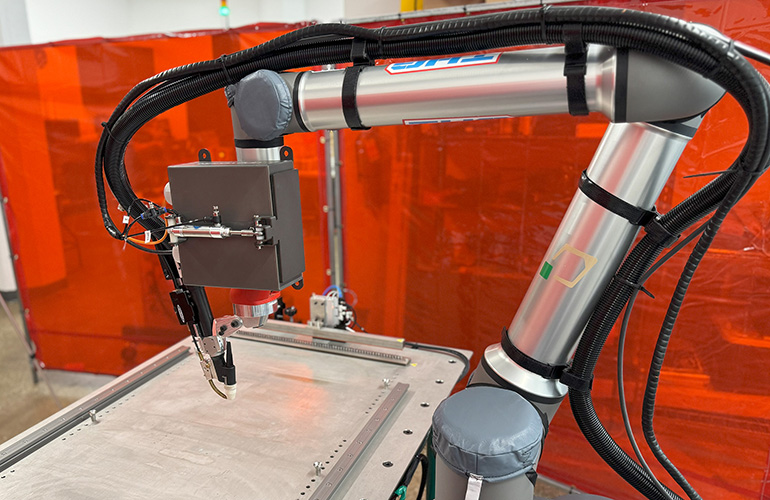
Welding Without Welders: The Smart Workcell That Doesn’t Need You

Welders used to rule the shop floor.

Their sparks were the signature of a skilled trade—equal parts craftsmanship, grit, and danger. But what happens when the torch passes to a machine that doesn’t sweat, doesn’t miss, and doesn’t complain?

This week, Cohesive Robotics answered that question loud and clear with the launch of its Smart Welding Robotic Workcell, a fully autonomous welding system that doesn’t just automate tasks—it replaces the art of welding with code, cameras, and algorithms.

Welcome to the new frontier of fabrication, where the welder’s helmet is traded for a machine-learning model, and experience is measured in training data—not decades on the job.

Continue reading… “Welding Without Welders: The Smart Workcell That Doesn’t Need You”

Laser-Controlled Soft Robotic Arm Mimics Octopus Movements

A flexible, octopus-inspired robotic arm may soon operate entirely free of wires or internal electronics. Developed by engineers at Rice University, this new soft robotic arm is controlled by laser beams and capable of executing complex tasks such as navigating around obstacles and precisely hitting targets.

This innovation marks the first real-time, reconfigurable, and automated control of a light-responsive material used in soft robotics. The key to the arm’s movement lies in a specialized material known as azobenzene liquid crystal elastomer. This light-responsive polymer contracts under blue laser light and quickly returns to its original shape in the dark, allowing for rapid, programmable motion.

Continue reading… “Laser-Controlled Soft Robotic Arm Mimics Octopus Movements”

SS Innovations Completes First Robotic Cardiac Surgery in the Americas Using SSi Mantra 3 System

SS Innovations International Inc. has successfully completed the first robotic cardiac surgery in the Americas using its SSi Mantra 3 surgical robotic system. The procedure took place on June 8 at Interhospital in Guayaquil, Ecuador, and marked a major milestone for robotic surgery in the Western Hemisphere.

Dr. Juan Zuniga, a cardiothoracic surgeon at Interhospital, performed the groundbreaking procedure, which involved a robotic Atrial Septal Defect (ASD) closure. This type of surgery repairs a hole between the heart’s upper two chambers. Following the surgery, a transesophageal echocardiogram confirmed the effective closure of the defect, and the patient began recovery with positive results.

Continue reading… “SS Innovations Completes First Robotic Cardiac Surgery in the Americas Using SSi Mantra 3 System”

Self-Healing Soft Robotics Inspired by Nature

If you grew up watching sci-fi classics like Terminator 2, you might remember the T-1000’s incredible ability to self-repair from bullet wounds and blade slashes. While real-world technology isn’t quite there yet, engineers at the University of Nebraska–Lincoln have made a major stride in that direction with a new self-healing soft robotics system.

Developed by a team led by engineer Eric Markvicka and graduate students Ethan Krings and Patrick McManigal, this system features an autonomous artificial muscle that detects and repairs its own damage. It’s designed to mimic how human and plant skin reacts to injury, pushing the boundaries of biomimicry in soft robotics.

Continue reading… “Self-Healing Soft Robotics Inspired by Nature”

Artedrone Develops Autonomous Robotic System to Expand Access to Stroke Treatment

Paris-based medtech startup Artedrone is advancing a groundbreaking microrobotic system designed to autonomously navigate the brain’s vasculature and remove blood clots, offering a new approach to stroke care with the potential to dramatically expand access beyond specialized treatment centers. Known as the Sasha system, the technology combines robotic catheterization, magnetic guidance, advanced imaging, and artificial intelligence to perform mechanical thrombectomy procedures with minimal operator intervention. Currently in preclinical development, Artedrone has submitted initial findings for publication and is targeting a first-in-human trial by 2027.

The Sasha system operates by using CT or MRI imaging to create a digital twin of the patient’s brain vasculature. This model is used to pre-map a path to the clot. During the procedure, an interventionalist accesses the patient’s arterial system through the groin and guides the catheter up to the carotid artery. From that point—referred to as the “base camp”—the microrobot takes over, propelled passively by blood flow. As it encounters bifurcations in the vessels, magnetic fields from an external device are used to steer the catheter by pulling or pushing a magnetic component on the device in the desired direction. This step-by-step advancement continues until the device reaches the target site.

Continue reading… “Artedrone Develops Autonomous Robotic System to Expand Access to Stroke Treatment”

DEEP Robotics Launches the Lynx M20: A Rugged All-Terrain Robot for Extreme Environments

China’s DEEP Robotics has introduced the Lynx M20, a next-generation all-terrain robot built to handle the harshest industrial and environmental conditions. Purpose-designed for infrastructure inspection, disaster response, and scientific exploration, the M20 combines rugged durability with advanced mobility features.

Building on the success of its earlier wheeled quadruped model unveiled in November 2025, the M20 pushes the boundaries of robotics in challenging terrains. It can navigate rocky trails, muddy wetlands, shifting sands, and unstable debris fields with impressive stability and control. A demonstration video released by the company highlights the robot descending steep slopes, crossing narrow bridges, and even traversing shallow water—all without missing a beat.

Continue reading… “DEEP Robotics Launches the Lynx M20: A Rugged All-Terrain Robot for Extreme Environments”

Corleo: Kawasaki Unveils Hydrogen-Powered Robotic Horse of the Future

Kawasaki Heavy Industries has taken the wraps off Corleo, a futuristic, four-legged hydrogen-powered robotic horse that blends artificial intelligence, clean energy, and off-road capability. Unveiled at the Osaka-Kansai Expo 2025, this bold concept drew attention for its unusual approach to sustainable mobility and its inspiration from both motorcycles and living creatures.

Corleo isn’t just built to turn heads—it’s designed to traverse tough terrain. Each of its four legs moves independently, enabling it to maintain balance and provide a smoother ride across a range of surfaces, from rocky trails to grassy fields. Kawasaki describes the concept as an “off-road mobility platform,” one capable of handling varied environments with stability and control.

Continue reading… “Corleo: Kawasaki Unveils Hydrogen-Powered Robotic Horse of the Future”

Locus Robotics Unveils Locus Array: A Game-Changing AI-Driven System for High-Density Storage and Automation

At ProMat, Locus Robotics, renowned for its goods-to-person automation, introduced a sneak peek of its latest innovation: Locus Array. This new system, designed to optimize high-density storage and throughput, leverages artificial intelligence (AI) and robotics to enhance warehouse operations.

“We’ve been working on this for the past several years,” said Rick Faulk, CEO of Locus Robotics. “Our zero-touch fulfillment automates induction, and double-deep storage covers 100% of SKUs.”

Continue reading… “Locus Robotics Unveils Locus Array: A Game-Changing AI-Driven System for High-Density Storage and Automation”

Humanoid Robotics Startup Unveils Next-Gen HMND 01, Paving the Way for Human-Robot Collaboration

The world of humanoid robotics continues to advance rapidly, with exciting developments surfacing almost weekly. Last week, London-based Humanoid.ai introduced its next-generation robot, HMND 01, offering a first look at its mechanical design, motion control, and integration of artificial intelligence. The company, founded by serial entrepreneur Artem Sokolov in 2024, aims to revolutionize industries with scalable, safe, and general-purpose humanoid robots.

Humanoid.ai, also known as SKL Robotics Ltd., has brought together experts in robotics, AI, and industrial design to create adaptable, intelligent robots capable of performing complex tasks. Sokolov envisions a future where humans and robots collaborate in harmony, addressing societal challenges such as labor shortages and the aging population. “The strongest argument for humanoids is that the world is already designed for humans, so they can seamlessly integrate and adapt quickly to existing environments,” said Sokolov.

Continue reading… “Humanoid Robotics Startup Unveils Next-Gen HMND 01, Paving the Way for Human-Robot Collaboration”

Boston Dynamics Partners with RAI Institute to Advance Atlas Robot’s Reinforcement Learning Capabilities

Boston Dynamics announced a new partnership on Wednesday with the Robotics & AI Institute (RAI Institute) to enhance the reinforcement learning capabilities of its electric Atlas humanoid robot. This collaboration aims to improve how Atlas learns new tasks through more efficient and advanced methods.

The RAI Institute, previously known as The Boston Dynamics AI Institute, was founded by Marc Raibert, a former MIT professor and the former CEO of Boston Dynamics for 30 years. Raibert established the Institute in 2022 to continue the cutting-edge research that formed the foundation of Boston Dynamics’ innovative robotics.

Continue reading… “Boston Dynamics Partners with RAI Institute to Advance Atlas Robot’s Reinforcement Learning Capabilities”

Breakthrough “Hyperelastic Torque Reversal Mechanism” Unlocks Rapid and Powerful Movements in Soft Robotics

A groundbreaking study has led to the development of the “hyperelastic torque reversal mechanism” (HeTRM), a new approach that allows robots made from soft, rubber-like materials to perform rapid and powerful movements. Published in Science Robotics, this research was led by Professor Kyu-Jin Cho from Seoul National University’s Department of Mechanical Engineering. The study draws inspiration from nature, specifically the remarkable abilities of the mantis shrimp and flea, known for their extraordinary power and speed despite their soft bodies.

The mantis shrimp is famous for delivering punches at speeds of up to 90 km/h to break through prey, while the flea can leap to heights exceeding 200 times its body length. According to Professor Cho, the secret behind these organisms’ ability to generate such powerful forces lies in the “torque reversal mechanism,” which allows for the rapid switching of rotational force direction applied by muscles to their limbs. This discovery has now been adapted into the field of soft robotics.

Continue reading… “Breakthrough “Hyperelastic Torque Reversal Mechanism” Unlocks Rapid and Powerful Movements in Soft Robotics”
Discover the Hidden Patterns of Tomorrow with Futurist Thomas Frey
Unlock Your Potential, Ignite Your Success.

By delving into the futuring techniques of Futurist Thomas Frey, you’ll embark on an enlightening journey.

Learn More about this exciting program.