Stanford Engineers Build Robot-run Restaurant

Engineering students at Stanford got tired of minimal food options on campus and high prices at the available locations. This struggle inspired Alex Kolchinski, Alex Gruebele, and Max Perham to create Mezli, a startup that makes fully autonomous modular restaurants. 

Kolchinski mentioned how they discovered that the $10 cost of a burrito bowl from Chipotle consists of $3 for food and the remaining $7 for labor, real estate, and overhead. That sparked the idea for a self-contained restaurant. 

The team also learned most chains did most cooking in mass in central kitchens and only had a few final steps to make meals on-site, such as heating and plating. They then concluded automating those final steps could provide meals at a smaller price. 

With backgrounds in soft robotics, aerospace engineering, and artificial intelligence, and the help of Michelin-star chef Eric Minnich, the students started Mezli. 

The startup has created a prototype robot, and the company hopes to launch its third version in 2022. Kolchinksi expects the company’s first publicly-deployed robot restaurant to serve hundreds of customers daily when it opens this year. Mass production will follow. 

Continue reading… “Stanford Engineers Build Robot-run Restaurant”
This Warehouse Robot Reads Human Body Language

Machines that understand what their human teammates are doing could boost productivity without taking jobs.

RODNEY BROOKS KNOWS a fair bit about robots. Besides being a pioneer of academic robotics research, he has founded companies that have given the world the robot vacuum cleaner, the bomb disposal bot, and a factory robot anyone can program.

Now Brooks wants to introduce another revolutionary type of robot helper—a mobile warehouse robot with the ability to read human body language to tell what workers around it are doing. Robots are increasingly working in close proximity to humans, and finding ways to maximize human-machine teamwork could help companies boost productivity and perhaps lead to new kinds of jobs rather than robots replacing people. But giving robots the ability to read human cues is far from easy.

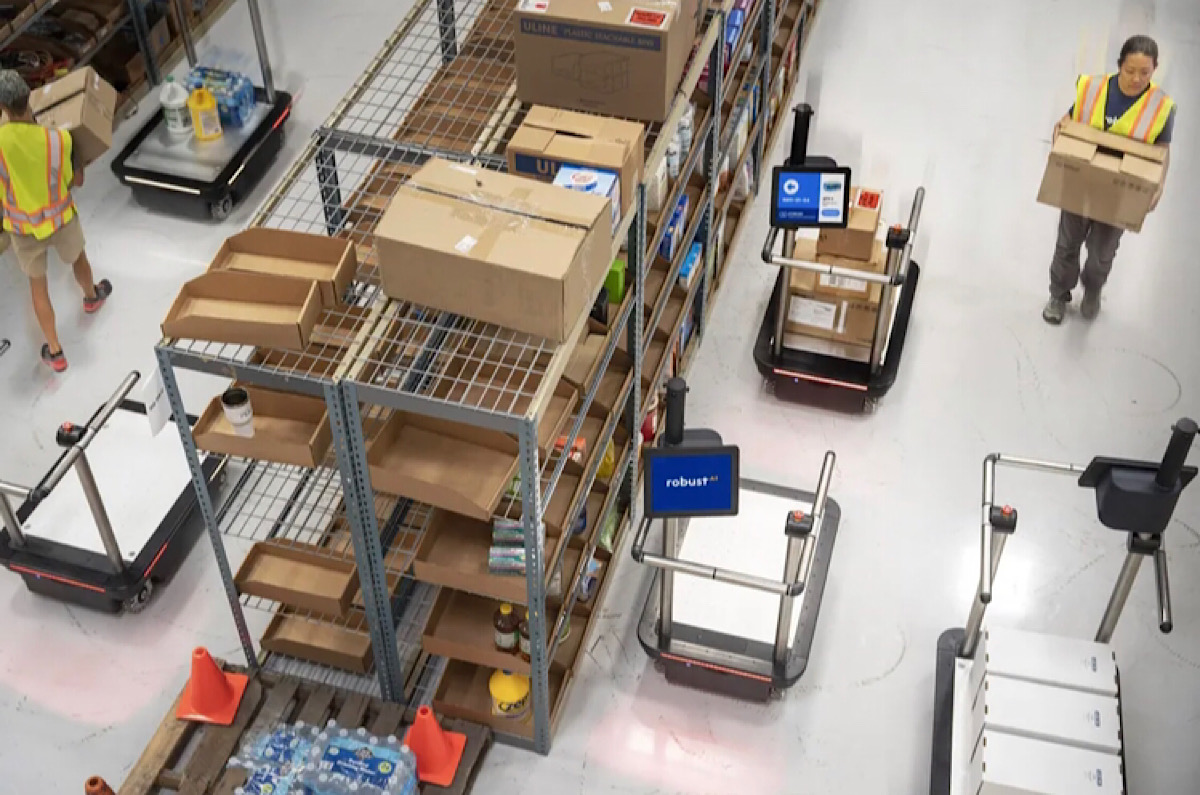
Brooks’ new company, Robust AI, unveiled its mobile robot, Carter, designed to work in warehouse facilities, last week. “The analogy here is a service dog,” Brooks says via video call. “It obeys you; you can modify its behavior, and it’s there to help you.”

Robust AI’s robot, Carter, looks like the kind of dolly you’d find at a home improvement store, but it has a motorized base, a touchscreen mounted above its handlebar, and a periscope with several cameras. It uses these cameras to scan the surrounding scene, allowing its software to identify workers nearby, and it attempts to infer what they are doing from their pose and how they are moving. If a human worker needs to move several boxes, for example, they can approach a Carter robot moving autonomously and, by grabbing the handlebar, take manual control. The robot can be configured to perform a variety of different tasks using a “no code” graphical interface—for example, to follow a person around a warehouse, carrying items that are picked from shelves.

Continue reading… “This Warehouse Robot Reads Human Body Language”

STanford Engineers Develop Tiny Robots To Treat Patients From The Inside

If you’re not a fan of swallowing pills, how about swallowing a robotic doctor instead?

A team at Stanford University has developed what it calls a ‘millirobot’ smaller than a fingertip, which is able to enter the human body and have a look around, identifying and treating complex diseases.

The team are working on several different robot designs, including one that can ‘crawl’ using the motion generated by magnetic fields, and can fold itself over to get around obstacles.

The ‘spinning-enabled wireless amphibious origami millirobot’ (might we suggest a catchier name?) can carry medicine until it reaches the precise location in the body it’s needed in, allowing for super-targeted drug delivery.

Continue reading… “STanford Engineers Develop Tiny Robots To Treat Patients From The Inside”

New technology helps robots move objects quickly and safely

by Marni Ellery

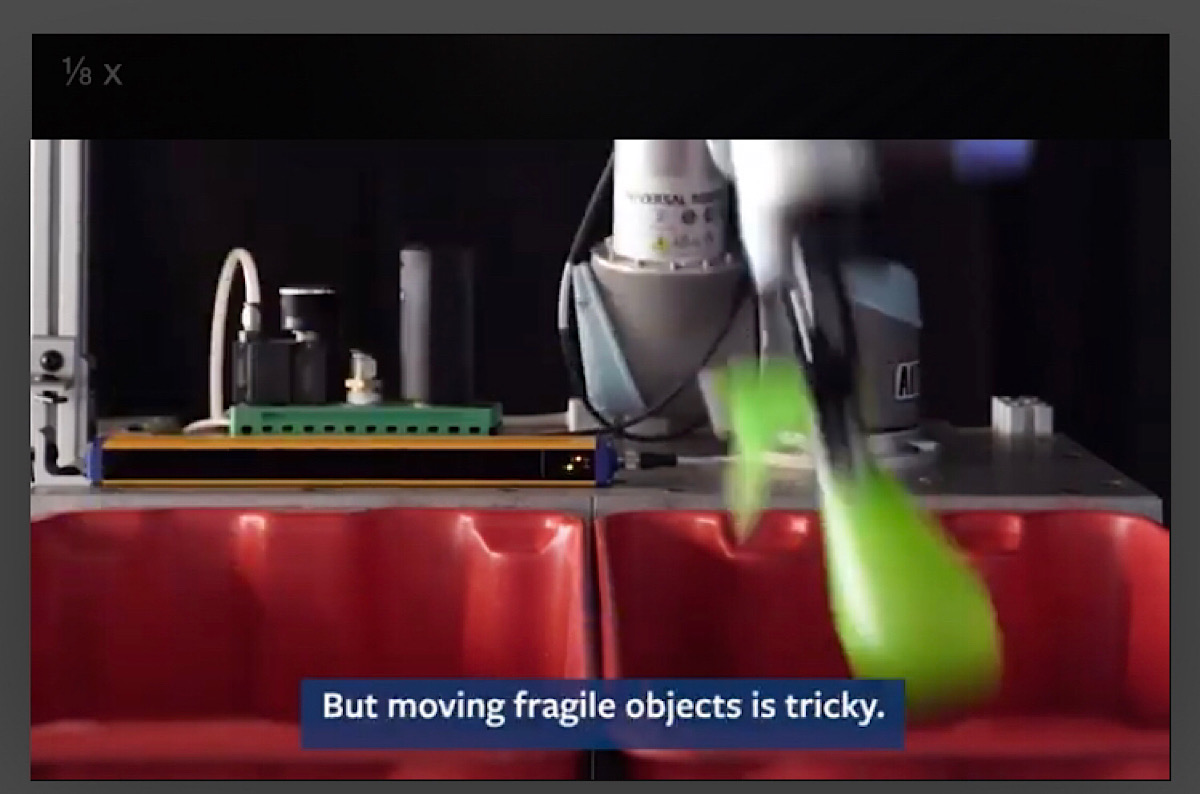
Rapidly moving containers without dropping, spilling or damaging them is tough enough for humans, let alone robots. Now, Ken Goldberg, professor of industrial engineering and operations research and of electrical engineering and computer sciences; postdoctoral researcher Jeff Ichnowski; and their team at UC Berkeley’s AUTOLAB have published Grasp-Optimized Motion Planning for Fast Inertial Transport (GOMP-FIT).

In their paper, presented in May at the 2022 International Conference on Robotics and Automation, the UC Berkeley team solves this challenge for robots transporting open-top containers and fragile objects in settings like warehouses and hospitals. Watch a video to see how GOMP-FIT makes this possible — and solves what the researchers call “the rushing sommelier” problem, where a waiter must quickly serve wine to customers.

Continue reading… “New technology helps robots move objects quickly and safely”

Tiny robot ‘fireflies’ could light the way for first responders

By Karin Mallett

When scientists get stumped, they often look to nature for inspiration.

That’s why, when robotics engineers at MIT were trying to build tiny robots that lit up, they turned to an obvious influence.

These man-made ‘fireflies’ are flying robots, the size of an insect, that could be a part of our everyday life in the near future.

But you may be wondering, why? Why build them, and what can they be used for?

One benefit is their size. These robots are seriously small.

They can fit on your fingertip, and weigh just a bit more than a paper clip. This allows them to navigate in tight spaces where other, larger robots just can’t reach.

The light they emit actually comes from the artificial muscles they use to flap their tiny, rubber-like wings.

Researchers say that ‘electro-luminescence’ also allows the robots to communicate with each other.

Continue reading… “Tiny robot ‘fireflies’ could light the way for first responders”

Proteus is Amazon’s first fully autonomous warehouse robot

In a post looking back over the past 10 years since it purchased robotics company Kiva, Amazon has revealed its new machines, including its first fully autonomous warehouse robot. It’s called Proteus, and it was designed to be able to move around Amazon’s facilities on its own while carrying carts fulls of packages. The company said the robot uses an “advanced safety, perception and navigation technology” it developed to be able to do its work without hindering human employees.

In the video Amazon posted, you can see Proteus moving under the carts and transporting them to other locations. It emits a green beam ahead of it while it moves, and it stops if a human worker steps in front of the beam. 

Amazon’s aim is to automate the handling of its package carts so as to reduce the need for human workers to manually move them around its facilities. In fact, the e-commerce giant stressed that its robots were designed to create a safer workplace for people. “From the early days of the Kiva acquisition, our vision was never tied to a binary decision of people or technology. Instead, it was about people and technology working safely and harmoniously together to deliver for our customers,” it wrote. 

Another new robot called Cardinal was also designed with the idea of reducing risk of employee injuries in mind. Cardinal is a robotic arm that picks up packages, reads their labels and then places them in the appropriate cart for the next stage of the shipping process. Artificial intelligence and computer vision enable it to sort packages correctly. Amazon is currently testing a prototype that’s able to lift boxes up to 50 pounds and expects to deploy the robotic arm to fulfillment centers by next year.

Continue reading… “Proteus is Amazon’s first fully autonomous warehouse robot”

Robot fish could solve the ocean’s microplastic pollution problem

By Amy Barrett

Bots that attract small pieces of plastic waste could one day help remove the millions of microplastics floating in the sea.

A fish-shaped robot that can collect tiny pieces of plastic waste has been developed by scientists at Sichuan University, China. The bot uses light from a laser to flap its tail side-to-side and has a body that can attract molecules found on microplastics, causing them to stick to it as it swims past.

The robo-fish was, in part, inspired by marine life – its moving body uses a structure similar to a naturally strong and flexible substance found on the inside surface of clam shells: mother-of-pearl.

Mother-of-pearl, also known as nacre, is a layered material that looks almost like a brick wall under the microscope. It’s this structure that the team mimicked in their robot, as the sliding layers enabled it to move its tail but the strength of the overall design made it more durable.

Continue reading… “Robot fish could solve the ocean’s microplastic pollution problem”

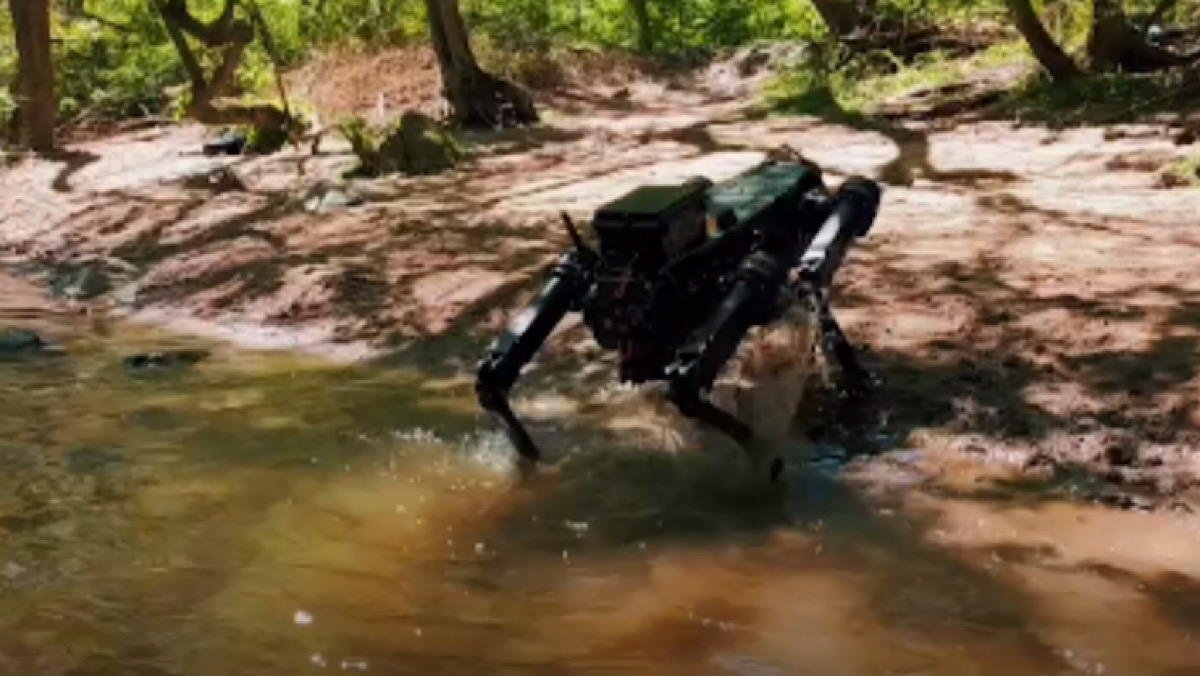
An advanced tail-kit can help robot dogs swim for the military

Vision 60 with NAUT after its brief swim

By  Ameya Paleja

Woof.

The ‘robot dogs’ used by the U.S. military to patrol its territories will soon have a new capability of swimming in the water, making them more like the real-world dogs they are mimicking. What’s more, this capability can be added to robot dogs that are already in service with a simple modification, Popular Science reported.

Unless you have been living under a rock, you have definitely seen Spot, the quadrupedal robotic dog walking around shop floors or climbing up the stairs with a human companion. While Spot’s deployment has been in civilian spaces, Philadelphia-based Ghost Robotics deploys the technology for military applications. 

Continue reading… “An advanced tail-kit can help robot dogs swim for the military”

This futuristic office was designed for 5,000 people—and 100 robot coworkers

This new building by Korean tech giant Naver was designed to experiment with the future of automation.

From the outside, the building resembles a 28-story robot hive—an anonymous box of metal and vents. And that’s exactly what it is.

Dubbed 1784, this is the new headquarters for Naver Labs, opening in June. Owned by Naver, which you might consider the Google of South Korea, it’s “the world’s first robot-friendly building,” according to the company.

Architected by Samsung subsidiary Samoo, it’s a space designed to test the boundaries of the future of automation, where 100 wheeled robots will soon work alongside 5,000 people, ferrying packages, lunches, and Starbucks coffee to their human counterparts. These robots aren’t just a gimmick, but an extension of the building architecture itself, serving as a way to give the building hands today while it learns how to take care of itself tomorrow.

Continue reading… “This futuristic office was designed for 5,000 people—and 100 robot coworkers”

University Of Glasgow Experts Develop Smart Skin To Provide Robots Human-like Sensitivity

ROBOTS MIGHT SOON HAVE THEIR TOUCH-SENSITIVE GENERATION AS UNIVERSITY OF GLASGOW RESEARCHERS HAVE DEVELOPED A SMART ARTIFICIAL SKIN SENSITIVE TO TOUCH.

By Harsh Vardhan 

In a bid to create a new generation of smart robots with human-like sensitivity, a team of researchers from the University of Glasgow has developed what they call computational electronic skin (e-skin). This is basically a prototype of an artificial skin that uses a new type of processing system. In their official report, the experts noted that this system is based on “synaptic transistors, which mimic the brain’s neural pathways” that enable the robot to learn to feel the pain. https://www.youtube.com/embed/QP1nd6jq4L8?rel=0

The University of Glasgow even shared a video explaining the mechanism of the artificial e-skin. Notably, the robot hand in the explainer video showed a remarkable ability to learn to react to external stimuli.

Continue reading… “University Of Glasgow Experts Develop Smart Skin To Provide Robots Human-like Sensitivity”

Samsung to Build First Private 5G Commercial Network for Cloud-Based Autonomous Robots

Samsung has built the first private 5G commercial network for cloud-based autonomous robots. The Korean giant have collaborated with NAVER Cloud on Thursday to work on South Korea’s first private 5G network. Deployed at NAVER’s new second headquarters, Samsung’s network solution will support NAVER’s private 5G commercial service to power cloud-based autonomous mobile robots this month. The new service would allow autonomous robots to travel throughout NAVER’s headquarters in Seoul, assisting with package delivery, coffee delivery, and lunch box delivery to staff.

Quicker connectivity on smartphones has largely been used to stream video and surf social media, but Samsung has come up with a new use case. The headquarters, simply dubbed 1784, will begin by employing 40 robots that will move across three floors. By the end of the year, the idea is to have “hundreds of robots moving over the entire 36-floor skyscraper.”

Continue reading… “Samsung to Build First Private 5G Commercial Network for Cloud-Based Autonomous Robots”

New York trials robot companions for 800 elderly people to combat loneliness

New York trials robot companions for 800 elderly people to combat loneliness

Officials in the US state of New York are offering robot companions to more than 800 senior citizens in a bid to combat social isolation.

The New York State Office for the Aging (NYSOFA) will work with local partners to identify older adults who would most benefit from the technology – a voice-operated smart device known as ElliQ.

The device, which consists of an interactive robot paired with a tablet, will help “foster independence and provide support for older adults,” NYSOFA said.

For example, it can carry out daily check-ins, suggest health and wellness tasks such as sleep relaxation and physical exercises, remind users to take their medication, and help them stay in touch with family and friends.

It also “proactively suggests” activities and initiates conversations, using artificial intelligence (AI) to foster a sense of relationship, NYSOFA added.

“Despite misconceptions and generalisations, older adults embrace new technology, especially when they see it is designed by older adults to meet their needs,” NYSOFA Director Greg Olsen said in a statement.

“For those who experience some form of isolation and wish to age in place, ElliQ is a powerful complement to traditional forms of social interaction and support from professional or family caregivers”.

Continue reading… “New York trials robot companions for 800 elderly people to combat loneliness”
Discover the Hidden Patterns of Tomorrow with Futurist Thomas Frey
Unlock Your Potential, Ignite Your Success.

By delving into the futuring techniques of Futurist Thomas Frey, you’ll embark on an enlightening journey.

Learn More about this exciting program.