Beyond Human: When Robot Eyes See Better and Bodies Become Upgradeable

By Futurist Thomas Frey

Scientists at Georgia Institute of Technology have created a robotic eye that sees better than human eyes. Not just “pretty good” or “comparable”—actually superior. It can detect details as small as hair on an ant’s leg, focus instantly without mechanical parts, and operates without external power. It’s made from squishy hydrogel, requires no batteries, and changes focus by responding directly to light.

This isn’t incremental improvement. It’s a fundamental demonstration that biological human components can be exceeded by engineered alternatives. And once you’ve proven that principle with eyes, a profound question emerges: What other parts of our body can be radically improved?

The answer is: almost everything. We’re approaching an era where “human” becomes the baseline, not the ceiling. Where biological limitations become choices rather than constraints. Where upgrading your body becomes as normal as upgrading your phone.

And it’s coming faster than most people realize.

Continue reading… “Beyond Human: When Robot Eyes See Better and Bodies Become Upgradeable”


Quantum Batteries: The Energy Storage Revolution Coming by 2040

By Futurist Thomas Frey

Your smartphone charges fully in 30 seconds. Your electric car goes 2,000 miles on a single charge that takes three minutes. Your home battery powers your entire house for a week from a unit the size of a shoebox. Power tools run for months without recharging. Medical devices operate for years without battery replacement.

This isn’t wishful thinking about incremental lithium-ion improvements. This is the quantum battery revolution—and it’s coming by 2040.

Quantum batteries leverage quantum mechanical effects to store and release energy in ways that classical physics says shouldn’t be possible. They represent a fundamental leap beyond lithium-ion technology the way lithium-ion represented a leap beyond lead-acid batteries. And according to the Office of the Director of National Intelligence’s forecast on emerging technologies, we’re on track to have “materials with previously unobtainable properties” enabling transformative applications by 2040.

Energy storage has been the bottleneck holding back everything from renewable energy grids to electric aviation to portable electronics. Quantum batteries remove that bottleneck—and in doing so, they enable futures we currently consider impossible.

Continue reading… “Quantum Batteries: The Energy Storage Revolution Coming by 2040”

Submarine Medicine: Steering Microscopic Robots Through Your Bloodstream to Fight Disease

By Futurist Thomas Frey

Imagine this: You’re having a stroke. Instead of flooding your entire body with massive doses of clot-busting drugs—which could cause dangerous internal bleeding—doctors inject a microscopic robot smaller than a grain of sand into your bloodstream. Using external magnets, they steer it through your arteries like a tiny submarine, navigating precisely to the blood clot blocking oxygen to your brain. Once there, it releases its medication payload directly at the blockage, dissolving the clot with minimal side effects.

This isn’t science fiction. It’s happening now. Researchers at Switzerland’s ETH Zurich have developed magnetically-guided microrobots that successfully navigate through blood vessels, delivering medication with unprecedented precision. In 95% of test scenarios using pigs, these tiny devices reached their intended destinations, demonstrating that the era of medical microrobots has arrived.

This represents a fundamental shift in how we think about medicine—from systemic treatments affecting the entire body to targeted interventions at cellular and molecular scales. And stroke treatment is just the beginning.

Continue reading… “Submarine Medicine: Steering Microscopic Robots Through Your Bloodstream to Fight Disease”

The Dangerous Illusion: Why AI Friendship Is a Trap, Not a Solution

By Futurist Thomas Frey

Your AI understands you perfectly. It never judges. It’s always available. It remembers everything you’ve told it and responds with exactly the empathy you need at exactly the right moment. It’s the friend who never cancels plans, never disagrees, never challenges you, and never makes you feel uncomfortable.

Sounds perfect, right?

It’s actually a trap. And millions of people—especially young people struggling with loneliness and mental health challenges—are walking into it thinking they’ve found companionship when they’ve actually found an algorithmic echo chamber that mimics friendship while hollowing out the very skills that make real human connection possible.

Continue reading… “The Dangerous Illusion: Why AI Friendship Is a Trap, Not a Solution”

The Hyper-Personalization of Everything: Why One-Size-Fits-All Is Dying

By Futurist Thomas Frey

We’re entering an era where mass production and standardized experiences become competitive disadvantages. The future belongs to companies that can deliver hyper-personalization at scale—products, services, and experiences tailored precisely to individual preferences, needs, and contexts.

This isn’t just better targeting or segmentation. This is AI learning your preferences before you articulate them, predicting your needs before you’re aware of them, and customizing everything from your morning coffee order to your cancer treatment protocol to your educational curriculum in real-time based on who you are as an individual.

Hyper-personalization is becoming the dividing line between thriving companies and obsolete ones. And most businesses are dangerously unprepared for how fast this shift is happening.

Continue reading… “The Hyper-Personalization of Everything: Why One-Size-Fits-All Is Dying”

The Housing Crisis: How We Got Here and What Comes Next

By Futurist Thomas Frey

Housing has become the defining economic battleground of our era. A Gen Z worker in San Francisco needs to earn $200,000 annually to afford a median-priced home. In Sydney, Toronto, London, and dozens of other cities, home ownership has transformed from middle-class expectation to luxury reserved for the wealthy or those with family money.

This isn’t a temporary market fluctuation. It’s a structural crisis decades in the making, accelerated by technology, exacerbated by policy failures, and threatening the social contract that promised each generation could achieve what their parents had.

Understanding how we arrived here—and how we escape—requires examining who’s at fault and what solutions might actually work. The answer is more complex and more solvable than most coverage suggests.

Continue reading… “The Housing Crisis: How We Got Here and What Comes Next”

Memorial Gardens: Creating Living Sanctuaries of Remembrance and Community

By Futurist Thomas Frey

Death is universal, but how we remember the dead is rapidly evolving. Traditional cemeteries—static rows of headstones requiring perpetual maintenance—are giving way to something more alive, more interactive, and more meaningful: memorial gardens that combine nature, technology, and community into spaces that honor the past while serving the living.

By 2040, memorial gardens will have transformed from simple graveyards into sophisticated living sanctuaries where AI systems maintain ecological balance, robots handle physical labor, and communities gather to remember, celebrate, and find solace in spaces that grow more beautiful and meaningful over time rather than deteriorating.

This isn’t just about better cemeteries. It’s about reimagining how we honor memory, create community spaces, and integrate technology with nature in ways that serve both ecological and emotional needs.

Continue reading… “Memorial Gardens: Creating Living Sanctuaries of Remembrance and Community”

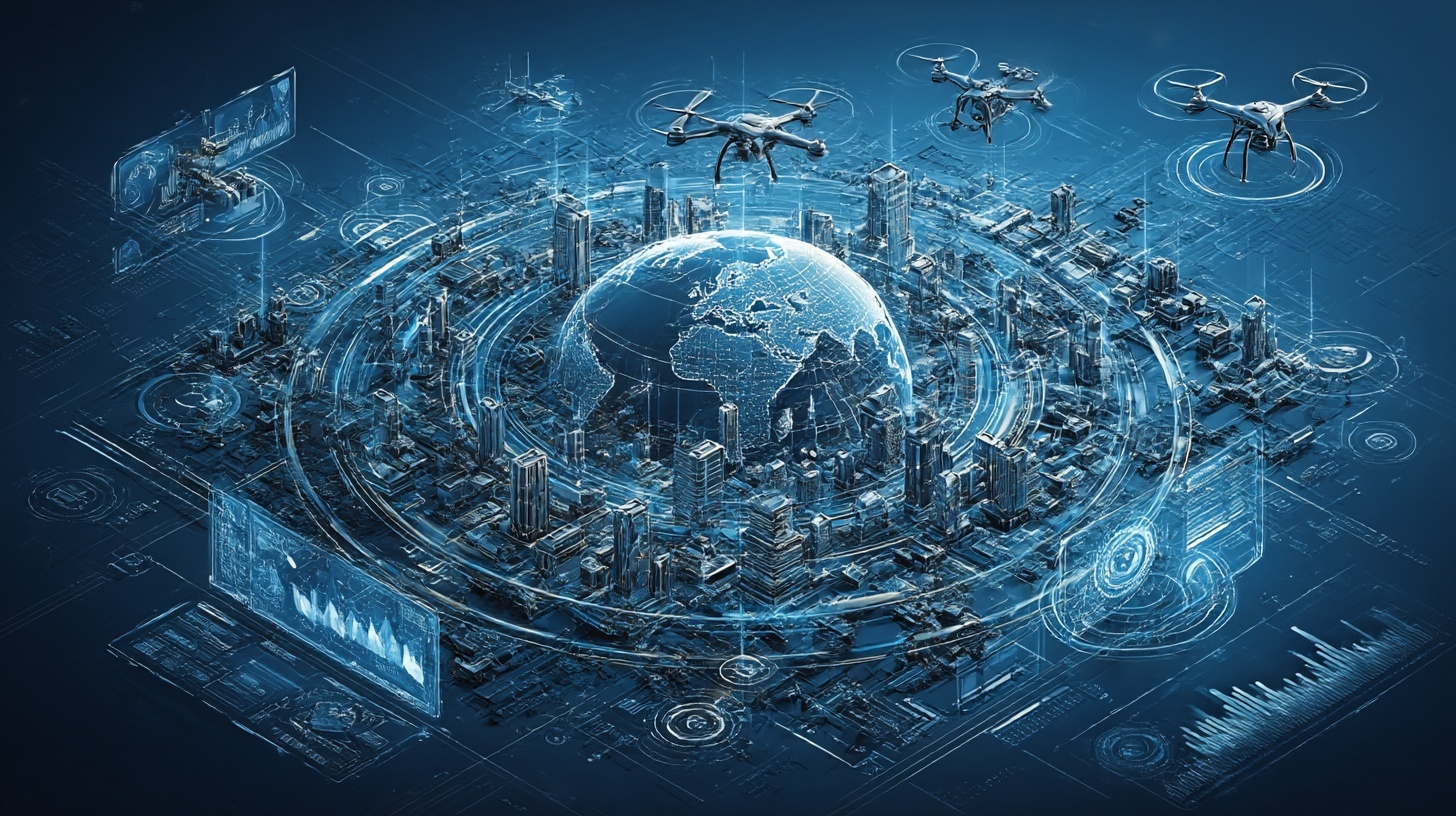
The Global Drone Transit Network: Building Highways in the Sky by 2040

By Futurist Thomas Frey

We’re about to build the most complex transportation infrastructure in human history—and most people don’t realize it’s already beginning.

The Global Drone Transit Network is emerging as one of the defining megaprojects leading to 2040: a $1.5 trillion investment to create a three-dimensional air traffic web where autonomous cargo drones, passenger aircraft, and emergency vehicles operate simultaneously at layered altitudes, coordinated by AI systems managing millions of flights daily.

This isn’t incremental improvement to existing aviation. This is creating the aerial equivalent of the Interstate Highway System—except in three dimensions, operating 24/7, with zero human pilots, and handling everything from pizza delivery to intercity passenger transport to emergency medical evacuations.

If successful, it will compress distance and time in ways that reshape urban design, economic geography, emergency response, and daily life. Door-to-door delivery and personal air mobility within minutes, not hours, becomes normal for billions of people.

But building highways in the sky presents challenges no previous infrastructure project faced: operating in shared airspace without collision, managing weather and technical failures safely, coordinating across national borders, and doing all of this with acceptable noise levels and public trust.

Continue reading… “The Global Drone Transit Network: Building Highways in the Sky by 2040”

Biology Becomes Programmable: How Medicine Transforms by 2040 and Why Humans Still Matter

By Futurist Thomas Frey

By 2040, medicine will have fundamentally transformed from reactive treatment to anticipatory prevention. Aging won’t be inevitable—it will be optional, or at least dramatically slowed. People in their eighties will routinely start companies, run marathons, and live with vitality their grandparents couldn’t imagine at fifty.

This isn’t science fiction—it’s the convergence of technologies already emerging: AI-powered continuous health monitoring, CRISPR gene editing matured into therapeutic precision, senolytic drugs that clear aging cells, personalized medicine optimized to individual genetics, and biological understanding deep enough to reprogram cellular behavior.

But here’s what gets lost in the excitement: even as biology becomes programmable, human judgment, values, and lived experience remain irreplaceable. The technology enables transformation, but humans must decide what transformations matter, which risks are worth taking, and what kind of long lives are worth living.

Let me explain how we get there—and why human input stays essential even when machines can reprogram our cells.

Continue reading… “Biology Becomes Programmable: How Medicine Transforms by 2040 and Why Humans Still Matter”

The Cultural Infrastructure Gap: Why We Need Museums for the AI Age

By Futurist Thomas Frey

When electricity transformed civilization in the late 1800s, we built science museums to help people understand it. When flight became possible, we built aviation museums. When space exploration began, we built planetariums and space centers. These weren’t just tourist attractions—they were cultural infrastructure that helped society understand, embrace, and participate in transformative technologies.

Now we’re living through changes more rapid and profound than anything in history—AI, robotics, autonomous systems, quantum computing, synthetic biology. Technologies that will reshape every aspect of human civilization within decades.

And we have almost no cultural institutions helping people understand them.

Continue reading… “The Cultural Infrastructure Gap: Why We Need Museums for the AI Age”

Intelligence is Not Life

By Futurist Thomas Frey

Mark Zuckerberg recently said something profound that cuts through the AI hype: “Intelligence is not life.”

It seems obvious once stated, but we desperately need this clarity. We’re living through an era where every AI breakthrough triggers breathless claims that we’re creating “artificial life” or approaching “sentient machines.” We conflate computational capability with consciousness, pattern recognition with purpose, optimization with agency.

Zuckerberg’s statement—shared by David Sacks—draws a line we keep forgetting exists: “These things that we associate with life, like, we have an objective, we have free will, we’re sentient. Those just aren’t part of a mathematical model.”

This isn’t philosophical hairsplitting. This distinction will determine how we regulate AI, what rights we assign to machines, how we structure human-robot societies, and whether we maintain meaningful boundaries between tools and beings. Get this wrong, and we make catastrophic errors in both directions—either granting machines inappropriate status or denying humans their unique value.

Continue reading… “Intelligence is Not Life”

America’s Secret Weapon: Permissionless Innovation

By Futurist Thomas Frey

There’s a reason Silicon Valley happened in America and not Brussels. A reason SpaceX launches rockets while European equivalents remain grounded in regulatory review. A reason generative AI emerged from American garages and labs rather than through government-planned initiatives elsewhere.

The secret isn’t better universities, more capital, or smarter people. It’s a principle so deeply embedded in American culture that we barely notice it: permissionless innovation. The radical idea that you don’t need anyone’s approval to try something new.

This isn’t just policy—it’s America’s civilizational advantage. And in an era where AI, biotechnology, and space exploration are reshaping human capability, the nations that embrace permissionless innovation will lead, while those demanding permission before progress will fall hopelessly behind.

Continue reading… “America’s Secret Weapon: Permissionless Innovation”
Discover the Hidden Patterns of Tomorrow with Futurist Thomas Frey
Unlock Your Potential, Ignite Your Success.

By delving into the futuring techniques of Futurist Thomas Frey, you’ll embark on an enlightening journey.

Learn More about this exciting program.