The Awakening Series Part 2: Graft and Corruption—When the Small Stuff Adds Up to Everything

By Futurist Thomas Frey

When most people think of corruption, they picture dramatic scenes: briefcases full of cash, secret offshore accounts, conspiracies hatched in smoke-filled rooms. But the corruption that’s about to be exposed by AI isn’t primarily the Hollywood version. It’s far more mundane, far more pervasive, and in aggregate, far more costly.

It’s the systematic gaming of systems that nobody was watching closely enough. And AI is about to watch everything.

Continue reading… “The Awakening Series Part 2: Graft and Corruption—When the Small Stuff Adds Up to Everything”

The Awakening Series: When AI Becomes the Ultimate Auditor

By Futurist Thomas Frey

We’re entering what historians will likely call “The Awakening”—a period when artificial intelligence doesn’t just automate tasks, but systematically reveals inefficiencies, inequities, and outright fraud that have been hiding in plain sight for decades.

This isn’t about technology replacing jobs. It’s about technology revealing truth.

For generations, certain industries have operated behind walls of complexity so dense that even insiders couldn’t see the full picture. Healthcare billing codes so Byzantine that no human could track them all. Defense contracts so layered with subcontractors that accountability disappears. Educational credentialing systems so opaque that their actual value remains unmeasurable. Financial services so deliberately complicated that “nobody really understands how it works” became an acceptable answer.

AI doesn’t get tired of looking. It doesn’t accept “that’s just how it’s always been done.” It doesn’t have a career to protect or relationships to preserve. It simply processes patterns, identifies anomalies, and generates reports that can’t be ignored.

Continue reading… “The Awakening Series: When AI Becomes the Ultimate Auditor”

The Great Transformation: How Humanity Redefines Itself Over the Next 30 Years

By Futurist Thomas Frey

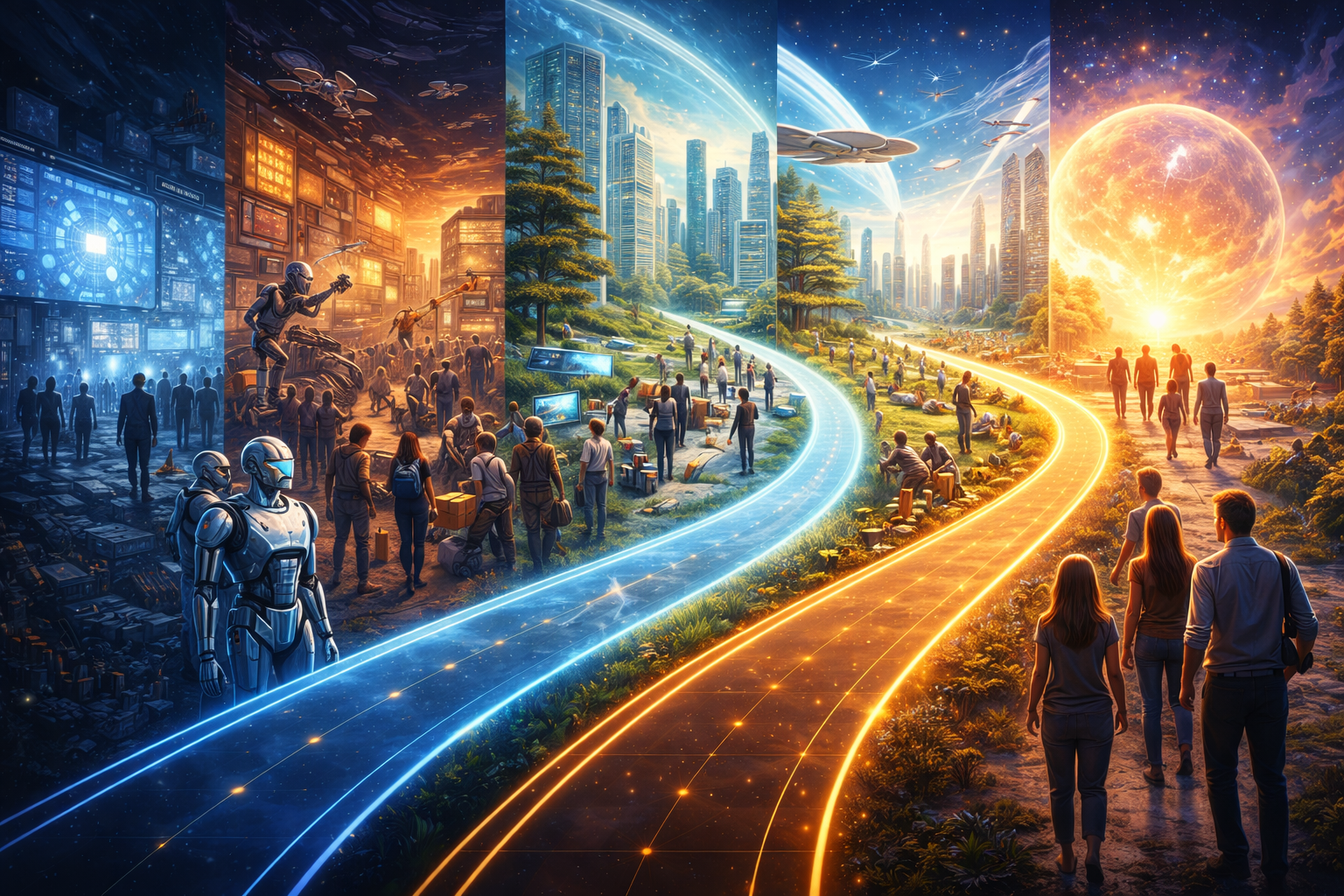
We’re not just facing another economic cycle or technological wave. We’re entering a civilizational inflection point that will unfold across distinct phases over the next three decades. Understanding these phases isn’t about prediction—it’s about preparation. The communities, organizations, and individuals who recognize which phase they’re in will navigate this transformation far more successfully than those caught off-guard.

What makes this transformation different from previous technological disruptions is its scope and simultaneity. The Industrial Revolution unfolded over roughly a century, giving societies time to adapt incrementally. This time, AI, robotics, drones, and automation are converging at once, across all sectors, in all regions. There’s no “later” geography that can learn from “earlier” adopters. We’re all early adopters now, whether we’re ready or not.

The phases I’m describing aren’t rigid boundaries but overlapping waves. By the time one phase becomes dominant, seeds of the next are already visible. Smart organizations and forward-thinking communities are already positioning themselves for Phase Three while most are still denying Phase One. That gap—between those who see what’s coming and those who don’t—will be the defining factor in who thrives and who struggles over the next generation.

Continue reading… “The Great Transformation: How Humanity Redefines Itself Over the Next 30 Years”

Social Anchors: What Will Draw Us Together in the Age of Automation

By Futurist Thomas Frey

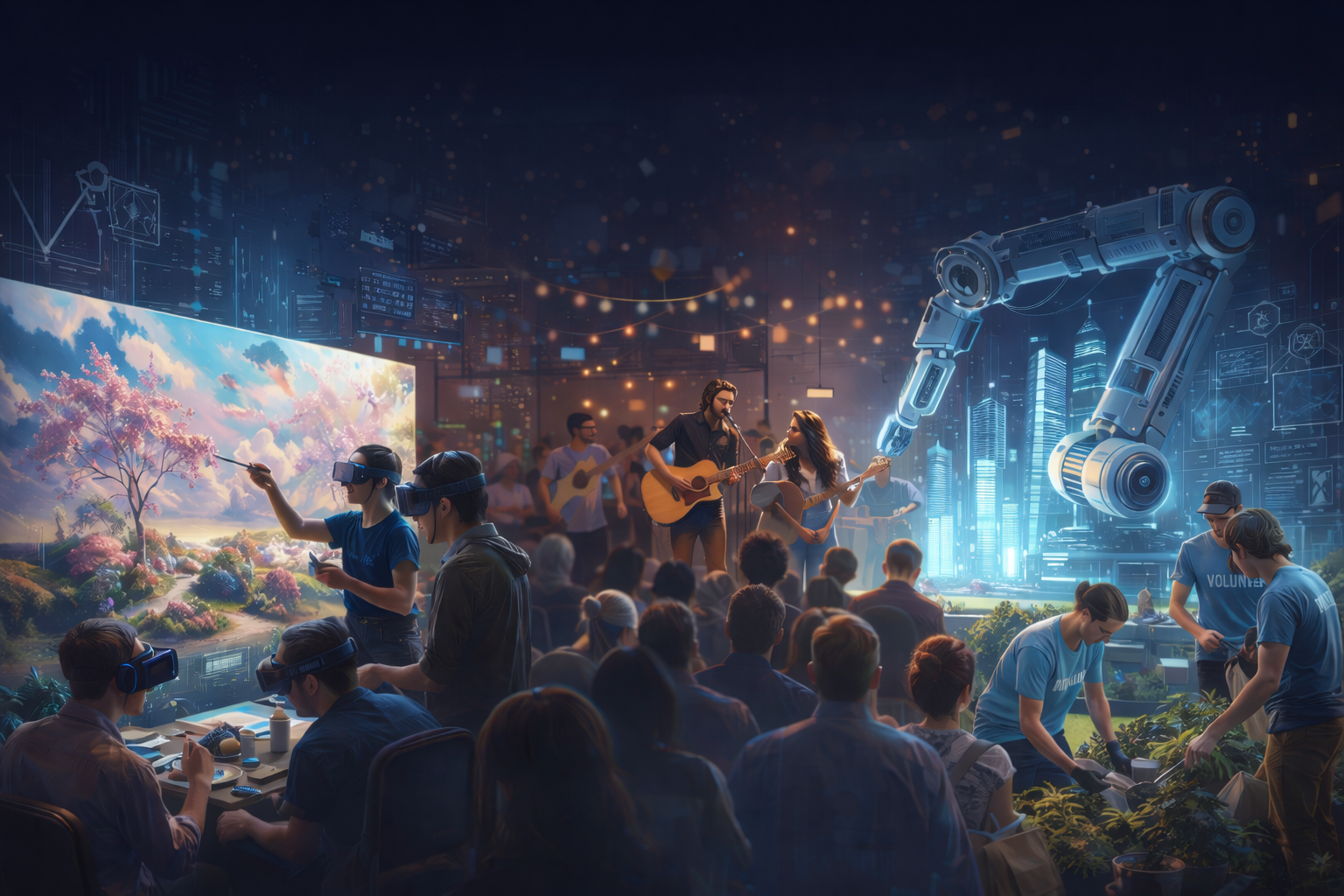
We stand at a peculiar threshold. As artificial intelligence, robotics, and automation reshape the employment landscape, forcing millions into career transitions, a counterintuitive truth emerges: our hunger for human connection will only intensify. The question isn’t whether people will venture out—they will. The question is: what will draw them out?

The experiences that thrive in the next decade won’t simply survive automation; they’ll offer something automation fundamentally cannot replicate. They’ll serve as social anchors in turbulent times, providing the very things that make us human: connection, spontaneity, and the irreplaceable texture of being physically present with others.

Continue reading… “Social Anchors: What Will Draw Us Together in the Age of Automation”

The Mars-Born Problem: Why Earth Humans and Mars Humans Won’t Be the Same Species

By Futurist Thomas Frey

The Question Nobody’s Asking About Mars Colonization

We obsess over getting to Mars—the rockets, the habitats, the life support systems. But here’s the question nobody’s seriously grappling with: what happens to humans born and raised on Mars?

Not tourists. Not astronauts rotating back to Earth. Actual Martian-born humans who spend their entire lives in 38% Earth gravity, breathing different air, eating different food, experiencing 24.6-hour days, enduring radiation levels that would kill Earth-born humans, and developing under fundamentally different physical constraints.

They won’t be “humans living on Mars.” Within a generation or two, they’ll be something else—a divergent branch of humanity adapted to Martian conditions in ways that make them incompatible with Earth. And Earth-born humans arriving on Mars will face a brutal choice: rapidly evolve or die trying to maintain Earth-normal biology in an environment fundamentally hostile to it.

This isn’t science fiction speculation. It’s straightforward biology. Change enough environmental variables and you get different organisms. Mars changes essentially everything about human development.

Let me walk you through the critical variables that differ between Earth and Mars—and why these differences mean Mars-born and Earth-born humans will have almost nothing in common physiologically, psychologically, or culturally within just a few generations.

Continue reading… “The Mars-Born Problem: Why Earth Humans and Mars Humans Won’t Be the Same Species”


Watching our Systems Unravel: Why Our Institutions Can’t Keep Pace with Machine-Speed Innovation

By Futurist Thomas Frey

We’re witnessing something unprecedented in human history—not just technological disruption, but a fundamental mismatch in operating speeds between the systems that govern us and the systems that are replacing them.

The institutions we depend on—government agencies, universities, healthcare systems, regulatory bodies—were architected for a world where change arrived in decades, not days. That world has vanished. And the collision between old-world infrastructure running at human speed and new-world systems operating at machine speed represents the defining challenge of our era.

Continue reading… “Watching our Systems Unravel: Why Our Institutions Can’t Keep Pace with Machine-Speed Innovation”

Ethan Thornton: What He’s Doing to Defense is What Musk Did to Aerospace

By Futurist Thomas Frey

The Pattern Nobody’s Recognizing Yet

Elon Musk didn’t become Elon Musk by building better apps. He became Elon Musk by attacking civilization-scale infrastructure problems everyone else considered unsolvable: reusable rockets when aerospace experts said impossible, electric vehicles when they were jokes, solar energy when utilities controlled the grid.

The pattern was specific: hard tech, vertically integrated manufacturing, existential risk tolerance, and rebuilding foundational infrastructure rather than optimizing what exists.

That exact pattern is emerging again—not in someone famous, but in a 26-year-old MIT dropout named Ethan Thornton who’s doing to defense manufacturing what Musk did to aerospace: rebuilding it from scratch because the existing system is fundamentally broken.

Most people haven’t heard of him. But his trajectory suggests he might be the closest thing to “the next Elon Musk” currently operating—not because he acts like Musk, but because he’s running the identical playbook on a different broken industry.

Continue reading… “Ethan Thornton: What He’s Doing to Defense is What Musk Did to Aerospace”

The Tooth Regeneration Revolution: When Biology Threatens a $124 Billion Industry

By Futurist Thomas Frey

The Treatment That Works But Can’t Reach Patients

Imagine regrowing a lost tooth the way children grow their first set—complete with roots, enamel, and natural integration with your jawbone. No surgery. No implants. Just biology doing what it was designed to do.

This isn’t science fiction. Researchers at Kitano Hospital in Japan and Seoul National University achieved it in March 2025. A drug that blocks a single suppressor protein allows adults to regrow fully functional teeth in 6-8 months. Clinical trials show 68% success rate across 412 participants aged 30-70. Five-year follow-ups show zero complications.

And the dental industry is doing everything possible to prevent this technology from reaching American patients.

Continue reading… “The Tooth Regeneration Revolution: When Biology Threatens a $124 Billion Industry”

The Coming Airport Revolution: When AI, Drone Ports, Air Taxis, and Autonomous Vehicles Converge

By Futurist Thomas Frey

The Transformation Nobody’s Fully Grasping Yet

Walk through any major airport today and you’re witnessing an institution in the early stages of existential transformation. The massive parking structures generating 40-50% of non-aeronautical revenue? They’ll be largely empty by 2035. The carefully designed terminal flows optimized for passengers arriving by personal vehicle? Obsolete. The clear separation between ground transportation and air operations? Dissolved.

Future airports won’t just look different—they’ll operate on fundamentally different economic models, serve radically different transportation modes, and integrate technologies that blur the distinction between ground and air travel in ways that make today’s airports seem as quaint as train stations from the 1950s.

I’ve written about future airports several times over the past few years, covering everything from air taxis to pilotless travel to robot food delivery. But I’ve never quite grasped the full scope of the transition we’re living through right now—the uncomfortable period where old revenue models collapse before new ones fully materialize, where infrastructure designed for one transportation paradigm must adapt to serve another, and where the very definition of “airport” expands to include facilities that look nothing like what we recognize today.

Let me walk you through what airports actually become by 2035, why the transition is more disruptive than anyone’s admitting, and what replaces the business models that have sustained airports for decades.

Continue reading… “The Coming Airport Revolution: When AI, Drone Ports, Air Taxis, and Autonomous Vehicles Converge”

The Orbital Economy Ramp-Up: How Space Industry Evolves in Waves, Not All at Once

By Futurist Thomas Frey

The Question About Space That Nobody Frames Correctly

When will the space economy take off? Wrong question. It’s not a single event—it’s a sequence of distinct industrial waves, each building infrastructure for the next, each operating on different timeframes with different economics.

We’re not waiting for “the space age” to arrive. We’re entering orbital economy’s first major expansion phase, where multiple industries establish operations simultaneously but on staggered timelines. Understanding which industries deploy when—and why—reveals how orbital infrastructure develops from experimental to essential over the next two decades.

I’m actively researching how orbital industrialization will unfold and would genuinely appreciate reader input on what I’m missing, misunderstanding, or underestimating. What follows is my current thinking on the sequence—but I’m certain there are gaps, timing errors, and entire categories I haven’t identified.

Let me walk you through the waves of orbital industrialization, the economic logic driving each phase, and why 2026-2045 represents genuine inflection point where space stops being frontier and becomes economy.

Continue reading… “The Orbital Economy Ramp-Up: How Space Industry Evolves in Waves, Not All at Once”

Five Jobs That Don’t Exist Yet But Will Be Essential by 2030

By Futurist Thomas Frey

When Tools Become Agents, New Jobs Emerge

What happens when your AI doesn’t just answer questions but acts on your behalf? When machines don’t just execute commands but make autonomous decisions? When reality itself becomes blended layer of physical, digital, and AI-generated experience?

New jobs emerge. Not renamed versions of existing work, but genuinely novel roles created by capabilities that didn’t exist before, constraints we’ve never faced, and social needs we’re just beginning to recognize.

I’m currently researching future jobs—roles that will exist by 2030 that don’t exist today. What follows are five examples that feel directionally correct to me, but I’m actively seeking input, critique, and additional examples from readers. If you work in emerging fields, see patterns I’m missing, or have ideas about jobs we’ll need that aren’t on anyone’s radar yet, I genuinely want to hear from you.

Let me walk you through five jobs that will feel obvious by 2030 but sound strange today—because they address problems we’re only starting to encounter.

Continue reading… “Five Jobs That Don’t Exist Yet But Will Be Essential by 2030”

Turning Student Loans Into Startup Capital: Why the Next Generation Needs Entrepreneurship Training, Not Degrees

By Futurist Thomas Frey

The Question Nobody’s Asking About Education Debt

What if instead of borrowing $100,000 to get a degree that might not lead to employment, young people could access government-backed capital to build businesses that create employment?

The student loan system is fundamentally broken—$1.7 trillion in outstanding debt, crushing burdens, declining value from degrees. But the infrastructure exists. The lending mechanisms work. What if we redirected this entire system toward the actual most important job of the future: entrepreneurship?

Let me be clear upfront: this is a half-baked idea. I’m not presenting polished policy. I’m throwing out a concept that needs serious refinement, critique, and development. What follows has gaps, potential problems, and unresolved questions. I’m sharing it because the core insight feels valuable, even if execution needs substantial work.

Continue reading… “Turning Student Loans Into Startup Capital: Why the Next Generation Needs Entrepreneurship Training, Not Degrees”
Discover the Hidden Patterns of Tomorrow with Futurist Thomas Frey
Unlock Your Potential, Ignite Your Success.

By delving into the futuring techniques of Futurist Thomas Frey, you’ll embark on an enlightening journey.

Learn More about this exciting program.