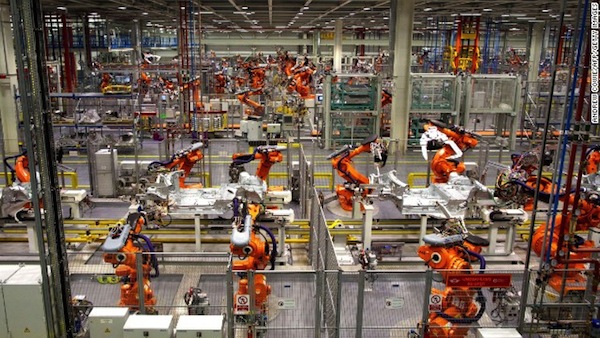
Machines are often filling in for our smarts, not just for our brawn — and this trend is likely to grow.
Although last week’s labor market report showed modest job growth, employment opportunities remain stubbornly low in the United States, giving new prominence to the old notion that automation throws people out of work.
The self-driving car is coming to a showroom near you. It could take a coupe of years or even a couple of decades but few people at the Geneva Motor Show would disagree that one day science fiction will become fact.
Baxter, the flagship robot by Rethink Robotics in Boston.
Computerization. Automation. Artificial intelligence. Technology. Innovation. Robots. These are the many names of an invisible force that has been stoking progress and killing jobs for centuries. But it’s different now because nearly half of jobs in America today could be automated in the next 10 to 20 years, according to a new paper by Carl Benedikt Frey and Michael A. Osborne, discussed recently in The Economist. The question is: Which half?
Futurist Thomas Frey: 2013 has been a year of considerable change for both me and the rest of our team at the DaVinci Institute. While most of what you see here on Futurist Speaker is about my research, thinking, and philosophy on the future, I thought this might be a good time to step back and fill you in on the people behind everything you’re reading.
Automation could do away with hundreds of millions of “simple” jobs.
By Gerd Leonhard: Over the next ten years the Web is set to change our lives dramatically. This will also raise questions about the use of personal data and the need to balance new powers with ethics.
Devices with “smart” technology these aren’t only our phones. It seems as if everything from watches to toothbrushes are integrating intelligent tech into its design.
Industry analysts say humans are disappearing from retail establishments, replaced by kiosks.
It all started in a chain of supermarkets when one section of the check-out aisles suddenly had self-service scanners. Consumers were encouraged to check themselves out, paying with cash or plastic.
OpenRemote is an open-source Internet of Things platform.
If you were to buy several Internet-connected home gadgets—say, a “smart” thermostat, “smart” door lock, and “smart” window blinds—you would likely have to control each one with a separate app, meaning it exists on its own. But, that’s not how Elier Ramirez does it. In his home, an iPad app controls his lights, ceiling fans, and TV and stereo. Pressing a single button within the app can shut off all his lights and gadgets when he leaves.
People will adapt to smart machines in their lives.
Coming to the business world: smart machines. But don’t tell that to the CEO’s. Sixty-percent of CEOs surveyed by Gartner Research say the emergence of smart machines capable of absorbing millions of middle-class jobs within 15 years is a “futurist fantasy.”
A new study from the Oxford Martin Program on the Impacts of Future Technology suggests that almost half of U.S. jobs could be susceptible to computerization over the next two decades.
Baxter is a robot meant to work with people in small manufacturing facilities.
Erik Brynjolfsson, a professor at the MIT Sloan School of Management, and his collaborator and coauthor Andrew McAfee have been arguing for the last year and a half that impressive advances in computer technology—from improved industrial robotics to automated translation services—are largely behind the sluggish employment growth of the last 10 to 15 years. Even more ominous for workers, the MIT academics foresee dismal prospects for many types of jobs as these powerful new technologies are increasingly adopted not only in manufacturing, clerical, and retail work but in professions such as law, financial services, education, and medicine.
Futurist Thomas Frey: Last week I was speaking at the MD&M West Expo in Anaheim, California on the “future of manufacturing.” With over 2,000 manufacturing exhibitors filling the convention center, there was no small amount of interest in this topic.