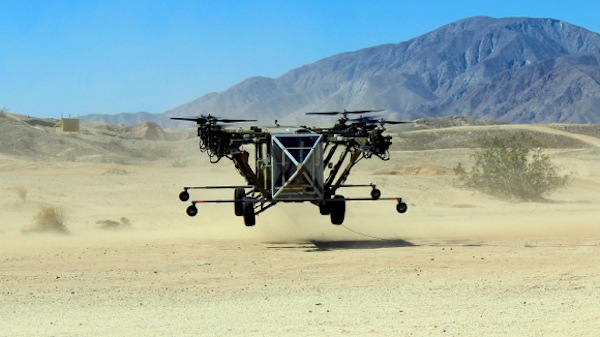
The Advanced Tactics Black Knight Transformer is a scaled up multicopter with a wheeled cargo compartment below. It took to the air for the first time recently. (Pics and video)
Boston Dynamics, a Google-owned robotics company, makes a number of stunning robots, perhaps most notably its Atlas humanoid and the “Big Dog” cargo-carrying robot. (Video)
Fifteen vehicles left a starting gate in the desert outside of Barstow, Calif., to make history in the DARPA Grand Challenge on March 13, 2004, a first-of-its-kind race to foster the development of self-driving ground vehicles. The goal of the race was to autonomously navigate a 142-mile course that ran across the desert to Primm, Nev. The longer-term goal was to accelerate development of the technological foundations for autonomous vehicles that could ultimately substitute for men and women in hazardous military operations, such as supply convoys.
U.N. will begin to lay the groundwork for the role robots will play in war.
People are promised their quality of life will improve with the advances of technology, and what could be a better example of that than sending robots instead of humans into dangerous situations? Robots can help conduct research in deep oceans and harsh climates, or deliver food and medical supplies to disaster areas. (Video)
The startup TrackingPoint unveiled the first in their line of “smart rifles” last summer. The smart rifles are unlike your average sniper rifle, which requires a great deal of training and expertise to effectively kill at range. The TrackingPoint rifles can be picked up by absolute novices, even those as young as 12 years old. (Videos)
Flying insects have one huge advantage over humans: the gift of enhanced mobility. Insects are small and nimble enough to get into almost any tight space, so it makes sense to create a similarly sized drone for stealth military missions.
The surveillance technology is so small it can fit in a rock.
Lockheed Martin showcased developments in their surveillance technology called SPAN (Self-Powered Ad-hoc Network) at the annual AUSA Army meeting in Washington, D.C. last week. SPAN, a “covert, perpetually self-powered wireless sensor network” that can provide “unobtrusive, continuous surveillance” in units so small they can fit in a rock.
The U.S. Army has just commissioned an Iron Man-like suit, called the Tactical Assault Light Operator Suit (TALOS) that will be strong enough to withstand a barrage of bullets.
This is the largest campaign we’ve seen that has been focused on drone technology.
Chines hackers based in Shanghai went after one foreign defense contractor after another, at least 20 in all, for nearly two years. Their target, according to an American cyber security company that monitored the attacks, was the technology behind the United States’ clear lead in military drones.
Putting new information directly in front of users as they go about their daily tasks is sure to disrupt a wide variety of industries.
Technology that was once only science fiction is now becoming a reality. Robots, touch screens and iPads could become passé as Google’s latest invention, Google Glass, begins to change the world forever.
American military drones engaged in combat across the world are certainly scary most days. But some days, swarms of little drones are scarier. Then there are days where it’s drones with really high-resolution cameras. Or maybe drones deployed by Homeland Security.
For every emergency situation, a city’s first response will be to “get eyes on” the situation
Futurist Thomas Frey: Yes, drones have been around for a long time and the military has already committed countless billions to drone R&D, but when a U.S. Senator dedicates 13 hours to filibuster the topic of drones, it signals far more than a token political move.