Tesla Showed “Cybertruck On Mars” AI-Generated Images During AI Day

Tesla used artificial intelligence on its supercomputer to create images of made-up Cybertrucks. 

By: Andrei Nedelea

Tesla says it used its artificial intelligence running on its Dojo supercomputer to create the six images featuring Tesla trucks pictured on the surface of the planet Mars. The images were shown during the recent AI Day presentation; the images it produced are interesting and they show the power of such tools, as well as their limitations.

What makes the Dojo supercomputer special is that it doesn’t use third-party components, with all its internals being designed in-house by Tesla. And whereas previously Tesla used Nvidia graphics processors, now even those have been replaced with Tesla’s own chips. The manufacturer developed Dojo especially to reduce the latency that its neural network developers encounter when making updates.

The images shown during AI Day were also processed by a Dojo supercomputer, using an internal software tool that looks similar to others which are publicly available. But you don’t need your own Dojo to get similar, or even better results, as we found out using a text-to-image AI generation platform called Midjourney.

Continue reading… “Tesla Showed “Cybertruck On Mars” AI-Generated Images During AI Day”

Working like bees, 3D-printing drones could change the future of construction

The drones could be used to build shelters in harsh conditions both on Earth and in space.

By Teodosia Dobriyanova  

A team of researchers at Imperial College London and Empa have been developing collaborative aerial drones. Inspired by the work of bees, the scientists are training the robots to construct 3D printed buildings from a single blueprint.

To ensure maximum accuracy, the cooperative drones would complete their own tasks and then supervise the work of their peers. The drones are fully autonomous once in flight and have so far successfully completed tests with lightweight cement mixtures.

Continue reading… “Working like bees, 3D-printing drones could change the future of construction”

This New Hydrogen-Powered Sailing Catamaran Cruises Emissions Free While Generating Its Own Fuel

The 80-footer will also feature Sunreef’s patented “solar skin”— which will see the world’s lightest solar cells fully integrated into the bodywork. 

BRACHEL CORMACK

Sunreef Yachts has been at the forefront of eco-innovation in the marine world for the past two decades. It’s not exactly surprising, then, that the Polish yard announced another groundbreaking project at this year’s Monaco Yacht Show.

Sunreef’s founder and president Francis Lapp took the stage to share that the team was recently commissioned to build an 80-foot sailing catamaran that will combine hydrogen power and electric propulsion to achieve “unrivaled autonomy for a new level of eco-conscious cruising.”

According to Lapp, hydrogen will be used to power both the cat’s appliances and electric motors. The 80-footer will also feature Sunreef’s patented photovoltaic system—sometimes referred to as a “solar skin”— which will see the world’s lightest solar cells fully integrated into the composite bodywork. This allows the cat to generate clean, green energy from the sun and then store it in the built-in batteries. Sunreef’s R&D department is currently developing a system that will use this solar power to produce hydrogen onboard. That means you could eventually sail the high seas silently and sans emissions while generating your own fuel. Not bad.

Continue reading… “This New Hydrogen-Powered Sailing Catamaran Cruises Emissions Free While Generating Its Own Fuel”

Dronamics deal to allow net-zero middle-mile drone delivery flights

By Bruce Crumley

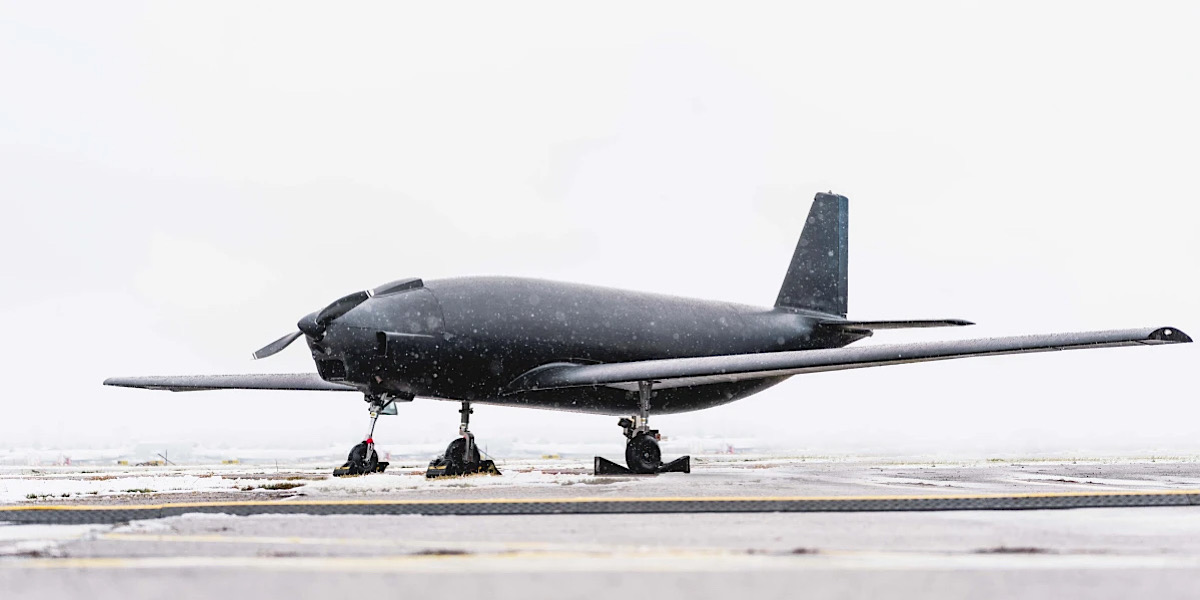
Europe’s middle-mile drone delivery specialist Dronamics is moving to make its flagship Black Swan UAVs entirely carbon neutral through a linkup with UK company Zero Petroleum to supply fossil-free fuel for future aerial cargo transport.

The partnership is the most recent in a series of deals Dromamics has revealed as it prepares to launch middle-mile drone transport of goods and medical materials across Europe as an option to existing road alternatives to destinations shorter-distance delivery UAVs don’t reach. Under the accord, Zero Petroleum will provide its ZERO SynAVGAS fossil-free fuel to power Black Swan craft on entirely sustainable, carbon-neutral flights of up to 2,500 km.

The companies describe ZERO SynAVGAS as a direct-drop replacement for traditional fossil-based fuels without any engine performance loss other synthetics can involve. It’s manufactured by extracting hydrogen from water and capturing carbon from atmospheric carbon dioxide, a process that emits the exact volume of carbon it burns. It becomes 100% sustainable when powered by renewable energy tech like solar or wind, and will be used in specially designed Rotax propeller engines that Dromamics will equip its delivery drones with.

Continue reading… “Dronamics deal to allow net-zero middle-mile drone delivery flights”

UAE unveils the first prototype of its Smart 3D Printed Bridge that can build and design itself

Autodesk & Dar Al-Handasah collaborate to design a smart 3D printed bridge

Dar Al-Handasah, a Lebanese engineering firm, collaborated with American software company Autodesk to create a smart 3D printed bridge that builds and designs itself using 3D printing, robotics, and artificial intelligence (AI). The bridge was unveiled recently in the UAE.

The five-metre bridge’s first prototype was designed in the UAE as part of the engineering firm’s efforts to introduce a safer, more sustainable, and smarter design to the country as a result of its digital capabilities and innovations.

Continue reading… “UAE unveils the first prototype of its Smart 3D Printed Bridge that can build and design itself”

DARPA developed a brain-zapping prosthesis that improves memory by 50%

By Joshua Hawkins

Memory loss is a terrible thing. With so many brain injuries and diseases able to cause significant loss of memory, scientists have spent a long time looking for ways to restore or improve memory in those cases. Now, a group of researchers has managed to create a memory-improving prosthesis with an improvement rate of around 50 percent.

The new and unique form of brain stimulation mimics how the brain creates memories. The system isn’t extremely advanced at the moment, relying on a single electrode that needs to be situated deep into the brain. However, the memory-improving prosthesis has shown amazing effectiveness overall and could probably be even more impressive with a more advanced setup.

If that happens, the possibilities of what they could do with it are astounding. The memory-improving prosthesis works by copying exactly what the human brain’s hippocampus does. This part of the brain is vital to memory storage and creation.

The researchers initially tested it in animals and in some patients with epilepsy. During this time, they tested two different versions of the memory-improving prosthesis in 24 different people. The researchers implanted electrodes to study the patient’s epilepsy. Some of these individuals also had brain injuries and saw results change depending on the electrode used.

Continue reading… “DARPA developed a brain-zapping prosthesis that improves memory by 50%”

Mastercard Adopts Artificial Intelligence In Fight to Tackle Crypto Crime

Mastercard is launching a system to assess the risk of criminal association with cryptocurrency exchange on its payment network.

By Nicholas Pongratz 

  • Mastercard is now offering crypto risk assessment system Crypto Secure for its bank and card issuers customers.
  • Crypto Secure provides a dashboard that indicates the riskiness of certain crypto merchants using a color-coded system.
  • Powered by CipherTrace, which it acquired last year, Mastercard is launching the system in the face of growing crypto crime.
  • The Crypto Secure platform is powered by artificial intelligence (AI) algorithms, harnessing on-chain data derived from blockchains, among other sources. 

Its intended users are banks and financial institutions, who are presented with a dashboard that provides color-coded ratings representing different levels of suspicious activity, from green meaning “low,” to red indicating “high” risk. 

Crypto Secure provides no other commentary, leaving the decision to accept a prospectively suspicious crypto merchant to the platform’s users.

Continue reading… “Mastercard Adopts Artificial Intelligence In Fight to Tackle Crypto Crime”

Tesla now can produce cars with just a few massive parts with MIT’s innovative 3D-printed metal

“Take Materials Science 101. You won’t regret it.”

By Nergis Firtina

Newly 3D printed metal could be used by Tesla to produce all-electric vehicles with just a few massive parts, thanks to two MIT students. 

Announced very recently, the new sort of steel was created by MIT undergraduates and their graduate student mentor in Germany, not for the construction of the cars but for the die-casting molds that stamp them out in just a few distinct pieces.

MIT junior Ian Chen and Kyle Markland managed to produce a 3D-printable steel alloy inspired by a manufacturing approach called Giga-casting, popularized by carmaker Tesla and used to assemble the all-electric Model Y.

Chen and Markland’s project is inspired by Gregory Olson, the Thermo-Calc Professor of Practice at MIT, who teaches Computational Materials Design.

Olson is a world-renowned expert in computational materials science, which employs computer modeling and simulation to understand and design new materials. His methodology was used by Apple to develop the Apple Watch, and it piqued the interest of Tesla CEO Elon Musk.

Continue reading… “Tesla now can produce cars with just a few massive parts with MIT’s innovative 3D-printed metal”

Lynk to Launch World’s First Cellular 5G From Space Payload

First of its kind payload will transmit Cellular 5G from Space

Lynk Global, (Lynk), the world’s leading satellite-direct-to-standard-phone telecoms company, will fly the world’s first 5G cellular base station in space in a first-of-its-kind demonstration. This test will demonstrate the ability to send a 5G signal from space to standard mobile devices on Earth. The test has been funded by an undisclosed partner.

Charles Miller, CEO and co-founder of Lynk, said “Lynk’s fast development cycle, combined with our unique patented and proven technology to connect satellites in orbit to standard mobile phones on Earth, allows Lynk to quickly build and test the world’s most advanced cellular technologies in space.”

Lynk is the only company in the world to demonstrate satellite-direct-to-standard-mobile-phone technology. Earlier this month, Lynk received the world’s first satellite-direct-to-phone commercial license from the Federal Communications Commission (FCC). Lynk has also patented the ability to connect to existing standard 5G devices on Earth, with no change to the 5G device, in 55 countries. The 5G payload will launch in December 2022 on Lynk’s second commercial satellite.

Continue reading… “Lynk to Launch World’s First Cellular 5G From Space Payload”

Smart helmet for firefighters uses sensors and AI to rescue victims faster

By Oceane Duboust 

Researchers in Scotland have developed a helmet that uses artificial intelligence (AI) to help firefighters find and rescue victims faster.

The team, from the newly opened National Robotarium in Edinburgh, designed the device using sensors, thermal cameras and radar technology.

The equipment aims to help firefighters navigate in a smoke-filled environment, map their surroundings and ultimately rescue victims more quickly.

“Firefighters are heroes. Everyone knows that. But what we are doing is (…) we also want them to have this superhero ability: see through smoke, see through darkness and have this ability to find effective solutions for search and rescue,” said Chris Xiaoxuan Lu, Lecturer in Cyber-Physical Systems at the School of Informatics of the University of Edinburgh.

“It will definitely improve the safety for firefighters from multiple dimensions. We already talk about victim searching. We also talk about navigation together with all the sensor units,” he added.

Continue reading… “Smart helmet for firefighters uses sensors and AI to rescue victims faster”

Wisk Aero’s latest flying taxi has four seats and can fly itself

It calls the four-passenger craft a ‘candidate for FAA certification.’

By S. Dent

Wisk Aero has unveiled its 6th-generation semi-autonomous air taxi, calling it the “first-ever candidate for type certification by the FAA of an autonomous eVTOL.” The design looks like a substantially updated version of the “Cora” air taxi we first saw fly and hover in New Zealand back in 2018. However, the company didn’t show any flight or detail the certification progress.

According to Wisk, the four-seat aircraft can cruise between 110 and 120 knots (138 MPH) at a height of 2,500 to 4,000 feet above ground level. It’s a VTOL (vertical takeoff and landing) aircraft with a 12-propeller design, featuring tilting propulsion units in front and fixed units aft for lift. It offers up to 90 miles of range and has improved control and efficient energy management over previous versions, according to the press release. 

Continue reading… “Wisk Aero’s latest flying taxi has four seats and can fly itself”

Researchers fabricate miniaturized bionic ocean-battery

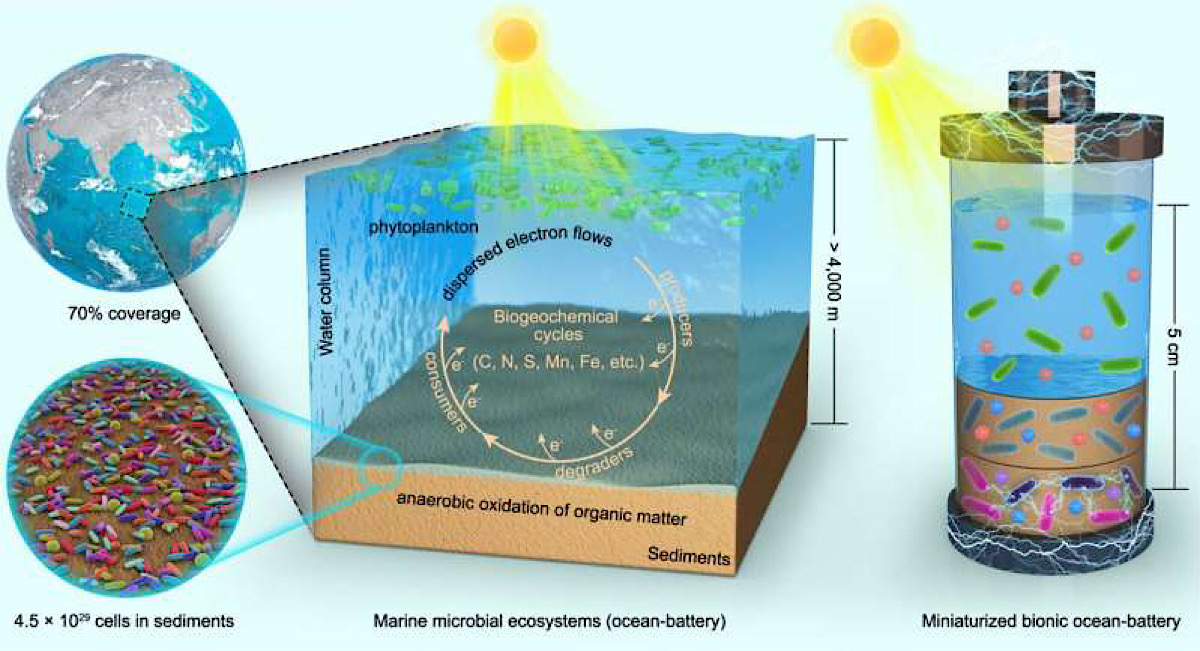
The structure comparison of the marine microbial ecosystems and the miniaturized bionic ocean-battery. Both systems possess same physical structure (water column layer and sediment layer) and same ecological structure (primary producers, primary degraders, and ultimate consumers). The marine microbial ecosystems are huge with the average depth exceeding 4000 m, while the miniaturized bionic ocean-battery was compacted in a vessel with a depth of 5 cm, thus accelerating the electron flow by shortening the electron transfer distance. In marine microbial ecosystems, especially in anaerobic sediments, the highly diversified microbial species and their complex interactions make the electron flow dispersed to various microbially mediated biogeochemical processes, i.e., elemental cycles. In contrast, the miniaturized bionic ocean-battery fabricated using the synthetic community only contains four microbial species connected by the specific energy carriers. This simplified structure targetedly directs electrons towards the only target, i.e., electrical current.

By Zhang Nannan

The researchers from the Institute of Microbiology of the Chinese Academy of Sciences have developed a miniaturized bionic ocean-battery, a bio-solar cell that converts light into electricity, by mimicking the basic ecological structure of marine microbial ecosystems. This study was published in Nature Communications.

Oceans cover about 70% of the Earth’s surface area. From the perspective of energy, marine ecosystems are a huge solar energy bioconversion system in which microorganisms dominate the energy conversion processes.

Energy conversion in marine ecosystems begins with photosynthesis. Photosynthetic microorganisms, called primary producers, located in the euphotic zone of water column, absorb solar energy and convert photons into electrons that are used to fix carbon dioxide into organic matter. The organic matter is partly consumed by plankton living in the water column and partly deposited into the marine sediments where facultative anaerobic or strictly anaerobic microorganisms mineralize the complex organic matter to carbon dioxide through successive oxidation.

Continue reading… “Researchers fabricate miniaturized bionic ocean-battery”
Discover the Hidden Patterns of Tomorrow with Futurist Thomas Frey
Unlock Your Potential, Ignite Your Success.

By delving into the futuring techniques of Futurist Thomas Frey, you’ll embark on an enlightening journey.

Learn More about this exciting program.