Blockchain and Smart Contracts Have German Auto Dealers on the Fast Track to Financing

BY DAVID EDWARDS 

ChinaTechNews reports on April 4 that German auto dealers are using the Ethereum blockchain to get around bank bureaucracy, speeding up dealer credit applications.

German car dealers and distributors have found a new use for blockchains – acquiring and financing their customers quickly and with less paperwork than traditional bank loans.

Using Ethereum smart contracts – computer protocols that facilitate, verify or enforce the negotiation of an agreement – dealerships can provide their clients with immediate access to fiat currencies through dealer credit applications. 

But this family-owned dealership has embraced the blockchain by incorporating cryptocurrency into its auto finance services. The result? Shortening closing times on car loans using virtual money that’s seen a 1,400 per cent rise in value since January 2017.

Continue reading… “Blockchain and Smart Contracts Have German Auto Dealers on the Fast Track to Financing”

This Micro-Sized Camera will Turn Nanorobots into Photographers

Nanorobotics, like graphene, have been trending topics in research for years but are still far from full industrial production. Everyone is aware of its potential, but the technical hurdles remain. Fortunately, research is progressing steadily. The latest invention that would allow the world’s tiniest robots to take a giant leap forward is a camera barely the size of a grain of salt.

Imagine for a moment that, instead of using a bulky CAT scan or intrusive endoscopy, an almost invisible robot could inspect your arteries or the most inaccessible corners of your heart. Those could be some of the of applications enabled by a new camera designed by scientists at Princeton University in the U.S. It is the size of a grain of salt and works in a radically different way from traditional lenses.

Continue reading… “This Micro-Sized Camera will Turn Nanorobots into Photographers”

Feature Article: Robot Dogs Take Another Step Towards Deployment at the Border

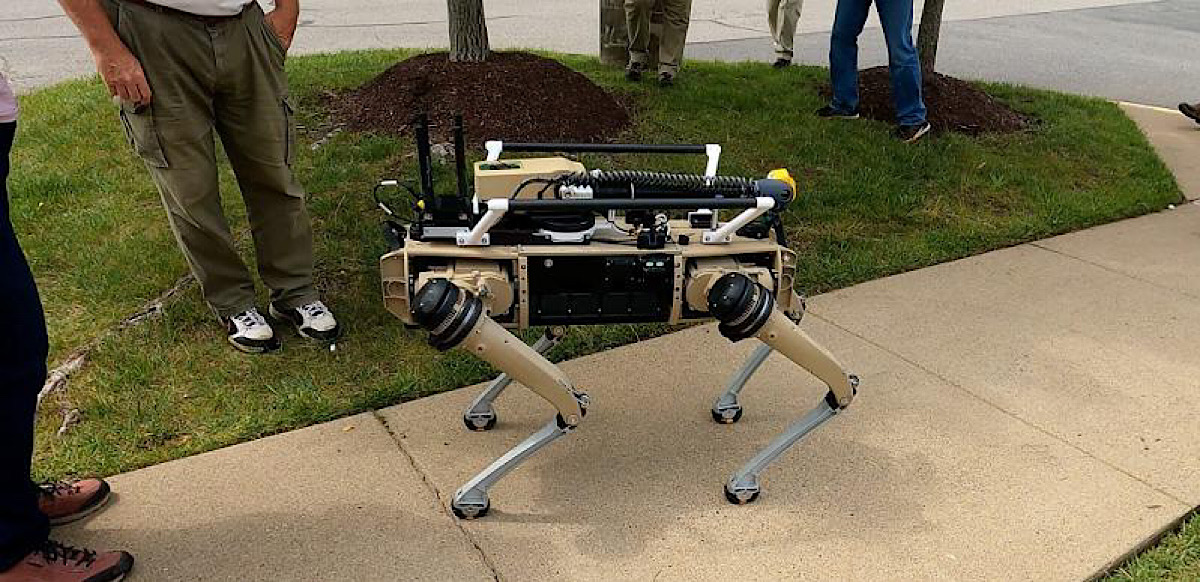
A robot dog showing off capabilities during testing in Lorton, Virginia.

The American Southwest is a region that blends a harsh landscape, temperature extremes and various other non-environmental threats that can create dangerous obstacles for those who patrol the border. The territory is vast and monitoring it is critical to our nation’s security. That’s why the Science and Technology Directorate (S&T) is offering U.S. Customs and Border Protection (CBP) a helping hand (or “paw”) with new technology that can assist with enhancing the capabilities of CBP personnel, while simultaneously increasing their safety downrange.

S&T has a deep understanding of CBP’s technology needs in the field. In its role as the research and development arm of the Department of Homeland Security (DHS), S&T is always identifying solutions to support the complex CBP mission. For instance, S&T is currently supplementing CBP’s bipedal human personnel with quadruped mechanical reinforcements to help the agency better allocate resources. In this case, Man’s best friend comes with a very futuristic twist.

“The southern border can be an inhospitable place for man and beast, and that is exactly why a machine may excel there,” said S&T program manager, Brenda Long. “This S&T-led initiative focuses on Automated Ground Surveillance Vehicles, or what we call ‘AGSVs.’ Essentially, the AGSV program is all about…robot dogs.” 

Continue reading… “Feature Article: Robot Dogs Take Another Step Towards Deployment at the Border”

EU launches billion euro fund for space startups

The Cassini fund has been announced for innovation in the space in Europe promising to be a far-reaching endeavor that acts a catalyst for private players in the space and earth observation sector. 

By Snehil Manohar Singh

CASSINI is a €1 billion ($1.1 billion) space fund that intends to provide impetus to startups and space innovation within the EU. As the European Commission’s official page for CASSINI describes, the initiative seeks to support entrepreneurship among space-related businesses in the European Union (EU). In particular, it caters to the needs of companies in different growth stages from seed to mid-caps, and to companies developing space technology as well as digital applications for various markets, by improving access to investments and professional networks (CASSINI – Space Entrepreneurship Initiative).

It was in January 2021 that Commissioner Thierry Breton announced that the European Commission would set up CASSINI. It is a watershed moment where, government agencies have for the first time, in the region, actively sought collaboration with private parties — not just for operational convenience, but for a truly symbiotic arrangement.

Continue reading… “EU launches billion euro fund for space startups”

Rise of the robots: How restaurants can automate without losing the human touch

Instead of adopting tech to replace humans, employers should use digital tools that make jobs more satisfying.

By Raju Malhotra

The following is a guest post by Raju Malhotra, chief product and technology officer at PAR Technology Corporation.

Greetings, fellow human!

Robots seem to be everywhere these days, at least in the restaurant business. A week doesn’t go by without industry trades and mainstream press bringing us headlines like “Robots take over major casual dining chains.”

Robots are flipping burgers and frying chicken wings, and driverless bots and drones are delivering meals to hungry customers. No wonder those headlines include words like “take over” — at this rate, it’s starting to feel as if androids will replace all of us pretty soon.

Continue reading… “Rise of the robots: How restaurants can automate without losing the human touch”

China unveils new 7,000mph ‘winged rocket’ hypersonic plane that could fly from New York to Beijing in ONE HOUR

By Tariq Tahir

PLANS for hypersonic plane capable of flying between Beijing and New York in an hour have been unveiled by a Chinese company.

The “rocket with wings” is being designed to fly at an astonishing 7,000mph and tests are reportedly due to begin next year.

Scientists hope it will be ready to take to the air by 2024.

The futuristic plane is being developed by Space Transportation, which hopes to conduct a full point-to-point flight by the end of the decade, reports Space.com.

A video released by the company shows the plane detaching from the wing powered by rockets after take-off, before continuing to its destination.

Meanwhile, the wing and boosters then land back on the launch pad.

When it arrives, the plane will land using three legs that unfold from the rear.

The company boasts it will be able to link New York with the capital of China in just an hour.

“We are developing a winged rocket for high-speed, point-to-point transportation, which is lower in cost than rockets that carry satellites and faster than traditional aircraft,” the firm told Chinese media.

Continue reading… “China unveils new 7,000mph ‘winged rocket’ hypersonic plane that could fly from New York to Beijing in ONE HOUR”

Virgin Hyperloop wants to revolutionize freight transport

Hyperloop developer working with global airports, ports for cargo movement systems

By Noi Mahoney

Virgin Hyperloop wants to accelerate the global supply chain using battery-powered pods gliding through sealed tubes at speeds of up to 670 mph. 

The company is in discussions with airports and port facilities around the world to create a pilot program for cargo shipment services, said Ryan Kelly, Virgin Hyperloop’s vice president of marketing and communications.

“We aim to execute these projects by the end of 2024,” Kelly told FreightWaves. “The U.S. is definitely one of the places where we have multiple airports that have shown interest in the pilot, a vision of what we were proposing for the next decade. There’s also a lot of conversation going on in India and there’s also conversations going on in Europe as well.”

The Virgin Hyperloop pilot will most likely begin with connecting airports to logistics warehouses or connecting one airport cargo facility to another airport.

“Obviously COVID-19 has changed the world, especially in the cargo industry and supply chain,” Kelly said. “It has had humongous effects on an infrastructure that has been updated in some ways and in other ways, for big infrastructure and mass infrastructure, it has not.”

Continue reading… “Virgin Hyperloop wants to revolutionize freight transport”

FDA: Blockchain-Based Food Tracking Bound for Widespread Adoption

By VICTORIA CAMPISI

A new rule could boost blockchain-based food tracking.

The rule, expected next November, would require the food industry to maintain records associated with the critical tracking events on the supply chain, according to Frank Yiannas, deputy commissioner for food policy and response at FDA, as reported by The Wall Street Journal (Feb. 1).

Events include growing, receiving, transforming, creating and shipping food products.

The Food Safety Modernization Act Proposed Rule for Food Traceability wouldn’t require companies to maintain electronic records. However, it is believed many would employ digital systems including blockchain to comply, Yiannas explained.

Blockchain is the distributed ledger technology supporting bitcoin and other cryptocurrencies. It is a decentralized technology spread across many computers that manages and records transactions.

Continue reading… “FDA: Blockchain-Based Food Tracking Bound for Widespread Adoption”

DeepMind’s AlphaCode AI writes code at a competitive level

By Devin Coldewey

DeepMind has created an AI capable of writing code to solve arbitrary problems posed to it, as proven by participating in a coding challenge and placing — well, somewhere in the middle. It won’t be taking any software engineers’ jobs just yet, but it’s promising and may help automate basic tasks.

The team at DeepMind, a subsidiary of Alphabet, is aiming to create intelligence in as many forms as it can, and of course these days the task to which many of our great minds are bent is coding. Code is a fusion of language, logic and problem-solving that is both a natural fit for a computer’s capabilities and a tough one to crack.

Of course it isn’t the first to attempt something like this: OpenAI has its own Codex natural-language coding project, and it powers both GitHub Copilot and a test from Microsoft to let GPT-3 finish your lines.

DeepMind’s paper throws a little friendly shade on the competition in describing why it is going after the domain of competitive coding:

Recent large-scale language models have demonstrated an impressive ability to generate code, and are now able to complete simple programming tasks. However, these models still perform poorly when evaluated on more complex, unseen problems that require problem-solving skills beyond simply translating instructions into code.

Continue reading… “DeepMind’s AlphaCode AI writes code at a competitive level”

AI “Nanny” Being Created by Chinese Scientists to Grow Babies in Robot Wombs

Researchers say the technology could help with imminent population crisis, with birth rates in China at their lowest level in six decades.

The artificial intelligence nanny has arrived. Robots and artificial intelligence (AI) may now be used in conjunction to optimize the generation of human life, marking a significant milestone in the science. 

Robotics and artificial intelligence can now assist in the development of newborns via the use of algorithms and artificial wombs, which is eerily similar to what we see in the cult classic, The Matrix.

According to the South China Morning Post, Chinese experts in Suzhou have pioneered the development of the latest technological breakthrough. However, there are concerns about the ethical implications of raising human beings in an artificial environment.

The discoveries were published in the peer-reviewed Journal of Biomedical Engineering by Suzhou-based scientists. The AI nanny, according to the researchers, might aid in the growth of human kids in a “long-term embryo culture device.”

This artificial womb is a big machine containing compartments for individual fetuses. The infants will be fed as they would be in a real womb if they are in the chamber, which will be filled with an optimized mix of “nutritious fluids.”

Continue reading… “AI “Nanny” Being Created by Chinese Scientists to Grow Babies in Robot Wombs”

This AI Learned the Design of a Million Algorithms to Help Build New AIs Faster

By Jason Dorrier 

The skyrocketing scale of AI has been hard to miss in recent years. The most advanced algorithms now have hundreds of billions of connections, and it takes millions of dollars and a supercomputer to train them. But as eye-catching as big AI is, progress isn’t all about scale—work on the opposite end of the spectrum is just as crucial to the future of the field.

Some researchers are trying to make building AI faster, more efficient, and more accessible, and one area ripe for improvement is the learning process itself. Because AI models and the data sets they feed on have grown exponentially, advanced models can take days or weeks to train, even on supercomputers.

Might there be a better way? Perhaps.

Continue reading… “This AI Learned the Design of a Million Algorithms to Help Build New AIs Faster”

‘Virtual surgeons’ to be able to join operations anywhere

A company pioneering technology to allow surgeons to virtually ‘scrub in’ to any operating room in the world is partnering with Vodafone to speed up adoption in Europe.

The Proximie platform was developed with funding from UK Research and Innovation (UKRI), as part of the medicines manufacturing challenge’s Digital Health Technology Catalyst.

It will help reduce variations in care and ensure every patient receives the best healthcare every single time.

Continue reading… “‘Virtual surgeons’ to be able to join operations anywhere”
Discover the Hidden Patterns of Tomorrow with Futurist Thomas Frey
Unlock Your Potential, Ignite Your Success.

By delving into the futuring techniques of Futurist Thomas Frey, you’ll embark on an enlightening journey.

Learn More about this exciting program.