
By Futurist Thomas Frey
The Coffee Shop Problem
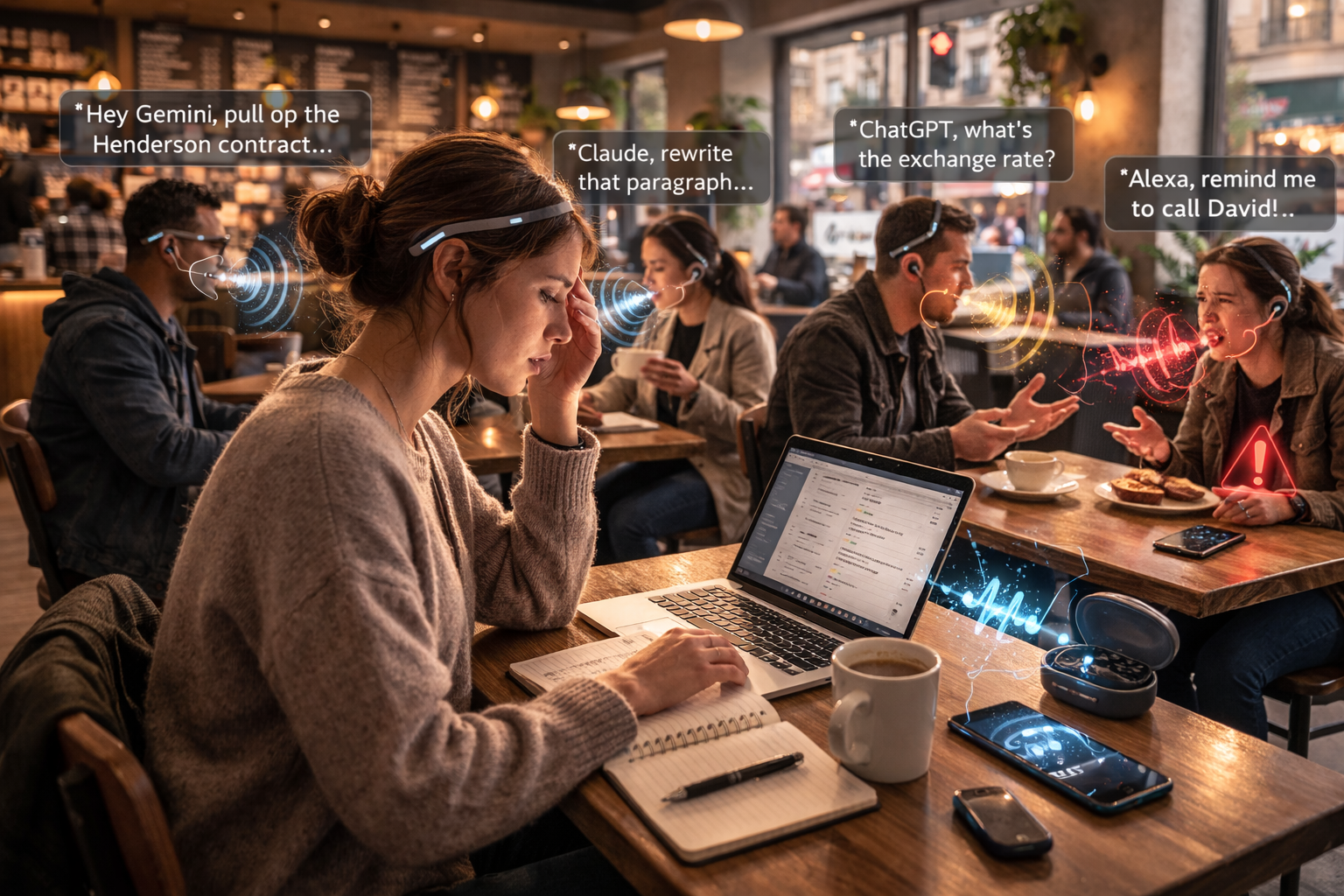
It’s 2028. Rachel Thompson sits in a busy Starbucks, working on her laptop. Around her, a dozen other people do the same. But the familiar quiet hum of typing and occasional whispered conversation has been replaced by something utterly maddening.
“Hey Gemini, pull up the Henderson contract from last Tuesday.”
“Claude, rewrite that paragraph to sound less aggressive.”
“ChatGPT, what’s the exchange rate for euros right now?”
“Alexa, remind me to call David at 3 PM.”
Every single person is talking. Out loud. To their AI assistants. Constantly.
Rachel tries to focus on her work, but the overlapping voices create an incomprehensible wall of noise. Someone three tables over is dictating an email. The woman next to her is having an argument with her AI about restaurant recommendations. A guy by the window is debugging code verbally, talking through each line.
After twenty minutes, Rachel gives up and leaves.
This is the future we’re hurtling toward—and it’s going to be absolutely unbearable.
Unless someone solves it.
Why We’re About to Start Talking Constantly
The shift toward voice-based AI interaction is already underway, and it’s accelerating fast.
Typing is inefficient. The average person types 40 words per minute. They speak 150 words per minute. For complex tasks—drafting documents, brainstorming ideas, debugging problems—voice is three times faster than fingers.
AI assistants are getting dramatically better at understanding natural speech, handling interruptions, maintaining context across long conversations. By 2027, talking to AI feels more natural than talking to most humans. The AI never gets impatient, never loses track of what you were discussing five minutes ago, never tells you to hurry up.
So people talk. A lot.
They talk to AI while walking down the street. While shopping. While sitting in waiting rooms. While riding the bus. While eating lunch. The AI becomes their external brain, and the connection is maintained through constant verbal interaction.
The problem? Everyone else can hear it.
The Public Disruption Crisis
Imagine airports in 2029. Hundreds of people in gate areas, all talking simultaneously to their devices. Some are working. Some are planning trips. Some are arguing with customer service AI. Some are just lonely and chatting with their AI companion.
The noise level becomes unbearable. Airports install “quiet zones” where voice AI is prohibited, but they’re constantly overcrowded and under-enforced.
Libraries face an existential crisis. Their entire purpose—providing quiet spaces for concentration—gets destroyed when patrons insist on vocally collaborating with their AI research assistants.
Restaurants add “voice-free sections” to their floor plans, but enforcement is spotty. Dinner conversations get interrupted by the person at the next table loudly asking their AI for wine recommendations.
Office environments become chaos. Open-plan offices—already terrible—become completely dysfunctional when twenty people are simultaneously having different conversations with their AIs.
Public transportation turns into mobile bedlam. The quiet car on trains becomes the only desirable space, and fights break out over enforcement.
This isn’t some distant dystopia. We’re maybe three years away from this becoming the dominant social friction of daily life.
The question isn’t whether this will happen. The question is: what technology will emerge to fix it?
Enter the Invisible Sound Helmet
The solution, when it arrives around 2029, will seem almost magical.
You put on what looks like a minimalist headband—lightweight, stylish, barely noticeable. Some versions will be completely invisible, embedded in glasses frames or even implanted behind the ear.
But this isn’t just audio equipment. It’s a precisely engineered acoustic isolation system.
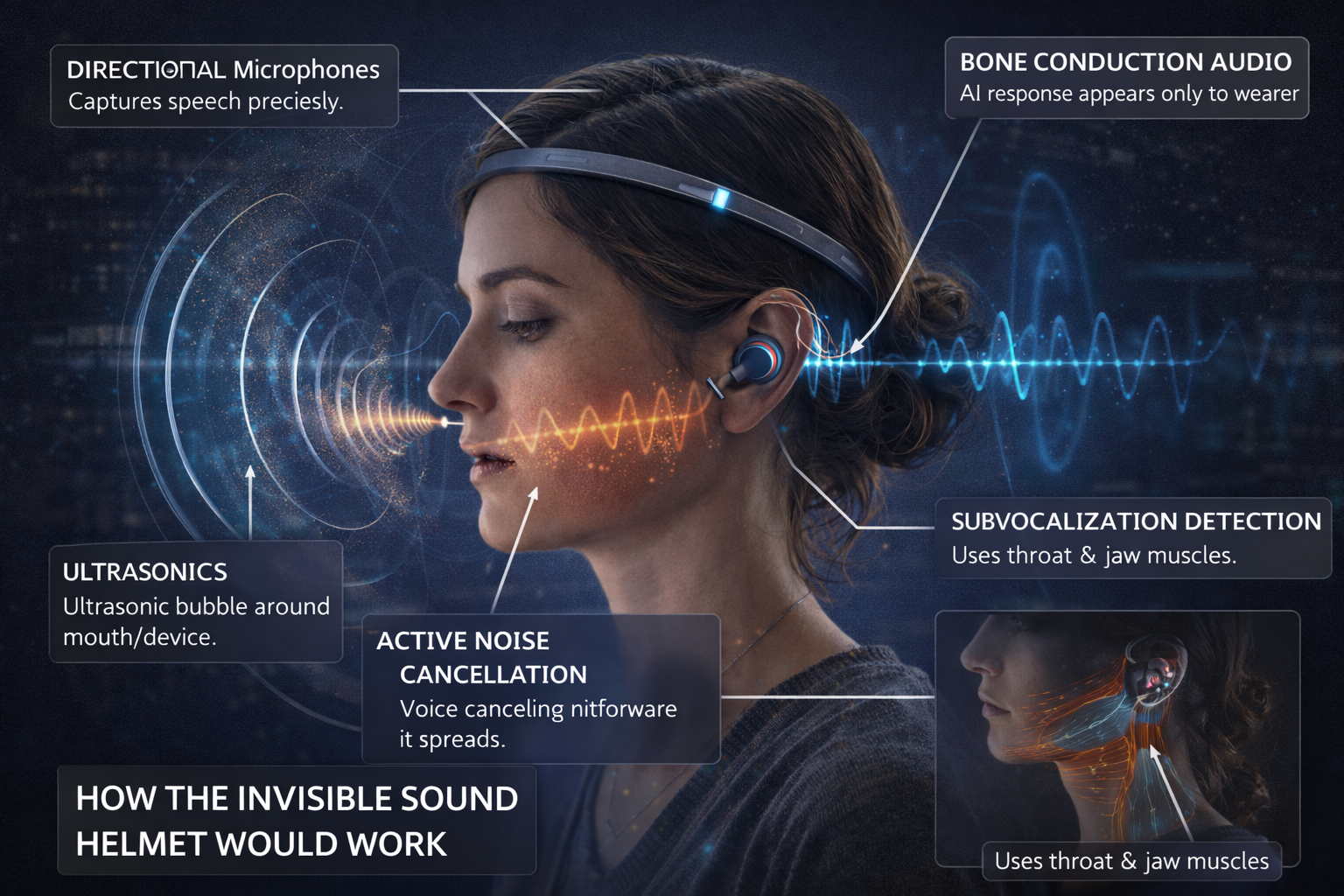
The technology works through a combination of directional speakers and active noise cancellation. When you speak, ultrasonic transducers create a “sound bubble” around your mouth and the device’s microphone. Your voice travels from your lips to the microphone, but the sound waves are actively canceled before they propagate more than eighteen inches.
To everyone around you, you appear to be moving your lips silently. They might see you talking, but they hear nothing—or at most, a faint whisper that’s barely audible even at close range.
Meanwhile, the AI’s responses come through bone conduction speakers or directional audio that only you can hear. The sound appears to come from inside your head, completely inaudible to anyone else.
You’re having a full-volume conversation. But it’s completely private.
How It Actually Works
The engineering behind invisible sound helmets is surprisingly complex.
Directional Microphones capture your voice while rejecting ambient noise. They’re tuned to pick up the specific frequency range and directionality of your speech, ignoring everything else.
Active Noise Cancellation generates inverse sound waves that cancel out your voice before it travels beyond your immediate personal space. The system analyzes your speech in real-time and produces precisely calibrated counter-frequencies that destructively interfere with the original sound waves.
Ultrasonic Boundary Creation uses high-frequency transducers to create an acoustic “wall” around your mouth. The ultrasonic waves don’t carry your voice, but they do define the boundary of your sound bubble—the space within which your voice travels normally.
Bone Conduction Audio delivers the AI’s responses directly through vibrations in your skull, bypassing your eardrums entirely. Nobody else can hear what the AI is saying because it’s not traveling through air—it’s traveling through bone.
Subvocalization Detection for advanced versions. You don’t even need to move your lips. The device detects the subtle muscle movements in your throat and jaw that occur when you “speak” internally, translating those micro-movements into commands for the AI.
The whole system runs on a battery smaller than a hearing aid, lasts 18-24 hours on a charge, and costs about what AirPods cost in 2025.
The Social Transformation
Once invisible sound helmets become commonplace—and they will, probably by 2031—social dynamics shift dramatically.
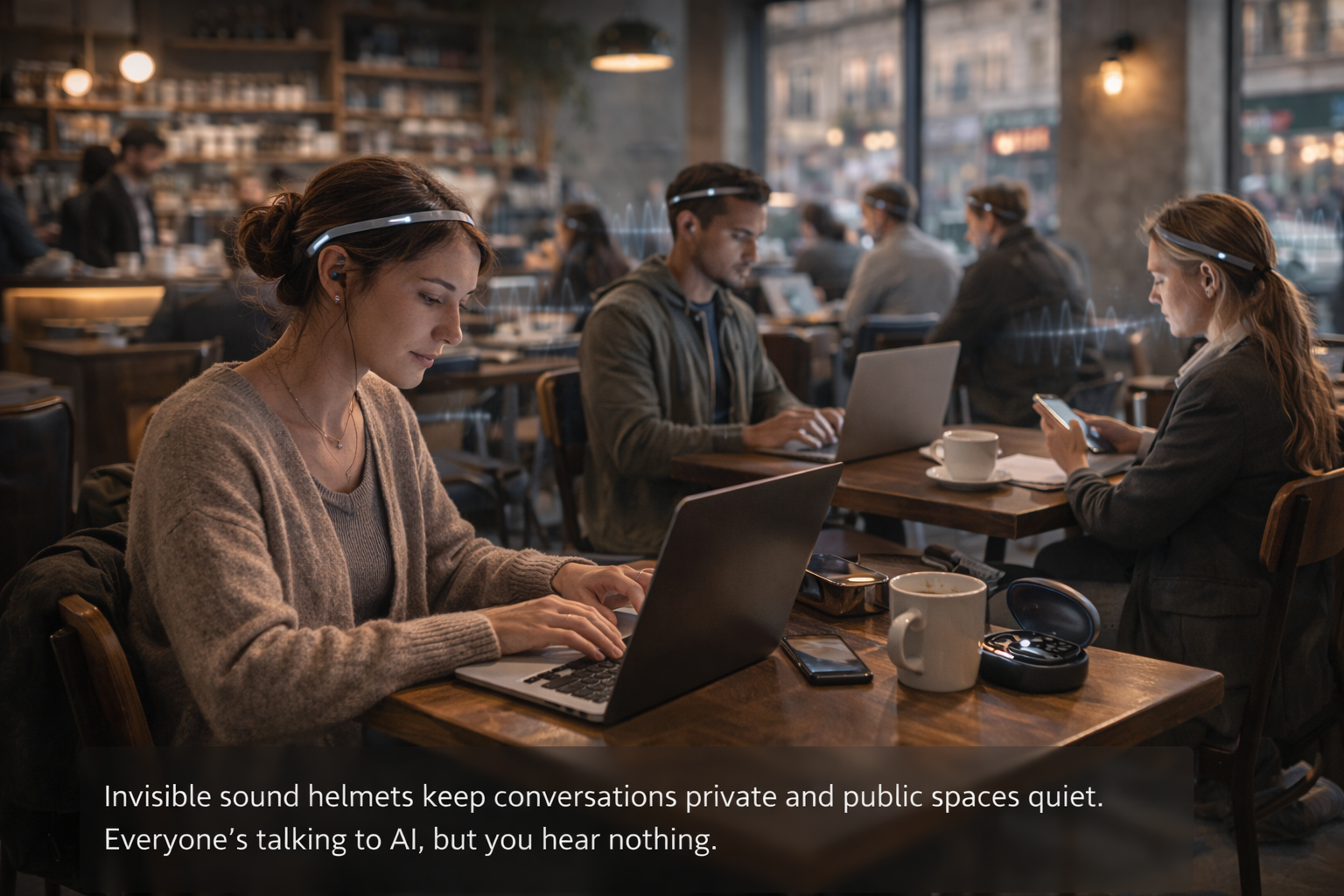
Public spaces become usable again. Coffee shops, libraries, airports, trains—all regain their functionality because the cacophony disappears. People are still talking to their AIs constantly, but silently.
The visual cue replaces the audio cue. You’ll know someone is AI-engaged not because you hear them, but because you see them—lips moving slightly, eyes focused on nothing, subtle hand gestures as they interact with AR overlays. It becomes the new version of “on the phone.”
Privacy expectations evolve. Just as headphones created the social norm of “leave me alone, I’m listening,” sound helmets create “leave me alone, I’m conversing.” The visible presence of the device signals that the person is occupied, even though you can’t hear their conversation.
Status symbols emerge. Early sound helmets are clunky. By 2032, luxury versions are nearly invisible—subtle jewelry-like pieces that hint at the technology without screaming it. The completely invisible implanted versions become status markers for executives and tech elite.
New etiquette develops. Taking off your sound helmet when someone approaches becomes the polite thing to do, signaling you’re available for human conversation. Keeping it on signals you’re busy. Social rules codify around these signals.
The Unexpected Consequences
As always with transformative technology, invisible sound helmets create effects nobody predicted.
People become more isolated in public. When you can be in constant conversation with your AI without anyone knowing, why engage with strangers? The coffee shop regular who used to chat with the barista now just orders through their AI and sits silently. Public spaces become lonelier even as they become quieter.
Relationships strain in new ways. Couples sitting at dinner, both wearing sound helmets, both having separate AI conversations. They’re physically together but mentally elsewhere. The technology that solved public disruption creates private disconnection.
Workplace surveillance concerns emerge. Can employers monitor what you’re saying to your AI during work hours? Some companies install “helmet-free zones” for meetings. Others require employees to use company-issued helmets that log all conversations. Labor law struggles to catch up.
Mental health implications surface. People who spend 8-10 hours daily in AI conversation start preferring it to human interaction. The AI never judges, never gets tired of listening, never disagrees. Some users develop what psychologists call “AI conversation dependency”—they become anxious when forced to remove their helmets.
Class divisions deepen. Premium sound helmets offer perfect isolation. Budget versions leak sound, fail at noise cancellation, create that annoying tinny hiss. You can identify someone’s economic status by how well their sound helmet works. Public spaces stratify: premium areas where sound helmet quality is assumed, budget areas where imperfect isolation remains tolerable.
The Alternatives That Failed
Before sound helmets became standard, other solutions were tried and abandoned.
Text-only AI interaction was pushed heavily, but people hated it. Too slow, too limiting, killed the natural flow of thought.
Silent spaces were designated in public areas, but enforcement was impossible and resentment built. People felt their technology usage was being unfairly restricted.
White noise generators were installed in offices and public spaces to mask AI conversations, but the constant background hum was almost as annoying as the conversations themselves.
Social pressure to keep AI conversations private failed completely. People insisted they had the right to use their technology how they wanted. The backlash against “voice-shamers” was intense.
None of the behavioral or regulatory approaches worked. The problem required a technological solution.
The 2035 Landscape
By the mid-2030s, invisible sound helmets are ubiquitous. Most people over age ten own at least one. The cheapest functional models cost about $60. Premium versions run $800 and up.
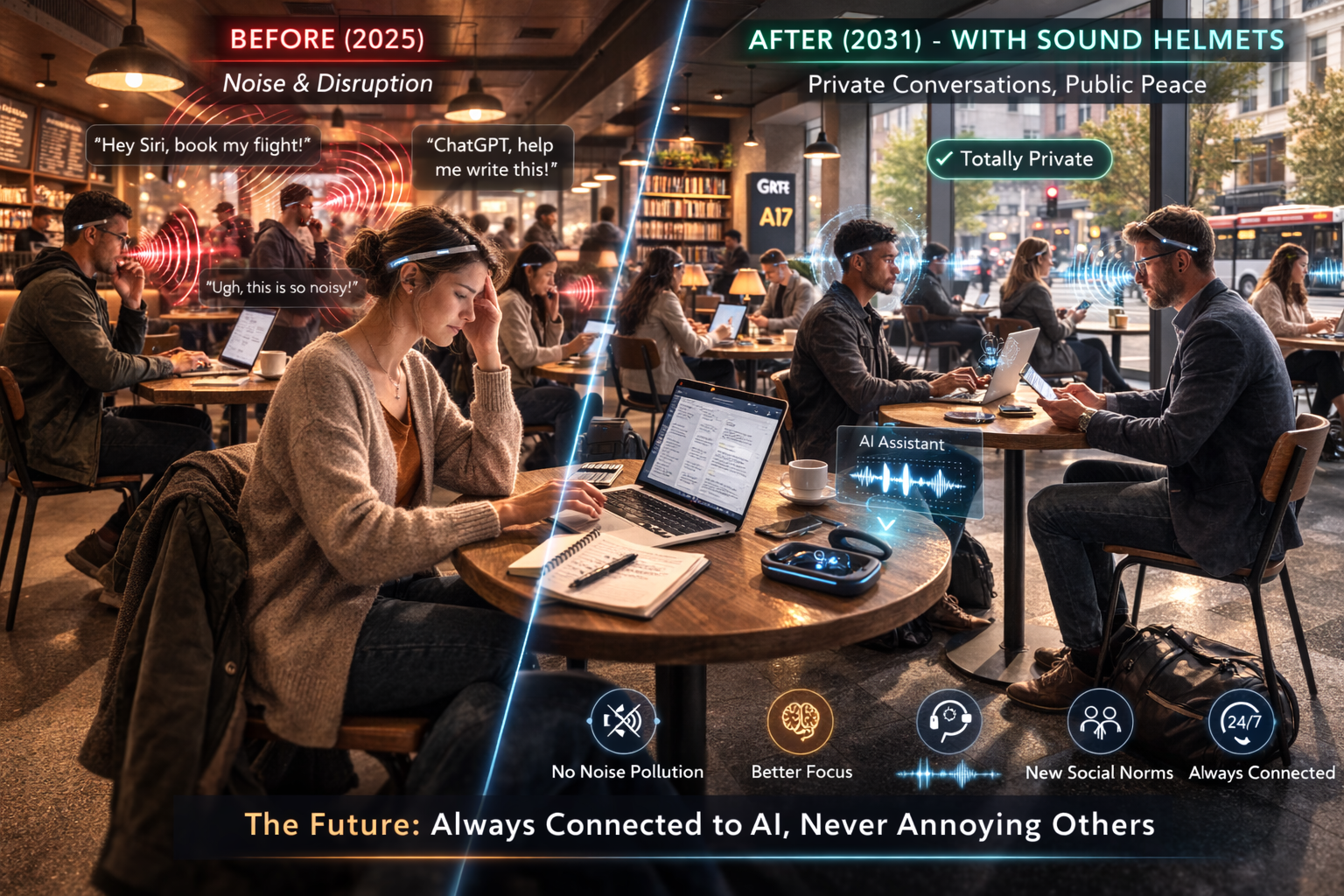
You can tell you’re looking at someone from 2035 versus 2025 by their behavior in public. The 2025 person checks their phone. The 2035 person sits quietly, eyes occasionally moving as they interact with AR interfaces, lips barely moving as they converse with their AI.
The silence is deceptive. Underneath it, billions of conversations are happening simultaneously. Every person connected to their AI assistant, continuously collaborating, questioning, delegating, planning.
We solved the noise problem. We created a world where everyone can talk to their AI without driving everyone else crazy.
What we lost was the last excuse to not be constantly connected. The final barrier—social embarrassment about public AI conversation—got engineered away.
Now there’s nothing stopping us from spending every waking moment in conversation with artificial intelligence.
Whether that’s progress or tragedy depends on who you ask.
But it’s definitely quiet.
The Question Nobody’s Asking
Here’s what keeps me up at night about invisible sound helmets:
When everyone around you is silently conversing with their AI, how do you know who’s available for human connection?
When the technology makes private AI conversation indistinguishable from quiet contemplation, do we lose the ability to be genuinely alone with our thoughts?
When children grow up wearing sound helmets from age seven, always having an AI voice in their head ready to answer questions, explain concepts, provide companionship—do they develop the same capacity for independent thought?
The invisible sound helmet solves one problem beautifully. It creates several others we’re just beginning to understand.
But it’s coming. Probably within five years. And it will change public space forever.
Get ready for the quietest, most isolated, most constantly-connected world we’ve ever built.
Related Articles:
Directional Audio Technology and Applications – Research on focused sound delivery systems
Bone Conduction Audio: Technology and Future – IEEE analysis of bone conduction speaker advances
Social Implications of Ambient AI Assistants – Study on how constant AI interaction affects human relationships
Word Count: 1,984