Boston Dynamics’ faintly terrifying quadruped dog robot—SpotMini—was first announced in 2016 and is expected to go on sale later this year. The robot has a whole lot of whizzy sensors and cameras, spindly mechanical legs, a creepy grabber arm that opens doors, and mind-bogglingly impressive robotics technology. (It’s expected to carry a five-digit price tag—a fitting sum to bring the uncanny valley direct to your home.)
But it’s never been very clear what, exactly, the point of Spot is—especially as a consumer product.
From drone deliveries to checkout-free brick-and-mortar stores, Amazon has made no secret of its desire to automate as many parts of the retail experience as possible. While Amazon employs thousands of people in its fulfillment centers, it may be because it hasn’t yet figured out a way to automate their role. Until now, that is. Things could be about to get even more dicey for human workers as Amazon is reportedly rolling out machines capable of boxing up customer orders.
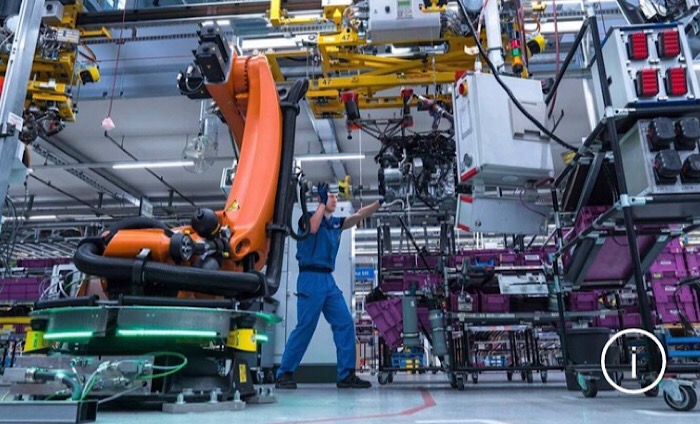
A worker leads a large industrial robot at the BMW Group Plant Regensburg, Germany.
Any minute now, some speculate, workers around the world will be asked to make way for robots.
Their arrival may be welcome in some cases. Our latest research suggests that when robots—or automated manufacturing technology—take over jobs that are oriented around repetitive tasks, operators are able to move onto more exciting and productive work.
This was the case at 16 “lighthouses of manufacturing,” which were identified as part of a joint McKinsey and World Economic Forum project presented at Davos.
How many robot dogs does it take to pull a massive truck? Apparently 10. Boston Dynamics
Boston Dynamics is back with another bizarre video starring its animal-like robots.
The latest video features 10 of the dog-like “SpotMini” robots pulling a truck across the company’s parking lot.
Unlike some of the sillier videos from Boston Dynamics, this one demonstrates the raw power of the company’s robots.
The doglike robots from Boston Dynamics are back with another video, but this time the video is less about virality and more focused on demonstrating the machines’ raw power.
The cooperative robot model that China is expanding could hold vital lessons for other developing economies that also rely heavily on small businesses.
There’s a “factory of the future” being built in Shanghai, with $150 million in investment from Swiss-Swedish automation giant ABB. Slated for completion in 2020, the factory is a place where “robots will make robots,” according to ABB. But the cutting-edge robotics technology the facility hopes to showcase won’t cater only to heavy industrial needs. It will also largely feature “collaborative automation solutions” — known as cobots — that work with humans instead of replacing them. The facility is evidence of an emerging Chinese automation strategy that’s beginning to reshape the world’s approach to robotics.
MIT’s Cheetah team has built some incredibly impressive electric robots, capable of jumping hurdles and navigating blindly, but in some ways the new Mini Cheetah might be the most impressive to date.
In a challenge to the narrative of a declining American advantage in the global tech race, U.S. factories are installing record numbers of robots — and elite universities, endowed with huge new contributions, are adding vast centers to study artificial intelligence.
Why it matters: As we have reported previously, China has a massive global lead in the absolute number of new factory robots, and is pouring large sums into developing AI. But the twin U.S. trendlines — a surge in university research spending and the spike in robots — suggest a still-robust competition to dominate technologies of the future.
Soft robotics is a rapidly growing field that has a huge amount of potential in applications where traditional rigid robots would be unsafe or unwieldy. But, building a soft robot comes with a number of unique challenges, particularly when it comes to actuation and position sensing. Fortunately, a newly-developed soft robotic finger with its own sense of self-perception may dramatically improve the situation.
This work comes from a team of researchers at the Bioinspired Robotics and Design Lab at the University of California San Diego and others around the globe. It’s intended to give soft robots the kind of positional sensing that is innately practical in rigid robots. Because a traditional robot’s frame is inflexible, it’s relatively simple to determine it’s exact position — you only need to measure the angle at each joint. But, due to their inherent flexibility, that’s not so easy with soft robots.
The solution that the researchers came up with was to use a neural network and machine learning to identify correlations between the readings from a motion capture system and flex sensors within the soft robotic finger. The flex sensors were placed somewhat arbitrarily, which would normally be extremely difficult to process through explicit programming. But, by using the neural network, the system is able to match those sensor readings to what it sees in the motion capture system.
iRobot is best known for making vacuum cleaner robots: the infamous Roomba lineup. But the company also makes mopping robots (Braava lineup), pool cleaning robots (Mirra lineup), a bot to help clean gutters, and even programmable robots (Create lineup). So, what’s next for your home? A lawn mower robot.
Queue the “get off my lawn” jokes.
iRobot today introduced the Terra robot lawn mower, which features “state-of-the-art mapping and navigation technologies, high-performance, high-quality mowing, and easy installation.” It is arguably easier for a robot to mow a lawn than clean a house, but the company is still starting off cautiously — the iRobot Terra robot mower will be available for sale in Germany and as part of a beta program in the U.S. sometime later this year. iRobot said it would share more specific availability and pricing at a later date.
Over the course of the last year, Amazon began rolling out a new worker safety wearable to 25+ sites. From the looks of it, the Robotic Tech Vest is really more like a pair of suspenders attached to an electronic utility belt. The Amazon Robotics-designed product was created to keep workers safe when they need to enter a space in order to fix a robotic system or retrieve fallen items. Built-in sensors alert Amazon’s robotic systems to the wearer’s presence, and they slow down to avoid collision.
The vest is designed to work in tandem with the robots’ existing obstacle avoidance detection.
Germany automotive firm Continental is best know for its tires, but at CES 2019 the company is demonstrating something a little different: package delivery by robot dog.
As part of its research into the future of mobility, Continental has partnered with robotics company ANYbotics (a spin off from ETH Zurich) to imagine the future of package delivery. In a staged demonstration on the CES show floor, the firm showed how one of ANYbotics’ four-legged robots could jump out the back of a self-driving delivery truck and carry a package right up to someone’s front door.
In the demo, the ANYMal robot could be seen slowly picking its way over debris in the garden before ringing the fake doorbell with one if its limbs. It then tips the package off its back onto the porch and performs a little victory dance as a bonus.