Open-source fish robot starts collecting microplastics from local lakes in the UK

Researchers turn the public’s ideas into reality

By Ioanna Lykiardopoulou

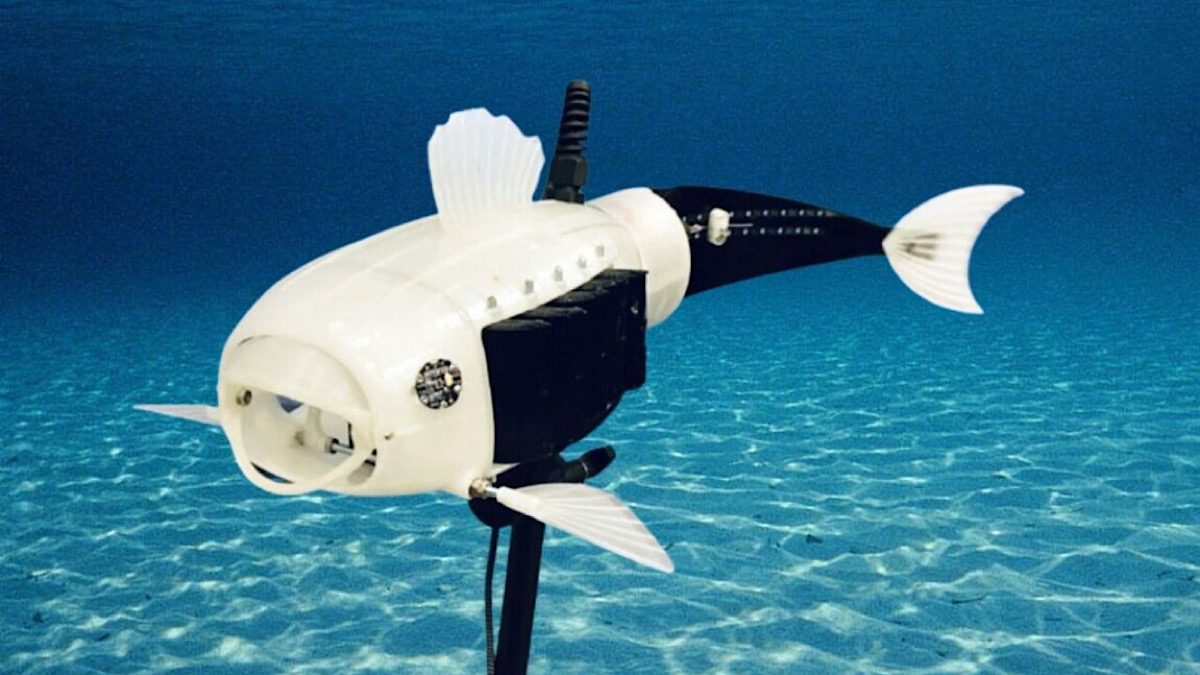
A robot fish that collects microplastics from waterways has been turned from an idea into a working prototype. The design was brought to life after it won the University of Surrey’s public competition, the Natural Robotics Contest.

The contest, which ran in the summer of 2022, invited the public to submit an idea for a bio-inspired robot that could help the world.

An international panel of judges chose the robot fish concept designed by student Eleanor Mackintosh because it could help reduce the amount of plastic pollution in water. The winning design was subsequently turned into a functioning prototype.

The robotics panelists and researchers, led by Dr. Robert Siddall, turned Mackintosh’s design into a 3D-printed prototype about the size of a salmon.

Named “Gillbert,” the device consists of a flooded head unit and a watertight tail unit. Thanks to a set of gills on its sides and a fine mesh in between them that can sieve about two-millimeter particles, the robotic fish filters the water and keeps the microplastics inside its container as it swims.

Continue reading… “Open-source fish robot starts collecting microplastics from local lakes in the UK”

Sky’s The Limit For World’s First High-Rise Robot Window Cleaner

IT SAVES LIVES, IT’S THREE TIMES FASTER, AND IT NEVER MISSES A SPOT

By John Jeffay

Robots using the technology that powers driverless cars are cleaning the windows of some of the world’s tallest buildings.

They can work around the clock, they don’t leave streaks, and unlike their human counterparts they never miss a spot.

But more important than all of that… they save lives.

The “dirty, dull and dangerous” job of cleaning steel and glass skyscrapers has cost thousands of lives, according to Michael Brown, CEO & chairman of Skyline Robotics, based in Tel Aviv. “The problem, put simply, is that cleaning windows at height is extremely dangerous.”

Robots do the job much better, they can do it at least three times quicker, and they mean lives are no longer being put at risk.

Other companies have experimented with automated window cleaning solutions, mostly using rollers, like a car wash. But they’re hit-and-miss in terms of actually getting the windows clean and they’re not designed for buildings over 10 stories.

Skyline proudly describes its machine, called Ozmo, as “the world’s first high-rise window-cleaning robot”.

Continue reading…Sky’s The Limit For World’s First High-Rise Robot Window Cleaner

AMAZON TESTS OUT SELF-NAVIGATING ROBOTS IN FULFILLMENT CENTERS

By Maia Jenkins

Amazon is testing out a new class of AI-powered, self-navigating robots in their fulfillment centers. Unlike their earlier counterparts, these next-generation robots will be able to roam freely, helping associates with tasks such as transporting oversized and bulky items around harder-to-navigate parts of the facility floors. 

The e-commerce leader uses around 500,000 robots in its fulfillment centers, but their current robots are restricted in their movements, sticking to a grid of markers enabled by cloud-based algorithms. 

What sets the new robots apart, Amazon says, are their capacity to not only move without restriction, but their “semantic  understanding” – that is, the ability to make sense of the three-dimensional structure of their environment and distinguish the behaviors of objects within it. Using LIDAR (light detection and ranging) and computer vision technology, the robots collect data, map out their surroundings, and can learn to avoid both fixed and moving obstacles. Through this, the robots can make sense of ever-changing, crowded settings such as fulfillment centers. 

For now, Amazon has rolled out these newer robots in select FCs and assigned them a limited number of tasks. The goal is to integrate the robots safely and seamlessly into the everyday operations of Amazon fulfillment center associates, the company said.

Continue reading… “AMAZON TESTS OUT SELF-NAVIGATING ROBOTS IN FULFILLMENT CENTERS”

New Compact And Dexterous Robotic Finger That Can Withstand Physical Impacts

A sectional view of the CAD model of the finger (top) and the prototype antagonistic variable stiffness finger mechanism (bottom).

By Amelia Podder

For decades researchers have worked to design robotic hands that mimic the dexterity of human hands in the ways they grasp and manipulate objects. However, these earlier robotic hands have not been able to withstand the physical impacts that can occur in unstructured environments. A research team has now developed a compact robotic finger for dexterous hands, while also being capable of withstanding physical impacts in its working environment.

The team of researchers from Harbin University of Technology (China) published their work in the journal Frontiers of Mechanical Engineering on October 14, 2022.

Robots often work in environments that are unpredictable and sometimes unsafe. Physical collisions cannot be avoided when multi-fingered robotic hands are required to work in unstructured environments, such as settings where obstacles move quickly or the robot is required to interact with humans or other robots. 

The energy generated by these impacts can damage the hardware systems of the robotic hands. The current dexterous hands are rigid and therefore can be easily damaged by physical impacts and collisions. There is a need for robots equipped with sturdy, dexterous hands that can withstand physical impacts. The research team worked to create a robotic finger that could mimic the human finger in dexterity and also in its ability to absorb and withstand physical impacts.

Continue reading… “New Compact And Dexterous Robotic Finger That Can Withstand Physical Impacts”

Jellyfish-Like Robot Can Carefully Grasp Fragile Objects

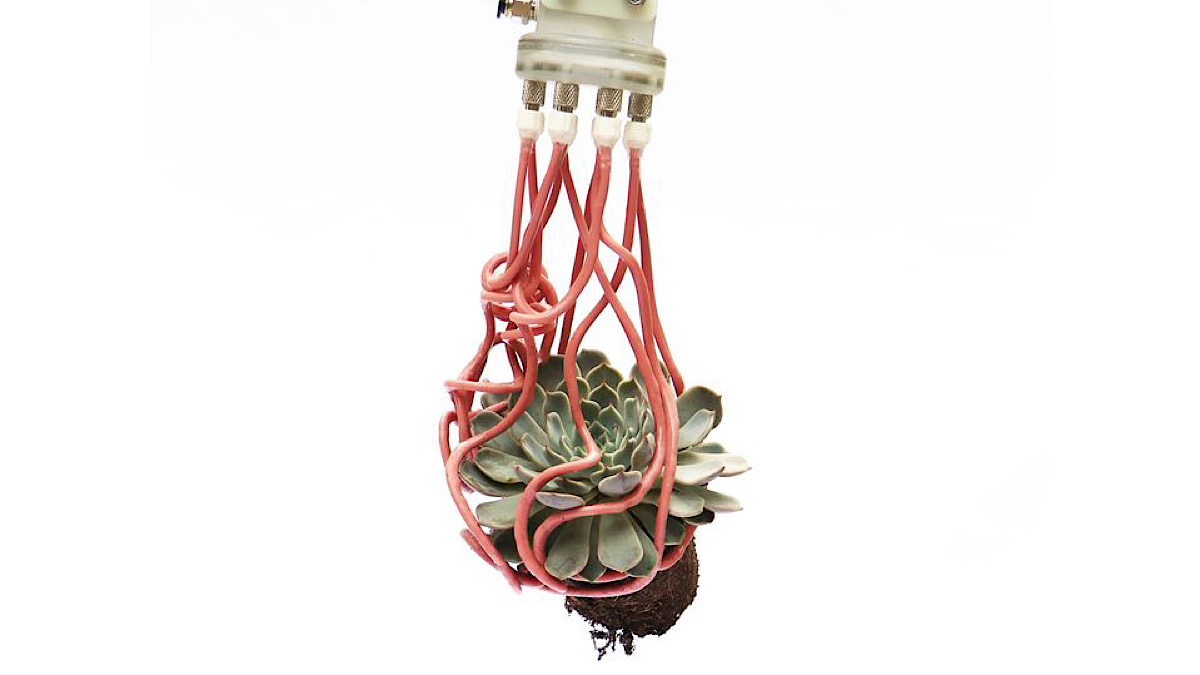
Soft gripper grasps succulent.

If you’ve ever played the claw game at an arcade, you know how hard it is to grab and hold onto objects using robotics grippers. Imagine how much more nerve-wracking that game would be if, instead of plush stuffed animals, you were trying to grab a fragile piece of endangered coral or a priceless artifact from a sunken ship. 

Most of today’s robotic grippers rely on embedded sensors, complex feedback loops, or advanced machine learning algorithms, combined with the skill of the operator, to grasp fragile or irregularly shaped objects. But researchers from the Harvard John A. Paulson School of Engineering and Applied Sciences (SEAS) have demonstrated an easier way.

Taking inspiration from nature, they designed a new type of soft, robotic gripper that uses a collection of thin tentacles to entangle and ensnare objects, similar to how jellyfish collect stunned prey. Alone, individual tentacles, or filaments, are weak. But together, the collection of filaments can grasp and securely hold heavy and oddly shaped objects. The gripper relies on simple inflation to wrap around objects and doesn’t require sensing, planning, or feedback control. 

Continue reading… “Jellyfish-Like Robot Can Carefully Grasp Fragile Objects”

10,000 Times Quicker: New Breakthrough Could Change the Field of Medical Microrobots

The breakthrough is expected to help improve the efficiency of regenerative medicine, such as stem cell delivery.

Scientists have developed a mass-production method for biodegradable microrobots that can dissolve into the body after delivering cells and medications.

In order to create a technology that can produce more than 100 microrobots per minute that can be disintegrated in the body, Professor Hongsoo Choi’s team at the Department of Robotics and Mechatronics Engineering at the Daegu Gyeongbuk Institute of Science & Technology (DGIST)worked with Professor Sung-Won Kim’s team at Seoul St. Mary’s Hospital, Catholic University of Korea, and Professor Bradley J. Nelson’s team at ETH Zurich.

There are many approaches to building microrobots with the goal of minimally invasive targeted precision treatment. The most popular of them is the ultra-fine 3D printing process known as the two-photon polymerization method, which triggers polymerization in synthetic resin by intersecting two lasers.

This technique has the ability to create structures with nanometer-level accuracy. The drawback is that it takes a lot of time to create a single microrobot since voxels, the pixels realized by 3D printing, must be successively cured. In addition, during the two-photon polymerization process, the magnetic nanoparticles in the robot may block the light path. When utilizing highly concentrated magnetic nanoparticles, the process result may not be uniform.

Continue reading… “10,000 Times Quicker: New Breakthrough Could Change the Field of Medical Microrobots”

A.I.-driven robots are cooking your dinner

Your next Friday night pizza may be made by robot hands.

BY STEPHANIE CAINE

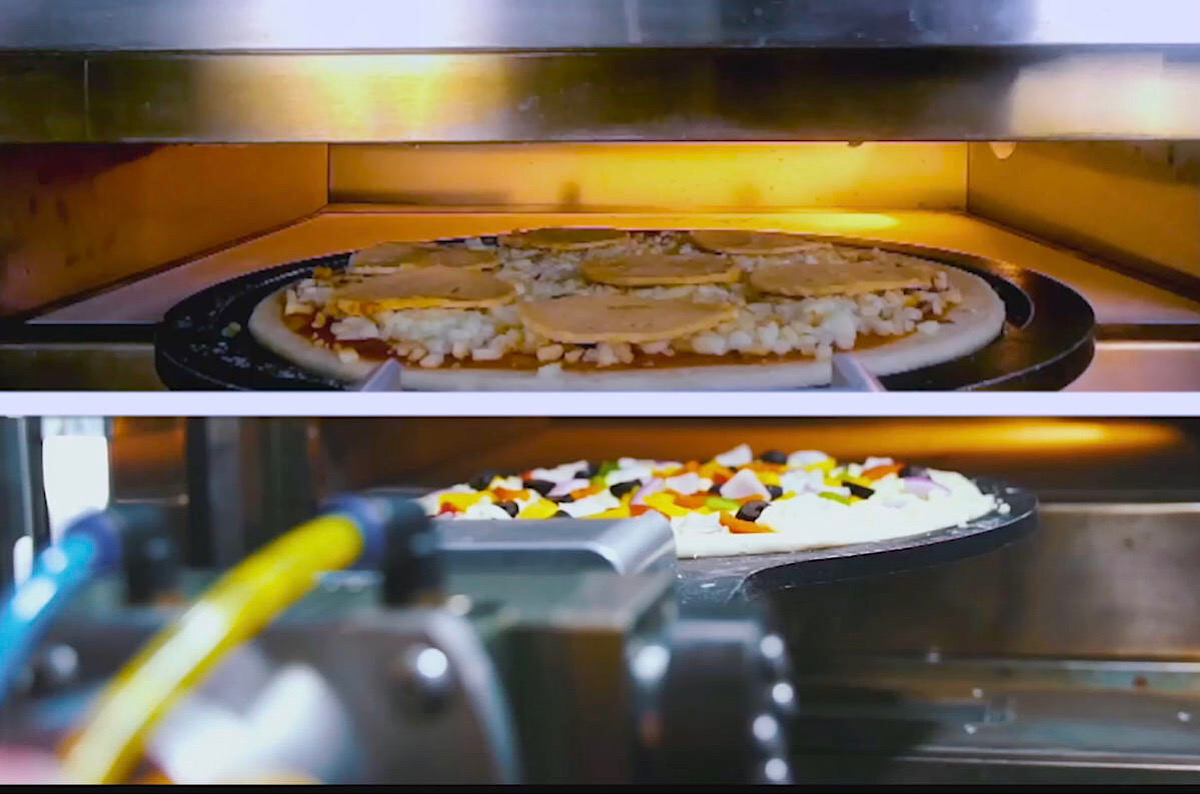
That’s the vision of Ajay Sunkara, who launched the Pizzaiola autonomous chef, an A.I.-driven, voice-controlled pizza maker that’s making its way to Chicago-based regional pizza chain, Slice Factory. The robotic chef monitors more than 1,200 parameters every microsecond, from managing food quality to the point-of-sales machine.

When a customer places a pizza order, Pizzaiola will select, press, and stretch the dough; add the sauce, cheese, and toppings; then cook, slice, and box the pizza all to the customer’s specified preferences. It’s fulfilled in real time and can even have an individual jumbo slice ready to go through the Slice Factory drive-thru in minutes.

Not a single human touch is involved.

“There are robotics in the food industry, but in factories, meat-processing centers, and packaged food processing,” Sunkara tells Fortune. “We reduced the scale of it from industrial to something that can fit in a normal commercial kitchen.”

Continue reading… “A.I.-driven robots are cooking your dinner”

How a fleet of robots could help solve the Great Lakes plastic pollution problem

A Seabin at work in one of the Great Lakes

By REBECCA REDELMEIER

Waste capture devices collect thousands of pieces of trash in the Great Lakes each day. Can they also motivate humans to stop putting waste in the water in the first place? 

In the murky waters of Lake Ontario just off the Toronto harbor, a stream of trash inches toward a round, tubular-looking device floating in the water. A piece of white styrofoam bumps up against the device’s lip. Then, in one fluid motion, it tumbles over the edge. With tendrils of marine plants circling the waste, it looks like the styrofoam could have entered a portal to an undersea world. Instead, the device is a gateway to a less mystical — yet vital — destination: the garbage dump.

“It’s basically like a floating trash can,” says Chelsea Rochman, professor of ecology and evolutionary biology at the University of Toronto, who has worked with a team at the university to capture trash in Lake Ontario with bins like these since 2019. Powered from shore, the device, called a Seabin, uses a motor to create a vortex that gently pulls in floating waste from a 160-foot radius and then stores the trash in an attached basket. 

Across the Great Lakes, which stretch from Duluth, Minnesota, to the border between the United States and Canada in northern New York, dozens of Seabins now work alongside stormwater filters in a cross-border project dubbed the Great Lakes Plastic Cleanup. In mid-September, they were also joined by aquatic waste-collection drones and beach-cleaning roving robots — all to remove some of the 22 million pounds of plastic that enter the lakes each year and help researchers like Rochman understand the Great Lakes waste problem.

People can’t remove waste 24 hours a day like the devices can

“We know that the amount of litter we have out there needs more power than the people power that we have,” Rochman explains. Though local groups have organized beach cleanups for decades, people can’t remove waste 24 hours a day like the devices can, nor can they pick up the tiny pieces that machines are able to capture.

Standing on the shore of Lake Ontario, with Toronto’s streetcars rattling by, Rochman points out the overflowing municipal trash bin along the sidewalk — one of several sources of the trash. Municipal sewage systems, industrial spills, stormwater runoff, recreational boating and beach waste, and agricultural debris all wind up in the lakes as well. In one bin, toothbrushes, tampon applicators, dental flossers, shoe strings, eyeglasses, food scraps, and syringes are entwined in the tendrils of marine plants. Between the leaves, tiny flecks of plastic poke out.

Continue reading… “How a fleet of robots could help solve the Great Lakes plastic pollution problem”

Israeli Robots To Dry-Clean Solar Panels In India

By Ariel Grossman

Israeli robots will clean solar panels in India under a new agreement.

Airtouch Solar will supply its autonomous and water-less cleaning robot to Avaada Group, India’s leading renewable energy supplier, for the next 25 years.

The robots use microfiber wipes and wind-blowing technology to remove dirt and soil from solar panels. The company’s software can also predict problems in advance and reduce failure rate.

According to the company, the robots will be able to save 80,000 to 100,000 kiloliters of water per megawatt of energy produced annually, in addition to revenue gains and faster cleaning.

Currently, 95 per cent of the solar panel market is operating without a robotic cleaning solution. The solar panel robotic cleaning industry is estimated to be worth $11 billion by the year 2025. 

Continue reading…Israeli Robots To Dry-Clean Solar Panels In India

Elon Musk Says His A.I. Robot Will Pave The Way to ‘A Future of Abundance’

At Tesla’s A.I. Day, Musk claimed that his robots will be able to handle a wide variety of tasks.

BY BEN SHERRY

Elon Musk gave the world a first look at Optimus, the company’s A.I.-powered “humanoid” robot, at Tesla’s second-annual A.I. Day event last week. Unlike a Tesla car, the robot was slow–very slow.

Emerging from behind a video screen, the robot, this prototype model referred to as “Bumble C,” stiltedly made its way across the stage, waved to the audience, and did a short “raise-the-roof” motion with its arms before shuffling back offstage. Unlike the proposed version shown off at the 2021 A.I. Day event, which Musk admitted was just a man in a costume, the prototype was clearly a work-in-progress, with exposed wires and blinking hardware. But Musk hinted that Tesla’s team had barely scratched the surface of the robot’s potential.

“The robot can do a lot more than what we just showed you, we just didn’t want it to fall on its face,” said Musk, who added that the demonstration was the first time that Bumble C had walked without being tethered to anything, such as a crane or external power source.

Continue reading… “Elon Musk Says His A.I. Robot Will Pave The Way to ‘A Future of Abundance’”

Chipotle is moving its tortilla robot to a real restaurant | Engadget

Chipotle’s tortilla-making robot will soon help out in a restaurant you can visit. The chain has unveiled a slew of technology updates that include moving the Miso Robotics-made Chippy robot to a real restaurant. The machine will start cooking tortilla chips in a Fountain Valley, California location in October. Feedback from customers and workers will help the company decide on a national rollout.

Artificial intelligence will influence some human cooks, too. Chipotle is piloting a demand-based cooking system that uses AI to tell staff what and when to cook based on forecasts for how much they’ll need. In theory, this lightens the load for employees while making sure there’s enough freshly-cooked tacos and burritos when you show up for dinner. The pilot is underway at eight Orange County, California restaurants.

Continue reading… “Chipotle is moving its tortilla robot to a real restaurant | Engadget”

Prime picking! New Amazon warehouse robot can handle ONE THOUSAND items per hour using ‘pinch-grasp’ technology to mimic human workers

By CHRISTOPHER CARBONE

Amazon’s new pinch-grasping robot can handle and stow 1,000 items per hour, which is significantly faster than human workers 

The prototype uses cameras, algorithms and machine learning to mimic how human hands grasp items of varying sizes and shapes

A video posted to the retail giant’s science blog showed the machine moving 19 items of varying size and shape in one minute 

‘We’re able to identify a specific item in the scene and use machine learning to know how best to pick it up and to move it quickly and without damage’

A new ‘pinch-grasping’ robot system unveiled by Amazon shows the machine deftly grabbing and stowing a wide range of items – moving at a rate of 1,000 items per hour, which is far faster than a human worker could.

Although humans don’t spend much time figuring out how to grasp a bottle from the back of the fridge that might fall and break open, teaching a robot to deal with cluttered spaces, locate a wide range of items and deftly move them is a challenge for the retail giant’s robotics division.

In a video posted to Amazon’s science blog, the robot prototype can be seen using its finger-like pinchers to move and stow 19 items – including small bags, a broom, a spice container and a small box – in 60 seconds. 

Continue reading… “Prime picking! New Amazon warehouse robot can handle ONE THOUSAND items per hour using ‘pinch-grasp’ technology to mimic human workers”
Discover the Hidden Patterns of Tomorrow with Futurist Thomas Frey
Unlock Your Potential, Ignite Your Success.

By delving into the futuring techniques of Futurist Thomas Frey, you’ll embark on an enlightening journey.

Learn More about this exciting program.