Oh, The Robots You’ll Meet! A Dr. Seuss Vision of Tomorrow

By Futurist Thomas Frey

A Creative Epiphany on Mt. Soledad

My wife and I recently spent a few days in La Jolla, California, exploring the stunning coastline and wandering through neighborhoods that once inspired some of America’s most imaginative minds. Nearby sits Mt. Soledad, where Dr. Seuss—Theodor Geisel himself—lived and created his whimsical worlds of Whos and Things and impossible creatures doing impossible things.

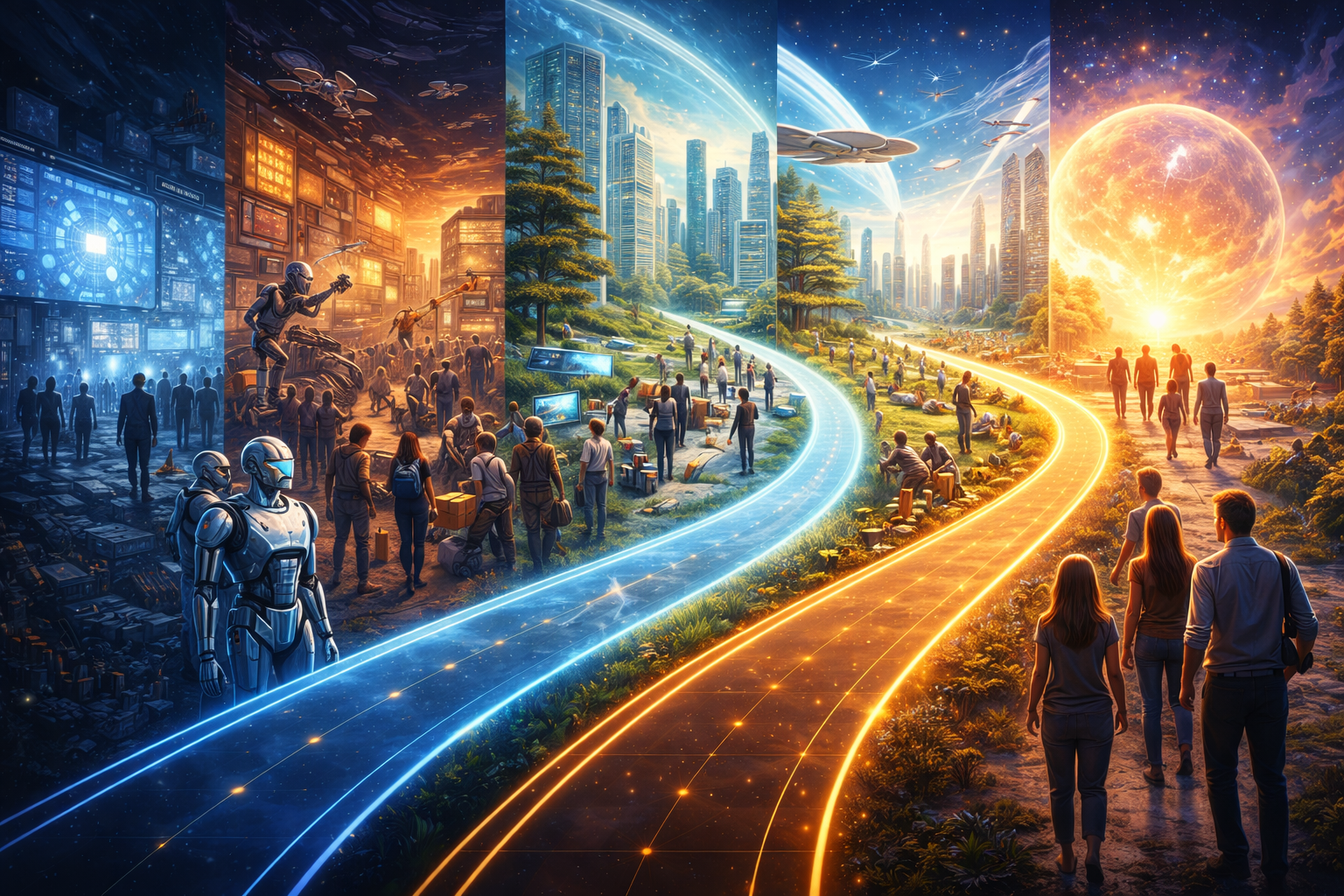
Standing there, looking out at the Pacific Ocean with the creative energy of that place washing over me, I found myself thinking: How would Dr. Seuss describe the transition we’re living through right now? The arrival of AI, robots, drones, and driverless cars isn’t science fiction anymore—it’s our daily reality, arriving faster than most people can process. We need a way to talk about this transformation that captures both the wonder and the strangeness, the opportunity and the adjustment. And what better voice than the man who taught generations of children that change, however peculiar, can be an adventure?

So here, inspired by the creative spirit of La Jolla and Mt. Soledad, is how I imagine Dr. Seuss might help us understand the magnificent, bewildering, robotic future we’re building together.

Continue reading… “Oh, The Robots You’ll Meet! A Dr. Seuss Vision of Tomorrow”

Is AI Humanity’s Greatest Invention? Ranking Non-Human Intelligence Against History’s Transformative Breakthroughs

By Futurist Thomas Frey

Every few centuries, humanity invents something so transformative that it fundamentally alters the trajectory of civilization. The printing press didn’t just make books cheaper—it democratized knowledge, enabled the Reformation, sparked the Scientific Revolution, and created the foundation for modern democracy. The airplane didn’t just make travel faster—it compressed the world, enabled global trade at unprecedented scale, and changed warfare forever. The lightbulb didn’t just illuminate darkness—it extended productive hours, enabled 24/7 civilization, and powered the electrification of everything.

Now we’re creating artificial intelligence—non-human intelligence capable of reasoning, learning, creating, and potentially exceeding human cognitive capabilities. The question isn’t whether AI is important. The question is whether it ranks among history’s truly transformative inventions—the ones that divided human civilization into “before” and “after.”

I think it does. In fact, I think AI might be the most significant invention in human history. Here’s why—and why that should terrify and excite us in equal measure.

Continue reading… “Is AI Humanity’s Greatest Invention? Ranking Non-Human Intelligence Against History’s Transformative Breakthroughs”

The Global Robotics Integration Program: One Billion Robots Joining Human Society by 2040

By Futurist Thomas Frey

By 2035, Japan will have more citizens over 65 than under 18. Germany’s workforce will have shrunk by 15 million people. China will face a demographic cliff with too few young workers supporting too many retirees. Across the developed world, the same crisis looms: not enough humans to care for the elderly, staff hospitals, deliver goods, or teach the next generation.

The Global Robotics Integration Program is humanity’s response—a $3 trillion megaproject to deploy one billion humanoid and autonomous robots across healthcare, logistics, and education sectors by 2040, all connected through an international “Robot Internet” that enables coordination, learning, and continuous improvement.

This isn’t replacing humans. It’s augmenting human civilization with machine partners designed to work alongside us, handle tasks humans can’t or won’t do, and prevent societal collapse as demographics invert. By 2040, human-robot co-societies won’t be science fiction—they’ll be how civilization functions.

Continue reading… “The Global Robotics Integration Program: One Billion Robots Joining Human Society by 2040”

From Designer Babies to Super Humans: How AI and Robotics Are Rewriting Human Evolution

By Futurist Thomas Frey

When I first wrote about designer babies and genetic enhancement in 2012, the technology was theoretical and the ethics were abstract. CRISPR hadn’t revolutionized gene editing yet. AI couldn’t design proteins. Robots couldn’t perform microsurgery with superhuman precision.

Now, in 2025, everything has changed. The conversation isn’t about whether we can enhance humans—it’s about which enhancements are already happening, which are coming next, and whether we can stop the process even if we wanted to.

But the real story isn’t just genetic engineering anymore. It’s the convergence of AI, robotics, genetic modification, and brain-computer interfaces creating enhancement possibilities that make “designer babies” look quaint. We’re not just designing better humans—we’re redesigning what “human” means.

Continue reading… “From Designer Babies to Super Humans: How AI and Robotics Are Rewriting Human Evolution”

Space-Based Solar Power: The $1 Trillion Bet on Beaming Energy from Orbit

By Futurist Thomas Frey

Imagine solar panels the size of Manhattan floating 22,000 miles above Earth, collecting sunlight 24/7 without clouds, night, or atmospheric interference—then beaming that power wirelessly down to receiving stations that feed it directly into the grid.

It sounds like science fiction. It’s not. Multiple countries and companies are investing billions in space-based solar power (SBSP), and the first demonstration systems could be operational by 2030.

This might be the most ambitious energy project in human history. It could also be the most expensive boondoggle. Let’s break down whether beaming power from space is revolutionary genius or catastrophic folly.

Continue reading… “Space-Based Solar Power: The $1 Trillion Bet on Beaming Energy from Orbit”

The Futurist’s Dilemma: When AI Can Predict the Future Faster Than You Can

By Futurist Thomas Frey

In 2012, I wrote about the eight critical value points of being a futurist. I explained how futurists provide unique value through pattern recognition, trend analysis, cross-disciplinary synthesis, and the ability to see connections others miss. It took years to develop these skills. They were rare, valuable, and in demand.

Now, in 2025, I can ask Claude or ChatGPT to analyze emerging trends, identify patterns across disparate domains, and generate plausible future scenarios—and get sophisticated answers in seconds rather than the weeks it would take me to research and synthesize the same information.

This isn’t just humbling. It’s existential. If AI can do in seconds what took me decades to learn, what’s the value of being a futurist anymore?

And here’s the uncomfortable truth: I’m not alone. Almost every knowledge profession is facing the same reckoning.

Continue reading… “The Futurist’s Dilemma: When AI Can Predict the Future Faster Than You Can”

The Evolution of Robots: When the Lines Between Human and Machine Disappear Completely

By Futurist Thomas Frey

We’re approaching a threshold that will fundamentally change what it means to be human. Not because robots are becoming more human-like—though they are—but because humans are becoming more machine-like, and the distinction between the two is evaporating faster than anyone predicted.

When I first wrote about the blurring lines between people and machines, humanoid robots were clumsy prototypes and brain-computer interfaces were experimental medical devices. That was then. Now we’re watching those lines dissolve in real-time, and the implications are staggering.

Continue reading… “The Evolution of Robots: When the Lines Between Human and Machine Disappear Completely”

The Megaproject Explosion: Why AI and Robotics Will Enable Humanity’s Grandest Ambitions

By Futurist Thomas Frey

Something remarkable is happening to human ambition. For the first time in history, we’re approaching a moment where the limiting factor on what we can accomplish isn’t capability—it’s imagination.

Over the coming years, AI and robotics, along with other exponential technologies, will enable a single person to accomplish more during their lifetime than entire civilizations could achieve a century ago. And as individual capability explodes, our collective sights are shifting toward megaprojects—huge, massive, grandiose undertakings that would have seemed impossible just years ago.

The numbers tell the story. In my original analysis, I predicted megaprojects would reach 24% of global GDP within a decade. That was before generative AI, before humanoid robots reached commercial viability, before we fully understood how rapidly these technologies would compound. Now? That estimate looks conservative.

Continue reading… “The Megaproject Explosion: Why AI and Robotics Will Enable Humanity’s Grandest Ambitions”

The Revenge of Gen Z: Why the Most Debt-Saddled Generation is Betting Everything on AI

By Futurist Thomas Frey

Nobody intended to pick on Gen Z. But somewhere between the financial crisis of 2008, the student debt explosion, the housing market becoming a speculative casino, and a pandemic that stole their early twenties, an entire generation got handed a bill they didn’t order.

Now they’re done asking nicely for change. They’re building it themselves, and their weapon of choice is artificial intelligence.

Continue reading… “The Revenge of Gen Z: Why the Most Debt-Saddled Generation is Betting Everything on AI”

The New Normal: Three Lives, Three Different Perspectives, in 2040

By Futurist Thomas Frey

What does everyday life actually look like in 2040? Not the breathless tech announcements about Mars settlements or the philosophical debates about brain-computer interfaces, but the grinding, beautiful, mundane reality of paying bills, raising kids, navigating relationships, advancing careers, and trying to build a meaningful life in a world that’s been fundamentally transformed by technologies that are barely prototypes today.

When we think about the future, we tend to focus on the spectacular—the moon colonies, the flying cars, the medical miracles. But the real future is lived in the spaces between those headlines: the morning commute (or lack thereof), the career anxieties that keep you awake at 3 AM, the vacation you save for all year, the healthcare decisions that determine your quality of life, the housing costs that dominate your budget, the relationships you struggle to maintain despite infinite connectivity, the retirement planning that spans decades you’re not certain you’ll live to see.

Continue reading… “The New Normal: Three Lives, Three Different Perspectives, in 2040”

The AGI Problem: Why We Can’t Define It, Test It, or Agree on Its Dangers

By Futurist Thomas Frey

We’re having intense debates about Artificial General Intelligence—whether it’s coming, when it will arrive, what dangers it poses—without agreeing on what AGI actually is or how we’d recognize it if we built it.

This isn’t a minor definitional quibble. It’s a fundamental problem that makes most AGI discussions incoherent. We’re arguing about the risks and timelines of something we can’t define, using tests that don’t exist, evaluated by authorities nobody has appointed.

Continue reading… “The AGI Problem: Why We Can’t Define It, Test It, or Agree on Its Dangers”

AI Roadside Guardians: How Australia’s LAARMA Tech Could End the Era of Roadkill

Every year, highways become killing fields—not just for humans, but for the animals whose habitats those highways slice apart. Fences can block some crossings, but they’re expensive, high-maintenance, and often just push the problem elsewhere. Now, Australian researchers believe they’ve found a smarter, faster, and more adaptable answer: AI that sees animals before you do—and warns you in real time.

Meet LAARMA—the Large Animal Activated Roadside Monitoring and Alert system. It’s an open-source, self-learning AI platform that uses sensors to detect large animals up to 200 meters away, in any weather, day or night. When a detection is made, roadside signs instantly flash a tailored warning to drivers, naming the animal and signaling urgency. The result? In a recent five-month trial in cassowary country, drivers slowed down by as much as 10%, with the system correctly spotting the birds 97% of the time.

Continue reading… “AI Roadside Guardians: How Australia’s LAARMA Tech Could End the Era of Roadkill”
Discover the Hidden Patterns of Tomorrow with Futurist Thomas Frey
Unlock Your Potential, Ignite Your Success.

By delving into the futuring techniques of Futurist Thomas Frey, you’ll embark on an enlightening journey.

Learn More about this exciting program.