Eight billion fasteners a year—every one a hole. Magnetic cement replaces them, turning walls into attachment surfaces without damage or hardware.
By Futurist Thomas Frey
Eight billion pounds. That’s the estimated weight of nails, screws, anchors, and wall fasteners consumed by the global construction industry every single year. Each one punches a hole. Each one leaves a mark. Each one represents a method of attaching things to walls that hasn’t fundamentally changed since the Roman Empire was mixing volcanic ash with lime.
A 29-year-old industrial engineering student from Argentina named Marco Agustín Secchi thinks that’s about to change. And the material he’s developed is so elegantly simple that the hardest part is convincing people it’s real.
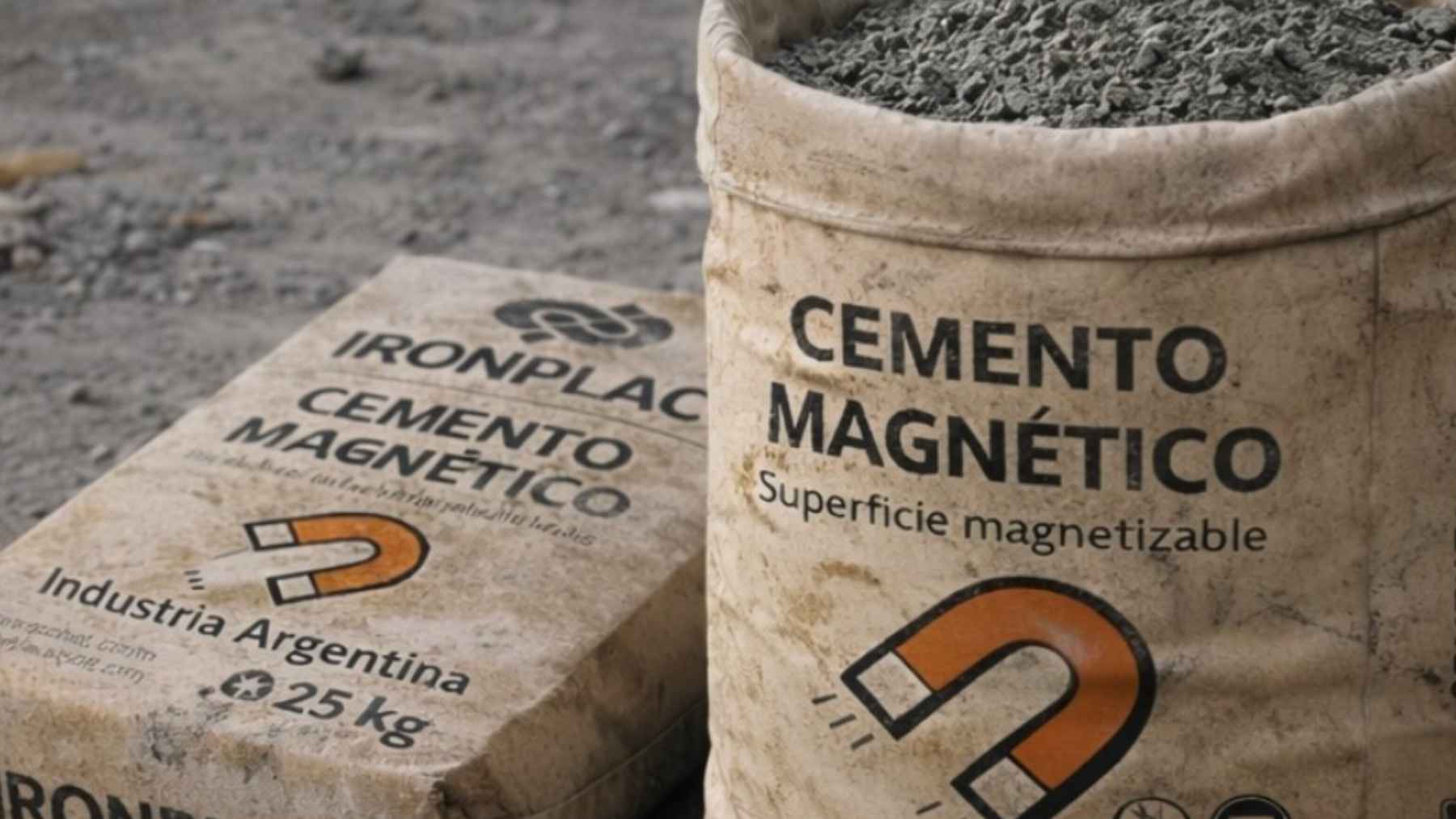
He calls it Ironplac. It’s magnetic cement. And the idea is exactly what it sounds like.
What It Actually Is
Let’s be precise, because the first instinct when you hear “magnetic wall” is to picture something out of a science fiction film — a wall that actively pulls at everything metallic, phones flying across the room, keys clinging to the living room wall.
That’s not what this is.
Ironplac is a passive, magnetizable surface material. It’s mixed with mineral and ferrous fillers — iron-based particles embedded in a cement or plaster-like compound — that give the finished surface the ability to hold objects backed by magnets. The wall itself doesn’t generate a magnetic field. It doesn’t need electricity. It doesn’t interfere with electronic devices. It just responds when you bring a magnet close to it, the same way a refrigerator door responds to a fridge magnet but doesn’t otherwise attract your keys from across the kitchen.
The application process is almost insultingly normal. Ironplac comes in standard 25-kilogram bags. For wet construction, you mix it with water and apply it like a conventional finishing coat, using the same trowels any plasterer already owns. For dry construction systems — the panel-based interior walls common in modern renovation — it integrates into existing board systems. No special training. No exotic equipment. No workflow disruption.
After curing, any object equipped with a strong magnet on the back — frames, tools, kitchen utensils, shelving brackets, decorative panels — can be stuck to the wall, repositioned, and removed without drilling a single hole or leaving a single mark. In demos, Secchi has shown Ironplac walls holding kitchen knives, full sets of tools, decorative panels, and — in one demonstration that tends to get people’s attention — a full-sized shovel, all held by magnet-backed attachments rather than hardware.
The material is still in development. It isn’t commercially available yet. Secchi is pursuing international patents and seeking industrial partnerships to scale production. But the underlying science is real, the demos are real, and the problem it solves is one that nearly every person who has ever rented an apartment, renovated a kitchen, or tried to hang a picture frame on a Sunday afternoon understands immediately and personally.
Why This Matters More Than It Looks
The construction industry generates roughly $13 trillion in annual revenue globally. It accounts for 37% of operational energy and process-related CO2 emissions. And despite all of that scale, its productivity growth has averaged about 1% per year for the past two decades — less than virtually any other major industry on Earth.
Part of the reason for that stagnation is that the construction industry is exceptionally resistant to new materials. A product that doesn’t fit existing workflows doesn’t get adopted, no matter how clever it is. The graveyard of construction innovations is full of genuinely good ideas that failed because they required builders to change how they worked.
Ironplac’s most strategically important feature isn’t the magnetism. It’s the bags. Standard 25-kilogram bags, mixed with water, applied with normal tools, dried and painted over like any other finish. It fits the workflow that already exists. That’s how construction innovations actually get adopted.
The science backing the approach is also more established than the “young inventor” framing might suggest. A 2026 paper from researchers at the University of Guilan and Adelaide University examined cementitious composites made with magnetic sand and magnetite powder, confirming measurable ferromagnetic properties in cement-based materials and exploring applications including wireless power transfer and magnetic sensing. Research into magnetic cement composites using magnetite nanoparticles has been ongoing for more than a decade, primarily aimed at infrastructure and structural engineering applications. What Secchi has done is take that materials science and point it at the most universal frustration in construction: the hole in the wall.

The Normal Uses That Will Drive Adoption
The residential market is the obvious entry point. Anyone who has rented a home — and renter populations are growing in nearly every major city globally — knows the specific anxiety of lease-end inspection: every hole, every anchor, every patch job that didn’t quite match the paint. Ironplac eliminates that problem entirely. Renters could mount shelving, hang artwork, install kitchen tool rails, and configure their living spaces with the same freedom homeowners have — and then remove everything when they leave without leaving a trace.
The commercial interior market is arguably larger. Office spaces, retail environments, classrooms, hotels, restaurants — any space that needs to configure and reconfigure its walls regularly, that hosts rotating exhibitions or seasonal displays or frequently updated signage, would benefit enormously from a wall surface that accepts and releases mounted objects without requiring a maintenance crew every time something moves.
Kitchens are a particularly natural fit. The magnetic knife strip, the tool rail, the spice rack — all of these currently require installation hardware. With magnetic walls, any surface in the kitchen can hold magnetically backed storage with no fixed commitment. Move the knife strip to a different wall because the workflow changed. Pull the spice rack down and take it with you when you move. The kitchen becomes as reconfigurable as furniture.
Schools and educational environments have been early adopters of magnetic wall surfaces in other forms — magnetic paint exists and has been on the market for years, though with limited strength. Ironplac, applied as a full finish coat rather than a painted-on thin layer, would deliver substantially stronger holding power, enough for heavier educational displays, projection screens, and modular classroom furniture systems that attach to walls.
The Exotic Uses Nobody’s Talking About Yet
This is where it gets more interesting.
Research published in Nature Scientific Reports demonstrated that embedding iron-based magnetic particles in cement significantly improves the bandwidth and signal performance of antennas embedded in the concrete. Buildings with magnetic cement walls could become passive antenna substrates — supporting embedded wireless sensors, IoT device networks, and communication systems without requiring retrofitted hardware. The wall becomes infrastructure.
Electromagnetic shielding is another documented property of magnetite-enhanced cement composites. Buildings or rooms constructed with magnetized cement could provide measurable electromagnetic shielding, reducing RF interference and signal leakage. That has applications in data centers, medical facilities with sensitive diagnostic equipment, secure government installations, and anywhere electromagnetic cleanliness matters.
Magnetic cement has been studied for its ability to enable inductive heating of surfaces — airport runways and pavements embedded with magnetic layers that can be heated inductively to melt ice and snow without chemicals or mechanical intervention. Research from 2025 showed that a one-centimeter soft magnetic layer in airport pavement can increase inductive heating efficiency by nearly 59%. Roads, bridges, walkways, and building exteriors treated with magnetic cement could be deiced remotely, without salt, without plows, without the infrastructure damage that freeze-thaw cycling and chemical deicers cause every winter.
Structural health monitoring is a field where magnetic cement opens interesting doors. As magnetic particles in cement respond to stress and deformation, embedded sensor systems could detect microfractures, load changes, and structural anomalies in real time. Buildings and bridges that report on their own structural condition, without requiring access for manual inspection, are already a goal of civil engineering research. Magnetic cement composites bring that capability closer.
Modular construction and building systems stand to benefit from magnetic cement at a larger scale than individual fasteners. Prefabricated wall panels, ceiling tiles, and floor sections that attach to structural substrates magnetically — repositionable, recyclable, reconfigurable — represent a fundamentally different approach to building interiors. Spaces that can be reorganized without tools, that adapt to new uses without renovation, that leave no permanent trace when a building is repurposed.
How This Changes the Home Improvement Industry
The home improvement industry in the United States alone generates over $500 billion in annual revenue. A substantial portion of that — tools, hardware, patching compounds, paint, professional repair services — exists specifically to manage the damage that conventional wall mounting causes and the costs of undoing it.
Ironplac, at scale, compresses that market. Not the fun part of home improvement — the designing, the decorating, the upgrading. The damage-management part. The repair and patch cycle that currently generates enormous amounts of waste, cost, and carbon.
Consider what disappears from the home improvement equation when walls don’t need holes. The market for plastic wall anchors, toggle bolts, drywall screws, and the companion market for spackling compound, sandpaper, and touch-up paint — all of it exists because we drill into walls as a matter of course. In a world where walls accept magnet-backed attachments, most of that market either shrinks dramatically or transforms into a market for magnetic mounting accessories.
The renovation cycle shortens. One of the primary drivers of interior renovation spending is accumulated wall damage — walls that have been drilled, patched, and repainted so many times that the surface is no longer worth preserving. Magnetic walls, maintained as intact surfaces, could extend the functional life of interior finishes significantly, reducing both renovation frequency and the construction waste that renovation generates.
At the same time, an entirely new product ecosystem opens up: magnetic-backed versions of everything that currently requires wall mounting. Picture frames with magnetic backing plates. Shelving systems that attach without brackets. Modular pegboard organizers that can be repositioned anywhere on the wall without new hardware. Magnetic wiring tracks that hold electrical components against the wall without conduit. The accessories industry that currently serves the hole-drilling ecosystem will transform into an accessories industry serving the magnetic attachment ecosystem.
The rental housing market would be particularly transformed. Landlords currently spend significant money repairing wall damage between tenancies — spackle, paint, the ongoing cost of maintaining surfaces that are regularly destroyed and restored. Ironplac-finished apartments eliminate most of that maintenance burden while simultaneously making the apartments more attractive to renters who value flexibility.
The Limitations Worth Naming
Ironplac is not commercially available yet. The path from compelling demos to full commercial deployment involves load-rating certification — reliable published data on exactly how much weight a given magnetic surface can hold under various conditions, with appropriate safety margins — and durability testing over time. Magnetic particles in cement composites can be affected by heat, humidity cycling, and mechanical stress in ways that need to be fully characterized before the material goes into mainstream construction.
The magnet strength required grows with the weight of the object being held. Strong neodymium magnets can hold considerable weight, but the attachment accessories themselves add cost and complexity to what is currently a very simple process — find a stud, drive a screw, hang the thing. The economics of magnetic attachment need to be genuinely competitive with conventional hardware for adoption to scale beyond premium applications.
There are also questions about end-of-life. Cement is already difficult to recycle cleanly. Iron-laden cement adds complexity to demolition and material recovery. These are solvable problems but not yet solved ones.
The Bigger Picture
What Marco Secchi has done — regardless of what ultimately happens with Ironplac specifically — is demonstrate that one of the most fundamental assumptions in construction is negotiable. The assumption that walls are passive surfaces that require permanent damage to serve as mounting points is not a law of physics. It’s just how we’ve always done it.
That reframing matters. Because once you stop treating wall penetration as the default and start treating it as a choice, a whole set of downstream assumptions about renovation cycles, rental agreements, construction waste, and building flexibility become negotiable too.
The construction industry’s $13 trillion doesn’t move fast. But it does move. And it tends to move when someone finds a way to make a genuinely better solution fit seamlessly into the workflow that already exists.
A standard bag. Mixed with water. Applied with a normal trowel.
That’s the packaging for a potentially significant idea.
Related Reading
Smart Materials in Construction: The Case for Functional Cement
Construction and Building Materials — Peer-reviewed research on the properties of cement composites enhanced with magnetic particles, documenting the measurable ferromagnetic and structural properties that underlie materials like Ironplac
The Productivity Crisis in Construction — and What Could Fix It
McKinsey Global Institute — Why construction has lagged every other major industry in productivity growth for decades, and which categories of innovation are most likely to move the needle
The Future of Interior Space: Adaptive, Reconfigurable, Zero-Waste
Brookings Institution — How emerging construction materials and modular building systems are redefining the relationship between built spaces and the people who use them — and what the sustainability implications are for reducing renovation-driven waste