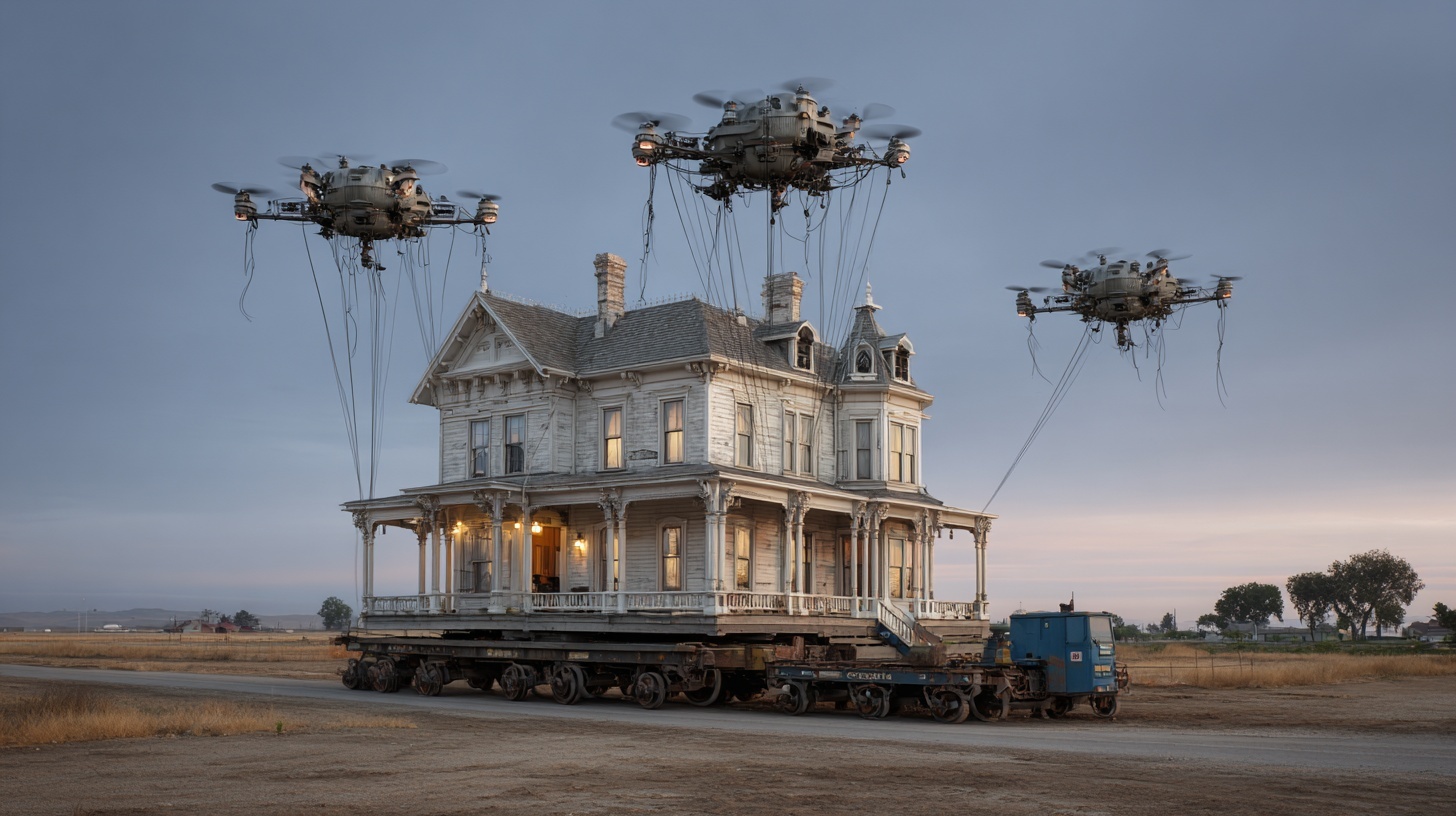
From rolling houses to flying them—heavy-lift drones could transform relocation,
turning days of logistics into coordinated lift, transport, and precise placement.
By Futurist Thomas Frey
House moving is one of the oldest and most peculiar industries in America.
Since the mid-1800s, entire buildings have been lifted off their foundations, placed on wheels, and rolled down the street to a new location. It’s slow, expensive, logistically nightmarish, and requires the temporary removal of every utility line and tree branch in the path. And yet it happens thousands of times a year — because sometimes a building is worth more than the cost of moving it.
Now imagine the same outcome without the wheels, the blocking, the utility crews, or the road permits.
Just a formation of heavy-lift drones, coordinated by a single control system, that lifts a structure off its foundation, carries it through the air at low altitude, and sets it down precisely where you want it.
That’s not science fiction. It’s the logical endpoint of a technology trajectory that is already well underway — and the implications extend far beyond moving houses.
How Big Are These Things?
The gap between “drone” as most people imagine it and what industrial heavy-lift systems actually look like today is substantial, so let’s start there.
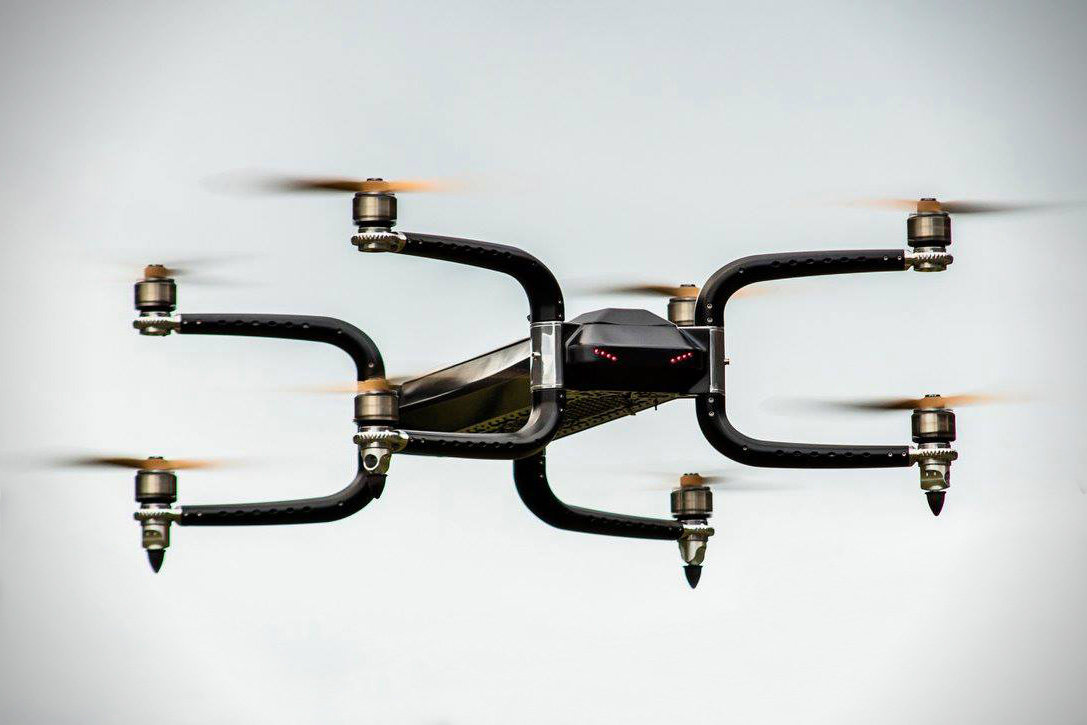
The largest commercially available heavy-lift drone right now is the Griff Aviation 300, built by a Norwegian company whose CEO spent twenty years in professional aerial cinematography before deciding the world needed something considerably more powerful. The Griff 300 is an eight-rotor octocopter with an airframe roughly eight feet across. It weighs 165 pounds on its own and can lift 500 pounds of payload — three times its own weight — for up to 45 minutes. It has EASA and FAA certification, runs on high-density lithium polymer batteries, and costs upward of $250,000. Griff has already announced the next model: the Griff 800, capable of lifting 1,764 pounds. After that, they plan to keep going.
AIR, an Israeli-American startup that has received FAA airworthiness certification and begun US flight operations in Florida, completed the first flight of its Production AIR Cargo-Heavy platform just this week — an uncrewed eVTOL that lifted 550 pounds, which the company is calling one of the world’s largest unmanned electric vertical takeoff and landing platforms. They already have dozens of orders.
DJI’s FlyCart 30 — the commercial workhorse — handles 66 pounds and is available for around $16,000. Built for logistics, it’s already being used for island supply runs, mountain rescue operations, and emergency medical delivery across several countries.
The JOUAV CW-80E, a hybrid VTOL platform, carries 110 pounds over ranges exceeding 300 miles and can fly for up to eight hours — numbers that make it less of a drone and more of an unmanned cargo aircraft.
And then there’s DARPA, which launched the Lift Challenge in late 2025 with $6.5 million in prize money, specifically seeking novel drone designs that can carry payloads more than four times their own weight. DARPA’s current best-case benchmark for commercial drones is roughly 1:1. Their target is 4:1. If someone wins that challenge, the entire payload calculus changes.
The Swarm Solution
Here’s the thing about moving a house. Even a modest wood-frame residential structure weighs between 50,000 and 150,000 pounds. No single drone on the current market, or on any drawing board, lifts that. The Griff 800 tops out at under a ton.
The answer isn’t a bigger drone. It’s more drones working together.
Georgia Tech researchers have developed adaptive control algorithms that allow teams of small drones to collaboratively lift heavy objects under centralized coordination. The system monitors each drone’s position and thrust output in real time, coordinates navigation commands across the swarm, and handles the dynamic load redistribution that happens when any individual unit adjusts its flight — or fails entirely. If one drone drops out, the others compensate automatically.
Researchers at Imperial College London and EMPA in Switzerland took a different but parallel approach, developing drone swarms that work together on construction tasks in ways directly inspired by how bees build hives. The individual units are modest. The collective is not.
Scale this concept up — take 200 heavy-lift drones, each capable of carrying 500 pounds, coordinated by a single autonomous control system with centimeter-level positioning precision — and the math starts to work. A coordinated swarm of that scale could theoretically lift 100,000 pounds. Enough for a modest residential structure. Enough, with larger swarms, for considerably more.
The engineering challenges are real. Maintaining synchronized lift across hundreds of rotors, managing rotor wash interference between units flying in close formation, handling the structural flex of a building not designed to be suspended from hundreds of points simultaneously — none of these are trivial. But none of them are theoretically impossible either. They’re engineering problems, not physics problems.
Who Is Developing This
The pure house-moving application doesn’t have a dedicated company yet. What exists is a rapidly maturing ecosystem of heavy-lift capability being developed for adjacent applications that converge on this one.
Griff Aviation, based in Norway, is the current leader in commercially certified extreme payload capacity and is pushing steadily toward the Griff 800 and beyond. Parallel Flight Technologies in the US is developing hybrid-powered heavy-lift drones — combining gas engines with electric motors to solve the battery endurance problem — and their Firefly platform can carry over 100 pounds for extended periods, designed initially for wildfire suppression.
Boeing, Lockheed Martin, and Bell are all developing or funding unmanned heavy-lift platforms for military logistics applications — the Pentagon is deeply interested in resupply missions that don’t require manned helicopters in contested environments.
Volocopter and Lilium are approaching the problem from the passenger air taxi side, with platforms designed to carry people that are structurally similar to what would be needed for heavy cargo.
The Chinese company EHang has already received type certification for its passenger-carrying EH216-S from the Civil Aviation Administration of China — a drone that carries two people — and is pushing toward larger platforms.
And the swarm coordination problem is being actively worked on by research teams at Georgia Tech, MIT, ETH Zurich, and several defense contractors who see obvious military logistics applications in the ability to move heavy objects without a pilot.
Who Is Actually Using Heavy-Lift Drones Today
Right now, the real commercial users are in three categories.
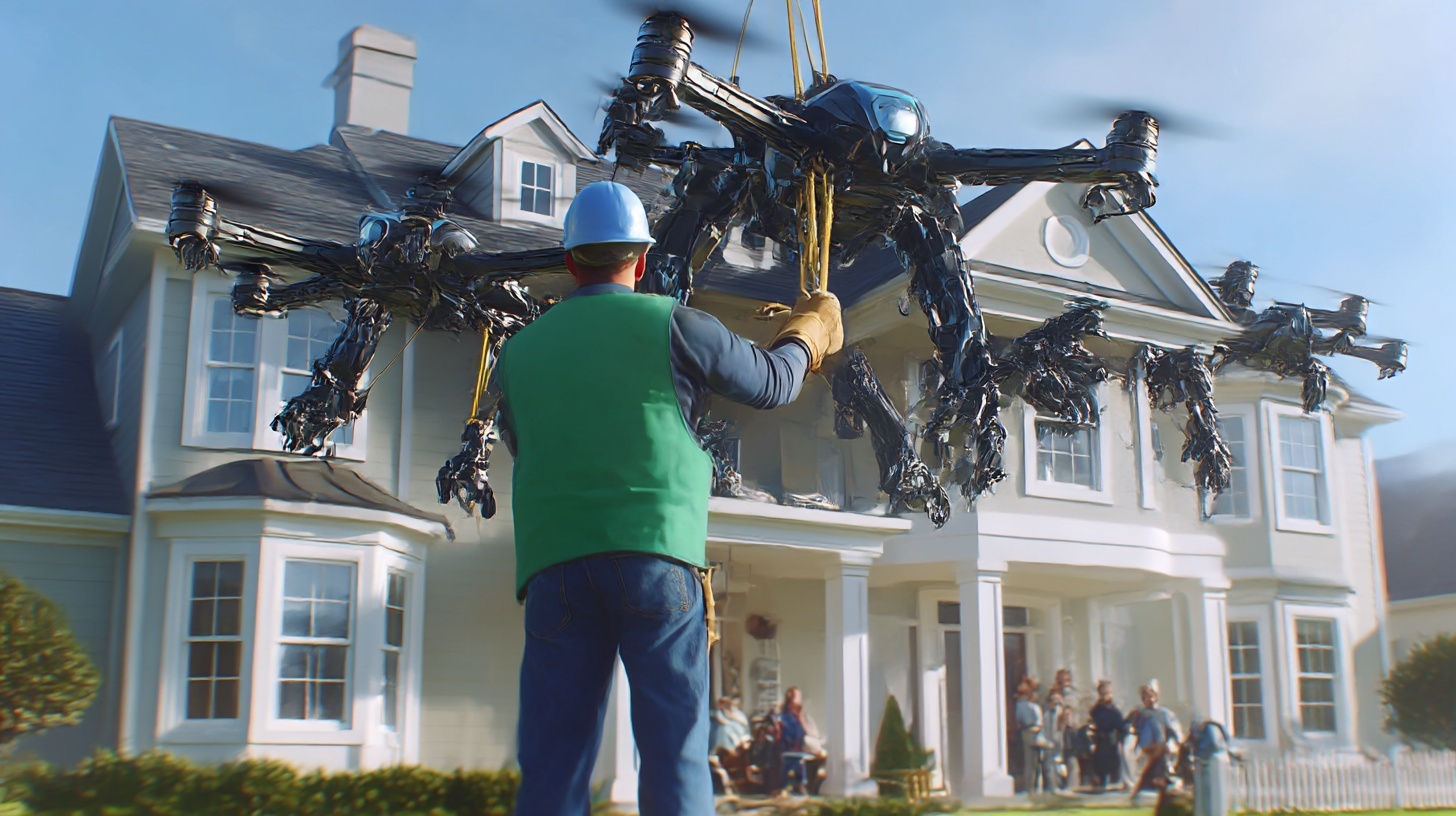
Construction and infrastructure is the most active. Heavy-lift drones are already being used to deliver materials to high-rise construction sites, position steel components in locations where cranes can’t reach, inspect and perform minor maintenance on wind turbines and transmission towers, and transport equipment across terrain where ground vehicles can’t operate. In remote mining and resource extraction, drone delivery of parts and tools has reduced both cost and risk compared to helicopter operations.
Emergency response is the second category, and it’s growing fast. When a wildfire or flood isolates a community, when a mountain rescue requires supplies at altitude, when a disaster zone has no functional road access — heavy-lift drones can deliver water, food, medical equipment, and emergency power to locations that nothing else can reach. California has been funding zero-emission heavy-lift drones specifically for wildfire support and has already subsidized over a thousand electric commercial vehicles including drones through its HVIP program.
Military logistics is the third, and it’s where the most significant near-term investment is flowing. The US military’s interest in DARPA’s Lift Challenge isn’t academic. Resupplying forward operating bases without putting pilots at risk, moving artillery components or vehicle parts to positions where roads don’t exist, extracting casualties from terrain a helicopter can’t safely enter — these are applications where a 4:1 payload-to-weight ratio drone changes the operational calculus dramatically.
What Else These Drones Can Do
The house-moving application is spectacular, but it’s actually one of the more demanding use cases on the capability spectrum. Between current reality and lifting buildings, there is an enormous range of applications that heavy-lift drones can serve at far lower capability thresholds.
Relocating small structures is already within reach. Utility sheds, tiny homes, modular units, prefabricated equipment shelters, construction site offices — anything in the 2,000 to 10,000 pound range could be moved by coordinated swarms operating today. Remote cabin relocation for environmental compliance, emergency shelter repositioning after disasters, moving prefab structures between construction sites without road transport — these are near-term real applications.
Cell tower installation and maintenance has historically required helicopters or extensive crane operations in difficult terrain. A heavy-lift drone can position a communications antenna or a small equipment cabinet at altitude without any of that infrastructure. This is already being evaluated by several telecommunications companies.
Bridge and infrastructure inspection used to mean either scaffolding or manned helicopters. Heavy-lift drones carrying human-equivalent sensor suites can access every surface of a structure, hover with precision while sensors take readings, and deposit maintenance equipment exactly where it’s needed.
Offshore platform supply represents a significant market. Helicopter supply to oil rigs is expensive and weather-dependent. Heavy-lift drones operating autonomously can move equipment weighing hundreds of pounds between shore facilities and offshore structures at a fraction of the cost.
Firefighting applications are where Parallel Flight has focused most of its energy. A drone that can carry a charged fire hose, position it at the exact point on a structure where it’s needed, and hold it there without putting a firefighter in a burning building is a capability that fire departments are actively evaluating.
Vertical farming and greenhouse operations — moving soil bags, harvesting equipment, lighting arrays — represent a quieter but substantial commercial market where the drone’s ability to operate in tight spaces with heavy payloads is directly valuable.
Disaster relief staging — pre-positioning supplies at strategic locations before a predicted hurricane, delivering pallets of bottled water to flooded communities, moving portable generators to hospitals that have lost grid power — this is where the humanitarian case for heavy-lift drones is most compelling and most immediate.

The Regulatory Ceiling
Here is the honest constraint. Everything described above runs into the same wall: regulatory frameworks that were written for drones in a different size class operating in a different risk envelope.
In the United States, drones over 55 pounds already move out of the relatively accessible Part 107 framework into Part 91 or Part 137 territory, which requires substantially more certification, documentation, and coordination with the FAA. A drone capable of lifting 500 pounds — let alone a coordinated swarm of them operating over populated areas — sits in a regulatory space that the FAA is actively developing rules for but has not yet finalized.
DARPA’s Lift Challenge is partly a technology development program and partly a signal to the regulatory ecosystem: this capability is coming, the rules need to catch up, and the government has a stake in making sure they do.
The countries moving fastest on actual certification — China with EHang, Norway with Griff Aviation — have regulatory environments that are less encumbered than the United States’. That’s where the first real commercial deployments at scale are likely to happen, which creates an interesting competitive dynamic for American manufacturers.
The Bigger Picture
Heavy-lift drone technology is following the exact trajectory that every transformative technology follows. Early platforms are expensive, limited, and restricted to specialized applications. Costs fall. Payloads increase. Battery energy density improves. Swarm coordination software matures. Regulatory frameworks catch up. What was a $250,000 platform serving a handful of industrial niches becomes a $25,000 platform serving hundreds of applications — and eventually a commodity infrastructure that reshapes the industries that depend on moving heavy things.
The house-moving application is the conceptual endpoint that clarifies what this technology ultimately becomes. Not just a tool for carrying payloads from point A to point B, but a new category of aerial infrastructure — one that can reposition physical objects of meaningful scale, including the structures humans live and work in, with a precision and flexibility that no previous technology has offered.
The first house moved by a drone swarm will be a proof of concept. The tenth will be a demonstration. The thousandth will be an industry.
Related Reading
DARPA Lift Challenge: Redefining What Drones Can Carry
DARPA — The official program documentation for the $6.5 million competition to achieve a 4:1 payload-to-weight ratio in drone design, and why the Defense Department considers it a critical capability gap
Aerial Additive Manufacturing: Construction Drone Swarms
Nature — The peer-reviewed research from Imperial College London and EMPA documenting the proof-of-concept success of coordinated drone swarms as autonomous construction platforms
The Future of Heavy Lift: Autonomous Aerial Logistics
RAND Corporation — A strategic analysis of how unmanned heavy-lift systems will reshape military and commercial logistics, with assessment of the regulatory, technical, and operational challenges that remain