
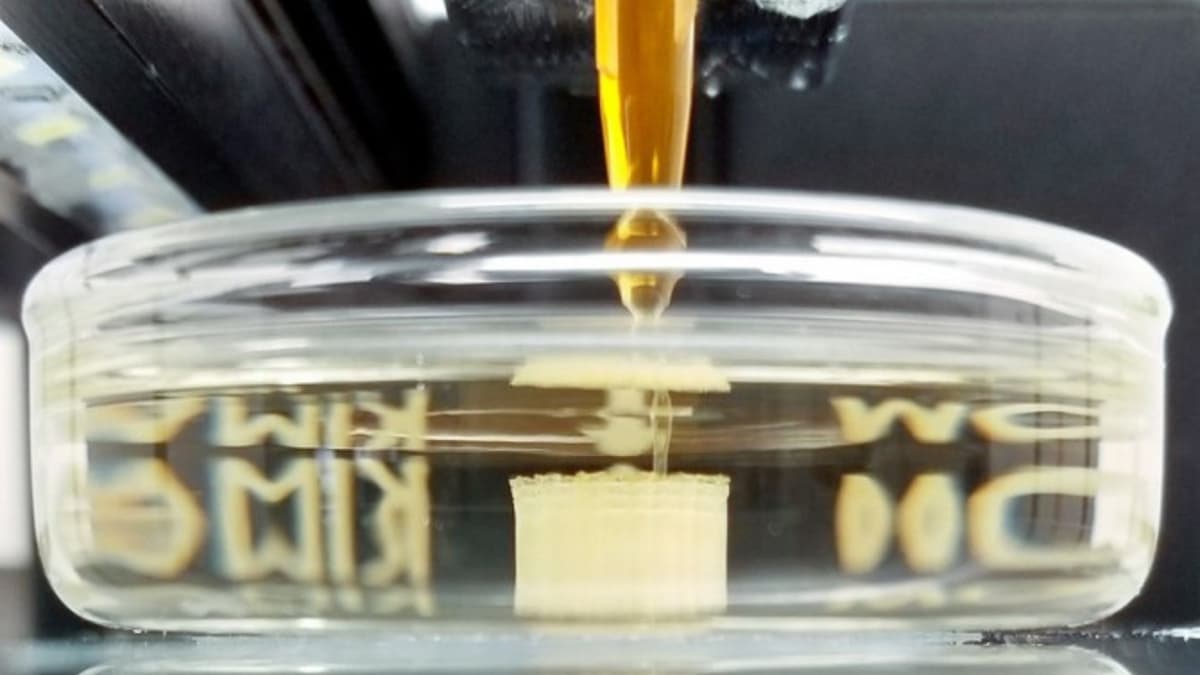
For more than a century, superconductors have represented one of science’s most tantalizing frontiers: materials capable of conducting electricity with zero resistance. They are the backbone of MRI machines, particle accelerators, and the dream of next-generation quantum devices. But until now, the process of making them has been slow, rigid, and rooted in decades-old methods. That just changed. Cornell researchers have unveiled a one-step 3D-printing process that doesn’t just simplify how superconductors are made—it unlocks unprecedented performance, shattering records with magnetic field strengths of 40 to 50 Tesla. To put that in perspective, the magnets used at CERN’s Large Hadron Collider peak around 8 Tesla. Cornell’s breakthrough isn’t just incremental; it’s transformative.
Continue reading… “3D-Printed Superconductors Smash Barriers and Redefine the Future of Power”Higgs particle discovery

This plot shows the discovery as seen in one of the LHC detectors.
In Geneva, scientists using the Large Hadron Collider have announced the discovery of a new subatomic particle to very high confidence that is consistent with what we expect the Higgs particle to look like.
Continue reading… “Higgs particle discovery”
How a particle accelerator works: Explained with donuts and chocolate bars
Using a fried dough and Kit Kat stop-motion animation, the folks over at Elementsexplain how a synchroton particle accelerator—like the Large Hadron Collider—accelerate particles up to the speed of light…
Continue reading… “How a particle accelerator works: Explained with donuts and chocolate bars”
Higgs Boson may not exist

To be or not to be. That is the question.
The Higgs boson is a hypothetical massive elementary particle predicted to exist by the Standard Model of particle physics. Its existence is postulated to resolve inconsistencies in theoretical physics, and experiments attempting to find the particle are being performed using the Large Hadron Collider at CERN and the Tevatron at Fermilab…
Continue reading… “Higgs Boson may not exist”
Large Hadron Collider Could Be World’s First Time Machine

The latest concept at what could product time travel.
If the latest theory of Tom Weiler and Chui Man Ho is right, the Large Hadron Collider — the world’s largest atom smasher that started regular operation last year — could be the first machine capable of causing matter to travel backwards in time.
Continue reading… “Large Hadron Collider Could Be World’s First Time Machine”
Supernova-creating Particle Accelerators Will Recreate Supernova Explosions

Explosions in deep space bring heavy atoms into existence.
Two new experimental facilities, billed as the successors to the Large Hadron Collider, will recreate the supernova explosions that produced most of the elements that make up our world.
