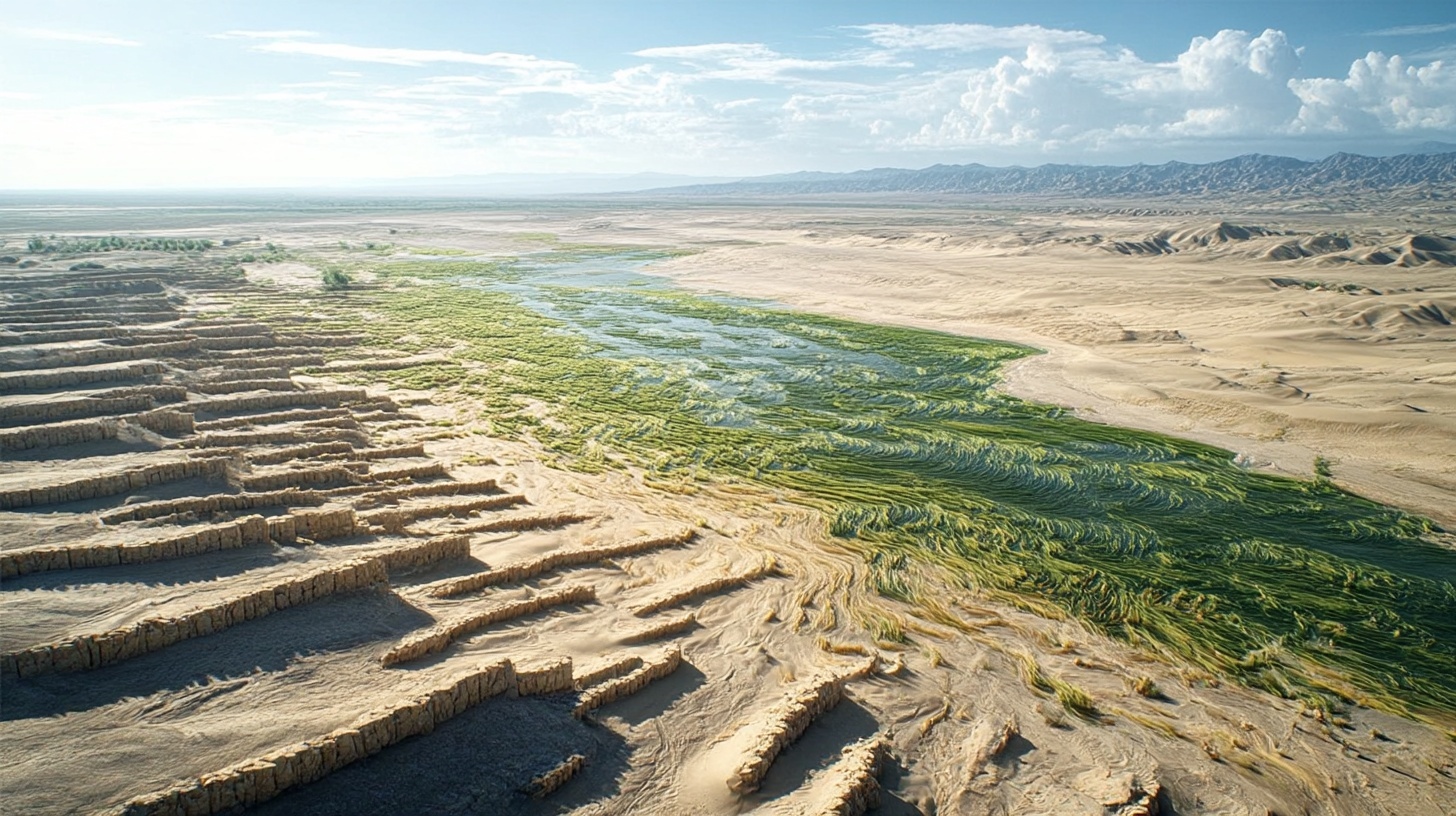
Gluing Deserts Together: How China’s Blue-Green Algae Is Terraforming Sand Into Soil

By Futurist Thomas Frey

The Question Desertification Forces Us to Answer

Deserts are expanding. Climate patterns shift, rainfall decreases, vegetation dies, and sand reclaims land that once supported agriculture and communities. Traditional approaches—planting trees, building barriers, pumping water—struggle against the fundamental problem: shifting sand won’t stay put long enough for anything to take root.

This forces an uncomfortable question: what if we’re fighting desertification wrong? What if instead of trying to grow plants in sand, we first turn the sand into something that can support plant life? What if we literally glue the desert floor together using organisms that have survived in extreme conditions for eons?

Chinese researchers at the Shapotou Desert Experimental Research Station have answered this question with a solution that sounds like science fiction: deploy massive quantities of blue-green algae to create an “ecological skin” that binds shifting dunes into stable substrate. Not in decades—in one year. Not as small-scale experiment—across 6,667 hectares in Ningxia province over the next five years, with plans to scale globally.

Let me walk you through why this blue-green algae approach represents a fundamental shift in how we reclaim deserts, what it means for global desertification battles, and why microbial geoengineering might be humanity’s best tool for reversing landscape degradation.

Continue reading… “Gluing Deserts Together: How China’s Blue-Green Algae Is Terraforming Sand Into Soil”

Cosmonauts find sea plankton on outside of International Space Station

cosmonaut

Cosmonauts found traces of sea plankton and microscopic particles on outside of ISS.

ITAR-TASS, a Russian press agency, is reporting something so surprising that it’s hard to believe: Cosmonauts have found microorganisms on the exterior of the International Space Station. Russian scientists are shocked by this discovery and can’t really explain how it is possible.

Continue reading… “Cosmonauts find sea plankton on outside of International Space Station”

Creating liquid fuel with electricity

isobutanol_bioconversion

Researchers have generated isobutanol from CO2 using a genetically engineered microorganism with solar electricity the sole energy input.

Electric vehicles have come a long way in the past decade, but they still have many disadvantages when compared to internal combustion engine-driven vehicles. The lithium-ion batteries that power electric vehicles have a much lower energy storage density when compared to liquid fuel, they take longer to “refuel,” and they lack the supporting infrastructure that has built up around conventional vehicles over the past century. Now researchers at the UCLA Henry Samueli School of Engineering and Applied Science have developed a process that could allow liquid fuel to be produced using solar generated electricity.

Continue reading… “Creating liquid fuel with electricity”

Discover the Hidden Patterns of Tomorrow with Futurist Thomas Frey
Unlock Your Potential, Ignite Your Success.

By delving into the futuring techniques of Futurist Thomas Frey, you’ll embark on an enlightening journey.

Learn More about this exciting program.