Are Tiny Homes the Answer to Escalating US Home Prices?

A tiny folding house made by Boxabl.

By Mary Prenon 

Mary Kate Taliafarro, along with her husband and three children, have been living in a 350-square-foot “tiny house” in Ulster County, New York, since March 2021. Last year, they decided to ride the real estate wave and sell their large, two-story home in the Hudson Valley and live in the tiny home while having a new home built on nearby property.

Although squeezing an entire family into small living quarters may seem like a recipe for chaos, Taliafarro told The Epoch Times that downsizing has definitely had its upside.

“It’s been great—actually a lot better than I expected,” she said.

Built and designed by Hudson River Tiny Homes in Ghent, New York, the 40-foot-long home offers two bedrooms and two loft spaces. It also boasts a dishwasher, washer, and dryer.

“My two boys just love it,” she said. The family’s newest addition, her four-month old daughter, has not weighed in yet.

Because of their growing family, the Taliafarros are planning an addition to the tiny house that will afford them a master bedroom, bath, and a just a bit more living space.

Continue reading… “Are Tiny Homes the Answer to Escalating US Home Prices?”

Scientists build robot that could one day help us travel around black holes

Researchers from Georgia Tech claim they’ve built a robot that can move in curved space without Newton’s third law 

By Adam Smith

Scientists have built a robot that defies the standard laws of physics and could eventually help humans travel around black holes.

When humans, animals, and machines move through the world they must push against something – be that the ground, air, or water. This is Newton’s third law: every action has an equal and opposite reaction.

The law applies to flat, three-dimensional space that humans move through, but in curved space forces can differ – and objects can move without frictional or gravitational impact.

As such, researchers from the Georgia Institute of Technology claim they have built a robot that can move in curved space without pushing against anything.

Continue reading… “Scientists build robot that could one day help us travel around black holes”

Unmanned Cargo Plane to Usher in New Era of Freight Transport

Natilus is developing a family of large unmanned cargo aircraft, starting with this twin turboprop model.

By Austin Weber

San Diego has one of the richest aerospace heritages of any city in America. Ryan Aeronautical Co. built Charles Lindbergh’s “Spirit of St. Louis” aircraft in the mid-1920s. During World War II, Consolidated Aircraft Corp. mass-produced planes such as the B-24 Liberator and the PBY Catalina.

In the 1950s, Convair’s Atlas Launch Vehicle helped usher in the Space Age. And, as everyone who has watched “Top Gun” knows, North Island Naval Air Station is home to some of the best combat pilots in the world.

A startup company called Natilus Inc. is planning to write the next chapter in San Diego’s illustrious aviation history. It is developing a large unmanned cargo aircraft that may someday revolutionize the air freight and logistics industry.

Natilus plans to design and manufacture a family of aircraft that feature a blended-wing body (BWB) configuration. Unlike traditional tube-and-wing airplanes, BWBs combine the wing, body and tail into a single wing that can generate a 30 percent reduction in fuel consumption.

“The blended-wing design with our patent-pending diamond cargo configuration allows for more volume, helping our customers optimize for the reality of today’s e-commerce freight,” says Aleksey Matyushev, CEO of Natilus. “For the same weight of tube-and-wing aircraft, [our plane] will transport more than twice as much revenue cargo for the same trip, lowering costs by 60 percent and reducing CO2 emissions by 50 percent.”

Continue reading… “Unmanned Cargo Plane to Usher in New Era of Freight Transport”

This New Supersonic Jet Will Fly From London to NYC in 3.5 Hours—on 100% Biofuel

Boom’s Overture Supersonic Jet to Fly From London to NYC in 3.5 Hours

By ROHIT JAGGI 

But the Boom Overture is not Concorde 2.0. It’ll be faster, quieter and more fuel efficient, with a larger interior space. 

Supersonic air travel has always messed with the concept of time. Such as being able to fly across the Atlantic and land before your scheduled departure time.

But planemaker Boom managed to reach new heights of temporal irony with the latest iteration of its Overture supersonic aircraft. Its production-conforming design revealed recently at the Farnborough Air Show in the UK has managed to turn the clock back to the 1960s and look astonishingly similar to Concorde. Huge delta wings, four underslung engines and a long, slim fuselage make a comparison hard to avoid.

But given the six decades of technological innovation since French and British designers penned the world’s first supersonic airliner, Boom has been able to bring in some improvements. Its composite Overture has a conventional tail, its wing has a sinuous twist and the medium-bypass turbofan engines do away with the need for afterburners—which were responsible for a substantial part of the noise levels that helped kill off Concorde.

Continue reading… “This New Supersonic Jet Will Fly From London to NYC in 3.5 Hours—on 100% Biofuel”

DARPA Wants to Build an ‘Internet’ of Connected Satellites in Low Earth Orbit

The agency is bringing together experts to build tools that seek to standardize communication between tens of thousands of satellites.

By Mack DeGeurin

If you’ve taken a good look at the night sky in recent years you may have noticed a few more twinkling lights. That’s largely due to a surge in low Earth orbit satellites, an increasing number of which are being deployed to offer satellite internet service. SpaceX, OneWeb, and Amazon, the latter through its yet-to-launch  Project Kuiper, together reportedly plan to launch over 46,000 more satellites into space in the coming years. 

There’s a problem though. In their haste to get satellites up and running and beat out competitors, few of these satellite companies actually bothered to hammer out a set of standards that would let their satellites communicate with other firms’ satellites. Enter DARPA, the Pentagon’s gonzo research and development arm. As part of its Space-Based Adaptive Communications Node (Space-BACN) program DARPA is bringing together a team of experts to standardize communications between the ever-increasing hoard of satellites. The end goal, according to DARPA, is a type of “internet” of low Earth orbit (LEO) satellites that lets civil, government, and military satellites easily communicate with each other.

Continue reading… “DARPA Wants to Build an ‘Internet’ of Connected Satellites in Low Earth Orbit”

Vision in Humans Restored Using Cornea Implants Bioengineered from Pig’s Skin

Cornea implant made of collagen protein from pig’s skin.

By Thor Balkhed

For the estimated 12.7 million people around the world who are blind due to corneal stromal disease, a transplanted cornea from a human donor is the only way of regaining vision. But just one in 70 patients receives a cornea transplant. Now, researchers describe a cell-free engineered corneal tissue implant—made of collagen protein from pig’s skin—and a minimally invasive surgical method for its implantation. In a pilot study, performed in India and Iran (clinicaltrials.gov no. NCT04653922), all 20 patients who received the implants had vision restored.

The study is published in Nature Biotechnology, in the article, “Bioengineered corneal tissue for minimally invasive vision restoration in advanced keratoconus in two clinical cohorts.”

“The results show that it is possible to develop a biomaterial that meets all the criteria for being used as human implants, which can be mass-produced and stored up to two years and thereby reach even more people with vision problems,” said Neil Lagali, PhD, professor at the department of biomedical and clinical sciences at Linköping University (LiU) in Sweden. “This gets us around the problem of shortage of donated corneal tissue and access to other treatments for eye diseases.”

Continue reading… “Vision in Humans Restored Using Cornea Implants Bioengineered from Pig’s Skin”

Next-gen cars will create new forms of entertainment 

The in-vehicle experience is set to change as cars turn autonomous and electric.

By Elle Farrell-Kingsley

According to MarketsandMarkets, the in-vehicle infotainment (IVI) market is projected to grow from US$20.8bn in 2021 to US$28.4bn by 2027, at a CAGR of 10.8%. Research suggests that the IVI market is driven by the increase in vehicle production, technological advancements, telematics regulations, and increasing demand for luxury vehicles. 

 In the wake of these trends, the entertainment offering is constantly evolving. “Infotainment in cars is approaching a critical inflexion point where many of the traditional forms of in-car entertainment are on the precipice of becoming extinct,” says Iliya Rybchin, Partner at Elixirr, a consulting firm which has advised automotive and entertainment companies. Rybchin specialises in customer experiences, particularly how changing consumer expectations and business model disruption impact various industries.  

Continue reading… “Next-gen cars will create new forms of entertainment ”

Xiaomi Unveils CyberOne, a Humanoid Robot That Can Sense Human Emotions

Xiaomi CyberOne is said to identify 85 types of environmental sounds and 45 classifications of human emotion.

By Nithya P Nair 

Xiaomi CyberOne can listen to human interactions.

Xiaomi unveiled its first humanoid robot named CyberOne alongside the Xiaomi Mix Fold 2 during a live event on Thursday. The robot can listen to human interactions and is capable of recognising individuals and their emotions. The CyberOne is 177cm tall, weighs 52kg, and has an arm span of 168cm. It is claimed to be capable of perceiving 3D space. The CyberOne comes equipped with technologies to recognise 85 types of environmental sounds and 45 classifications of human emotion. Xiaomi also has a quadruped robot called CyberDog, which was unveiled at the Mobile World Congress (MWC) 2022 in February.

During the Xiaomi Mix Fold 2 launch event on Thursday, Xiaomi unveiled the CyberOne. The humanoid robot handed a flower to the company’s Chief Executive Officer Lei Jun on stage and showcased some movements.

“CyberOne’s AI and mechanical capabilities are all self-developed by Xiaomi Robotics Lab. We have invested heavily in R&D spanning various areas, including software, hardware, and algorithms innovation,” said Lei Jun in a statement.

CyberOne comes with arms, legs, and supports bipedal motion and is said to reach a peak torque of up to 300Nm. It has an OLED module to display facial expressions and can see the world in 3D.

Continue reading… “Xiaomi Unveils CyberOne, a Humanoid Robot That Can Sense Human Emotions”

Swarms of Mini Robots Could Dig the Tunnels of the Future

The underground excavation industry is exploring mini robots, plasma torches, and superheated gas to replace the massive boring machines now in use.

By CHRIS BARANIUK

FOR DECADES, ENGINEERS seeking to build tunnels underground have relied on huge tube-like machines armed with a frightening array of cutting wheels at one end—blades that eat dirt for breakfast. These behemoths, called tunnel-boring machines, or TBMs, are expensive and often custom-built for each project, as were the TBMs used to excavate a path for London’s recently opened Elizabeth Line railway. The machines deployed on that project weighed over 1,000 tons each and cut tunnels over 7 meters in diameter beneath the UK capital.

But British startup hyperTunnel has other ideas. The firm proposes a future in which much smaller, roughly 3-meter-long robots shaped like half-cylinders zoom about underground via predrilled pipes. These pipes, around 250 millimeters (10 inches) in diameter, would follow the outline of the proposed tunnel’s walls. Once inside them, the bots would use a robotic arm topped with a milling head to penetrate into the surrounding earth and carve out small voids that would then get filled with concrete or some other strong material. Piece by piece like this, the structure of a new tunnel would come together.

“We’re talking about thousands of them,” says hyperTunnel’s director of engineering, Patrick Lane-Nott. “Much like an ant colony or a termite colony works in swarms.”

Continue reading… “Swarms of Mini Robots Could Dig the Tunnels of the Future”

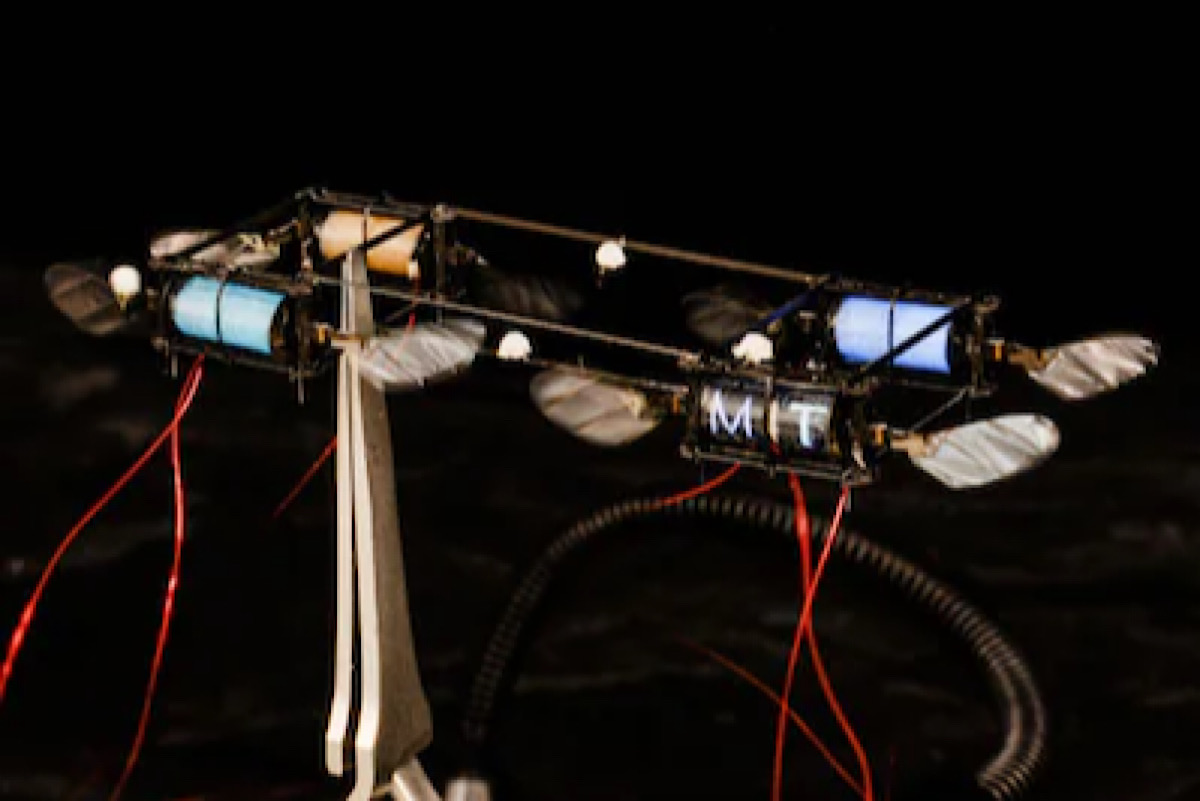
MIT Researchers Develop Insect-Sized Robot Fireflies That Emit Light When Flying

Each illuminating actuator served as an active marker that can be tracke

The ability of these tiny robots to emit light can enable them to communicate with each other.

  • Robot’s actuators work as muscles enabling them to flap their wings
  • Artificial muscles were made using ultrathin layers of elastomer 
  • Team could almost accurately tell the position and altitude of the robot

A team of researchers at the Massachusetts Institute of Technology, inspired by fireflies, created insect-sized robots that emit light when they fly. Fireflies are known for their luminescence which they use for communication purposes. The MIT researchers who created these tiny robots intended something similar.

Continue reading… “MIT Researchers Develop Insect-Sized Robot Fireflies That Emit Light When Flying”

A new shortcut for quantum simulations could unlock new doors for technology

Two of the “maps” of quantum phase transitions generated by the technique. The different colors represent different phases or transitions between different phases.

By Louise Lerner

From water boiling into steam to ice cubes melting in a glass, we’ve all seen the phenomenon known as a phase transition in our everyday lives. But there’s another type of phase transition that’s much harder to see, but just as stark: quantum phase transitions.

When cooled to near absolute zero, certain materials can undergo these quantum phase transitions, which can make a physicist’s jaw drop. The material can flip from being magnetic to non-magnetic, or it can suddenly acquire the superpower to conduct electricity with zero energy lost as heat.

The mathematics behind these transitions is tough to handle even for supercomputers—but a new Physical Review A study from the University of Chicago suggests a new way to work with these complicated calculations, which could eventually yield technological breakthroughs. The shortcut pulls only the most important information into the equation, and creates a “map” of all possible phase transitions in the system being simulated.

“This is a potentially powerful way of looking at quantum phase transitions that can be used with either traditional or quantum computers,” said David Mazziotti, a theoretical chemist with the Department of Chemistry and the James Franck Institute at the University of Chicago and senior author of the study.

Continue reading… “A new shortcut for quantum simulations could unlock new doors for technology”

Mawi launches a patch to track your heart health faster and in real time

By Haje Jan Kamps

If you’ve ever had the misfortune of needing continuous EKG monitoring, you’ve probably used a Holter monitor. It’s like carrying a 1980s walkman made of metal with a bunch of wires going from it to your chest. If that sounds uncomfortable, and as if you won’t sleep or enjoy showers much for the two weeks you need to carry it around, you’ve neatly stumbled across the use case for the Mawi Heart Patch. The company just released its product, a two-lead cardiac monitor that can be read in real time.

There are consumer-grade products that can do EKG readings, including the Withings ScanWatch (and its fancier-looking sibling, the ScanWatch Horizon), and there are other patches on the market, such as the Zio patch, but Mawi claims to have done something unique, and suggests that its Heart Patch is the first ever single-use, two-lead cardiac monitor to reach the market.

The company describes it as “a stick-and-go, wireless solution” and further suggests that the disposable nature of the device is a benefit; it means that cardiologists can run tests on as many patients as they need to without having to wait for reusable Holter monitors to come back from other patients and get sanitized and maintained between uses.

Continue reading… “Mawi launches a patch to track your heart health faster and in real time”
Discover the Hidden Patterns of Tomorrow with Futurist Thomas Frey
Unlock Your Potential, Ignite Your Success.

By delving into the futuring techniques of Futurist Thomas Frey, you’ll embark on an enlightening journey.

Learn More about this exciting program.