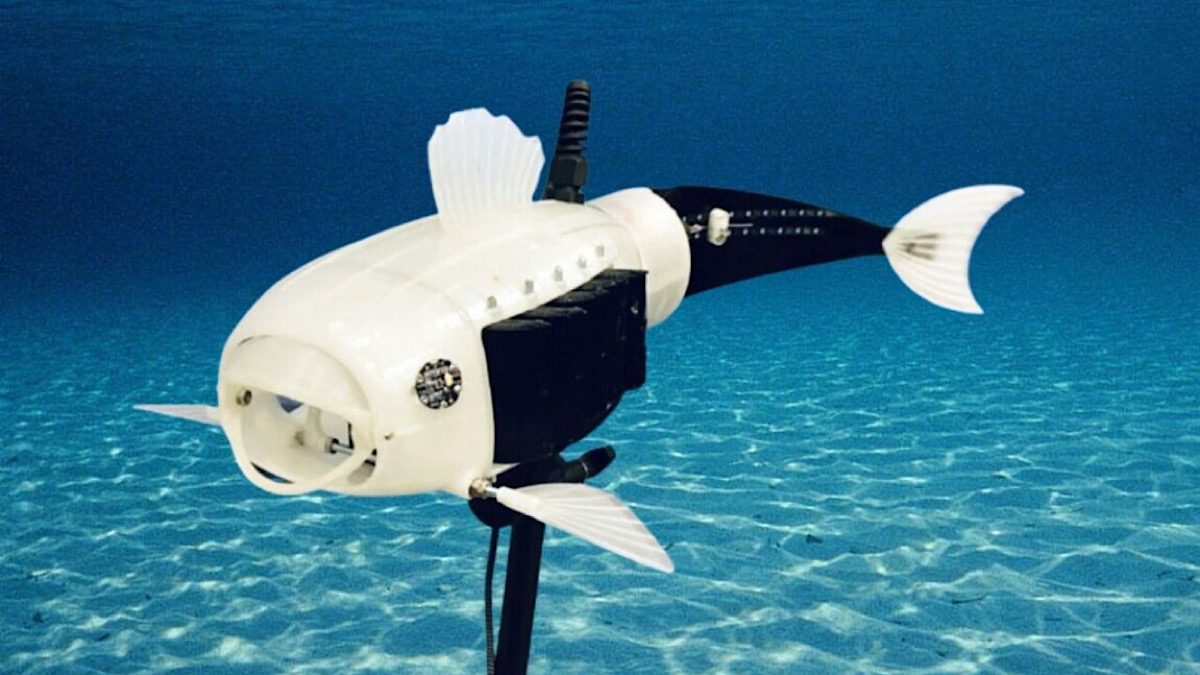
Open-source fish robot starts collecting microplastics from local lakes in the UK

Researchers turn the public’s ideas into reality

By Ioanna Lykiardopoulou

A robot fish that collects microplastics from waterways has been turned from an idea into a working prototype. The design was brought to life after it won the University of Surrey’s public competition, the Natural Robotics Contest.

The contest, which ran in the summer of 2022, invited the public to submit an idea for a bio-inspired robot that could help the world.

An international panel of judges chose the robot fish concept designed by student Eleanor Mackintosh because it could help reduce the amount of plastic pollution in water. The winning design was subsequently turned into a functioning prototype.

The robotics panelists and researchers, led by Dr. Robert Siddall, turned Mackintosh’s design into a 3D-printed prototype about the size of a salmon.

Named “Gillbert,” the device consists of a flooded head unit and a watertight tail unit. Thanks to a set of gills on its sides and a fine mesh in between them that can sieve about two-millimeter particles, the robotic fish filters the water and keeps the microplastics inside its container as it swims.

Continue reading… “Open-source fish robot starts collecting microplastics from local lakes in the UK”

Revolutionary new cancer treatment uses light to kill tumors

By Joshua Hawkins

Researchers have managed to create a cancer-killing patch that turns light into heat and “cooks” cancer cells until they die. The patch, which researchers first detailed in a paper published in Advanced Functional Materials, can heat up melanoma cells and kill them. It’s a treatment that kills the cancerous cells but leaves the other cells around it unharmed.

Finding new ways to treat cancer effectively has been at the top of scientists’ and medical professionals’ goals for the past decade. And we’ve come up with some very innovative ways to treat cancer. From this cancer-killing patch to cancer-killing viruses, and even a radioactive gel that can kill cancerous cells all offer great ways to fight these deadly diseases.

The treatment relies heavily on a procedure called surgical resection. This is a common treatment for skin melanoma, but it can also lead to postoperative recurrence. That then calls for even more surgery, as well as possibly chemotherapy. With a cancer-killing patch, though, the doctors could focus the treatment more directly on the cancerous cells.

Continue reading… “Revolutionary new cancer treatment uses light to kill tumors”

Google’s new AI Test Kitchen demos will let you build cities and create monsters

By Nickolas Diaz

  • Google is bringing new AI advancements to its AI Test Kitchen for user feedback and testing.
  • Researchers have worked on a way for users to create a long form video based on text along with text-to-image technology.
  • Using its AI model AudioLM, users can provide a piece of audio to this program which can then generate its own version.
  • Through its research, Google is looking to bring AI-powered generative models into the lives of creators and artists.

According to Google’s Keyword post, one of the ways it’s taking AI research is in the direction of allowing people to be more expressive by using words to create videos and imagery.

Continue reading… “Google’s new AI Test Kitchen demos will let you build cities and create monsters”

AMP Robotics in Denver, Colorado, has raised $91m to boost the development of its artificial intelligence (AI) and robotics technologies for the waste and recycling industry.

The  Series C financing was led by Congruent Ventures and Wellington Management as well as new and existing investors including Blue Earth Capital, Sidewalk Infrastructure Partners (SIP), Tao Capital Partners, XN, Sequoia Capital, GV, Range Ventures, and Valor Equity Partners. This new round of funding follows a $55 million Series B financing led by XN in January 2021. 

AMP’s proprietary technology applies computer vision and deep learning to identify and recover plastics, cardboard, paper, cans, cartons, and many other containers and packaging types reclaimed for raw material processing. The company’s AI platform, AMP Neuron, has recognized more than 50 billion objects in real-world conditions, making it the largest known dataset of recyclable materials for machine learning. 

“Advancements in robotics and automation are accelerating the transformation of traditional infrastructure, and AMP is seeking to reshape the waste and recycling industries,” said Michael DeLucia, sector lead for Climate Investing, Wellington Management. “By bringing digital intelligence to the recycling industry, AMP can sort waste streams and extract additional value beyond what is otherwise possible.”

AMP will use the latest funding to scale its business operations while continuing its international expansion from the US.

Continue reading… “AMP Robotics in Denver, Colorado, has raised $91m to boost the development of its artificial intelligence (AI) and robotics technologies for the waste and recycling industry.”

Watch Xpeng VTOL Flying Electric Car Successfully Complete First Flight

It’s a massive 2-ton vehicle with a huge drone strapped to the roof that just successfully completed its maiden flight. 

By: Andrei Nedelea

The arrival of commercially viable flying cars has been erroneously foretold countless times before over the course of the last century, but in recent years, with the popularization of electric vehicles, the idea that we will travel around like the Jetsons in the foreseeable future seems to be gaining traction again. Companies dedicated to providing such a product are now popping up, and other companies like China’s Xpeng are also looking allocating resources for this.

They even created a separate company, Xpeng HT, with the sole focus of creating eVTOL (electric vertical takeoff and landing) vehicles and now that company shared video of its prototype’s maiden flight during a larger Xpeng presentation in China. The final part of the video embedded at the start of the article is dedicated to the Xpeng AeroHT’s first flight – we get to see it drive out of a garage (or hangar), then it is weighed, revealing that it weighs just under 2 metric tons (4,400 pound), before firing up its eight large rotors and lifting off.

Continue reading… “Watch Xpeng VTOL Flying Electric Car Successfully Complete First Flight”

Robotics company to introduce the world’s fastest shoe

Get to your destination in less than half the time with a 100 per cent increase in your walking speed

By MARLEY DICKINSON

A U.S. start-up, Shift Robotics of Pittsburgh, has launched a Kickstarter campaign for what they claim is the world’s fastest shoe. The “Moonwalker” apparently let you walk at the speed of a run while maneuvering stairs, through crowds, hills and even getting on public transit.

Late to work, and don’t want to run? The Moonwalkers will help you get to your destination in less than half the time it would normally take you to walk there with a 100 per cent increase in your walking speed. The shoes use artificial intelligence (AI) to measure your gait and react to how you walk, reaching the top speed of 12 km/h in a matter of seconds.

The shoes have two modes, lock and shift–and they only move when you do. This means you can go up and down stairs, step into mass transit, and confidently wait at the crosswalk while the AI switches modes using an algorithm to adapt to your walking gait and environment. The shoes have a hinge system that allows your foot to naturally bend at your toes, preserving your natural gait, mobility and balance.

Continue reading… “Robotics company to introduce the world’s fastest shoe”

Chinese Scientists Converted Lunar Soil Samples Into Rocket Fuel, Oxygen

Lunar soil collected from China’s Chang’e-5 moon mission display during an exhibition at the National Museum of China in Beijing on March 4, 2021.

By Margaret Davis

A team of researchers from the University of Science and Technology of China, Nanjing University, and China Academy of Space Technology said that they managed to convert actual lunar soil samples or regolith from the Chang’e mission into a source of rocket fuel and oxygen.

Futurism reports that the team found that the regolith samples can act as a catalyst to convert carbon dioxide and water from the bodies of astronauts and the environment into methane and oxygen. The discovery is a potential game-changer for future space exploration, ensuring the success of the mission by providing in-situ resources to fuel up their spacecraft for the return journey.

Continue reading… “Chinese Scientists Converted Lunar Soil Samples Into Rocket Fuel, Oxygen”

Want To Send A Parcel To The Moon? A Japanese Startup Is Working To Establish A Courier Service For Space- Technology News, Firstpost

By Amelia Podder

The race to be the first one in space, and then the Moon was a contest between mainly the USA and the Soviet Union. Today though, the race to be the first one to completely commercialise space travel and make it feasible for tourists is practically anybody’s race, including private players.

Thanks to a Japanese aeronautical research company, people on Earth can now send parcels and couriers to space. Image Credit: ISpace.

We have heard about space agencies and aeronautical firms partnering up to make the world’s first space hotel. Now, we have an up-and-coming startup from Japan that wants to establish a courier service in space. Want to send a parcel or an urgent document to someone in space? Well, in a few years, you can.

ISpace Inc., a Tokyo-based company, plans to launch a lunar lander by the end of this month, that will carry a variety of commercial and governmental payloads, including 2 rovers.

The goal of this firm is to establish a human population on the moon by 2040, but before then it wants to transform one of its modules on the moon as a courier and logistical lunar hub. The aim is to make money by transporting commercial products and research equipment up in space, on behalf of research institutes, private players, and certain government agencies.

ISpace’s first trip will test both the technological capabilities it has developed since its creation in 2010 and the trust of its investors. The Japan Times reported that a lot depends on its success, including the possibility of an IPO as early as this fiscal year and a chance to take a larger piece of space tourism and commercial logistics industry, which, Morgan Stanley predicts would triple to $1 trillion in two decades from 2020.

Continue reading… “Want To Send A Parcel To The Moon? A Japanese Startup Is Working To Establish A Courier Service For Space- Technology News, Firstpost”

NASA’s new Glider Could Turn any Airport Into a Spaceport

 BY ANDY TOMASWICK

Getting to space has almost always been a multi-stage process. Those stages typically took the form of different stages of chemical rockets, but it doesn’t have to be that way. Plenty of alternative options have been proposed, and one that NASA has been working on for almost a decade is getting closer to commercialization. The project, known as the Towed-Glider Air Launch System (TGALS), uses three very different stages – a business jet, and glider, and two separate rockets – sort of. But its main advantage means that any airport large enough to host a business jet could also become a spaceport.

That’s a tempting proposition, as spaceport access is relatively limited. Few launch pads can support chemical rockets, such as those traditionally used in space launch systems. Most of those ports are dominated by giants of the industry – ULA and SpaceX own a combined six, which make up a large portion of privately operable spaceports in the US. 

The prospect of opening up some of the 5,000 public airports for use as space launch sites is therefore tempting. To make that happen, though, a company can’t use standard chemical rockets. So why not use a plane? Or a glider? Or, better yet, both?

Continue reading… “NASA’s new Glider Could Turn any Airport Into a Spaceport”

Ogle brings Airo concept car to life with Neo 800 SLA 3D printer

An innovative EV that not only removes pollutants as it travels but can also be used as an office and bedroom

Multi-award-winning British design and architecture studio Heatherwick Studio had been approached by IM Motors to create Airo, a vehicle that has driver and autonomous controls. It is an innovative electric car that not only removes pollutants as it travels but can also be used as an office and bedroom, could be in production next year.

Eagerly watching from the sidelines will be Ogle Models which played a key role in the creation of the pioneering Airo.

Heatherwick, founded by the world-renowned designer Thomas Heatherwick, has a long-established relationship with Ogle and asked the specialist team to make a fully hand-finished and painted model for their clients.

Philip Martin, director of the Herts-based company, said: “We have a long-running relationship with Heatherwick. Over that time, we have worked on numerous projects with them. We offer the high level of quality they look for with quick turnaround times. They appreciate being able to talk to us, knowing that any problem can be overcome with an efficient solution.”

Continue reading… “Ogle brings Airo concept car to life with Neo 800 SLA 3D printer”

Meta’s newest AI determines proper protein folds 60 times faster | Engadget

Life on Earth would not exist as we know it, if not for the protein molecules that enable critical processes from photosynthesis and enzymatic degradation to sight and our immune system. And like most facets of the natural world, humanity has only just begun to discover the multitudes of protein types that actually exist. But rather scour the most inhospitable parts of the planet in search of novel microorganisms that might have a new flavor of organic molecule, Meta researchers have developed a first-of-its-kind metagenomic database, the ESM Metagenomic Atlas, that could accelerate existing protein-folding AI performance by 60x.

Metagenomics is just coincidentally named. It is a relatively new, but very real, scientific discipline that studies “the structure and function of entire nucleotide sequences isolated and analyzed from all the organisms (typically microbes) in a bulk sample.” Often used to identify the bacterial communities living on our skin or in the soil, these techniques are similar in function to gas chromatography, wherein you’re trying to identify what’s present in a given sample system.

Similar databases have been launched by the NCBI, the European Bioinformatics Institute, and Joint Genome Institute, and have already cataloged billions of newly uncovered protein shapes. What Meta is bringing to the table is “a new protein-folding approach that harnesses large language models to create the first comprehensive view of the structures of proteins in a metagenomics database at the scale of hundreds of millions of proteins,” according to a TK release from the company. The problem is that, while advances of genomics have revealed the sequences for slews of novel proteins, just knowing what those sequences are doesn’t actually tell us how they fit together into a functioning molecule and going figuring it out experimentally takes anywhere from a few months to a few years. Per molecule. Ain’t nobody got time for that.  

Continue reading… “Meta’s newest AI determines proper protein folds 60 times faster | Engadget”

CHILLING AI DEVELOPMENT MEANS THAT ROBOTS CAN NOW TALK TO ANIMALS – AND WE MIGHT BE ABLE TO NEXT

Robots can now talk to animals

By Callie Patteson

HUMANS are one step closer to talking to animals as new technologies are allowing artificial intelligence-enabled robots to speak with different species. 

Karen Bakker, a professor at the University of British Columbia, recently revealed this technology is being used to communicate with honeybees, dolphins and elephants and offered up a warning regarding the development. 

“Now, this raises a very serious ethical question, because the ability to speak to other species sounds intriguing and fascinating, but it could be used either to create a deeper sense of kinship, or a sense of dominion and manipulative ability to domesticate wild species that we’ve never as humans been able to previously control,” Bakker said in an interview published with Vox. 

She pointed to the use of artificial intelligence to communicate with honeybees in Germany. 

“A research team in Germany encoded honeybee signals into a robot that they sent into a hive,” Bakker said. 

“That robot is able to use the honeybees’ waggle dance communication to tell the honeybees to stop moving, and it’s able to tell those honeybees where to fly to for a specific nectar source.”

Continue reading… “CHILLING AI DEVELOPMENT MEANS THAT ROBOTS CAN NOW TALK TO ANIMALS – AND WE MIGHT BE ABLE TO NEXT”
Discover the Hidden Patterns of Tomorrow with Futurist Thomas Frey
Unlock Your Potential, Ignite Your Success.

By delving into the futuring techniques of Futurist Thomas Frey, you’ll embark on an enlightening journey.

Learn More about this exciting program.