AI THAT BUILDS AI: SELF-CREATION TECHNOLOGY IS TAKING A NEW SHAPE

Deep neural networks, a type of Artificial Intelligence began outperforming standard algorithms 10 years ago.

by Madhurjya Chowdhury

The majority of artificial intelligence (AI) is a game of numbers. Deep neural networks, a type of AI that learns to recognize patterns in data, began outperforming standard algorithms 10 years ago because we ultimately had enough data and processing capabilities to fully utilize them.

Today’s neural nets are even more data and power-hungry. Training them necessitates fine-tuning the values of millions, if not billions, of parameters that define these networks and represent the strength of interconnections between artificial neurons. The goal is to obtain near-ideal settings for them, a process called optimization, but teaching the networks to get there is difficult.

Continue reading… “AI THAT BUILDS AI: SELF-CREATION TECHNOLOGY IS TAKING A NEW SHAPE”
Researchers develop new AI form that can adapt to perform tasks in changeable environments

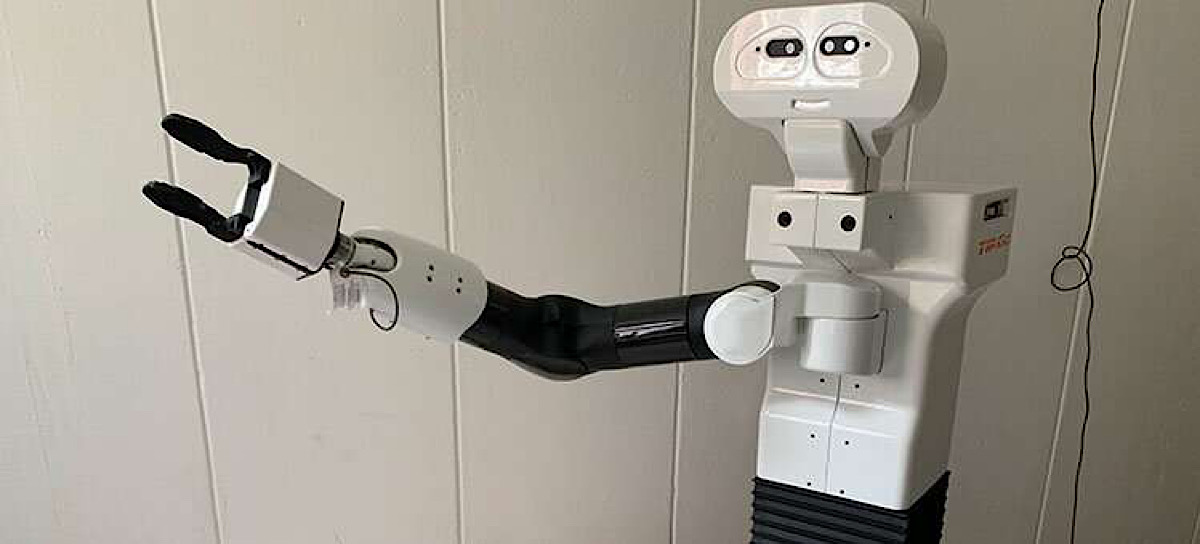
Robot Tiego is ready to stack cubes.

by Sandra Tavakoli and Karin Wik,  Chalmers University of Technology

Can robots adapt their own working methods to solve complex tasks? Researchers at Chalmers University of Technology, Sweden, have developed a new form of AI, which, by observing human behavior, can adapt to perform its tasks in a changeable environment. The hope is that robots that can be flexible in this way will be able to work alongside humans to a much greater degree.

“Robots that work in human environments need to be adaptable to the fact that humans are unique, and that we might all solve the same task in a different way. An important area in robot development, therefore, is to teach robots how to work alongside humans in dynamic environments,” says Maximilian Diehl, Doctoral Student at the Department of Electrical Engineering at Chalmers University of Technology and main researcher behind the project.

Continue reading… “Researchers develop new AI form that can adapt to perform tasks in changeable environments”

Spain hosts mass drone flight tests to prepare for a future where unmanned aircraft rule the skies

Image shows drones at sunset. Researchers in Spain have conducted a mass drone flight test to trial a new traffic management system for UAVs 

By Aisling Ní Chúláin 

Some bad news is in store for those irritated by the unmistakable buzzing of electric drones: they’re not going away anytime soon. In fact, they are set to become only more ubiquitous.

If estimates from SESAR – a European partnership tasked with overhauling European airspace and air traffic management – are to be believed, by 2050 there could be close to 7.5 million personal and commercial drones zipping through European skies.

To prepare for this new reality, researchers in Spain are testing out a new system that will, hopefully, keep these drones from crashing into each other.

Continue reading… “Spain hosts mass drone flight tests to prepare for a future where unmanned aircraft rule the skies”

CAR T Cells “Loaded” with Oncolytic Viruses Boost Attack on Solid Tumors

A new cancer immunotherapy approach devised by Mayo Clinic researchers combines chimeric antigen receptor (CAR) T-cell therapy with a cancer-killing virus. In animal models, the dual therapy, in the form of a virus-loaded CAR T cell, has been shown to target and treat solid cancer tumors more effectively than either the CAR T-cell therapy or the virus alone, or indeed, the CAR T-cell therapy and the virus administered sequentially.

Details about the new approach appeared in Science Translational Medicine, in an article titled, “Oncolytic virus–mediated expansion of dual-specific CAR T cells improves efficacy against solid tumors in mice.” The article indicates that virus-loaded CAR T cells can transfer and release an oncolytic virus in the vicinity of tumor cells, and that tumor cells subsequently become infected, suffer viral replication, and burst open. This sequence of events leads to a potent immune response.

“We show in an immunocompetent mouse model that coadministration of an oncolytic virus (OV) with CAR T cells expands dual-specific (DS) CAR T cells through presentation of viral antigens through their T-cell receptor (TCR),” the article’s authors wrote. “[This approach confers] a potent proliferative advantage, distinct memory phenotypes, and superior efficacy compared to virus alone or to CAR T cells without OV-mediated TCR stimulation.”

Continue reading… “CAR T Cells “Loaded” with Oncolytic Viruses Boost Attack on Solid Tumors”

Photonic quantum computer made in Germany

Everyone is talking about quantum computers. With the help of high interconnection of as many qubits as possible, huge amounts of data are to be processed more easily, quickly and securely in the future.

By Kiera Sowery

In the PhoQuant project, a consortium led by the quantum startup Q.ANT is researching photonic quantum computer chips – made in Germany – which can also be operated at room temperature. One of the 14 consortium partners is the Dresden-based Fraunhofer Institute for Photonic Microsystems IPMS.

In the project “PhoQuant” many years of experience in cutting-edge research and business come together to bring quantum technology to industry. Many quantum computers still operate at extremely low temperatures close to absolute zero (- 273.15 °C). Cooling requirements are correspondingly high, and direct on-chip coupling with classical computer architectures is not possible. In order to ensure a symbiosis of quantum computer chips and conventional mainframe computers, the new photonic chip process is being applied in the “PhoQuant” research project.

Continue reading… “Photonic quantum computer made in Germany”

NASA Tests Spacesuits With New Cooling System To Save Astronauts From Moon Temperatures

According to NASA, the spacesuit technologies are being tested for the upcoming Artemis missions on the Moon, which are set to take place in 2025. 

By Bhavya Sukheja

NASA tests spacesuits for upcoming Artemis missions on the Moon.

The US National Aeronautics and Space Administration (NASA) has recently revealed that it is developing spacesuit technologies for future astronauts on the Moon. In a new YouTube video, the US space agency informed that astronauts onboard the International Space Station (ISS) are testing the new spacesuits with built-in water cooling systems in order to stay safe from Sun’s unfiltered rays. NASA has outlined its upcoming technologies in the clip titled “Keeping Cool in Space”.

“As NASA embraces commercial partnerships to optimize spacesuit technology as part of the Artemis program, the Spacesuit Evaporation Rejection Flight Experiment (SERFE) payload continues to be tested onboard the International Space Station,” NASA wrote in the caption of the clip. 

Continue reading… “NASA Tests Spacesuits With New Cooling System To Save Astronauts From Moon Temperatures”

Bank of Canada Using Quantum Computing to Simulate Crypto Adoption Scenarios

The researchers’ model can complete in half an hour what would take a regular PC longer than a human lifetime.

By Stacy Elliott

The Bank of Canada has become the first G7 country to turn to quantum computing to simulate scenarios where cryptocurrency and fiat currency can coexist.

This week, Multiverse Computing, the startup leading Canada’s research, hit a milestone: Its model can evaluate more than 1 octillion possible scenarios in 30 minutes. An octillion is a 10 followed by 30 zeros.

That means Multiverse Computing has completed its proof-of-concept, which combines blockchain data from stablecoin Tether (USDT), whose tokens are pegged to the U.S. dollar, and public data from up to 10 major financial institutions. It also consulted with experts from two major Canadian banks to come up with realistic parameters. 

Multiverse Computing chose Tether for its model because the stablecoin, founded in 2014, had endured a variety of market scenarios in its eight years worth of blockchain data.

Most scenarios in the model showed that non-financial institution adoption of the cryptocurrency would be slow, since there was some upfront knowledge and cost associated with converting fiat to a digital asset. It was also able to simulate how banks might respond by reducing wire transfer fees to compete with the very low cost of crypto transactions.

Continue reading… “Bank of Canada Using Quantum Computing to Simulate Crypto Adoption Scenarios”

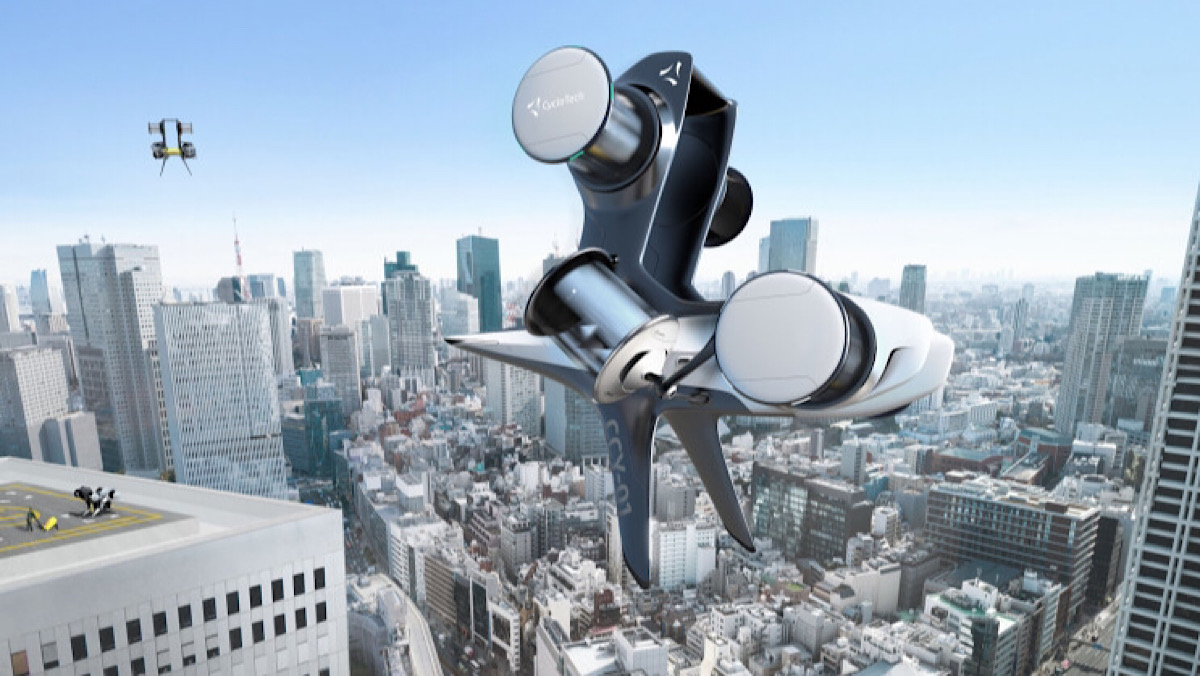
A new and outlandish delivery drone concept can carry 100 pounds up to 80 miles

It uses a cargo pod as an airfoil.

By  Chris Young

The CCY-01Cyclotech

Is that a UFO?

Austria-based vertical propulsion company Cyclotech partnered with Japanese delivery firm Yamato to develop a concept for an unusual delivery drone using Cyclotech’s thrust vectoring propulsion system.

The concept aircraft, called CCY-01, flies using six of Cyclotech’s unique CycloRotors and the company says it will be capable of precision landing in confined space at the same time as handling challenging wind conditions.

Cyclotech’s cylindrical rotors spin around at high speeds while several blades alter their angle to direct thrust. The company has performed its first free flight test using its system, which allows aircraft to rapidly redirect thrust. During that flight test, it used four Cyclorotors arranged in a manner that made its aircraft look almost like a flying car with wheels instead of a traditional drone.

Continue reading… “A new and outlandish delivery drone concept can carry 100 pounds up to 80 miles”

Your Next Surgeon Could Be a Slime Robot

Like an octopus, it wraps around objects. It can also swallow things inside your stomach and even “self heal.” This ooze could be the future of surgery.

By Claire Reilly

When you think of robotic surgery, you might think of remotely controlled robotic arms whirring over a patient, or tiny endoscopic cameras that help surgeons navigate with precise instruments.

You probably don’t think of a magnetically controlled slime robot slithering through your gastrointestinal tract and swallowing objects, like some kind of sci-fi ooze. 

But that’s the exact idea behind the Reconfigurable Magnetic Slime Robot — a stretchy, sluglike robot that can squeeze through tight spaces, wrap around objects and even “self heal” after it’s been cut in two. 

Continue reading… “Your Next Surgeon Could Be a Slime Robot”

A new heat engine with no moving parts is as efficient as a steam turbine

A thermophotovoltaic (TPV) cell (size 1 cm x 1 cm) mounted on a heat sink designed to measure the TPV cell efficiency. To measure the efficiency, the cell is exposed to an emitter and simultaneous measurements of electric power and heat flow through the device are taken.

by Jennifer Chu,  Massachusetts Institute of Technology

Engineers at MIT and the National Renewable Energy Laboratory (NREL) have designed a heat engine with no moving parts. Their new demonstrations show that it converts heat to electricity with over 40 percent efficiency—a performance better than that of traditional steam turbines.

The heat engine is a thermophotovoltaic (TPV) cell, similar to a solar panel’s photovoltaic cells, that passively captures high-energy photons from a white-hot heat source and converts them into electricity. The team’s design can generate electricity from a heat source of between 1,900 to 2,400 degrees Celsius, or up to about 4,300 degrees Fahrenheit.

The researchers plan to incorporate the TPV cell into a grid-scale thermal battery. The system would absorb excess energy from renewable sources such as the sun and store that energy in heavily insulated banks of hot graphite. When the energy is needed, such as on overcast days, TPV cells would convert the heat into electricity, and dispatch the energy to a power grid.

Continue reading… “A new heat engine with no moving parts is as efficient as a steam turbine”

Scientists Use New Ultrasound Tech To Treat Type 2 Diabetes Without Insulin

By Bharat Sharma

Scientists claim to have found a way to treat diabetes without insulinA new study published in the journal Nature Biomedical Engineering in late March deployed a special type of ultrasound called peripheral focused ultrasound stimulationThe treatment was able to treat type 2 diabetes in three animal species without requiring any additional medicines

Scientists claim to have found a way to treat diabetes without insulin. Apparently, the treatment worked in animals and human trials are on the cards next.

A new study published in the journal Nature Biomedical Engineering in late March deployed a special type of ultrasound called peripheral focused ultrasound stimulation(pFUS) to treat diabetes. It focused on the livers of subjects to assess whether sugar levels could be reduced.

The treatment was able to treat type 2 diabetes in three animal species without requiring any additional medicines.

Continue reading… “Scientists Use New Ultrasound Tech To Treat Type 2 Diabetes Without Insulin”

Nexo, Mastercard Launch World’s First Crypto-Backed Card

The Nexo Card allows you to spend the value of your cryptocurrency without selling it.

By Matthew Humphries

If you dabble in cryptocurrency, a new payment card has just launched with the support of Mastercard that allows you to spend the value of your crypto without actually selling it.

As Reuters reports, the card was created through a partnership between Mastercard and digital finance lending company Nexo. The so-called Nexo Card is being touted as the world’s first “crypto-backed” payment card.

Continue reading… “Nexo, Mastercard Launch World’s First Crypto-Backed Card”
Discover the Hidden Patterns of Tomorrow with Futurist Thomas Frey
Unlock Your Potential, Ignite Your Success.

By delving into the futuring techniques of Futurist Thomas Frey, you’ll embark on an enlightening journey.

Learn More about this exciting program.