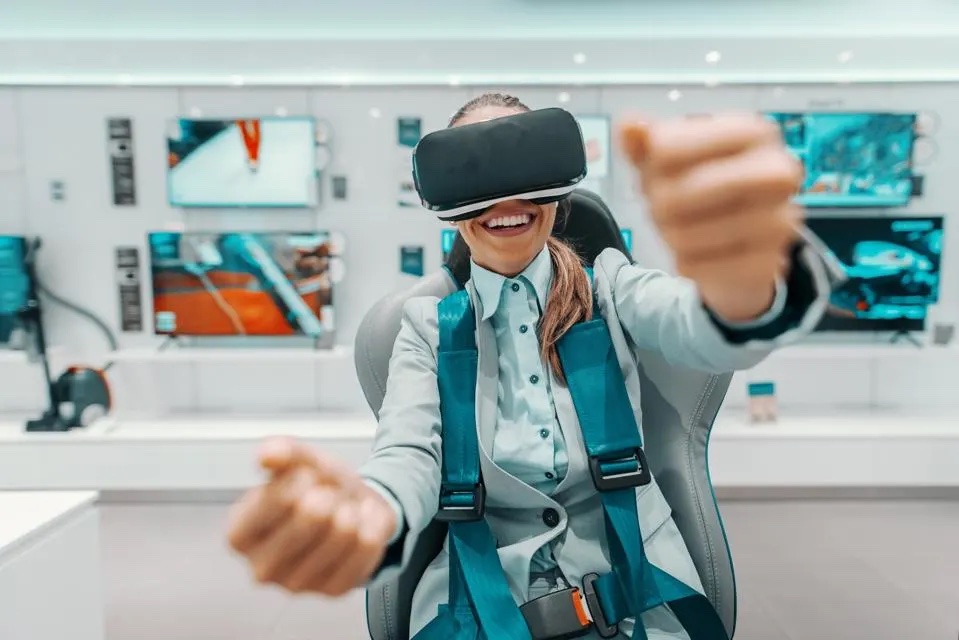
Wearable Tech Revolutionizes Music Experiences: The Impact of 5G on Immersive Entertainment

Jill Stark’s experience watching “The Flying Dutchman” at the Lyric Opera of Chicago in October was not just a visual delight; it was a sensory revolution. Stark, who is deaf, donned a groundbreaking innovation called the SoundShirt, allowing her to feel the opera’s sounds through haptic sensations transmitted by embedded microactuators in the fabric.

The SoundShirt, created by London-based wearable-tech brand CuteCircuit, wirelessly receives sound data captured by stage microphones and translates it into vibrations across the wearer’s torso and arms. For Stark, it was a transformative experience, highlighting the technology’s potential to create unique and immersive experiences for those with hearing loss.

Continue reading… “Wearable Tech Revolutionizes Music Experiences: The Impact of 5G on Immersive Entertainment”


Russia Unveils ‘Invisibility Cloaks’ for Troops: A Closer Look at Advanced Camouflage Technology

Recent reports from local news outlets reveal that Russia has developed and implemented cutting-edge camouflage technology for its military forces, commonly referred to as “invisibility cloaks.” This development aligns with the Russian military doctrine of ‘maskirovka,’ emphasizing the importance of deception in warfare.

Rebekah Koffler, a strategic military intelligence analyst and author of “Putin’s Playbook,” explained that the new ‘cloak-nevidimka’ is a manifestation of the maskirovka doctrine, designed to mislead adversaries about troop presence, position, size, attack timing, and equipment types. The emphasis is on controlling and manipulating the adversary’s perception of the battlefield.

Continue reading… “Russia Unveils ‘Invisibility Cloaks’ for Troops: A Closer Look at Advanced Camouflage Technology”

CRISPR Technology Unleashes Water-Efficient Tomatoes: A Breakthrough by Tel Aviv University

Researchers at Tel Aviv University have achieved a groundbreaking feat by cultivating and characterizing tomato varieties with increased water use efficiency, all without compromising yield. Leveraging the CRISPR genetic editing technology, the team managed to grow tomatoes that not only consume less water but also maintain high yield, quality, and taste. The study, led by Prof. Shaul Yalovsky and Dr. Nir Sade from the School of Plant Sciences and Food Security at Tel Aviv University’s Wise Faculty of Life Sciences, involved contributions from a diverse group of researchers, including collaborators from Ben Gurion University and the University of Oregon.

Published in the journal PNAS, the research addresses the pressing need for agricultural crops that thrive with reduced water consumption, given the challenges posed by global warming and dwindling freshwater resources. The study focuses on the intricate relationship between transpiration, where plants release water through their leaves, and the uptake of carbon dioxide, essential for photosynthesis.

Continue reading… “CRISPR Technology Unleashes Water-Efficient Tomatoes: A Breakthrough by Tel Aviv University”

Goji Berry Unveils Potential Against Alzheimer’s: A Groundbreaking Study

Chinese scientists have unveiled a groundbreaking discovery regarding the goji berry, a fruit traditionally revered in Chinese culture for its health benefits. Commonly known as the ‘wolfberry,’ this vibrant orange-red fruit is making waves beyond its culinary and medicinal roots due to its potential role in the fight against Alzheimer’s disease.

The study, led by a team at the Institute of Biophysics under the esteemed Chinese Academy of Sciences, investigated the neuroprotective properties of goji berry extract. Using the well-established biological model, C. elegans, the researchers explored how the extract could impact the notorious amyloid-beta protein, a significant contributor to Alzheimer’s disease.

Continue reading… “Goji Berry Unveils Potential Against Alzheimer’s: A Groundbreaking Study”

Ferrock: A Revolutionary Building Material Born in the Arizona Desert

In the realm of innovative construction materials, a unique substance that originated in the Arizona desert is gaining attention in scientific journals, promising a potential transformation of our buildings and infrastructure. Ferrock, a material pioneered at the University of Arizona, is proving to be a more resilient and environmentally friendly alternative to traditional concrete.

The inception of Ferrock dates back over a decade when doctoral student David Stone triumphed in an innovation contest with his groundbreaking cement substitute utilizing waste steel dust. Stone secured a patent for Ferrock in 2013 and subsequently founded Iron Shell to facilitate its commercialization, as reported by the university.

Continue reading… “Ferrock: A Revolutionary Building Material Born in the Arizona Desert”

Beyond Play: How Gaming Shapes the Future of Technology

Human evolution and development have been significantly influenced by play, a fundamental aspect that goes beyond mere entertainment. Through play, crucial behaviors for survival are learned, skills are honed, and cooperation is fostered, driving us toward innovation and social breakthroughs.

Evolution of Games Through Millennia Games have played an integral role in human history for over 5,000 years, evolving from ancient board games like Egypt’s Senet to today’s sophisticated video games. This evolution mirrors human progress and propels it, particularly in the realms of technology and business innovation.

The gaming industry has been a hotbed for novel business models, introducing concepts like freemium models, in-game purchasing, and advertising, setting precedents that now permeate the global business landscape. Today’s ubiquitous streaming subscription models trace their roots back to gaming, showcasing the industry’s profound influence on revenue generation and consumer habits.

Continue reading… “Beyond Play: How Gaming Shapes the Future of Technology”

Seoul Twin Eye: A Marvel of Innovation and Tradition Set to Redefine the Skyline

In a city where tradition intersects with innovation, the collaborative efforts of UNStudio, Arup, and local firm Heerim Architecture are about to unveil a groundbreaking architectural wonder—the Seoul Twin Eye. Poised proudly at Sangam World Cup Park in Seoul, this spokeless Ferris wheel marks a significant step forward in architectural achievement.

The brainchild of the Mayor’s visionary initiative, ‘Han River with a Thousand Sunsets,’ the Seoul Twin Eye stands as a symbol of unity, progress, and innovation. Soaring to a height of 180 meters, it is poised to become the world’s tallest spokeless Ferris wheel, gracing the banks of the Han River.

Continue reading… “Seoul Twin Eye: A Marvel of Innovation and Tradition Set to Redefine the Skyline”

Poly-Employment: A Growing Trend in the Workforce

Polyamory has been making headlines lately, but there’s another “poly” trend on the rise: “Poly-employment,” or the practice of working more than one job. A recent study by Deputy, a workforce management platform, reveals a significant increase in poly-employed shift workers, shedding light on this emerging trend.

While the concept of holding multiple jobs to make ends meet is not new, Deputy’s study indicates a notable surge in poly-employment from 2021 to 2023. The data, drawn from 120,000 shift workers across the globe, shows a doubling of poly-employed shift workers during this period.

Continue reading… “Poly-Employment: A Growing Trend in the Workforce”

Conversational AI: Shaping the Next UX Era

According to Nielsen Norman Group, the advent of AI and conversational interfaces marks the first significant shift in user interface (UI) paradigms in 60 years. This development might catch some off guard, prompting questions about the widespread presence of AI assistants and the timing of their emergence. Why is conversational AI gaining prominence now, and what considerations should guide our approach to these technologies moving forward?

Since the inception of personal computing in the 1980s, our interaction with technology has gradually evolved. Initially, users communicated with computers through command lines, requiring them to speak the computer’s language. Advancements in programming languages improved efficiency in this regard. The evolution continued with the introduction of graphical user interfaces (GUIs), the birth of UX design, and the integration of new interaction modes like swiping and tapping through smartphones and tablets.

Continue reading… “Conversational AI: Shaping the Next UX Era”

iCub 3 Humanoid Robot Allows Remote Attendance at Events

An innovative humanoid robot, iCub 3, is breaking new ground by enabling users to experience events remotely using haptic feedback gloves and a virtual reality (VR) headset. Weighing 52 kilograms and standing at 125 centimeters tall, the iCub 3 boasts 54 points of articulation, with cameras and sensors strategically placed across its aluminum alloy and plastic body. These sensors send data to the robot’s “brain,” allowing it to replicate sensations on a suit and VR headset worn by a person located hundreds of kilometers away.

Equipped with two cameras in its head resembling human eyes and an internet-connected computer functioning as its brain, the iCub 3 captures visual data and transmits it to the remote operator. The suit worn by the operator also features sensors that pick up their movements, enabling the robot to mirror their reactions. While there may be a slight delay of up to 100 milliseconds in capturing and transmitting visual footage, users can adjust by moving slightly slower than normal.

Continue reading… “iCub 3 Humanoid Robot Allows Remote Attendance at Events”

Google Unveils AI Writing Assistant for Chrome: Transforming the Web Landscape

Next month, Google is set to introduce a groundbreaking feature in its Chrome browser—an AI writing assistant designed to enhance users’ online writing experiences. With an estimated 3 billion people accessing the web through Chrome, this feature aims to assist users in expressing themselves confidently across various online platforms.

AI writing assistants have become increasingly prevalent in popular software, with Google testing generative AI in Gmail, Android messaging, and Docs. Microsoft has also integrated similar features into Office, Edge browser, and Windows. The introduction of AI-driven writing tools aligns with the evolution of user interfaces, extending beyond suggested replies and spellcheck.

Continue reading… “Google Unveils AI Writing Assistant for Chrome: Transforming the Web Landscape”

Navigating the XR Landscape: The Role of Virtual and Augmented Reality in Modern Workspaces

Jussi Havu, CEO of Glue Collaboration in Helsinki, opens his workweek immersed in a virtual-reality meeting room with 30 colleagues. Glue Collaboration’s mission is to integrate VR into conventional knowledge-work office settings, presenting a compelling business case for the transformative technology.

While initial expectations of XR (extended reality) revolutionizing knowledge-work offices on a broad scale haven’t materialized, XR tech companies like Glue Collaboration emphasize the continued relevance and potential of augmented reality (AR) and virtual reality (VR) in the evolving landscape of hybrid work.

Continue reading… “Navigating the XR Landscape: The Role of Virtual and Augmented Reality in Modern Workspaces”
Discover the Hidden Patterns of Tomorrow with Futurist Thomas Frey
Unlock Your Potential, Ignite Your Success.

By delving into the futuring techniques of Futurist Thomas Frey, you’ll embark on an enlightening journey.

Learn More about this exciting program.