
Where the next generation of companies will be built
By Futurist Thomas Frey
For over a century, makerspaces have been places where curious people learned to build things with their hands. They housed machine tools, welding stations, woodworking equipment, electronics benches, and 3D printers. Students, hobbyists, engineers, and entrepreneurs gathered under one roof to transform ideas into physical objects.
But something profound is happening to that model.
The next generation of makerspaces won’t be centered on making things. They’ll be centered on making intelligence. We’re entering the era of the AI Makerspace — and once you see the shape of it, you start to realize it may become the most important building type of the next twenty years.
A Building Designed Around One Purpose
Imagine walking into a 25,000-square-foot innovation center. There are no rows of cubicles and very few traditional offices. Instead, every room is designed around a single mission: helping people transform an idea into a functioning business, product, service, or invention at unprecedented speed.
Rather than providing access to expensive machine tools, this new kind of makerspace provides access to artificial intelligence, robotics, drones, autonomous agents, advanced computing, and rapid manufacturing technologies. It becomes a place where almost anyone can build what once required an entire company — and the barriers between imagination and execution start to disappear.
This isn’t a thought experiment. Agentic venture studios are already operating this way. One studio recently described running nine companies simultaneously with a single human co-worker and over a thousand AI agents working around the clock — a swarm that grew from roughly 40 agents to more than 300 within two days, and now sits above 1,000, with a nightly review agent proposing new hires for the founder to approve each morning. That’s not a prototype of the future. That’s Tuesday.
The AI Creation Studio
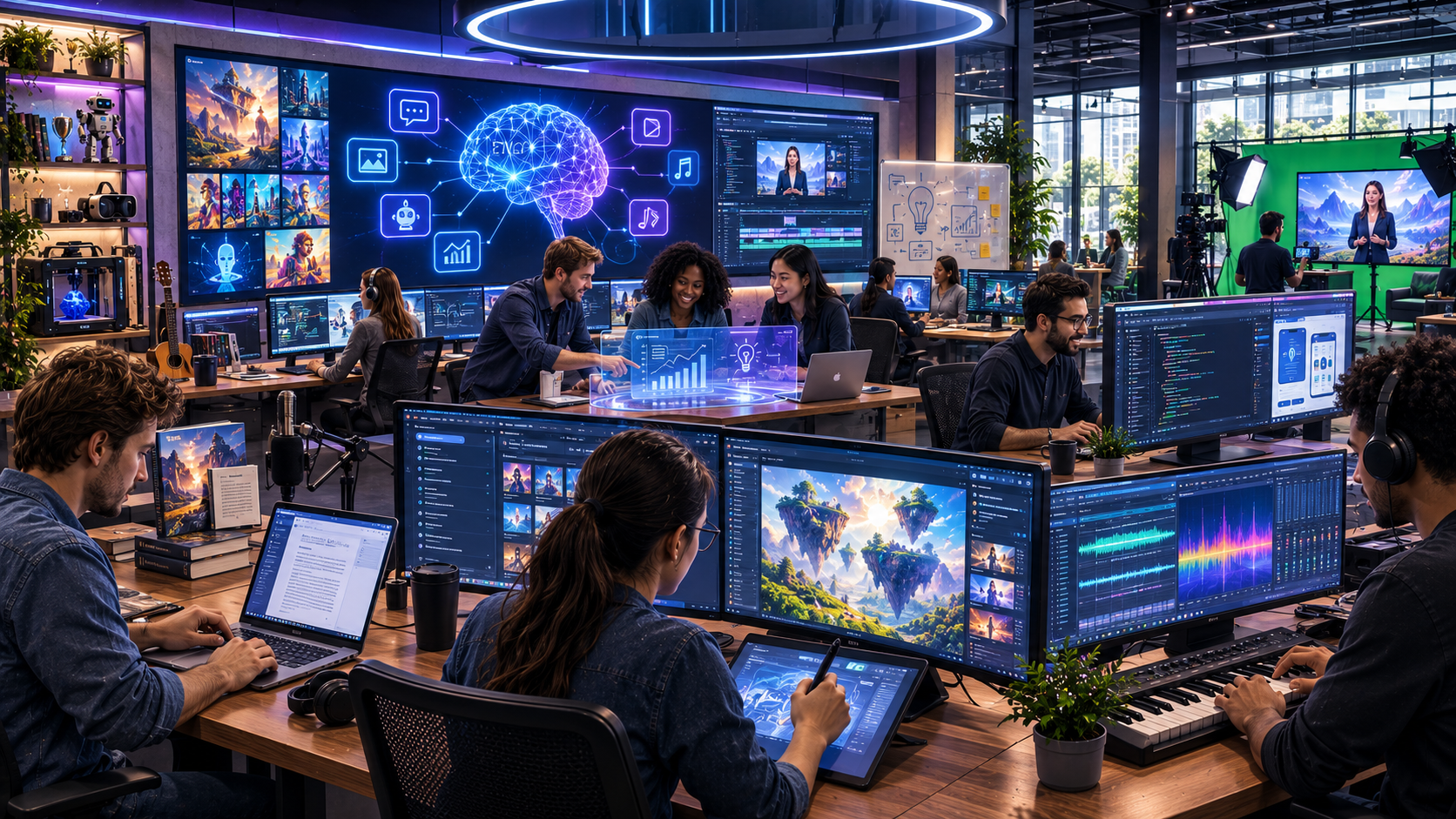
At the heart of the facility is an AI Creation Studio. Rows of workstations provide access to the latest language models, image generators, video production systems, coding assistants, music composition tools, research agents, and business planning software.
A visitor may arrive wanting to write a book. By the end of the day they have a manuscript, illustrations, a marketing strategy, audiobook narration, and a publishing plan. Another walks in with an idea for a software application. AI helps generate the code, design the interface, build documentation, create advertisements, and launch a website before dinner.
The speed is almost unsettling. But the tools don’t replace creativity — they amplify it.
The Robotics Lab
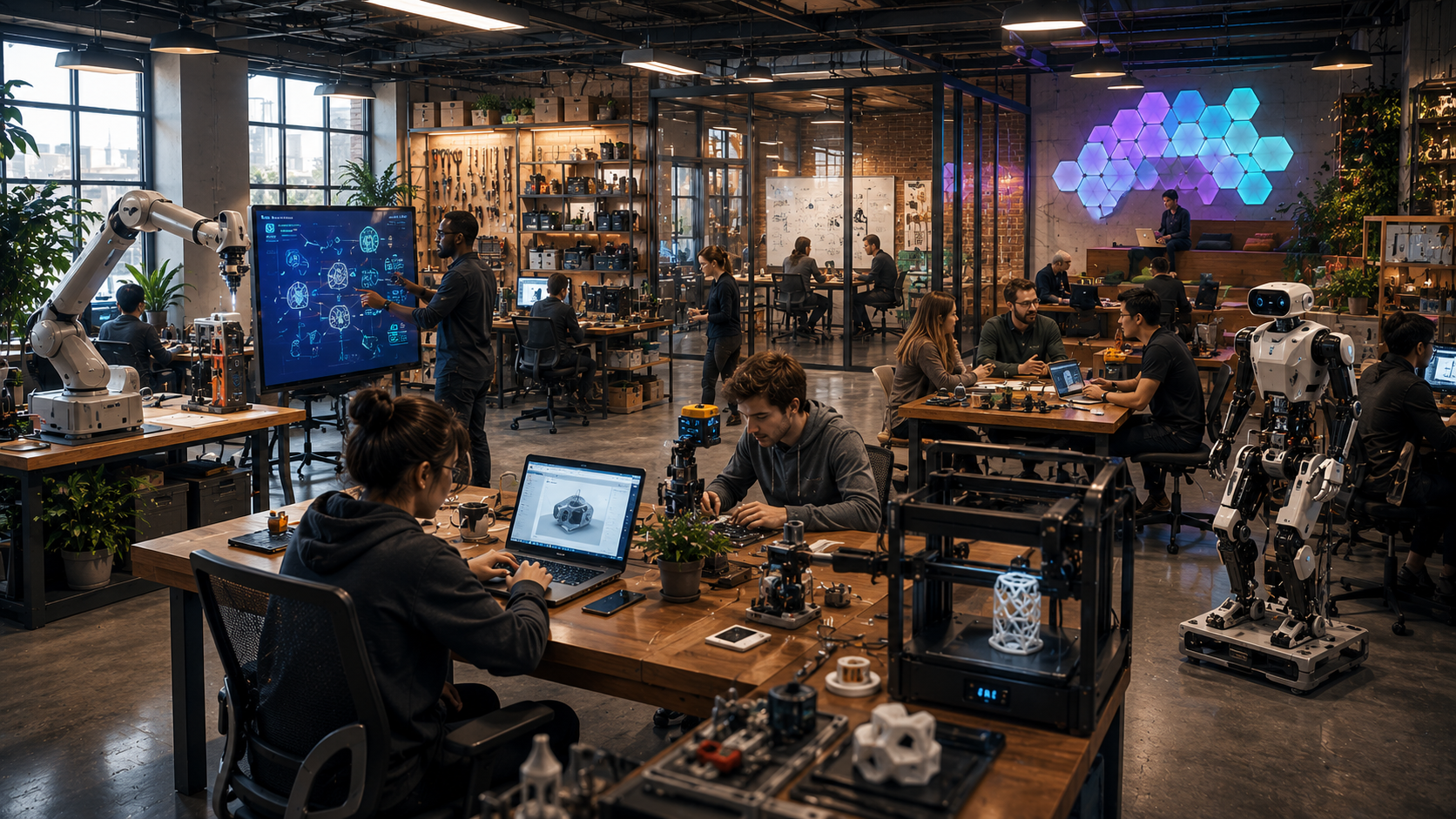
Just down the hall is the Robotics Lab. Industrial robot arms share space with autonomous mobile robots, drones, vision systems, robotic grippers, and increasingly capable humanoid robots.
Instead of spending months programming movement sequences, builders describe what they want accomplished. AI generates much of the underlying control logic while digital simulations identify problems before hardware is ever assembled. The result is dramatically faster experimentation — healthcare robots, warehouse automation, construction assistants, agricultural machines, and home service robots can all be prototyped under one roof.

The AI Agent Factory
Perhaps the most fascinating room is the AI Agent Factory. This isn’t where physical robots are built — it’s where digital workers are assembled.
Entrepreneurs create research assistants, financial analysts, customer support specialists, software developers, sales representatives, legal assistants, grant writers, and executive assistants, all powered by AI. Instead of hiring ten employees to launch a company, founders may begin with ten intelligent software agents that work continuously, coordinate with one another, and improve over time.
This shift is already visible in how AI-native startups measure themselves. Industry benchmarks now suggest AI-native companies can generate roughly three times the revenue per employee of traditional software firms — a $10 million company that once needed 50 to 70 people might now run with 15 to 20. The first generation of startups may genuinely have more AI employees than human ones. That changes the economics of entrepreneurship forever.
Your First Employees May Not Be Human
For generations, every startup followed a familiar path: raise money, rent office space, hire employees. Today that sequence is beginning to reverse.
Founders increasingly assemble teams of AI workers before hiring a single person. A startup might launch with an AI chief financial officer, marketing director, software engineer, customer support team, legal researcher, operations manager, and sales representative — all operating around the clock. Human employees are added only where judgment, relationships, leadership, or specialized expertise provide unique value.
Instead of asking, “How many people do we need?” future founders may ask, “Which jobs actually require people?” That’s a fundamentally different question — and it’s one that a growing number of AI venture studios are already answering in practice, running six or more portfolio companies with a five-person human team and an agent workforce underneath.
Digital Fabrication Meets Artificial Intelligence
Physical manufacturing doesn’t disappear inside the AI Makerspace. It becomes dramatically smarter. Designs generated by AI move directly into 3D printers, laser cutters, CNC machines, electronics labs, and composite fabrication equipment.
Need a better drone frame? AI generates one. Need a lighter robotic arm? AI proposes twenty alternatives before lunch. Need a custom enclosure? The printer starts producing it while you’re still discussing improvements. Design cycles that once required weeks now take hours.

The Venture Studio Connection
One of the most valuable features of an AI Makerspace isn’t the technology — it’s the business intelligence layered on top of it. Every project can be evaluated in real time, with AI estimating market demand, competitive pressure, manufacturing cost, pricing strategy, customer acquisition expense, intellectual property risk, and investment requirements.
Instead of asking whether something can be built, entrepreneurs immediately begin asking whether it should be built. The makerspace naturally evolves into a venture studio, and promising projects receive coaching, investment, legal support, branding assistance, customer validation, and strategic partnerships. Ideas no longer leave the building unfinished. They leave as companies — a model established venture studios have already validated, launching dozens of AI-native companies with the majority raising follow-on funding within a year.
Simulation Before Investment
Another room houses a giant visualization theater. Entire factories, hospitals, supply chains, neighborhoods, retail stores, transportation systems, and manufacturing operations exist as living digital models.
Before spending millions of dollars, entrepreneurs test thousands of possible futures. How will customers behave? Where are supply chain bottlenecks likely to emerge? How does pricing affect demand? What happens if a competitor enters the market? Simulation dramatically reduces uncertainty — the ability to test tomorrow before building tomorrow becomes one of the greatest competitive advantages any entrepreneur can possess.

The AI Media Factory
Marketing often determines whether an invention succeeds, and an AI Makerspace recognizes this. Dedicated media studios help founders create podcasts, videos, advertising campaigns, websites, training programs, virtual presenters, interactive avatars, and social media content. Small teams produce media that previously required agencies with dozens of specialists.
Ideas don’t simply get built. They get discovered.
The Community Becomes the Product
The most important feature of an AI Makerspace isn’t artificial intelligence — it’s human intelligence. The building becomes a magnet for entrepreneurs, engineers, designers, educators, investors, artists, programmers, students, retirees, and domain experts.
Every day includes demonstrations, hackathons, startup competitions, robotics showcases, investor forums, design challenges, educational workshops, and collaborative projects. The real value isn’t access to technology — it’s access to people who know how to use it. Innovation has always been a team sport. AI simply gives every team far more leverage.
Beyond the Makerspace
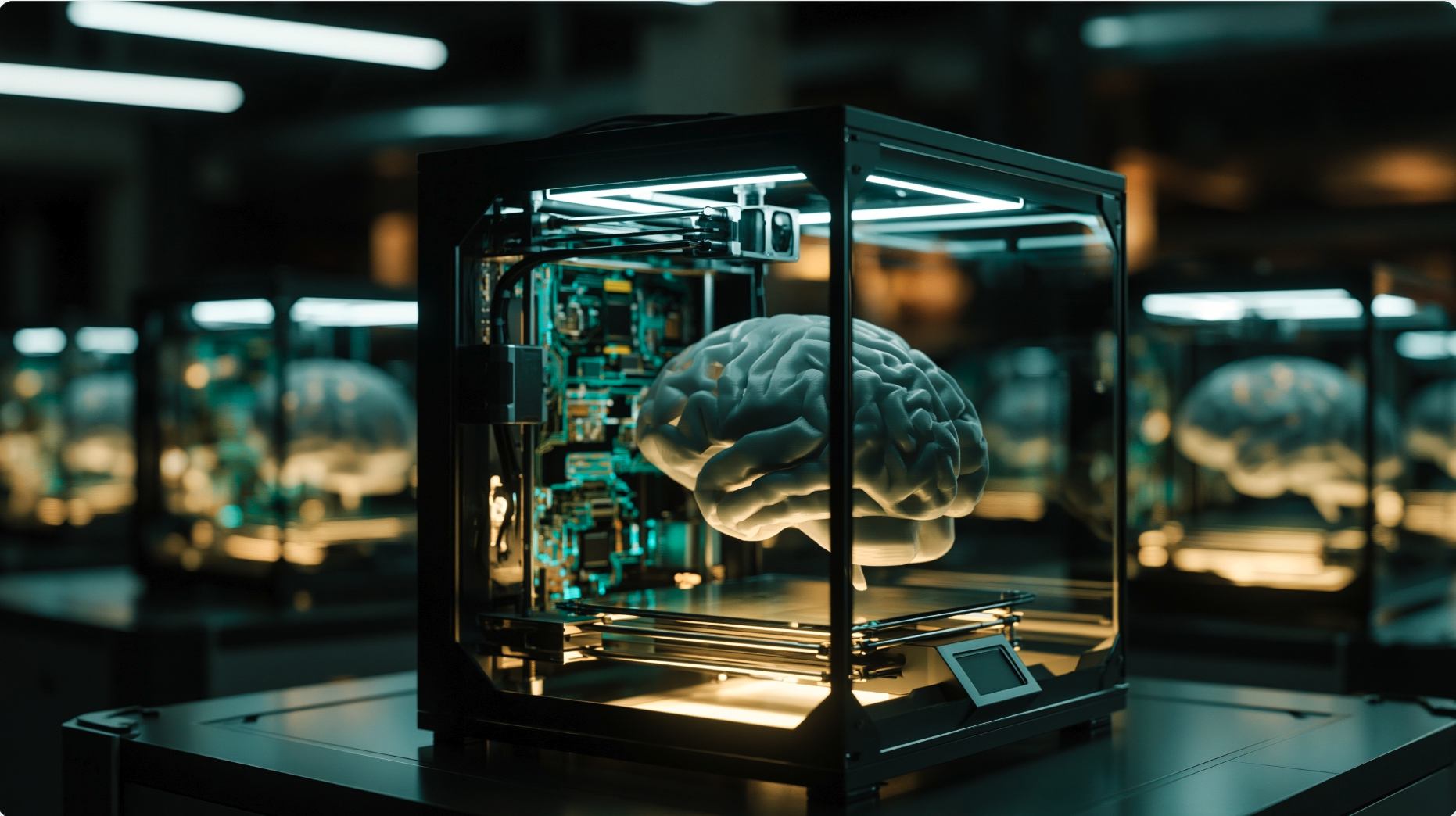
Historically, makerspaces have helped people build prototypes. The AI Makerspace builds futures. It shortens the distance between imagination and execution, lowers the cost of entrepreneurship, and democratizes innovation, allowing one determined individual to accomplish what once required an entire corporation.
Most importantly, it transforms communities. Imagine every city having an AI Makerspace connected to local schools, universities, businesses, investors, governments, nonprofits, and startup founders. Every challenge facing that community — whether transportation, healthcare, housing, education, energy, or economic development — could become a project waiting for someone to solve. The AI Makerspace becomes far more than a workshop. It becomes the innovation headquarters of an entire region.
History suggests that every great technological era creates a new kind of physical gathering place. The Industrial Revolution gave us factories. The Information Age gave us office parks and data centers. The startup revolution gave us incubators, accelerators, and coworking spaces.
The AI era will demand something different — not just a place where machines are built, but a place where intelligence itself is designed, assembled, tested, and launched into the world.
The communities that build these spaces first won’t simply create more startups. They’ll create entirely new economies. And twenty years from now, we’ll look back at the traditional makerspace the same way we now look at blacksmith shops — with admiration for what they accomplished, but with the understanding that an entirely new generation of builders has arrived.
Related Articles
- Alloy Partners — Inside the First Agentic Venture Studio: Building Nine Companies Simultaneously with 1,000+ AI Agents
- Shape — What Is an AI Venture Studio? (And Why It’s Different From a Regular One)
- Forum Ventures — AI Venture Studio for Startups