
Robotic walls, ceiling-mounted furniture, and windows that tint on command are early signs that tomorrow’s homes may behave less like buildings and more like machines.
By Futurist Thomas Frey
Imagine a home whose walls move, rooms expand, windows change transparency, and furniture reconfigures itself based on the needs of its occupants. Could future houses become more like programmable machines than permanent structures?
Think about the house you live in right now. The walls are exactly where they were the day it was built. The kitchen is the same size it was decades ago. The bedrooms sit empty for most of the day, while the living room gets crowded every evening.
We’ve always accepted this. When a house doesn’t fit our needs, we adapt to it. We squeeze into small spaces, ignore unused rooms, or eventually pack up and move.
But what if the house adapted to us instead?
Homes Have Always Been Frozen in Time
For thousands of years, a building has been a snapshot of one moment. An architect decides how people will live, the builders pour concrete and frame walls, and that decision becomes permanent.
The problem is that our lives aren’t permanent. Families grow and shrink. People start working from home, then go back to the office. Kids move out, parents move in. A layout that made perfect sense in 2005 can feel all wrong in 2030.
Remodeling is the only solution we’ve had, and it’s slow, expensive, and messy. That’s starting to change.
The Walls Are Already Starting to Move
One of the earliest signs came out of the MIT Media Lab. A spinout company called Ori developed robotic furniture that can transform a small apartment into a bedroom, office, walk-in closet, or living space, or slide back against the wall to open up the room.
The system is an L-shaped unit that rides on a track along a wall, packed with a closet, fold-out desk, drawers, a pull-out bed, and a space for a television. Residents control it with a wall panel, a phone app, or a smart speaker.
Ori’s founder, Hasier Larrea, had an even bigger vision. He imagined a day when kitchens, bathrooms, and partition walls could move too, letting a two-bedroom apartment turn into a large studio, a three-room office for a startup, or a wide-open space for a party. In his words, spaces would finally adapt to people, instead of people adapting to spaces.
Furniture That Lives in the Ceiling
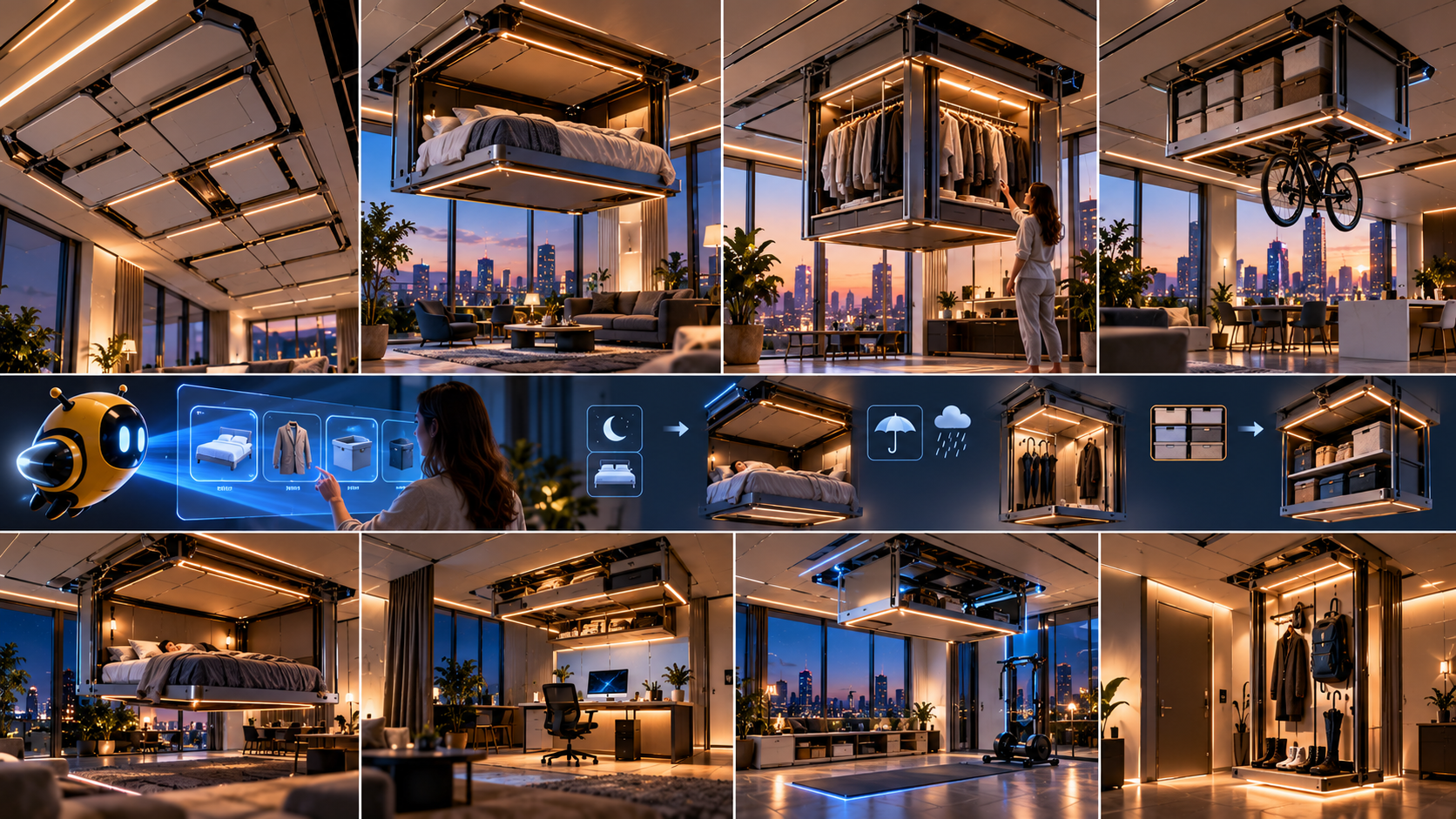
Another company, Bumblebee Spaces, looked up and saw wasted real estate. Its system stores beds, wardrobes, and storage units in the ceiling and lowers them on demand.
What makes Bumblebee interesting is the intelligence behind it. The system catalogs stored items and learns its owner’s habits over time so it can anticipate what will be needed. It might lower the bed at a set time each night, or link to the weather report to know when you’ll want an umbrella.
This isn’t just a lab demo. Bumblebee furnished five apartments at The Smile, a building in New York City designed by Bjarke Ingels Group, with a ceiling-mounted system that can stow away beds, desks, wardrobes, and storage.

Windows That Become Walls
The walls and furniture aren’t the only parts of the home learning new tricks. Windows are getting smarter too.
Electrochromic glass, often called smart glass, changes tint when an electrical charge is applied. Kinestral Technologies, maker of a product called Halio, installed its glass in meeting rooms where the windows could darken enough to become private partitions.
Users can control the tint with a phone or voice command, and the system can learn what level of shading people prefer at different times of day.
Now picture that idea spread across an entire house. A glass wall could be transparent in the morning to flood a room with sunlight, frosted at noon for privacy during a video call, and fully darkened at night for a movie.

A Day in the Life of a Shape-Shifting Home
Let’s fast-forward a couple of decades and walk through a single day.
At 6 a.m., your bed rises quietly into the ceiling while the windows slowly brighten to mimic sunrise. The bedroom becomes a small gym, with a yoga mat lowered into place.
By 8 a.m., the home has shifted into office mode. A desk slides out from a wall, a partition moves to create a quiet workspace, and the glass beside you frosts so neighbors can’t see your screen.
At noon, your elderly mother arrives for a visit. The house widens a hallway for her walker and opens a guest suite that didn’t exist an hour ago.
At 7 p.m., friends come over. The walls between the kitchen and living room retract, the furniture tucks away, and the lights and windows shift into party mode.
And while you sleep, the house quietly resets itself for tomorrow.
Why This Matters More Than It Sounds
At first glance, this might sound like a luxury gadget for tech enthusiasts. But adaptable homes could solve some very real problems.
Affordability
If a 500-square-foot apartment can perform like a 900-square-foot one, more people could afford to live closer to jobs and city centers.
Aging in Place
As populations grow older, homes that can widen doorways, lower shelves, or create accessible bathrooms on demand could help millions of people stay in their homes longer.
Changing Families
Multigenerational living is on the rise. A home that can split into separate spaces for grandparents, parents, and adult children, then merge back together, would fit modern families far better than fixed floor plans.
Energy and Comfort
Smart windows and adjustable spaces can reduce heating and cooling needs by managing sunlight and shrinking the area that needs climate control at any given moment.

The Home as a Programmable Machine
Here’s where it gets really interesting. Once a home’s walls, furniture, and windows are controlled by software, the house starts to behave like a smartphone.
You could download new room layouts the way you download apps. Designers could sell “room templates” for a home theater, a podcast studio, or a holiday dinner setup. Your AI assistant could notice that you’ve been working late and automatically reconfigure your space to separate work from rest.
A home might even receive software updates that improve how it moves, saves energy, or responds to your routines, long after the last nail was hammered.
The Problems We’ll Need to Solve
As exciting as this sounds, a house that moves raises new challenges.
Safety
Moving walls and descending beds must never trap a child, a pet, or a sleeping adult. Safety sensors and fail-safes will need to be far more reliable than today’s garage door openers.
Repairs and Obsolescence
What happens when a motor fails, or the company that built your system goes out of business? A home that depends on a single app or server could become a very expensive problem.
Privacy
Systems that catalog your belongings and learn your routines know a great deal about your life. Homeowners will need clear rules about who owns that data and where it goes.
Building Codes
Most building codes assume walls stay where they were built. Regulators will need new standards for structures that change shape every day.
Final Thoughts
For most of history, a house has been a container, a fixed shell we fill with our lives. The next generation of homes may become something closer to a partner, a system that listens, learns, and rearranges itself to fit the way we actually live.
It won’t happen overnight. Today’s robotic furniture is still expensive and limited to a handful of apartments. But the pieces are falling into place: moving walls, intelligent ceilings, glass that changes on command, and AI that can tie it all together.
Someday, we may look back at fixed floor plans the way we now look at rotary phones. They worked, but only because we didn’t know any better.
And the most valuable feature of the future home may not be its size or its view, but its ability to become whatever we need it to be by the time we wake up.
Related Articles
- MIT News: Robotic interiors
- Furniture Today: Bumblebee Spaces adds space with descending ceiling furniture
- The American Ceramic Society: Self-tinting electrochromic glass windows eliminate need for window coverings