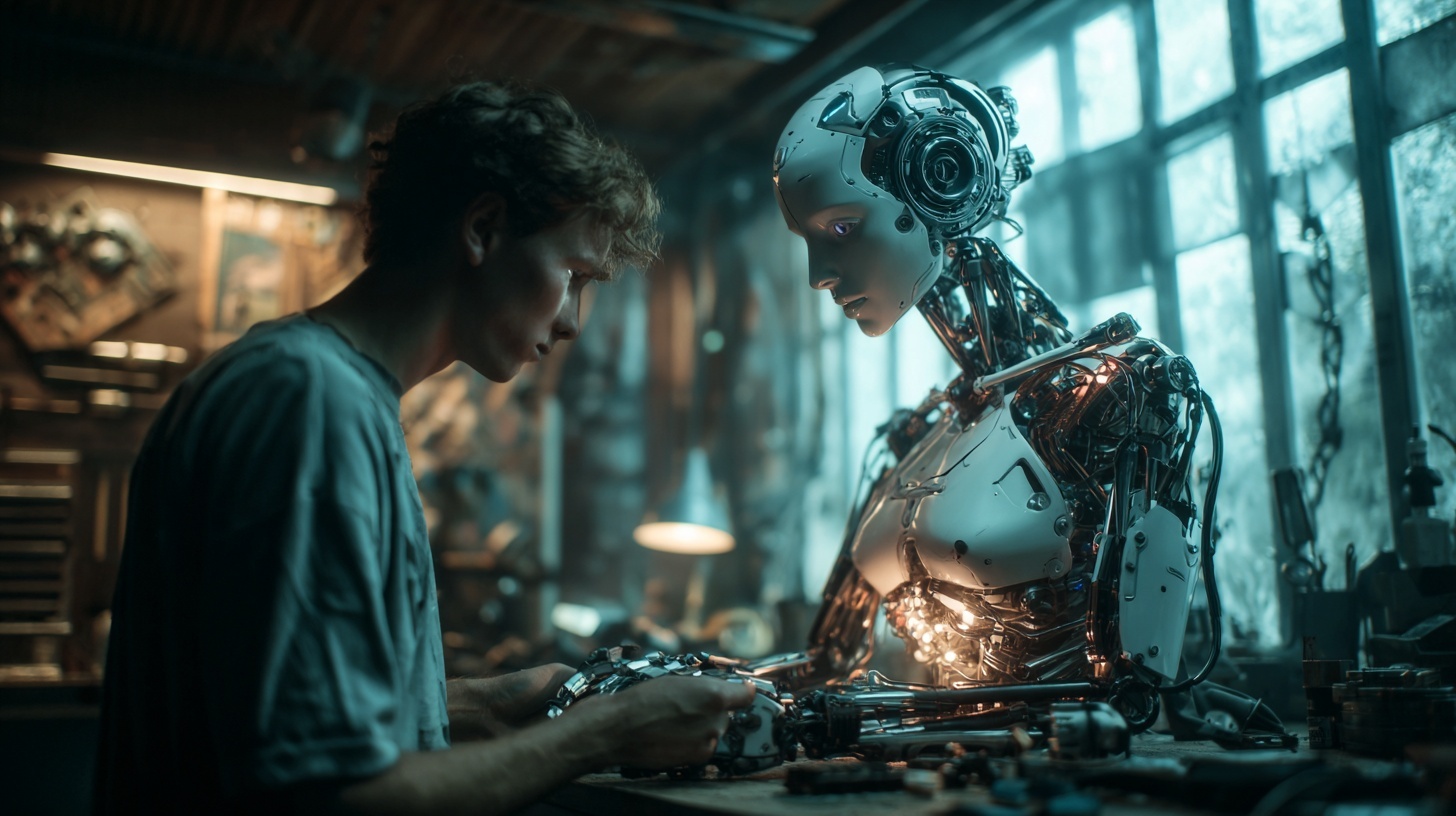
The Last Shift: Column 2
By Futurist Thomas Frey
Let me tell you about the worst first day anyone has ever had at a job.
It was yours. And mine. It was everyone’s.
You showed up not knowing where the bathroom was. You asked questions you’d later be embarrassed about. You made small mistakes and bigger ones. You nodded along in meetings while understanding about 40 percent of what was happening. You went home exhausted from the effort of simply trying, and you lay awake wondering if you’d made a terrible mistake taking this job at all.
That’s what it costs humans to start something new. Weeks or months of being worse at the job than the person who left. A slow, stumbling climb toward competence that we’ve come to accept as just how things work.
Now imagine a competitor who skips all of that.
Not someone who gets good fast. Someone who arrives already at the top. No orientation, no learning curve, no bad days. Just full capability, from the first minute, deployed everywhere at once.
That’s what we’re dealing with. And it changes everything about how we think about human work.
The Zero-to-Master Problem
When a company trains an AI system to do a job, it doesn’t train one version of that system. It trains one version, and then copies it infinitely. Every hospital that licenses a diagnostic AI gets the same model — the one trained on millions of scans, refined over years, performing at the level of a specialist with decades of experience.
The radiologist working her first shift in a community hospital in rural Ohio doesn’t have that. She has her training, her instincts, her slowly-accumulating experience. She will get better over years. The AI was better on day one.
That’s not a criticism of the radiologist. She’s doing something genuinely hard and genuinely human. But it illustrates a competitive dynamic that the working world has never faced before. Historically, every new worker starts weak and grows. Every new technology takes time to mature. This time, the technology arrives fully formed.
The FDA had approved more than 870 radiology AI tools by mid-2025 — tools that assist with detecting tumors, flagging anomalies, and processing imaging workloads that would take a human team hours. One platform reduced radiologist reporting time by nearly 18 percent in clinical studies. Another cut stroke treatment response times by over an hour. These aren’t marginal improvements. They are the kind of gains that, in any other industry, would justify eliminating entire layers of the workforce.
White Collars, Meet Your Replacement
Here’s the part that surprises people: it’s not just the physical jobs that are going. The assumption has always been that automation handles the grunt work, and the educated knowledge workers — the lawyers, the analysts, the financial advisors — remain safely above the fray.
That assumption is already wrong.
Legal discovery is a good example. In major litigation, lawyers used to spend months — and clients spent millions — having junior associates read through hundreds of thousands of documents looking for relevant material. It was mind-numbing, expensive, and error-prone work. AI systems now do it in days, sometimes hours, and in many cases find things the human reviewers missed. Some firms have cut their document review time by more than 90 percent.
The junior associates who used to do that work? There are fewer of them. The ones who remain are being asked to do higher-level work — which sounds like a good thing, until you realize that “higher-level work” doesn’t require nearly as many people.
The same pattern is playing out in finance. AI models now write earnings summaries, flag portfolio risks, and generate investment analysis that used to be the bread and butter of entry-level analysts. In customer service, AI handles the first, second, and often third tier of interaction with a fluency and patience that has shocked the companies deploying it. It doesn’t lose its temper. It doesn’t have a bad shift. It doesn’t quietly resent the customer who calls in for the fourth time that week.
In accounting, AI audits financial records with a consistency no human can match. In insurance, it processes claims and identifies fraud patterns at scales that would require armies of adjusters. In HR, it screens resumes, drafts job postings, and in some cases conducts initial interviews.
It is very, very good at these things. Right away. Without trying.
No Bad Days
There’s a phrase that keeps coming up in conversations with people who work alongside these systems: it doesn’t have bad days.
That sounds like a small thing. It isn’t.
Human performance varies. Everyone knows this, and most workplaces are built around managing it — the manager who checks in when someone seems off, the team that covers for each other, the client who understands that sometimes things slip. All of that built-in tolerance for human variability exists because variability is unavoidable.
Robots and AI systems don’t need that tolerance. The model that performs at 94 percent accuracy on a Tuesday performs at 94 percent accuracy on a Friday afternoon before a long weekend. It processes the same volume at 2 a.m. as it does at 10 a.m. It treats the ten-thousandth customer call with the same attention it gave the first.
In a business environment where efficiency is everything, consistency is worth an enormous amount of money. And the moment companies fully internalize that — and they are internalizing it right now — the pressure to reduce human headcount becomes not just a cost decision, but almost a logical necessity.
The Competence Trap
Here’s what makes this era genuinely different from every previous wave of automation: the machines are becoming competent at the things we thought made us irreplaceable.
Earlier waves of automation took over muscle. The cotton gin, the assembly line, the excavator — all of them replaced physical effort that humans found exhausting. We felt, perhaps rightly, that our minds were still our edge.
But the new wave is coming for cognition. Pattern recognition, analysis, language, reasoning — the tasks that required degrees and years of training and were rewarded accordingly. These are precisely the tasks that machine learning excels at, because they can be reduced to patterns in data. And the world runs on patterns in data.
The architect of this shift isn’t malice. It isn’t some corporate villain deciding to hollow out the workforce. It’s just math. An AI that can do in seconds what takes a human hours, and do it without benefits, sick days, or salary negotiations, isn’t a threat — from the perspective of a CEO and a balance sheet, it’s a miracle.
The threat, of course, is to the person whose job just became a miracle for someone else’s bottom line.
What Makes a Human Valuable Now
This is the question worth sitting with, and we’ll return to it throughout this series.
If a machine can diagnose your scan, review your contract, process your claim, and draft your report — and do all of it faster and more consistently than any human — what exactly is a human good at?
Some answers are obvious: creativity, moral judgment, genuine emotional connection, the ability to navigate situations that have never happened before. These are real. These matter. But they don’t currently employ most people, and they won’t absorb the displaced workforce anytime soon.
The optimists believe new jobs will emerge — that they always have, and that this time will be no different. Maybe. But the pace of this shift is unlike anything in industrial history, and “maybe” is a cold comfort to the paralegal, the radiologist, the junior analyst, and the customer service manager who are watching their roles evaporate in real time.
The robots arrived fully trained. The humans are still figuring out what to study.
Next column: “The Dwindling — How the Workforce Hollows Out”
Related Reading
How AI Is Transforming eDiscovery and Legal Document Review — American Bar Association
AI in Radiology: 2025 Trends, FDA Approvals & Adoption — IntuitionLabs
Navigating the AI Revolution: Will Radiology Sink or Soar? — National Institutes of Health / PMC