
A museum built around the physics that refuses to make intuitive sense
By Futurist Thomas Frey
Every museum I’ve written about in this series has one thing in common: whatever the subject, visitors can eventually wrap their heads around it. Robots move. Synthetic organisms grow. Space habitats can be walked through. Even the strangest ideas in those museums still play by rules your intuition recognizes.
Quantum physics breaks that pattern entirely. It’s the one field where even the physicists who work in it professionally will tell you, without embarrassment, that intuition is useless here. Particles exist in multiple states until observed. Two entangled particles influence each other instantly across any distance, with no signal traveling between them. The universe, at its smallest scale, behaves less like a machine and more like a probability cloud that only resolves into something definite the moment you look at it.
That’s exactly why it deserves its own museum. Not a wing inside a physics hall, not a rotating exhibit at a science center — a dedicated institution built entirely around the strangest, most consequential physics humans have ever discovered. Welcome to the Quantum Reality Museum.
Why This Museum Is Arriving Right on Schedule
This isn’t a museum concept ahead of its time. It’s a museum concept behind schedule, given how fast the underlying technology has moved into public view. The Museum of Science in Boston has already displayed a full-scale replica of IBM’s Q System One — the golden, chandelier-like structure that houses a quantum processor smaller than a fingernail at its base. Chicago’s O’Hare Airport recently installed a public quantum computing exhibit built by university students, explicitly designed to give travelers a hands-on encounter with quantum technology between flights. The University of Waterloo runs a traveling pop-up exhibition specifically built to explain superposition and cryptography to general audiences at science centers. Germany’s Deutsches Museum built an entire wing of its Nuremberg branch around future technology, quantum computing included, drawing government ministers to its opening.
In other words, the appetite and the content already exist — scattered across airport terminals, museum lobbies, and travelling pop-ups. What’s missing is the dedicated institution that pulls all of it together into one place, with the scale and depth the subject actually deserves.
Superposition and Entanglement: Making the Invisible Felt
Every quantum museum lives or dies on one design problem: how do you show someone something they can never directly see? A classical machine has moving parts you can watch. A quantum system, by definition, stops being quantum the moment you try to observe it directly.
Science educators have already found one answer: gamification. Interactive, game-based exhibits built specifically to teach quantum information concepts have shown real promise in museum settings, precisely because you can let visitors experience probabilistic outcomes through play — flipping a “quantum coin” that genuinely doesn’t have a determined value until it’s checked — rather than trying to explain the underlying math. The Quantum Reality Museum would take that instinct and scale it up: a room-sized entanglement demonstration where two visitors, physically separated, watch synchronized light patterns respond to each other’s choices in real time, making a phenomenon Einstein himself called “spooky action at a distance” something you feel in your body rather than just read about on a placard.
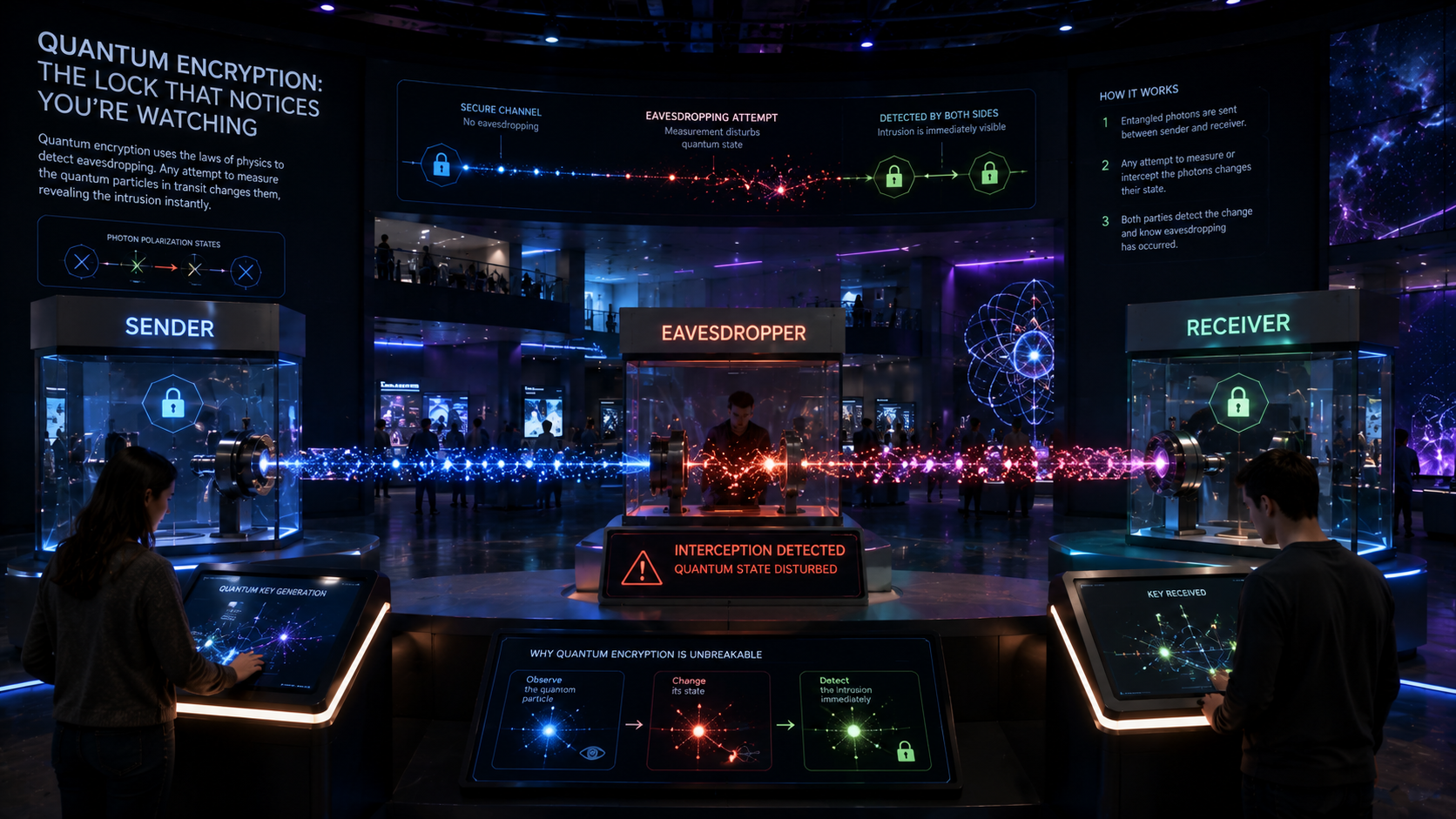
Quantum Encryption: The Lock That Notices You’re Watching
Few quantum applications are easier to make dramatic than encryption, because the core idea reads like a spy thriller: a quantum-encrypted message physically changes the moment someone tries to intercept it. Eavesdropping doesn’t just get detected after the fact — it alters the very particles being observed, making the intrusion visible to both parties instantly.
A hands-on exhibit here writes itself: visitors send a “secure” message across the room using entangled photons, then watch what happens when a planted “eavesdropper” tries to peek at it along the way. The message doesn’t just fail to arrive cleanly — it visibly, physically breaks, and both sender and receiver see exactly when and where the intrusion happened. It’s the closest thing physics has to a burglar alarm built into the laws of the universe itself.
Simulating Tomorrow’s Medicines and Materials
Quantum computers are notoriously bad at some things classical computers are great at. But there’s one category of problem where quantum machines have a genuine, structural advantage: simulating other quantum systems — which is exactly what a molecule is.
This gallery would let visitors watch, in simplified visual form, a quantum simulation modeling how a new drug candidate might bind to a protein, or how a novel battery material might behave at the atomic scale — the same kind of problem-solving global quantum research forums are now explicitly organizing entire conference tracks around, spanning pharma, energy, and climate applications. A classical supercomputer can approximate these interactions. A quantum computer can, in principle, model them the way nature actually computes them — because nature, at that scale, is already running on quantum rules.
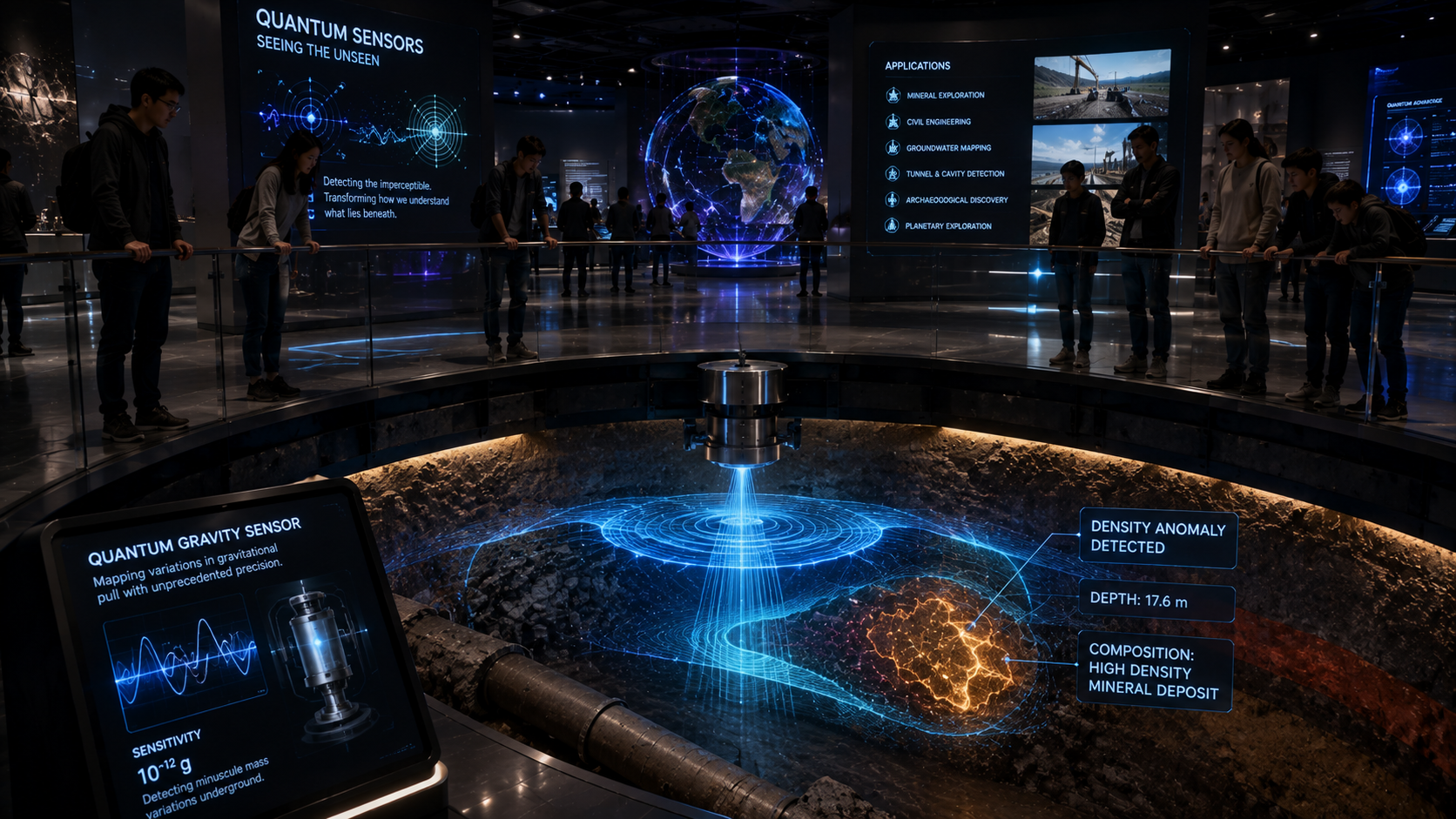
Quantum Sensors: Seeing Through the Ground Itself
Of all the applications in this museum, quantum sensing might be the most viscerally impressive, because it doesn’t require any leap of imagination about the future — it’s already deployable technology. Quantum gravity sensors can detect tiny variations in gravitational pull caused by underground voids, mineral deposits, or structural anomalies invisible to any camera or radar.
Picture a museum floor built as a working demonstration: a quantum gravimeter mounted beneath a walkway, revealing a hidden object buried beneath the museum floor itself — a chunk of dense mineral, an empty cavity, a buried pipe — detected purely through its gravitational signature, with no digging required. It’s a genuinely eerie experience: watching a machine “see” something using nothing but the faint tug of mass on space itself.
Classical vs. Quantum: Same Question, Radically Different Machines
Every gallery in this museum eventually circles back to one foundational comparison, and it deserves its own dedicated space: what actually makes a quantum machine different from the computer in your pocket?
A classical bit is either a 0 or a 1, full stop. A qubit can exist as a genuine mixture of both simultaneously — not “unknown,” but actually, physically undetermined until measured. This gallery would let visitors run the exact same simple problem on a classical logic demonstration and a simplified quantum circuit side by side, watching the quantum version explore multiple possible answers in parallel rather than checking them one at a time. It’s the clearest, most concrete way to make an abstract computer science concept feel like a genuine difference in kind, not just a difference in speed.
The Signature Exhibit: The Room of Probabilities
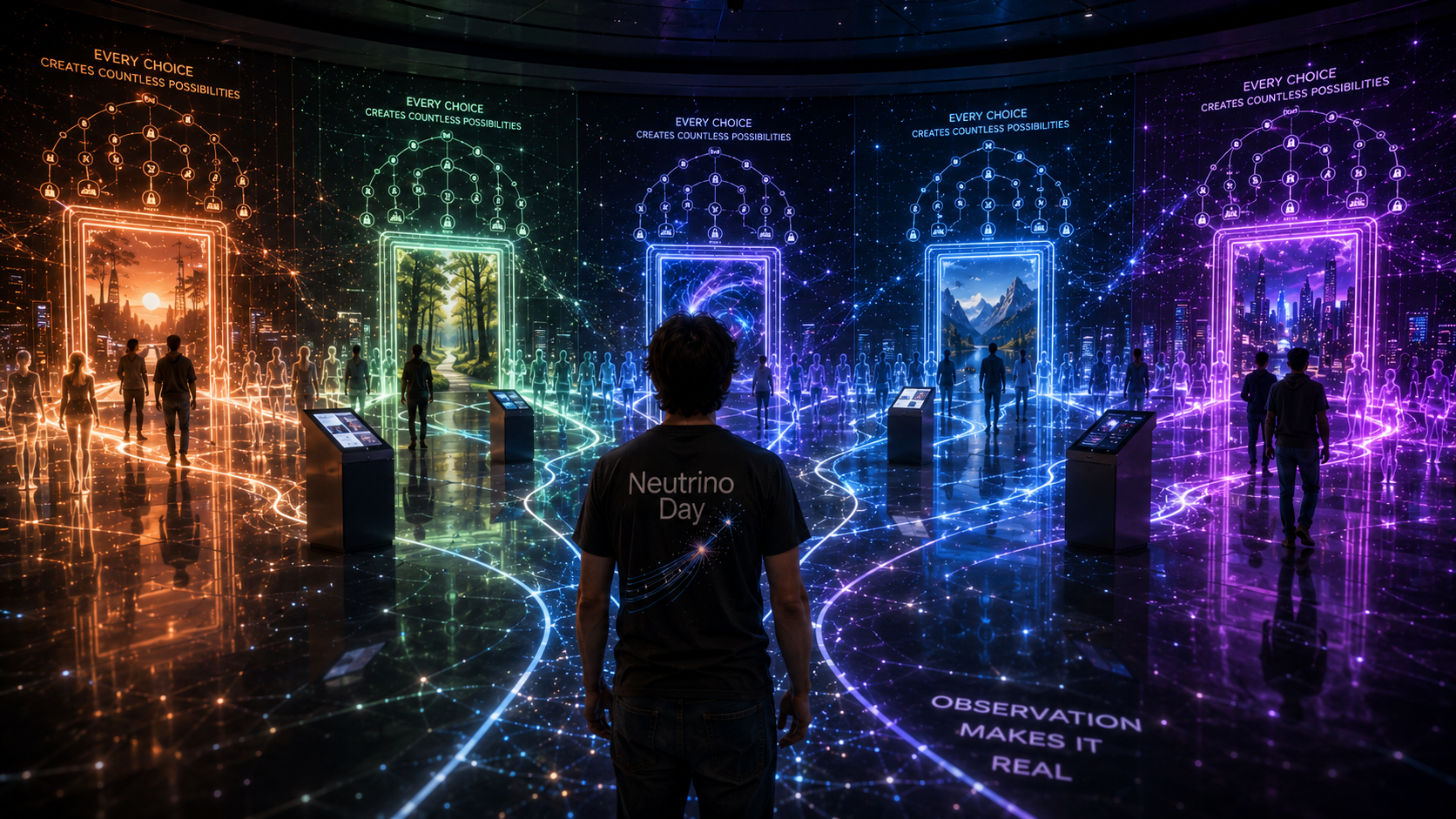
Every museum in this series needs one exhibit that visitors travel specifically to experience, and for the Quantum Reality Museum, it has to be a walk-through Room of Probabilities.
Here’s how it would work: as a visitor moves through the room, sensors track their choices — which path they take, which door they open, which button they press. Rather than committing to a single outcome, the room’s projection system displays every possible branching result simultaneously, layered translucently across the walls like overlapping ghosts of futures that haven’t happened yet. Only when the visitor commits to a final choice — stepping through a designated threshold — does the room “collapse” the projection down to a single, definite outcome, echoing the same measurement problem that defines quantum mechanics itself: a system exists in multiple potential states until an observation forces it into one.
It’s part physics lesson, part fun-house mirror, and part genuine philosophical gut-punch. Visitors don’t just learn what superposition means. They walk through a room that briefly makes them a superposition — every choice unresolved, every outcome simultaneously possible, right up until the moment they choose.
A Museum for a Universe That Refuses to Simplify Itself
Most museums exist to make the complicated feel understandable. This one has a stranger job: making the genuinely incomprehensible feel real anyway. Quantum mechanics isn’t confusing because we haven’t explained it well enough yet — it’s confusing because it describes a universe that doesn’t behave the way human intuition evolved to expect.
The Quantum Reality Museum wouldn’t resolve that tension. It would let visitors stand inside it — walking through a room built entirely around uncertainty, and coming out the other side with a felt, physical memory of what physicists have been trying to explain in words for a century.
Related Articles
- Inside Quantum Technology — Replica of IBM Q System Quantum Computer on Display in Museum of Science in Boston
- University of Chicago (STAGE Center) — New STAGE Center exhibit at O’Hare welcomes travelers to the Quantum Prairie
- Association of Science and Technology Centers (ASTC) — Engaging the public in quantum information science through interactive gamified learning