When Every Vehicle Becomes a Robot
How Tesla’s Next Move Rewrites the Rules of Transportation
By Futurist Thomas Frey
n Every Vehicle Becomes a Robot
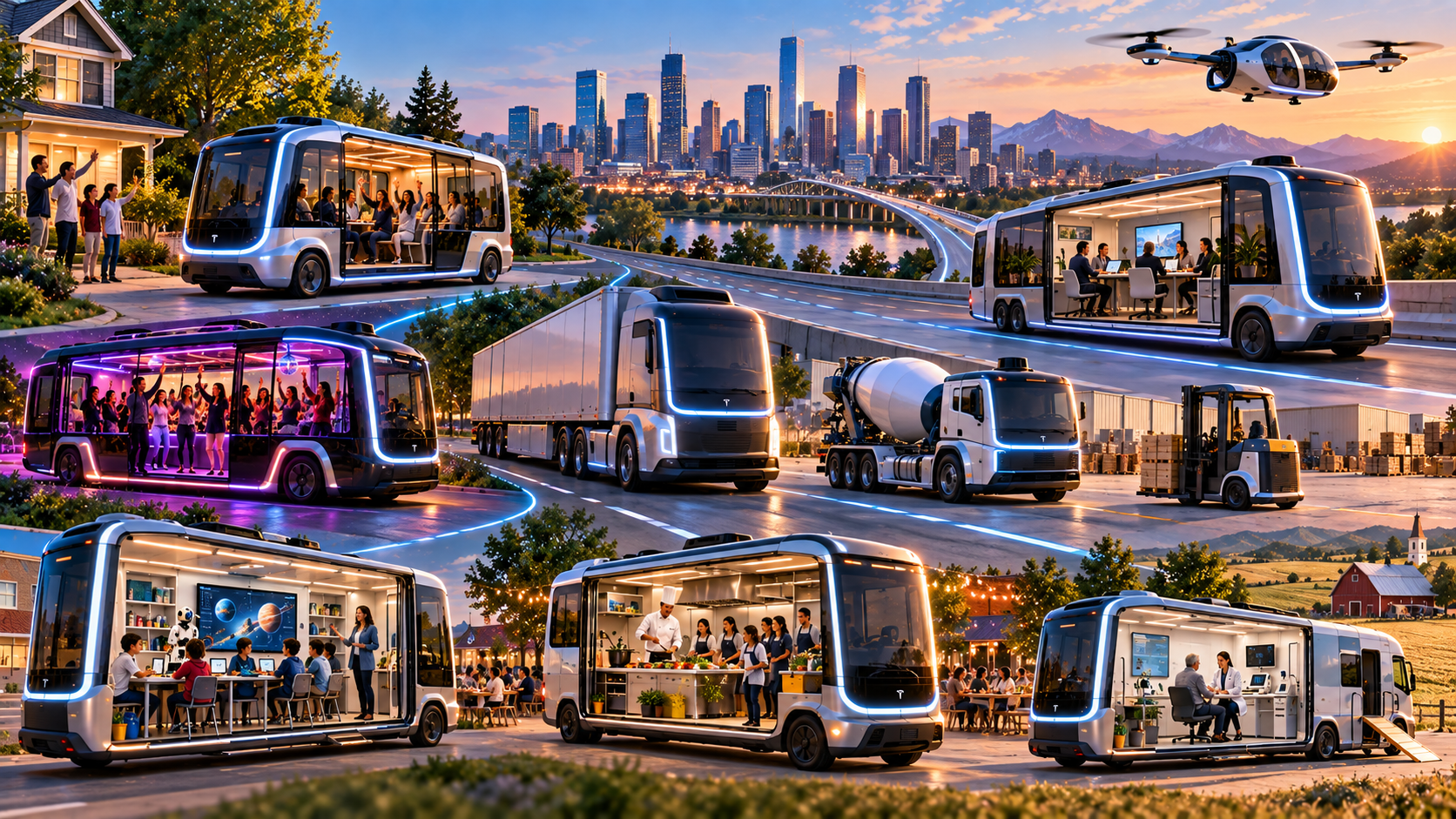
When Tesla gets Full Self-Driving working reliably in cars, their next move will be to add it to a wide range of other vehicles — cement trucks, forklifts, mobile offices, mobile party trucks, mobile conference rooms, mobile classrooms, mobile cooking schools, and more. The profound question isn’t whether this technology will spread beyond the passenger car — it’s how we manage a world where nearly everything with wheels can drive itself.
Here’s a pattern I’ve seen play out again and again in my career studying the future: a technology gets perfected for one narrow use case, and then someone realizes the underlying capability is actually a general-purpose tool that belongs everywhere. The electric motor started in factories and ended up in toothbrushes. The microprocessor started in calculators and ended up in refrigerators. I believe self-driving technology is about to follow the exact same arc — and Tesla is positioned to be the company that proves it.
Right now, most people think of Full Self-Driving as a feature for commuting to work or hailing a robotaxi. That’s a rounding error compared to what’s coming next. Once a company solves the hard problem of teaching a vehicle to perceive its surroundings, predict what other objects will do, and navigate safely without a human — the “vehicle” part becomes almost interchangeable. A cement truck, a forklift, and a Model Y are all, at their core, boxes on wheels that need to get from point A to point B without hitting anything. Solve that problem once, and you can license the solution to nearly any vehicle category that exists.
The S-Curve Nobody’s Watching Closely Enough
Every technology I’ve ever studied follows the same basic shape when you chart its adoption over time: a flat, frustrating start, a sudden and almost violent middle acceleration, and then a leveling-off once the market is saturated. We call it the S-curve, and it explains almost everything about why new technologies feel simultaneously “nowhere” and “everywhere” within the space of just a few years.
The early flat part of the curve is brutal and deceptive. It’s where a technology spends years absorbing capital, working through failures, and getting dismissed by skeptics as overhyped — right up until it isn’t. Electric vehicles spent roughly a decade crawling along the bottom of their own S-curve before sales exploded. Smartphones did the same thing throughout the 2000s before the iPhone tipped the curve upward. Self-driving passenger cars are, right now, still climbing out of that flat opening stretch — genuinely useful in select cities, still expanding market by market, still occasionally stumbling in ways that make headlines.
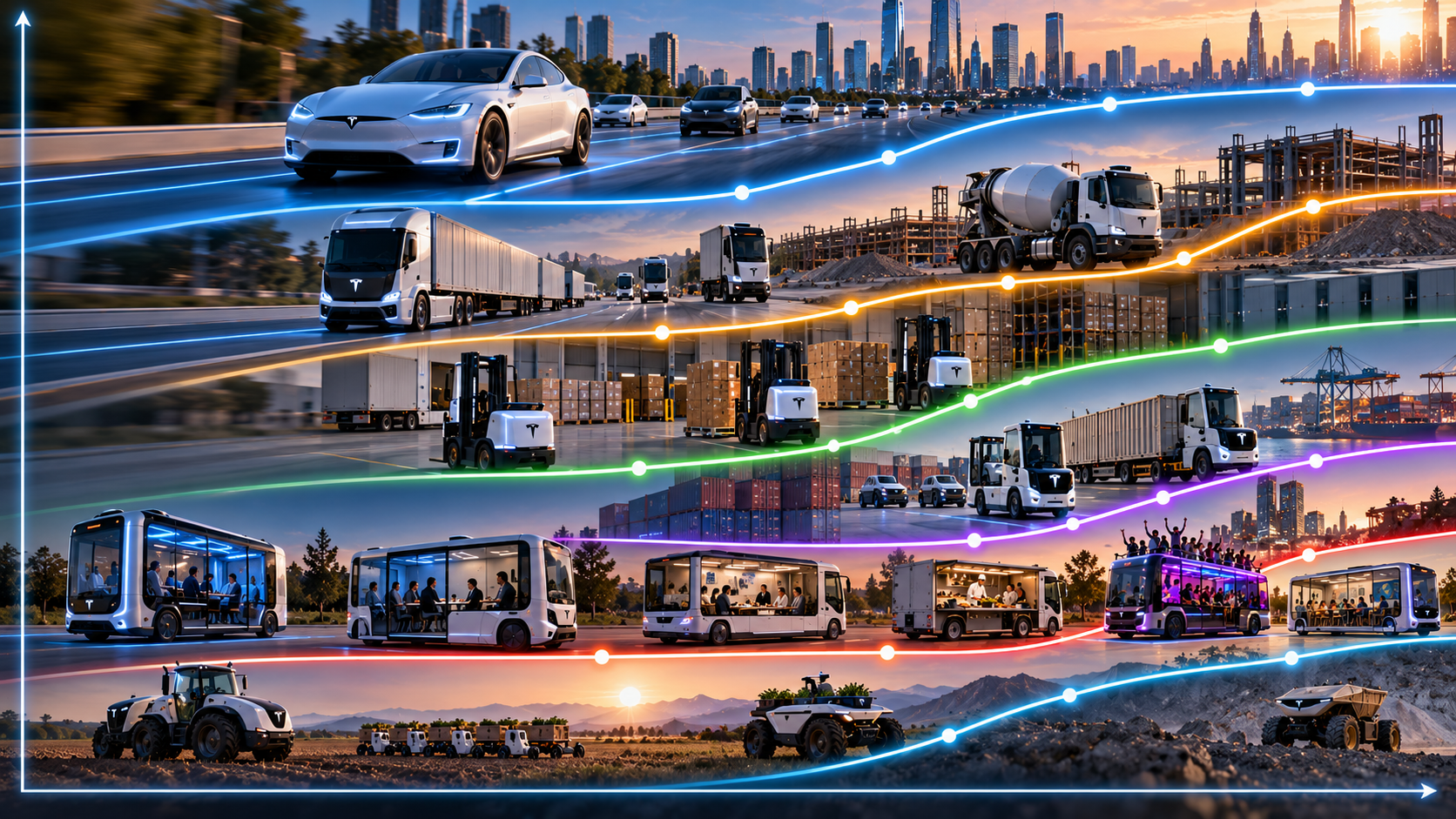
Here’s what most people miss: Tesla isn’t running one S-curve. It’s about to run several, stacked on top of each other, each starting its climb at a different moment. Passenger-car autonomy is the first curve, further along than any of the others. Industrial and commercial autonomy — cement trucks, forklifts, yard tractors — is a second curve, just beginning its climb, riding on the technical breakthroughs the first curve already paid for. And an entirely new category — autonomous mobile spaces like conference rooms, classrooms, and cooking schools built around self-driving platforms — hasn’t even started its curve yet. It’s still sitting at the flat, unglamorous starting line, waiting for someone to prove the concept works even once.
This stacking effect is exactly why disruption from this technology will feel sudden even though, in hindsight, it was building for years. Each curve, once it starts climbing, climbs faster than the one before it, because it inherits sensors, safety validation, and public trust the first curve had to earn the hard way. The self-driving car took Tesla and its competitors the better part of two decades to get road-legal. The self-driving forklift, riding on that same underlying perception technology, won’t take anywhere near that long. And the self-driving mobile classroom, once someone builds the first credible version, may go from novelty to commonplace in a handful of years rather than a handful of decades.
From Passenger Cars to Industrial Fleets
The clearest early evidence of this second curve is happening in warehouses right now, just not with Tesla’s badge on it. The autonomous forklift market alone is projected to roughly double by the early 2030s, driven by labor shortages and round-the-clock e-commerce demand. These machines use the same core toolkit as a self-driving car — cameras, sensors, real-time mapping — just scaled down to navigate narrow warehouse aisles instead of city streets. It’s a textbook example of a technology climbing a fresh S-curve faster because the hardest problems were already solved somewhere else first.
Tesla’s own roadmap points the same direction. The company has already signaled that its next major autonomy target after passenger cars is the Tesla Semi, with full self-driving capability expected to follow the truck’s production ramp. Once a Semi can safely merge onto a highway without a driver, the leap to a self-driving cement truck circling a construction site, or an autonomous yard tractor shuttling containers around a port, is far smaller than the leap Tesla already made getting a car to navigate a chaotic city intersection.
Think about what that means for a concrete company today. Every mixer truck currently requires a licensed driver, working limited hours, taking mandated breaks, and costing the company real money whether the truck is hauling a load or sitting empty. An autonomous mixer truck could run its route around the clock, precisely timed to when the concrete needs to be poured, without ever needing a lunch break or hitting a daily hours-of-service limit. Multiply that efficiency gain across every industrial vehicle in America — cranes, dump trucks, street sweepers, snowplows — and you start to see why this isn’t a minor product extension. It’s an entirely new industry, and it’s still early enough on its own curve that most competitors haven’t even noticed the race has started.
When the Vehicle Becomes the Destination
Here’s where things get genuinely strange, and genuinely exciting — and where we’re standing at the very base of an S-curve that hasn’t started climbing yet. Once a vehicle can drive itself, the vehicle no longer needs to exist primarily as a way to get somewhere. It can become the destination itself.
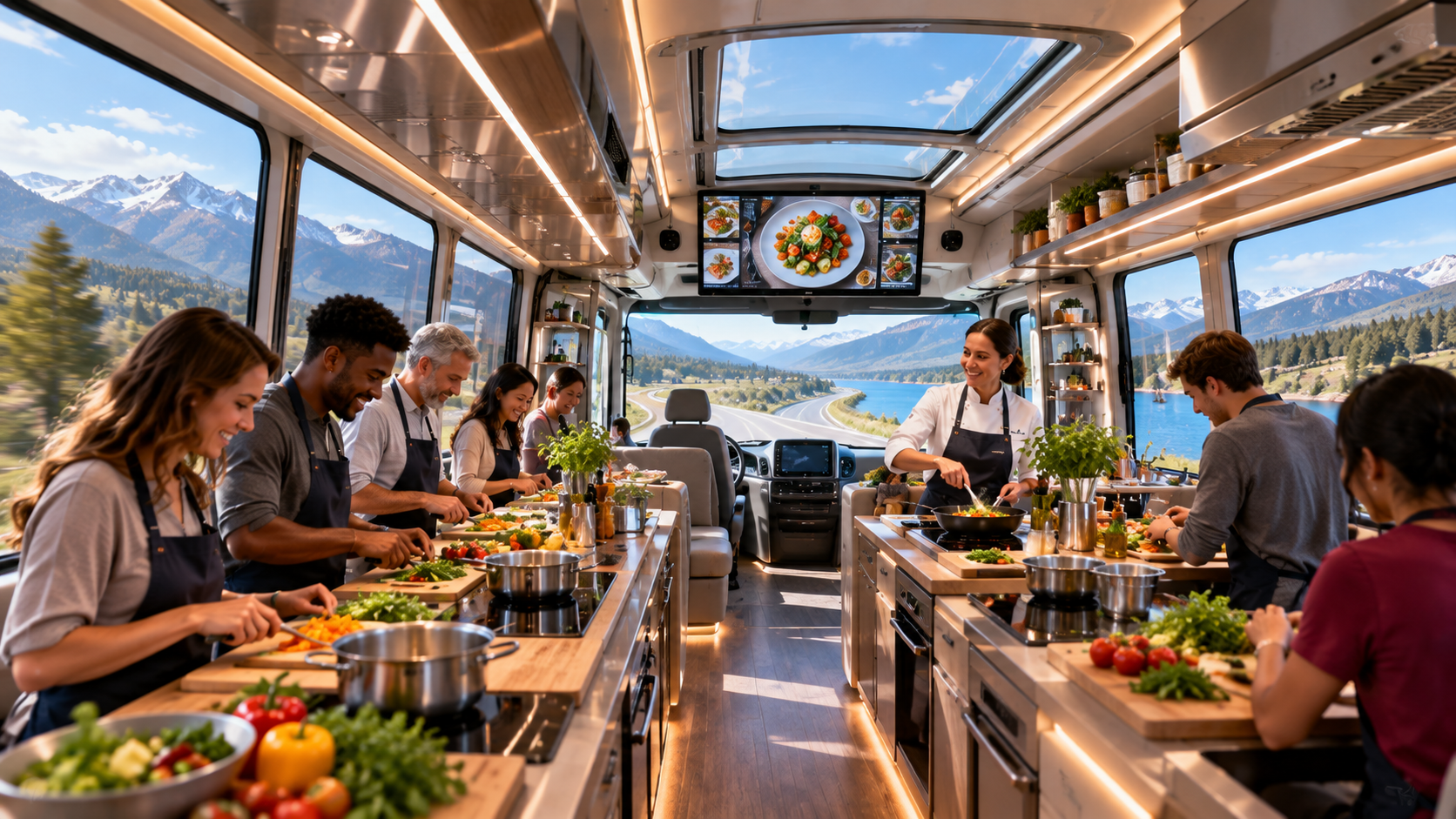
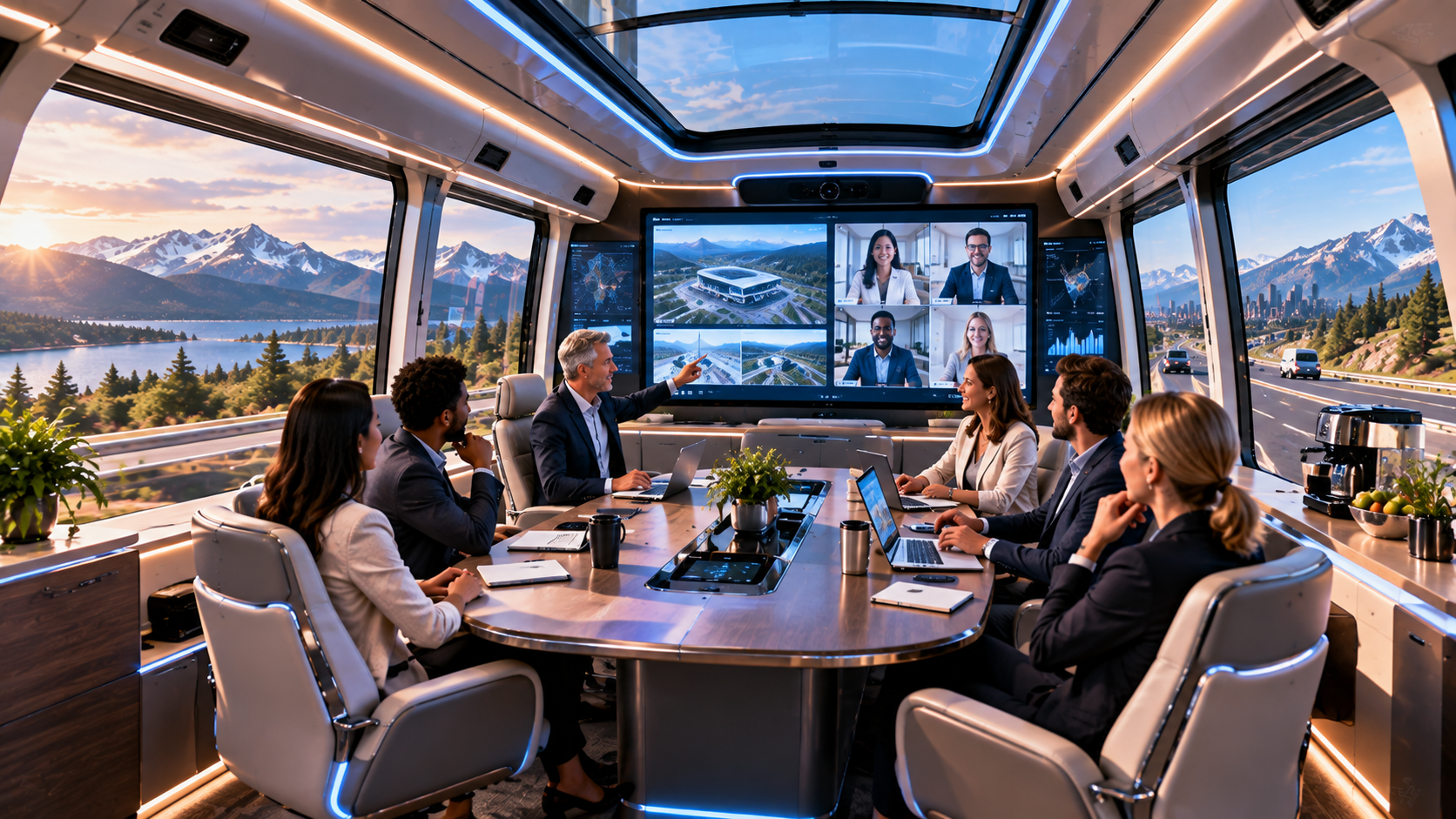
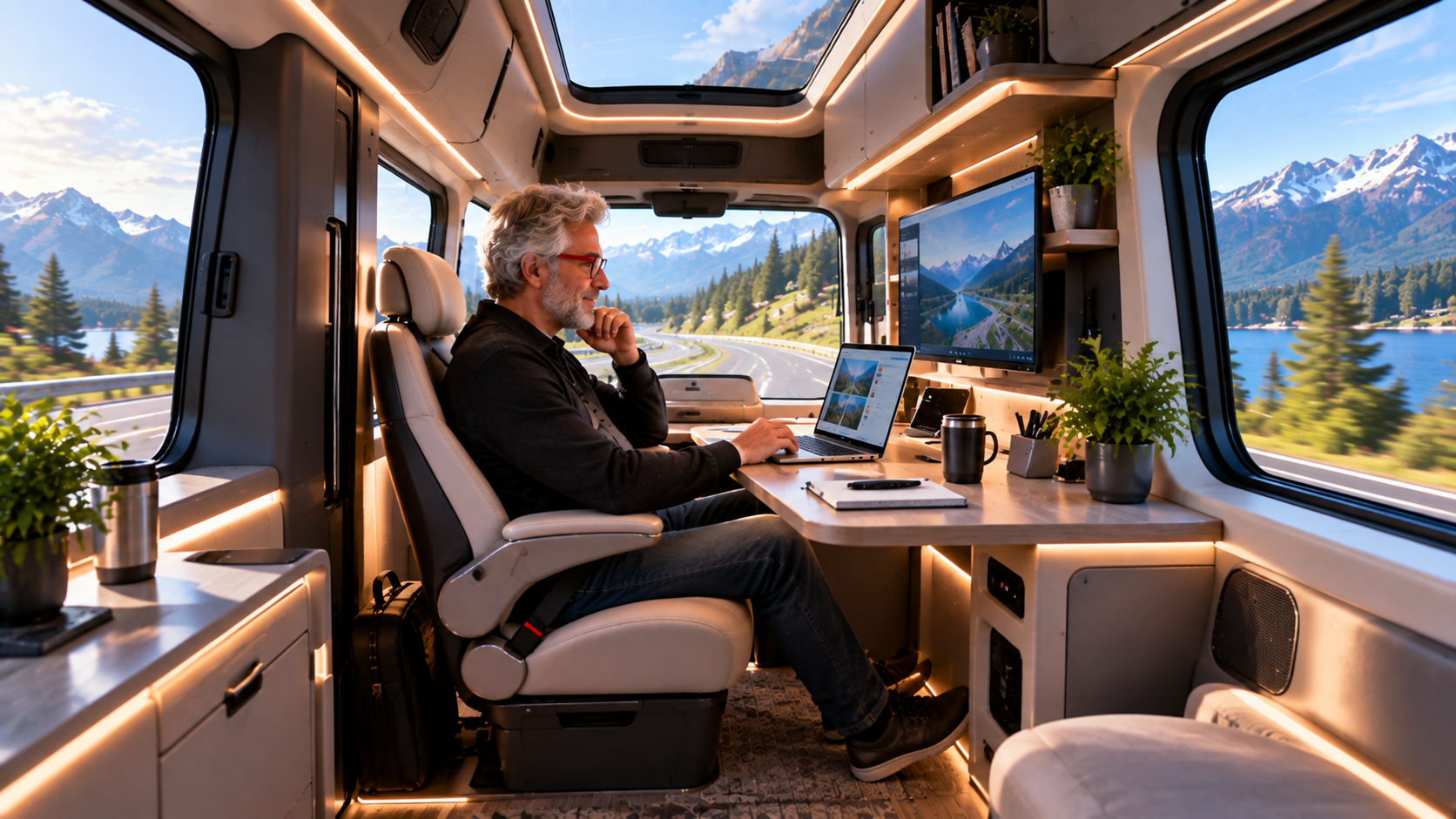
Picture a mobile conference room that autonomously drives to your office park at 9 a.m., parks itself outside for a scheduled all-day strategy session, and then drives itself to a different company’s parking lot the next morning. No conference center booking, no travel time, no wasted real estate sitting empty on the days nobody’s using it. Or imagine a mobile cooking school — a fully outfitted kitchen on wheels — that autonomously rotates through neighborhoods each week, teaching evening cooking classes at a local park on Monday and a corporate campus on Wednesday, powered by nothing more than a booking calendar and a self-driving system.
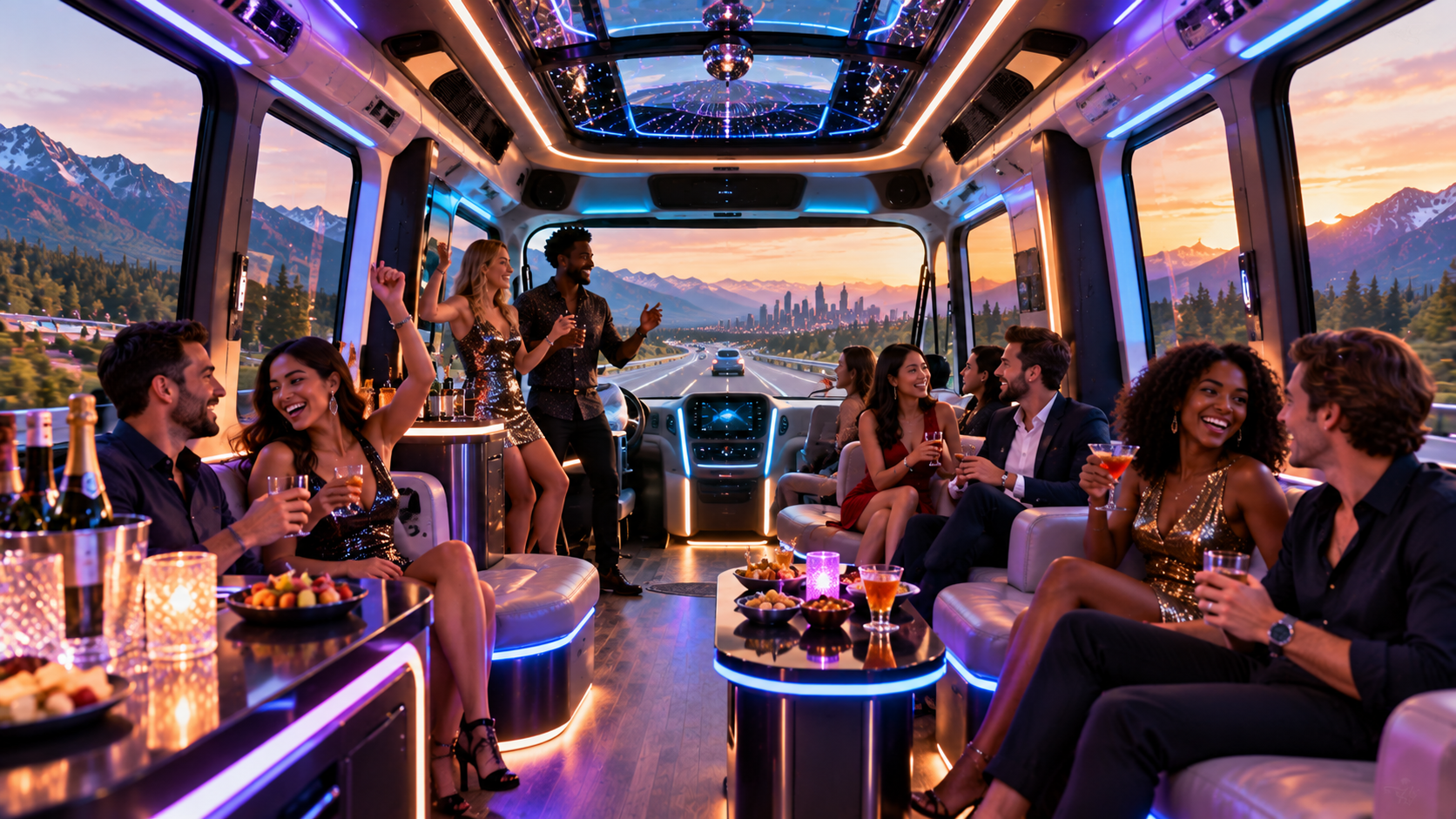
A mobile party truck could pick up a group at their front door, drive itself to a scenic overlook for photos, and roll on to the reception venue, functioning as both transportation and event space simultaneously. A mobile classroom could bring specialized STEM equipment — a portable robotics lab, say — to a different rural school every day of the week, solving the age-old problem of small districts that can’t afford to put expensive equipment in every building.
None of this requires new technology beyond what Tesla is already racing to perfect. It just requires someone to realize that “self-driving” doesn’t just mean “no driver.” It means the vehicle can finally be redesigned around what happens inside it, instead of being built around a steering wheel and a human being’s field of view. Categories like this always look like a fringe curiosity right up until the first one proves profitable — and then, true to the shape of every S-curve, a dozen imitators appear almost overnight.
The Management Headache Nobody’s Solved Yet
Here’s the part that should worry city planners and excite entrepreneurs in equal measure: none of our current transportation infrastructure was built with any of this in mind, and the flat part of the curve is exactly when that infrastructure needs to get built — because by the time the curve bends upward, it’s too late to plan calmly.
Curb space in most American cities is managed the way it was managed in 1965 — first come, first served, mostly free, with occasional parking meters. Now imagine that same curb also needs to accommodate a self-driving cement truck making a scheduled delivery, a mobile conference room parked for eight hours, and a fleet of robotaxis doing rapid pickup-and-drop-off cycles, all competing for the same eighteen feet of asphalt. Cities that don’t start actively managing curb access as a dynamic, priced resource — the way airports manage runway slots — are going to find their downtown streets gridlocked with parked autonomous vehicles within the decade.
Insurance and liability frameworks face a similar reckoning. Who’s responsible when an autonomous cement truck causes an accident while merging into traffic on the way to a job site — the software company, the construction company that rented it, or the property where it was headed? Right now, the honest answer in most states is: nobody quite knows yet. Regulators are still working through liability questions for consumer robotaxis; a wave of specialized autonomous work vehicles is going to multiply that complexity many times over, and it’s arriving faster than the last one because it’s climbing a steeper curve.
My Prediction: The Rise of Vehicle-as-a-Service
I believe we’re heading toward a world where almost no business owns its vehicles outright anymore. Instead, they’ll subscribe to a rotating fleet of autonomous-capable machines the same way companies subscribe to cloud computing today — paying for exactly the capability they need, exactly when they need it, with the vehicle driving itself to the job and driving itself home when the work is done.
A landscaping company won’t own a fleet of trucks sitting idle all winter; it’ll rent autonomous flatbeds only during the growing season. A school district won’t build five separate science labs; it’ll book a mobile STEM classroom on a weekly rotation. A city won’t maintain an oversized snowplow fleet for three heavy storms a year; it’ll call in autonomous plows from a regional pool exactly when the forecast demands it.
If you want to know when this shift is about to hit your industry, don’t watch Tesla’s stock price — watch the shape of the curve. The flat part is when pilots quietly succeed in a handful of cities and nobody outside the industry notices. The steep part is when your competitor announces they’ve cut fleet costs in half and everyone scrambles to catch up at once. My advice, as unglamorous as it sounds: the smartest move for any business built around vehicles is to start experimenting now, while the curve is still flat and mistakes are cheap, rather than waiting for the middle of the climb, when everyone is scrambling for the same limited supply of hardware, software talent, and regulatory approval at the same time.
The companies that win this next decade won’t necessarily be the ones that build the best self-driving software — Tesla, Waymo, and a handful of others are already racing hard on that front. The real winners will be the ones who figure out how to manage, schedule, insure, and coordinate an entire economy of vehicles that no longer need a human behind the wheel to justify their existence. That’s not a transportation problem anymore. It’s a logistics and urban-planning problem wearing a car’s clothing — and almost nobody is building for it yet, because almost nobody is looking closely enough at where each curve actually stands.
Related Articles
- “Elon Musk Gives Update on Tesla’s Robotaxi Expansion Timeline in the U.S.” — Drive Tesla Canada — driveteslacanada.ca/news/tesla-self-driving-cars-without-human-monitors-2026
- “What Are Autonomous Forklifts and Why Is the Market Growing?” — Deseret News — deseret.com/business/2026/01/13/robots-taking-place-of-forklifts
- “Elon Musk Admits Millions of Tesla Owners Need Upgrades for True ‘Full Self-Driving'” — TechCrunch — techcrunch.com/2026/04/22/elon-musk-admits-millions-of-tesla-owners-need-upgrades-for-true-full-self-driving