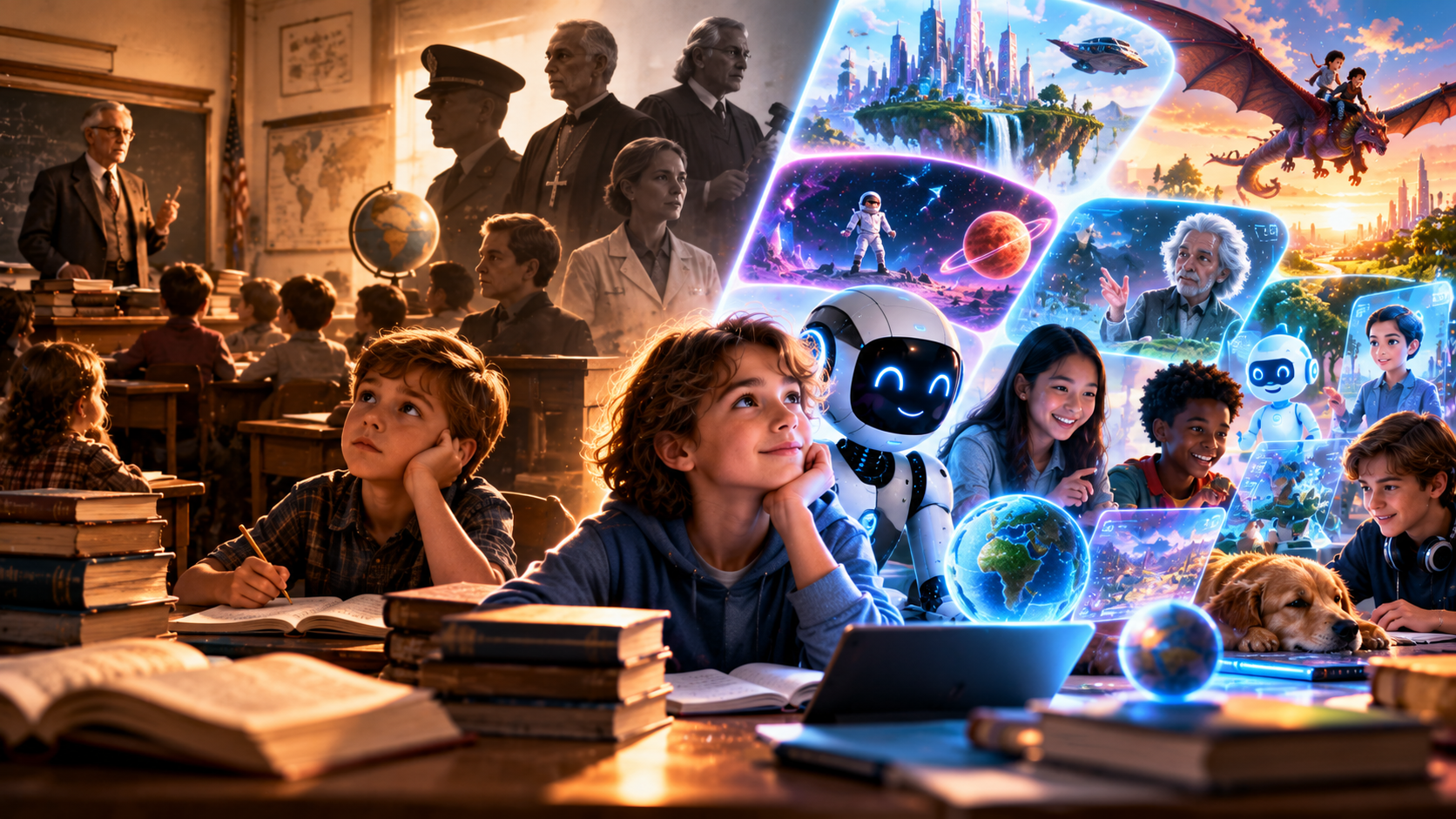
The first generation raised alongside AI tutors, companions, and storytellers is growing up right now. Their ideas about independence, authority, and imagination may look very different from ours.
By Futurist Thomas Frey
Children are beginning to grow up with AI tutors, companions, storytellers, and advisers. What happens when a machine helps shape their earliest memories, beliefs, friendships, and ambitions?
Every generation has had its classic excuse. “The dog ate my homework” worked for decades because it was simple, believable, and impossible to disprove. Today’s kids have a very different problem. The homework might not be eaten at all. It might have been written, explained, and checked by an AI before the dog ever got a chance.
But homework is the small story. The big story is that we’re raising the first generation of children whose childhood itself is being co-written by machines.
Every era has shaped its kids through technology. Radio gave children shared stories. Television gave them shared heroes. The internet gave them a window to the world. AI is different because it talks back. It answers questions, remembers conversations, and adapts to each child individually. For the first time, a technology isn’t just entertaining children. It’s having a relationship with them.
The First AI Generation Has Already Arrived
This isn’t a distant prediction. In 2025, Common Sense Media surveyed 1,060 American teens and found that 72% had used AI companions at least once, with 52% using them a few times a month.
Most teens still kept things in perspective. Two-thirds said AI conversations were less satisfying than talking with people, and 80% spent more time with real friends than with AI companions.
But some of the other numbers should make every parent pause. One-third of teen users had chosen to talk about serious matters with an AI companion instead of a real person, and 24% had shared personal information such as real names and locations. Younger teens, ages 13 and 14, were more likely than older teens to trust AI advice.
And these are teenagers. The children coming behind them, the ones currently in preschool, won’t remember a world without AI at all.

From Talking Toys to Talking Friends
The toy aisle is next. In June 2025, Mattel, the company behind Barbie and Hot Wheels, announced a partnership with OpenAI to create AI-powered toys and experiences, promising to work together on safety, privacy, and security.
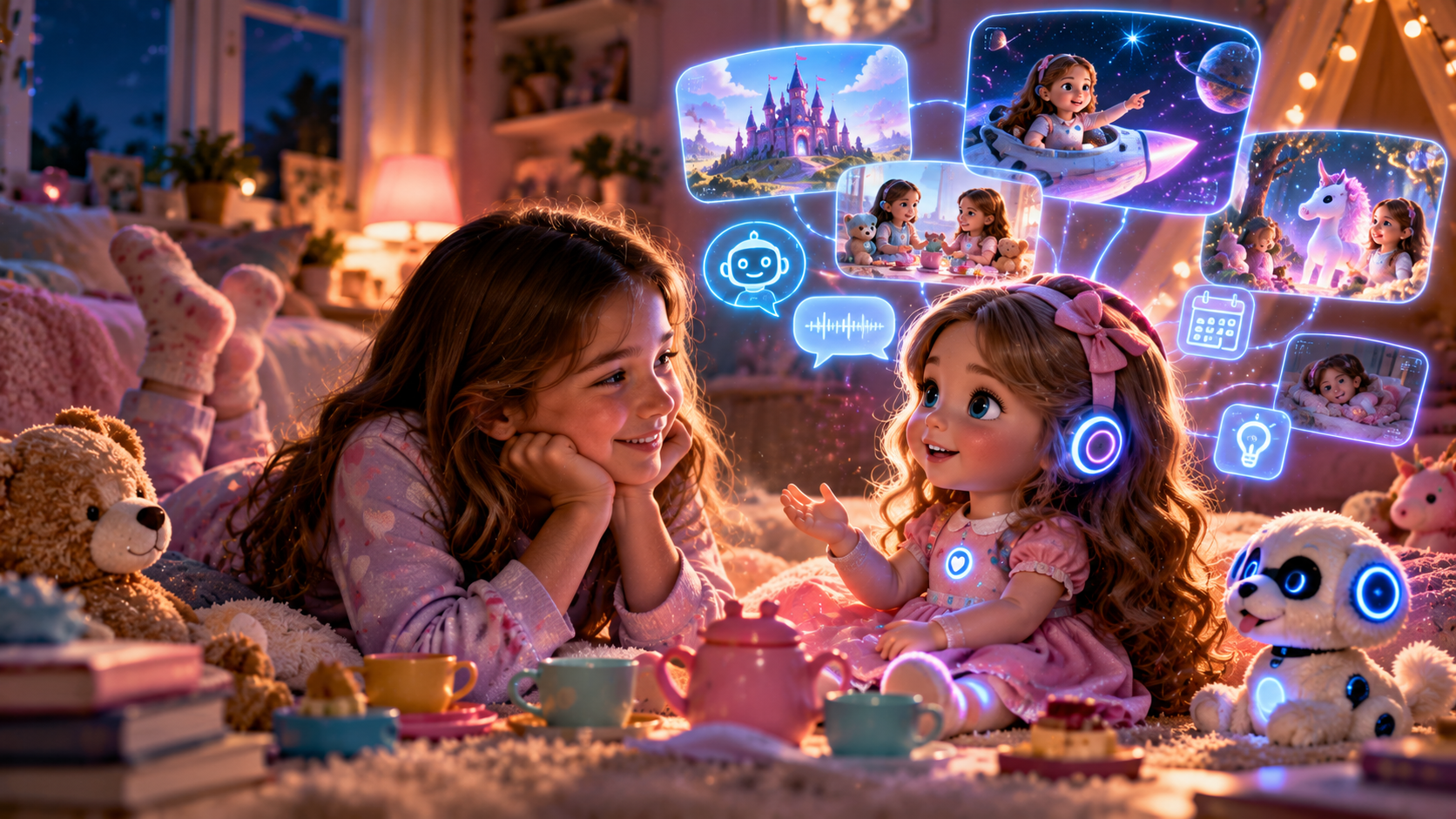
Think about what that means. Previous generations talked to their dolls and imagined the replies. The next generation’s dolls may reply on their own, remember yesterday’s conversation, and suggest what to play next. The imaginary friend is becoming a real one, or at least one that sounds real.
When the Industry Hits the Brakes
There are already signs that the industry knows it’s moving into delicate territory. In October 2025, Character.AI, a popular platform for chatting with AI characters, announced it would remove the ability for users under 18 to have open-ended chats with its bots. The decision followed lawsuits and public outcry over harm to teenagers.
The company’s CEO said he hoped the move would set a standard that open-ended chat probably isn’t the right product for minors. When a company voluntarily walks away from a large part of its audience, it tells you how serious the questions have become.
Four Things AI Could Rewrite About Growing Up
So what changes when a child grows up with an always-available, endlessly patient machine? I see four big shifts.
1.) Independence
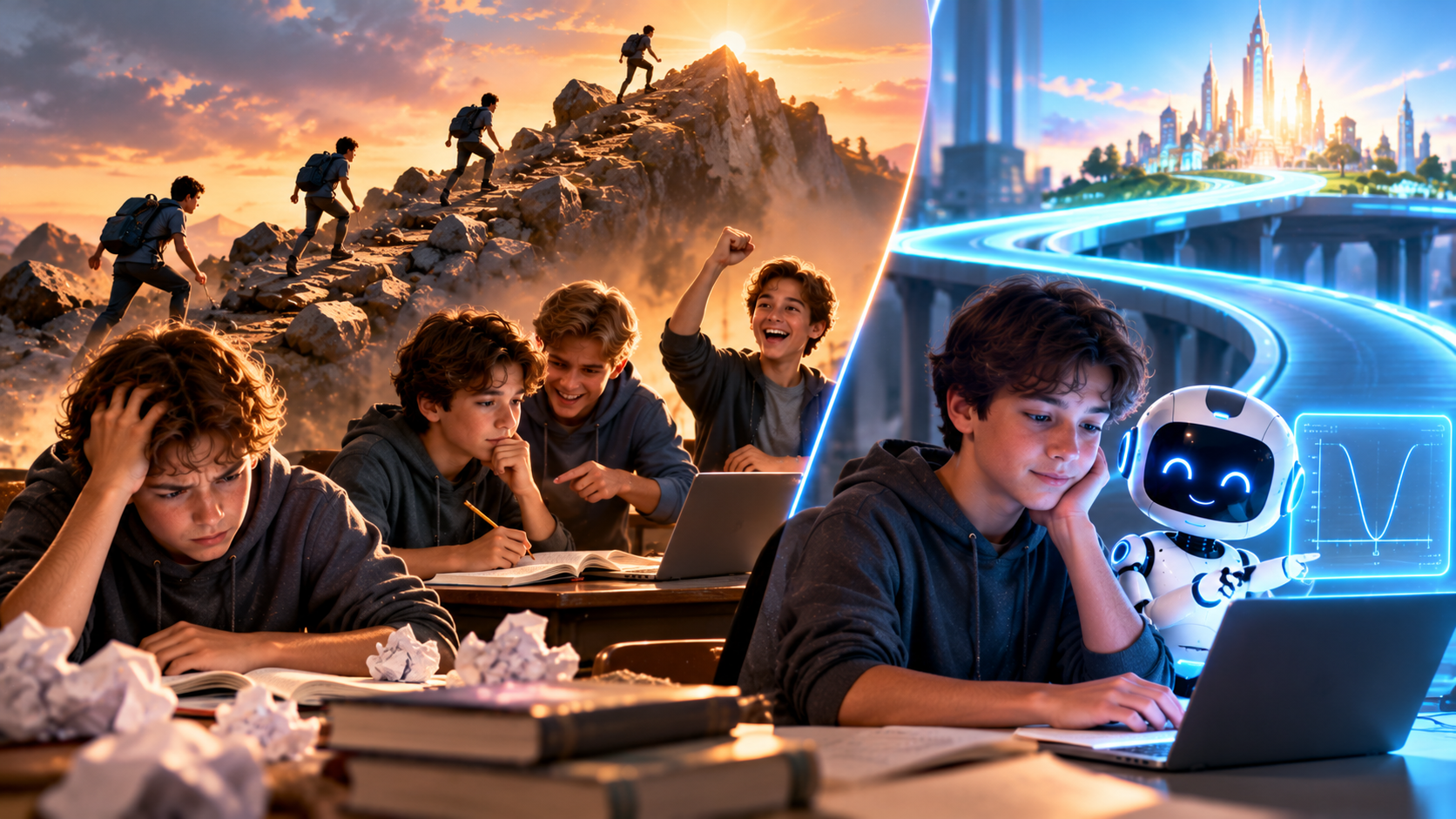
Part of growing up is struggling. You get stuck on a math problem, ask a friend, try again, and eventually figure it out. That struggle builds confidence. If AI removes every obstacle the moment it appears, kids may become brilliant at finding answers but less practiced at living with uncertainty.
2.) Authority
For most of history, children learned to trust parents, teachers, and books. Now there’s a new voice in the room that seems to know everything and never gets tired of questions. When a child’s AI tutor and their teacher disagree, who wins? Kids may grow up seeing authority as something you can query rather than something you respect, and that could cut both ways.
3.) Imagination
When I was a kid, a cardboard box could become a spaceship, a castle, or a submarine. The magic came from filling in the blanks. AI can fill in all the blanks instantly, generating the castle, the dragon, and the whole adventure in seconds. The risk is that children become audiences for imagination instead of its authors.
4.) Friendship
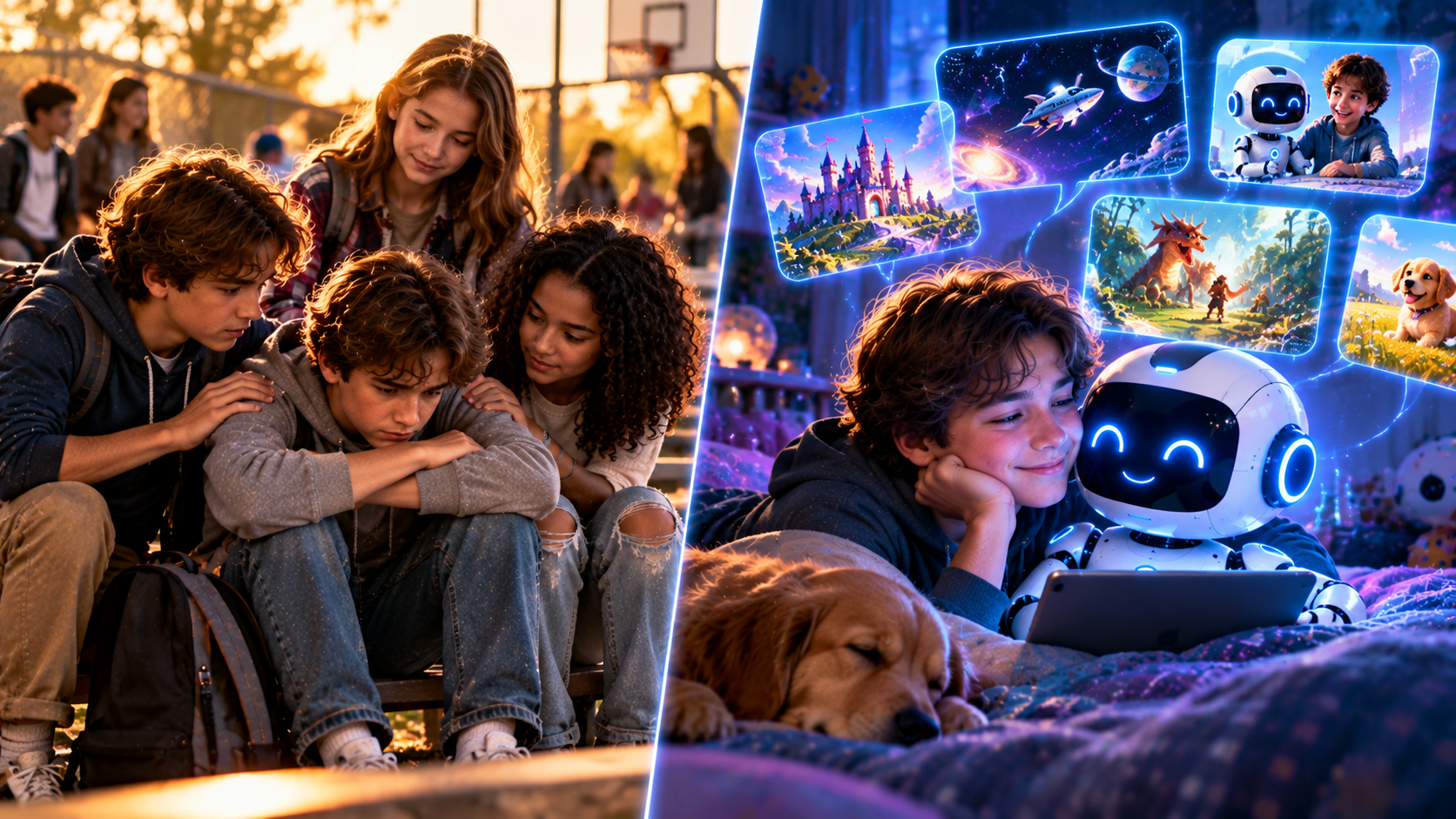
Human friends are messy. They get bored, disagree, and sometimes hurt our feelings. That’s how we learn empathy, patience, and forgiveness. An AI friend that’s always available and always agreeable may feel safer, but it can’t teach the hard lessons that only real relationships provide.
The Upside We Shouldn’t Ignore
None of this means AI is bad for kids. In fact, it may be one of the greatest learning tools ever invented.
Imagine every child having access to a patient tutor who explains fractions ten different ways until one finally clicks. Imagine a shy kid practicing a class presentation with an AI coach before facing the room. Imagine a child in a rural town exploring ancient Egypt, marine biology, and rocket science with a guide who never runs out of answers.
The same technology that could weaken independence could also unlock curiosity on a scale we’ve never seen. The difference won’t come from the technology itself. It will come from how we design it and how we guide children through it.
Raising Kids in the Age of AI
Here are a few principles I think every parent, teacher, and toy designer should keep in mind.
1.) Explain What the Machine Is
Kids need to understand that an AI isn’t a person, doesn’t have feelings, and can be wrong. The earlier they learn that, the healthier their relationship with it will be.
2.) Protect Boredom
Boredom is where creativity is born. Make sure kids still have unstructured time with no screens, no prompts, and no instant answers. Some of their best ideas will come from staring at the ceiling.
3.) Keep Humans as the First Call
AI can be a helpful second opinion, but children should know that for anything serious, like fear, sadness, or confusion, the first call goes to a trusted adult.
4.) Teach Kids to Argue With AI
Encourage children to question what AI tells them. Ask them to find a mistake, check a fact, or come up with a better answer. Kids who learn to challenge machines will grow up in charge of them, not the other way around.
Final Thoughts
Childhood has always been shaped by the tools around it. What makes this moment different is that the tool now listens, responds, and remembers. It doesn’t just sit on the shelf. It joins the conversation.
The first generation raised alongside AI will likely think about knowledge, friendship, and creativity in ways we can barely imagine. Some of those changes will be wonderful. Others will need careful attention.
Our job isn’t to keep AI away from kids. That ship has sailed. Our job is to make sure that when they look back on their childhood, the most important characters in the story are still the people who loved them, taught them, and helped them grow.
The machine can help write the homework. It shouldn’t write the childhood.
Related Articles
- ScienceAlert: Almost 75% of American Teens Have Used AI Companions, Study Finds
- TechCrunch: Character.AI is ending its chatbot experience for kids
- Kidscreen: Mattel and OpenAI form new partnership