
What If We Started Mining the Sky Instead of the Ground?
Turning pollution into tomorrow’s raw material.
By Futurist Thomas Frey
For thousands of years, humans have dug into the ground for the raw materials of civilization. We mined coal, drilled for oil, quarried limestone, and extracted metals. Then we burned, smelted, and processed those materials, sending much of their carbon into the sky.
Now imagine reversing that process. What if, instead of digging down, we started reaching up?
The Biggest Mine on Earth Is Overhead
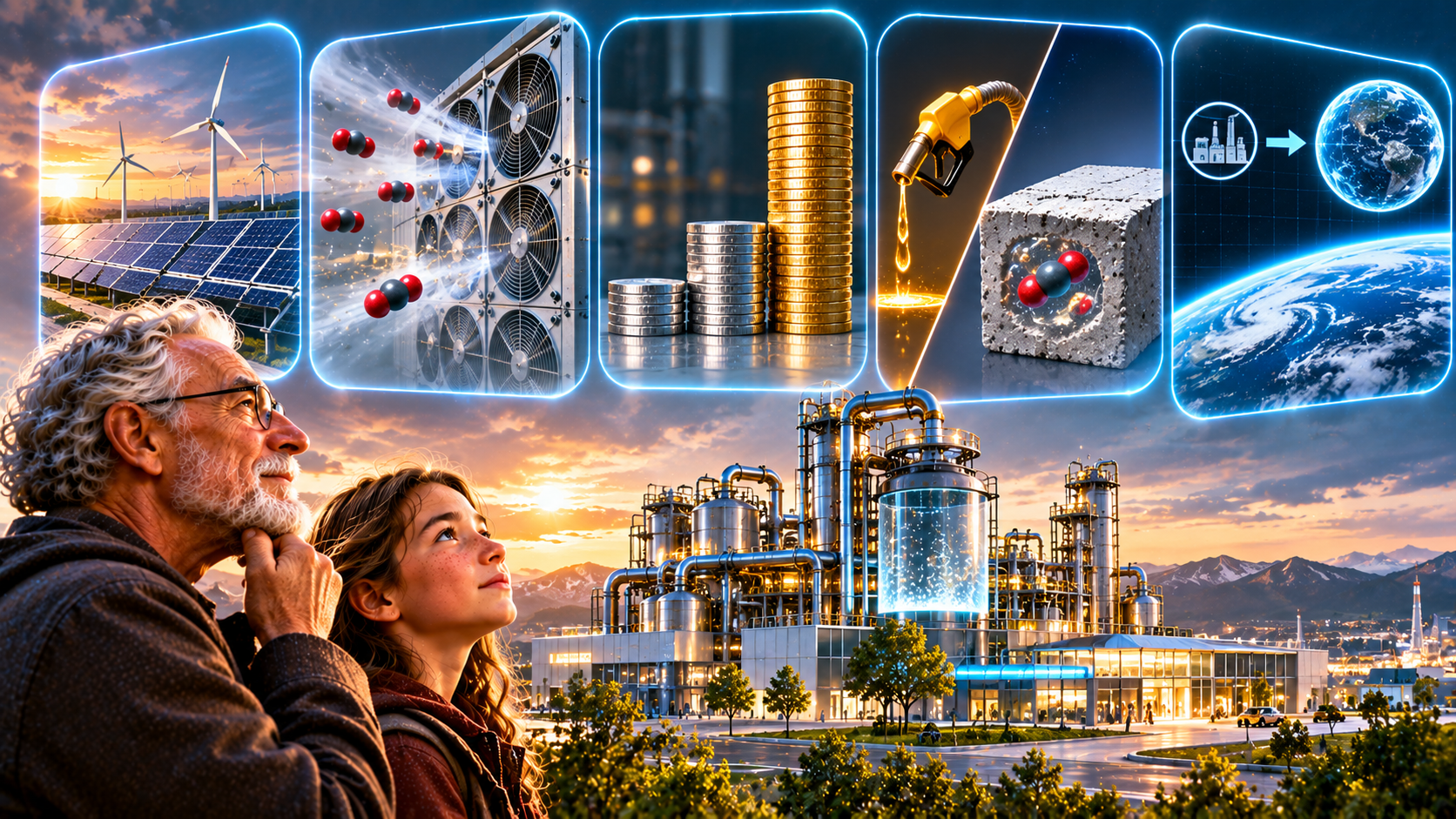
The atmosphere holds trillions of tons of carbon dioxide, and humans add tens of billions more every year. We’ve always treated that carbon as waste, something to reduce, offset, or bury underground.
But carbon is the backbone of modern life. It’s in our fuels, plastics, fabrics, medicines, and building materials. Most of that carbon currently comes from fossil fuels pulled out of the earth. The atmosphere, meanwhile, holds a nearly limitless supply sitting right above our heads.
Think of it like a city that spends millions hauling garbage to a landfill, then realizes the garbage contains gold. Suddenly the landfill isn’t a cost center. It’s a mine.
That’s the shift now quietly underway. A new wave of carbon-conversion companies is learning to treat carbon dioxide not as pollution but as a raw material. One market analysis estimates that products made from captured carbon, including fuels, chemicals, polymers, and building materials, will generate roughly $2 billion to $3 billion in revenue this year. That’s small compared to the oil industry, but it’s growing from first-of-a-kind plants into real supply chains.
What the Sky Can Become
Carbon dioxide is a stubborn molecule. Turning it into something useful takes energy and clever chemistry. But scientists and startups are finding more ways to do it every year.
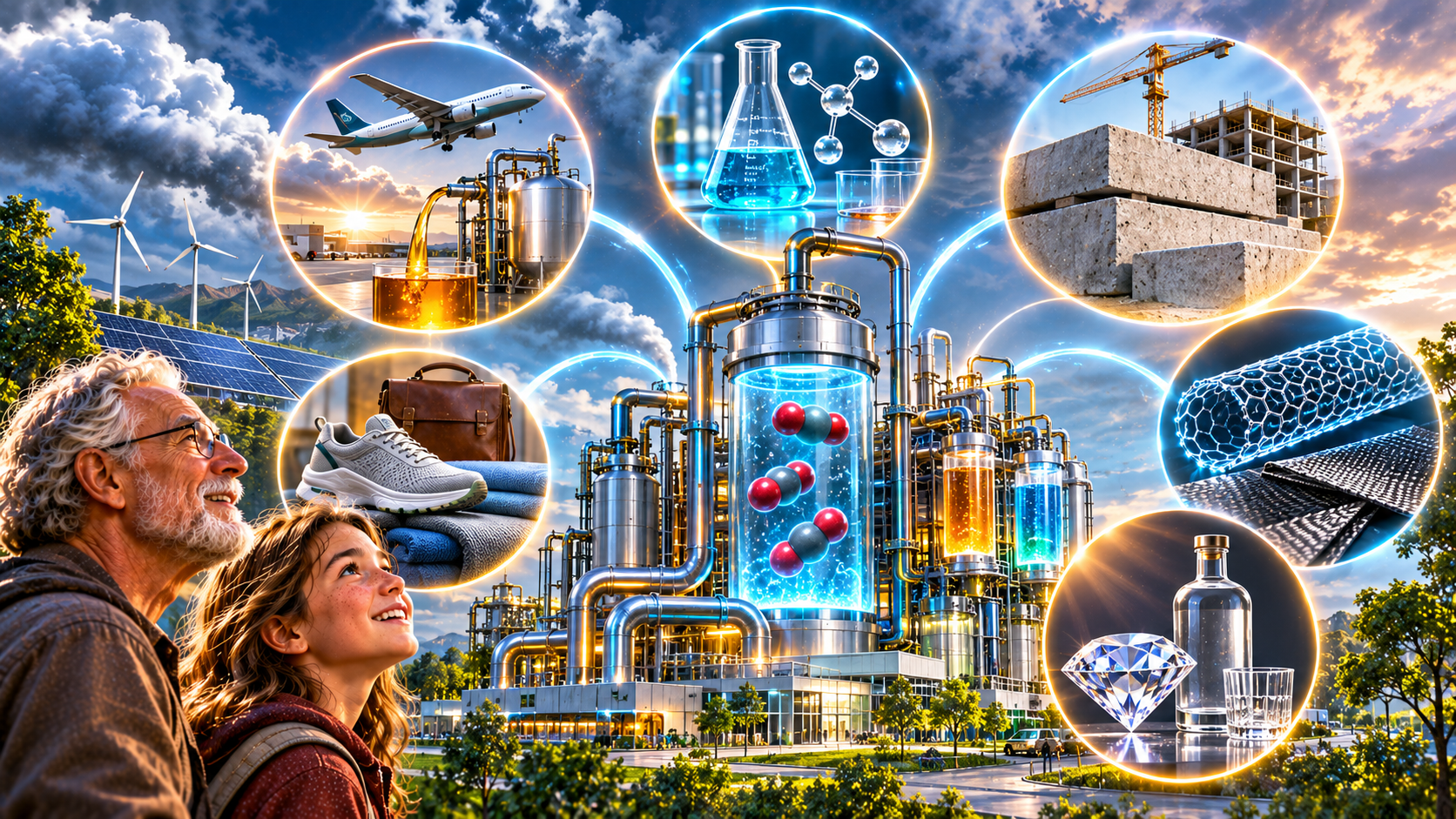
- Fuels. LanzaTech uses bacteria at a steel mill in China to convert waste gases into ethanol, which can be made into cleaner fuel. Other companies, such as Twelve and Lydian, combine captured carbon dioxide, water, and renewable electricity to produce synthetic fuels, including jet fuel.
- Chemicals. OCOchem has built an electrolyzer that turns captured carbon dioxide and water into formic acid, an industrial chemical used in everything from leather tanning to de-icing. CERT Systems is working on a process that captures carbon dioxide from the air and converts it into ethylene, a building block for plastics.
- Building materials. Carbon Upcycling raised $10 million this spring to build a production line at a cement plant near Toronto, making cement ingredients that lock captured carbon inside them. Concrete could become one of the largest carbon storage systems on the planet, hiding in plain sight in sidewalks and skyscrapers.
- Advanced materials. Researchers are developing ways to turn carbon dioxide into carbon nanotubes, battery-grade carbon, and lightweight composites. Some of these materials could be stronger and lighter than steel.
- Everyday products. Companies are already experimenting with carbon-based polyurethanes for shoes, enzymes that convert carbon dioxide into textile fibers, and even carbon-derived vodka and diamonds.
Each of these replaces something we currently dig up with something we pull out of the air.
From Cost to Commodity
Here’s the key insight. For decades, cleaning the atmosphere has been framed as a cost: a tax, a regulation, a sacrifice. That framing has made climate action a constant political fight over who pays.
But what happens when pulling carbon out of the sky becomes profitable?
History offers a clue. In the 1800s, oil refineries treated gasoline as a useless byproduct and often dumped it. Once the automobile arrived, that waste became the most valuable product in the barrel. Similarly, sawdust was once swept up and burned, until someone figured out how to press it into particleboard.
Carbon dioxide may be on the same path. Once enough products can be made from it, every smokestack becomes a potential supply line, and every ton of carbon in the air becomes inventory waiting to be harvested.
The Hurdles Still Ahead
None of this is easy. Before sky mining becomes a major industry, several big obstacles need solving:
- Energy. Breaking apart carbon dioxide takes a lot of power. If that power comes from fossil fuels, the process can release more carbon than it captures. Cheap, abundant clean energy is the key that unlocks everything else.
- Concentration. Air contains only about 0.04% carbon dioxide. Capturing it directly from the atmosphere is far harder than capturing it from a smokestack, where it’s much more concentrated.
- Cost. Most carbon-based products still cost more than their fossil-fuel equivalents. Government incentives, fuel mandates, and buyers willing to pay a premium are carrying many early projects.
- Permanence. Not all products lock carbon away for long. Synthetic fuel releases its carbon again when burned, while concrete can hold it for centuries. These differences matter when measuring climate benefits.
- Scale. Today’s plants process thousands of tons. The atmosphere needs billions of tons removed. That’s a gap of roughly a million times.
What Happens Next
I predict that within the next 15 years, we’ll see the first factories that pull their primary raw material directly from the air, much like today’s breweries draw from local water supplies. Some will be built next to solar farms in deserts, where cheap electricity makes the chemistry affordable.
I also expect a new class of jobs to emerge: atmospheric miners, carbon refiners, and sky-harvest engineers. Regions that once depended on coal or oil may find new life producing carbon-based materials from the very air above them.
Perhaps most important, I expect the politics of climate change to shift. When cleaning the atmosphere creates jobs, profits, and products, it stops being a burden that nations argue over and becomes an opportunity they compete for.
Final Thoughts
For most of human history, progress meant digging deeper. The next era of progress may mean looking up.
The sky has always been our dumping ground. It could become our warehouse. And the moment pulling carbon out of the air becomes more profitable than pumping it out of the ground, the future of manufacturing, and of the planet, may change faster than anyone expects.
Related Articles
- Eco-Business – Startups Strive to Recycle Emissions for ‘New Carbon Economy’
- Meticulous Research – Carbon-to-Value Market Outlook 2026–2038
- Presseportal (nova-Institute) – CO2 to E-Methanol, Aviation Fuels and Speciality Chemicals: Six Nominees Announced for the “Best CO2 Utilisation 2026” Innovation Award