Author: admin

West Japan Railway Unveils Humanoid Robot for Maintenance Tasks

It resembles a malevolent robot from 1980s sci-fi, but West Japan Railway’s new humanoid employee was designed with nothing more sinister in mind than a spot of painting and gardening. Starting this month, the machine, which features a crude head and coke-bottle eyes mounted on a truck that can drive on rails, will be put to use for maintenance work on the firm’s network.

The operator sits in a cockpit on the truck, “seeing” through the robot’s eyes via cameras and operating its powerful limbs and hands remotely. With a vertical reach of 12 meters (40 feet), the machine can use various attachments for its arms to carry objects as heavy as 40 kilograms (88 pounds), hold a brush to paint, or use a chainsaw. Initially, the robot’s primary tasks will focus on trimming tree branches along rails and painting metal frames that hold cables above trains, according to the company.

Continue reading… “West Japan Railway Unveils Humanoid Robot for Maintenance Tasks”
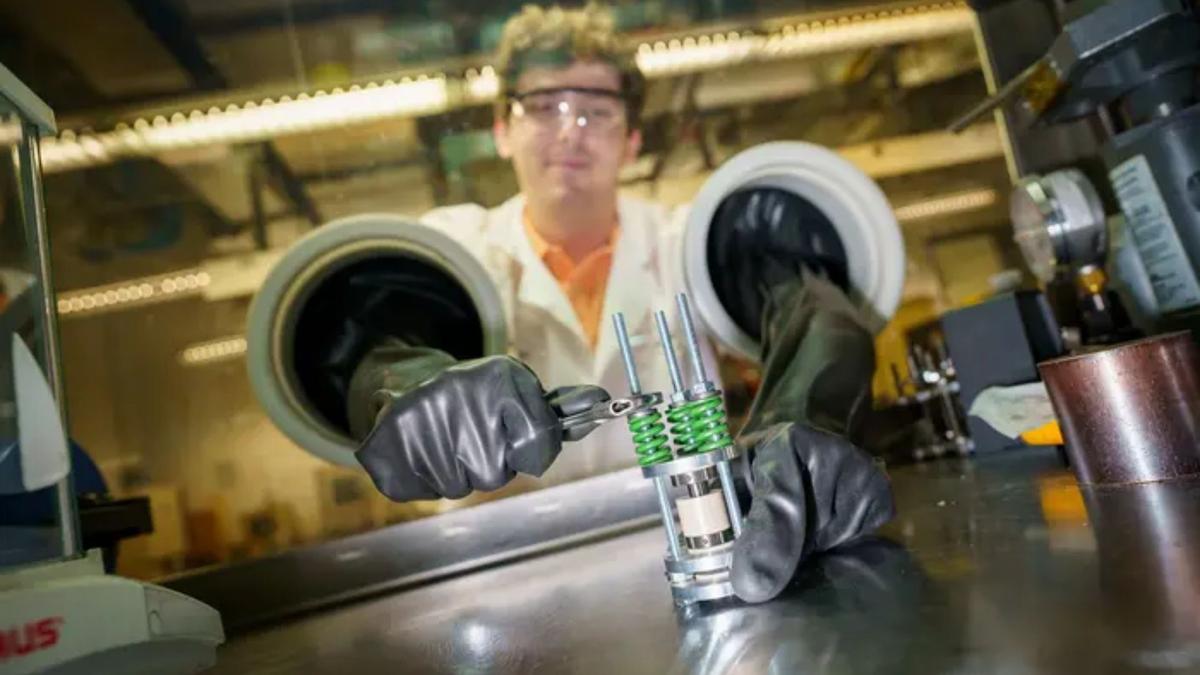
World’s First Anode-Free Sodium Solid-State Battery Revolutionizes Energy Storage

A team of researchers has combined the best battery technologies to create the world’s first anode-free sodium solid-state battery. This innovative design uses a stable solid electrolyte and pressure to form dense sodium metal. An aluminum current collector ensures efficient, repeatable sodium plating and stripping at high capacities and speeds.

This new type of battery will be less expensive and less harmful to the environment since the anode is removed, and sodium, which is cheap and plentiful, is used instead of lithium. “Although there have been previous sodium, solid-state, and anode-free batteries, no one has been able to successfully combine these three ideas until now,” said Grayson Deysher, a Ph.D. candidate at UC San Diego and first author of the study.

Continue reading… “World’s First Anode-Free Sodium Solid-State Battery Revolutionizes Energy Storage”

Revolutionary NTNU Technology Harnesses Industrial Waste Heat for Clean Water Production

Researchers at the Norwegian University of Science and Technology (NTNU) have developed an innovative technology that addresses two significant environmental challenges: utilizing industrial waste heat and generating clean water. This breakthrough was highlighted in a recent university press release.

Industrial heat is a major component of global energy consumption. After being used in industrial processes, a significant portion of this heat is typically wasted, released into oceans or the atmosphere. In Norway alone, it is estimated that 20 TWh of heat is wasted annually—equivalent to half the energy demand of Norwegian households or the energy used for heating homes. Kim Kristiansen, a doctoral researcher in NTNU’s Department of Chemistry, sought a more efficient way to repurpose this wasted energy.

Continue reading… “Revolutionary NTNU Technology Harnesses Industrial Waste Heat for Clean Water Production”

Unveiling Stem Cell Secrets: A New Non-Invasive Method Using Machine Learning

Stem cells are like the emergency tool kit of the human body, possessing the unique ability to transform into various specialized cells, from immune cells to brain cells. They can divide and regenerate indefinitely to repair and replenish our system on command. The ability to culture stem cells in the lab and grow them into any cell type needed is the Holy Grail of medicine. This capability could enable clinicians to create an endless supply of new cells for repairing damaged tissues and organs. However, achieving this requires a comprehensive understanding of how stem cells replicate and transition into different cell types.

New research from USC’s Alfred E. Mann Department of Biomedical Engineering brings us closer to unraveling the mysteries of these essential cells. Associate Professor Keyue Shen and his team have harnessed machine learning to develop a non-invasive system that offers unprecedented insight into how stem cells proliferate and regenerate into specialized cells. Their work, published in Science Advances, represents a significant breakthrough.

Continue reading… “Unveiling Stem Cell Secrets: A New Non-Invasive Method Using Machine Learning”

Revolutionizing Space Missions: The Promise of CAL 3D Printing Technology

NASA’s Flight Opportunities Program, alongside Berkeley Engineering and the Berkeley Space Center, has funded a groundbreaking mission to develop Computed Axial Lithography (CAL) technology. This innovative 3D printing method holds the potential to revolutionize space missions by producing everything from spare parts and tools for spacecraft to new contact lenses and dental crowns for astronauts.

3D printing, also known as additive manufacturing, has significantly evolved since its inception in the 1980s. In 2017, Hayden Taylor, Associate Professor of Mechanical Engineering, led a team of researchers at UC Berkeley and Lawrence Livermore National Laboratory to invent CAL technology. This advanced additive manufacturing technique uses light to form solid objects from a viscous liquid, enabling faster and more versatile production of 3D parts.

Continue reading… “Revolutionizing Space Missions: The Promise of CAL 3D Printing Technology”

Pushing the Boundaries of Time: The Most Precise Atomic Clock Ever Created

In humankind’s relentless pursuit of perfection, scientists have developed an atomic clock that is more precise and accurate than any clock previously created. This groundbreaking clock was built by researchers at JILA, a joint institution of the National Institute of Standards and Technology (NIST) and the University of Colorado Boulder.

Enabling pinpoint navigation in the vast expanse of space as well as searches for new particles, this clock transcends mere timekeeping. With their increased precision, these next-generation timekeepers could reveal hidden underground mineral deposits and test fundamental theories such as general relativity with unprecedented rigor. For atomic clock architects, it’s not just about building a better clock; it’s about unraveling the secrets of the universe and paving the way for technologies that will shape our world for generations to come.

Continue reading… “Pushing the Boundaries of Time: The Most Precise Atomic Clock Ever Created”

Breakthrough in Liquid Metal Conductors for Wearable Technology

Traditional liquid metal-based conductors often require complex secondary activation processes, which can lead to device failure due to leakage. A research team led by Tao Zhou has developed a novel method combining liquid metal, the conductive polymer PEDOT, and hydrophilic polyurethane to address these challenges.

This innovative composition allows the material to self-assemble during the printing and heating process. The liquid metal particles form a conductive pathway on the material’s bottom surface while oxidizing to create an insulated top layer. This dual-layer structure ensures accurate data collection by preventing signal leakage.

Continue reading… “Breakthrough in Liquid Metal Conductors for Wearable Technology”

Giant Clams: Nature’s Most Efficient Solar Energy Systems

Giant clams boast precise geometries—dynamic, vertical columns of photosynthetic receptors covered by a thin, light-scattering layer—that might make them the most efficient solar energy systems on Earth.

“It’s counterintuitive to a lot of people because clams operate in intense sunlight, but actually, they’re really dark on the inside,” says Alison Sweeney, associate professor of physics and ecology and evolutionary biology at Yale. “The truth is that clams are more efficient at solar energy conversion than any existing solar panel technology.”

Continue reading… “Giant Clams: Nature’s Most Efficient Solar Energy Systems”

RoboGrocery: MIT’s New Soft Robotic System Revolutionizes Automated Bagging

The first self-checkout system was installed in 1986 in a Kroger grocery store just outside of Atlanta. While it took several decades for the technology to proliferate across the U.S., grocery stores are now firmly headed in the direction of automation. With this trend, robotic bagging seems to be the next logical step. MIT’s CSAIL department is at the forefront of this development, showcasing their new system called RoboGrocery.

RoboGrocery combines computer vision with a soft robotic gripper to bag a wide range of grocery items. To test the system, researchers placed 10 unknown objects on a grocery conveyor belt. The products included delicate items such as grapes, bread, kale, muffins, and crackers, as well as sturdier items like soup cans, meal boxes, and ice cream containers.

Continue reading… “RoboGrocery: MIT’s New Soft Robotic System Revolutionizes Automated Bagging”

Robot Pets: A New Frontier in Combating Loneliness Among Older Adults

In the early 1990s, a researcher at Japan’s National Institute of Advanced Industrial Science and Technology began work on what would become Paro, a therapeutic robot resembling a doe-eyed seal pup. Over 30 years later, Paro remains the best-known example of a robot designed to provide companionship for older adults. In 2011, Paro even made an unofficial cameo on “The Simpsons,” highlighting its cultural impact.

Japan has long been a leader in age-tech robotics due to its rapid adoption of new technology and its aging population, with 29% of its citizens being 65 or older. While increased life expectancy is generally positive, it can also erode traditional support structures. Robots have been proposed as a solution to supplement human care shortages and alleviate loneliness among older adults.

Continue reading… “Robot Pets: A New Frontier in Combating Loneliness Among Older Adults”

Revolutionizing Agriculture: The Transformative Power of Edge AI

The transformative power of artificial intelligence (AI) is poised to make a significant impact on one of the world’s oldest and most critical sectors: agriculture. A new study suggests that “edge AI” could revolutionize farming practices, boost productivity, and achieve sustainability goals across the global food chain.

Edge AI involves programming AI algorithms directly on local devices “at the edge” of a network rather than in a centralized data center. This technology has the potential to enhance farming practices by integrating sensors and AI into smart farm vehicles and machines, facilitating precise irrigation and agrochemical application. According to the study, this precision can reduce the use of water, fertilizers, and agrochemicals, advancing sustainability strategies on farms.

Continue reading… “Revolutionizing Agriculture: The Transformative Power of Edge AI”

Rio Tinto to Launch Carbon-Free Aluminum Smelting Technology in Canada

British-Australian mining company Rio Tinto is set to debut a novel carbon-free aluminum smelting technology at its facility in Canada. This initiative aims to accelerate the shift to more environmentally friendly production methods and significantly reduce greenhouse gas emissions.

The Elysis technology, which replaces traditional smelting processes, promises to eliminate all direct greenhouse gases, producing oxygen instead. This groundbreaking technology will be installed at Rio Tinto’s Arvida smelter in Quebec, where the company will design, engineer, and build a demonstration plant with ten pots operating at 100 kiloamperes (kA).

Continue reading… “Rio Tinto to Launch Carbon-Free Aluminum Smelting Technology in Canada”
Discover the Hidden Patterns of Tomorrow with Futurist Thomas Frey
Unlock Your Potential, Ignite Your Success.

By delving into the futuring techniques of Futurist Thomas Frey, you’ll embark on an enlightening journey.

Learn More about this exciting program.