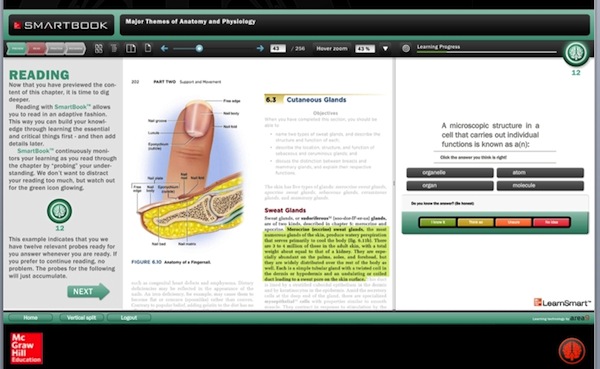
Publishing giants and tech companies try to remake the humble textbook in their own image. But on Tuesday, McGraw-Hill Education offered up its latest take on the learning platform of the future.
A vision for the future would be one where everyone will be able to learn at their own pace and where it would be competency based. Once you feel like you know something you can prove it, and the world respects that, and maybe you have to maintain that knowledge state, it’s not that you just have to prove it once and not have to worry about it.
Stephen Hawking wants to stop the rise of the machines.
Stephen Hawking turned 71 on January 8th and has joined the board of an international think tank devoted to defending humanity from futuristic threats. The newly founded organization, the Cambridge Project for Existential Risk, researches existential threats to humanity such as extreme climate change, artificial intelligence, biotechnology, artificial life, nanotech, and other emerging technologies. Skype cofounder Jaan Tallinn and Cambridge professors Huw Price and Martin Rees founded the project in late 2012.
3D printers are under constant pressure to become bigger, faster, and more powerful. 3D Systems is answering that call with its latest pair of 3D printers.
“Paid apps work because they provide the great experience people deserve as customers.”
Time is money, and apps don’t last forever. All the weeks you spent on your apps and you’re never going get back all those hours you spent on them. And all of the free apps are dangerous, yet free is the dominant business model most mobile apps are taking these days. The idea is to grow as quickly as possible then insert ads of some kind or get acquired. For consumers it offers a crummy set of choices: either losing the countless hours you put into the app or have your private data sold to marketers — since as well all know, when the product is free, you are the product.
Iran has an intense relationship with the internet. The country has made many attempts to curtail its citizens’ use of social media. Iran’s supreme leader, Ayatollah Ali Khamenei, in May, issued a fatwa against anti-filtering tools that have helped citizens to access blocked material on the Internet. In December, they launched Mehr, its own version of YouTube, which allows users to upload and view content they create, and to watch videos from IRIB, Iran’s national broadcaster. They have also been building a national intranet – a government-run network that would operate “largely isolated” from the rest of the World Wide Web. Reporters Without Borders named Iran to its 2012 “Enemies of the Internet” list with Iran’s intensified online crackdowns, increased digital surveillance of citizens, and the imprisonment of web activists.
The survey found there is no widespread loyalty among consumers about operating systems.
Google and Apple better watch out. According to a new study by Accenture, two-thirds of smartphone and tablet owners don’t have strong brand loyalty to any one particular operating system.
Here is one more 2012 year-in review report from Nielsen, which examined how Americans have been consuming content over the course of the past year. Of the 289 million U.S. TV owners, the report found that 119 million own four or more television sets, making TV still the device to beat when it comes to watching and recording programs, among other things.
The Consumer Electronics Show in Las Vegas begins this week and the state of digital consumption is looking good. Consumers are adopting all sorts of smart, web-connected consumer technology and becoming “digital omnivores.”
Heartspeak Productions with the Community Justice Initiatives Association has produced a 48-minute video from the Fraser region of British Columbia. The film discusses Canadian law and constitution and human rights as a fundamental basis of law.