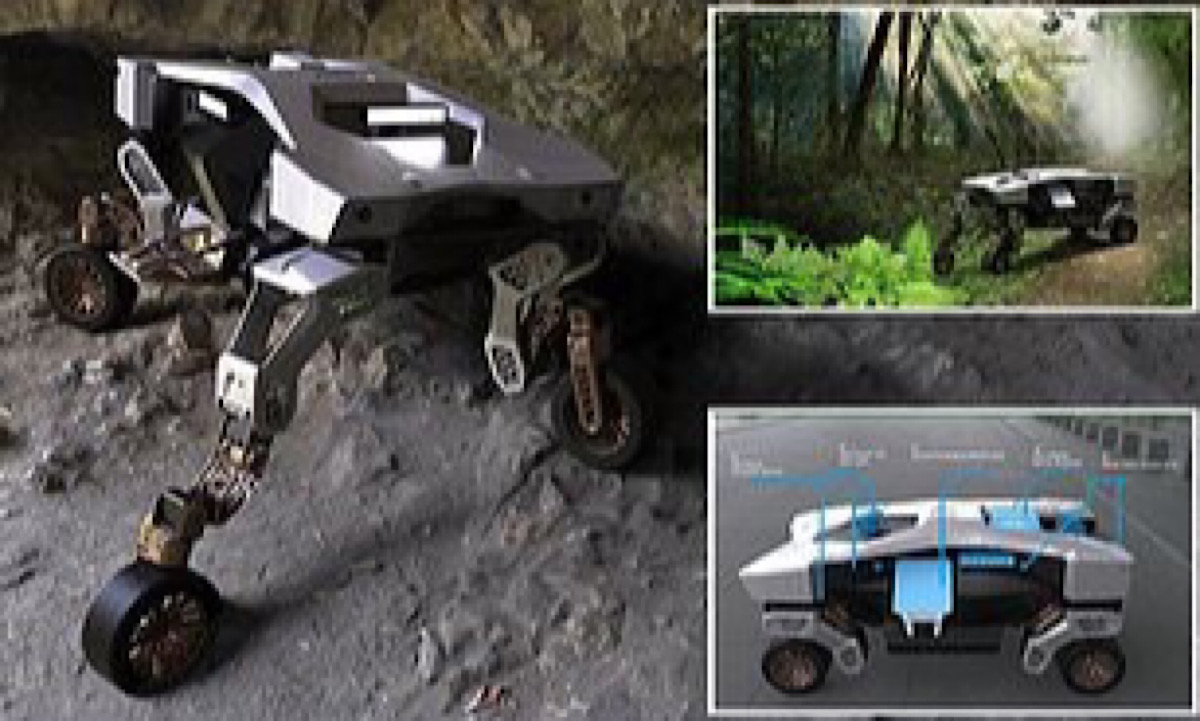
Hyundai develops an autonomous vehicle that sprouts legs to WALK across remote terrains to transport urgent goods and medication to inaccessible locations

Korean car manufacturer Hyundai has unveiled its latest vehicle.

By Rob Hull

  • The Hyundai TIGER is a Transforming Intelligent Ground Excursion Robot
  • It has been developed by the auto manufacturer’s New Horizons Studio in the US
  • When terrains are not too difficult to navigate, the vehicle uses its wheels and a four-wheel drive system to quickly navigate to a set destination
  • If the route is blocked, it sprouts four legs and can clamber over items such as large rocks and fallen trees

But instead of being a family-friendly hatchback or a school-run SUV, the brand has revealed an autonomous vehicle that sprout legs and walk.

Called TIGER – short for Transforming Intelligent Ground Excursion Robot – it is an unmanned electric robotic vehicle designed to transport cargo and medication to the world’s most inhospitable locations.

Continue reading… “Hyundai develops an autonomous vehicle that sprouts legs to WALK across remote terrains to transport urgent goods and medication to inaccessible locations”
Toyota reveals plans to take on big tech with self-driving vehicles

Toyota has devised a plan to take on big tech. The Japanese car making giant recently unveiled its Woven Planet research group, which is set to develop driverless and connected cars.

This move represents a giant change of direction for the car maker, which has previously spurned development of autonomous car tech in comparison to companies such as Mercedes-Benz and VW that have invested heavily.

Tesla is also a big time developer of autonomous car tech, with its controversial Autopilot and Full Self-Driving mode.

Toyota said it would unveil a fully self-driving prototype in the near future but didn’t give any further details.

Woven Planet is led by ex-Google roboticist James Kuffner, who said that Toyota has a distinct advantage in developing electric cars because of the amount of data they can collect from the tens of millions of Toyotas on the road around the globe.

Toyota is now on a collision course with some of tech’s biggest names.

Continue reading… “Toyota reveals plans to take on big tech with self-driving vehicles”

Driverless bus trials draw 320, including curious passengers

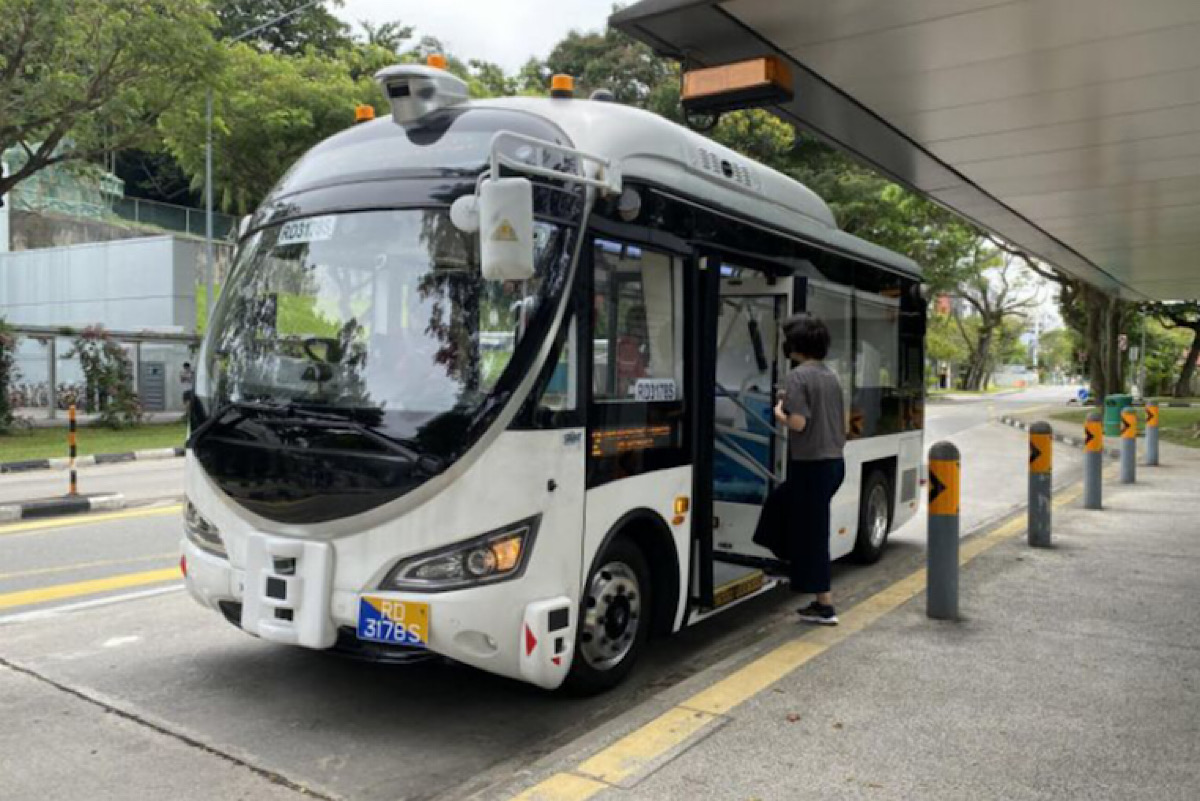
Japanese housewife Satoko Nemoto boarding one of the driverless buses at Haw Par Villa.

Singapore- Ms. Satoko Nemoto, a 43-year-old Japanese housewife who has been in Singapore for only three months, travelled by MRT all the way from her home is Pasir Ris to Haw Par Villa just to ride on a driverless buss operated by SMRT.

She said the bus ride was quiet and smooth, and she especially liked that the bus was fully electric thus, eco-friendly.

She was among a total of 320 people who have taken the driverless buses at HawPar Villa and Jurong Island since they were launched last month, with some specially making the trip to the two areas for the ride.

Most found it a pleasant enough experience, saying the buses were not as slow as they had expected and the presence of a driver at the wheel in case of emergencies reassured them.

There remained concerns, however, over safety issues.

Continue reading… “Driverless bus trials draw 320, including curious passengers”

Driverless robotaxis are now available for public rides in China

By Jon Fingas

AutoX is the first in the country to offer rides without safety drivers.

After lots of tests, it’s now possible to hail a truly driverless robotaxi in China. AutoX has become the first in the country to offer public rides in autonomous vehicles without safety drivers. You’ll need to sign up for a pilot program in Shenzhen and use membership credits, but after that you can hop in a modified Chrysler Pacifica to travel across town without seeing another human being.

As with Waymo One, there is help if you need it. You can talk to customer support reps if you have questions or need help.

AutoX is eager to tout its robotaxis’ ability to handle real-world conditions after several months of stress testing. In a demo video (below), the driverless van knows how to safely “nudge” past a parked vehicle and deal with a scooter running a red light. The vehicles use a combination of LiDAR, radar and blind spot sensing to get a feel for their environment.

Fully driverless robotaxis are still very rare anywhere in the world, and it’ll take a combination of refined technology and updated regulation before they’re relatively commonplace. This is an important step in that direction, though. They might get a boost in the current climate, though. The COVID-19 pandemic has added risk to conventional ride hailing for both drivers and passengers, and removing drivers could make this one of the safest travel options for people without cars of their own.

Continue reading… “Driverless robotaxis are now available for public rides in China”

Milton Keynes to trial 5G drones, robots and driverless shuttles

By Christopher Carey

The trials will be hosted at the Stadium MK sports arena on the outskirts of the city.

Milton Keynes Council has secured more than £4 million  (US$5.4 million) in funding, including £2.3 million from the government, to create and test mobility services using 5G technology.

Trials will include the use of driverless shuttles and road vehicles for moving people and goods, autonomous surveillance vehicles and drones for enhancing security, and robots and drones for goods delivery and hospitality use. E-scooters could be included in the trials in future.

The initiative, which builds on a £10 million investment by the South East Midlands Local Enterprise Partnership (SEMLEP), industry and academic partners, will be hosted at the Stadium MK sports arena on the outskirts of the city.

Speaking to Cities Today, Brian Matthews, Head of Transport Innovation, Milton Keynes Council, said: “The trials will be designed to provide useful input into thinking how visitors move around the venue, which includes an arena, a large hotel, restaurants and a retail complex.

Continue reading… “Milton Keynes to trial 5G drones, robots and driverless shuttles”

Toyota’s driverless shuttles could double as ‘office-on-the-go’

Toyota's-driverless-shuttles-double-office-on-the-go
Toyota’s e-Palette is a largely transparent, driverless oblong carriage on wheels that’s powered by a battery. It can accommodate up to 20 passengers, with seats that fold up and allow the space to be re-purposed. (Bloomberg)

TOYOTA IS AIMING TO COMMERCIALISE AN AUTONOMOUS SHIPPING-CONTAINER-LIKE VEHICLE WITHIN A FEW YEARS THAT IT SAYS COULD DOUBLE AS A MOBILE STORE OR ROVING OFFICE.

Toyota is aiming to commercialize an autonomous shipping-container-like vehicle within a few years that it says could double as a mobile store or roving office.

Toyota’s e-Palette is a largely transparent, driverless oblong carriage on wheels that’s powered by a battery. It can accommodate up to 20 passengers, with seats that fold up and allow the space to be re-purposed.

The e-Palette began as a concept vehicle, announced at the 2018 Consumer Electronics Show by Toyota President Akio Toyoda, who said it is a symbol of how he is trying to transform the world’s second-largest automaker into a mobility company. On Tuesday, Toyota said it plans to make the e-Palette commercially viable within a few years.

Continue reading… “Toyota’s driverless shuttles could double as ‘office-on-the-go’”

Mini Urbanaut concept hints at how its cars could look in a decade

B5748838-F660-4637-A932-23B5875B1C65
Mini Urbanaut concept hints at how its cars could look by the time new petrol and diesel vehicles are banned – and it can convert into a living room on wheels at the push of a button

  • Mini has unveiled an electric and self-driving compact car concept it sees as a vision for vehicles sold in 2030
  • At a turn of a switch, the Urbanaut mini-MPV doubles as a relaxing sanctuary for drivers and passengers
  • It features a comfortable sofa in the rear, fold-down dashboard day-bed, rotating chairs and a dining table
  • The windscreen swings open from the top hinges to provide what designers have called a ‘street balcony’

Continue reading… “Mini Urbanaut concept hints at how its cars could look in a decade”

Honda launching world’s first production car with ‘eyes-off’ self-driving tech by mid 2021

8679A479-891D-4936-A1E2-38AFA12FFA55

Japanese officials approved Honda’s Automated Drive feature to be deployed on the upcoming Honda Legend.

Honda has received regulatory approval from the Japanese Ministry of Land, Infrastructure, Transport, and Tourism (MLIT) to begin selling vehicles equipped with Level 3 autonomous driving, the automaker announced on Wednesday.

In a press release, Honda highlighted that it would begin the sale of the Honda Legend equipped with its all-new “Traffic Jam Pilot” feature by the end of the company’s fiscal year (March 31, 2021). The feature is reportedly similar to GM’s Super Cruise and Ford’s Active Drive Assist in the sense that all road conditions must be perfect before Traffic Jam Pilot can be activated.

However, unlike the current domestic offerings where the driver is still technically in control of the vehicle, SAE J3016 defines Level 3 as a vehicle-operated functionality while engaged.

Continue reading… “Honda launching world’s first production car with ‘eyes-off’ self-driving tech by mid 2021”

Quantum sensors could let autonomous cars ‘see’ around corners

414D2E82-9FC2-40C1-BE97-D13018845410

High-precision metrology based on the peculiarities of the subatomic world

Quantum computers get all the hype, but quantum sensors could be equally transformative, enabling autonomous vehicles that can “see” around corners, underwater navigation systems, early-warning systems for volcanic activity and earthquakes, and portable scanners that monitor a person’s brain activity during daily life.

Quantum sensors reach extreme levels of precision by exploiting the quantum nature of matter—using the difference between, for example, electrons in different energy states as a base unit. Atomic clocks illustrate this principle. The world time standard is based on the fact that electrons in cesium 133 atoms complete a specific transition 9,192,631,770 times a second; this is the oscillation that other clocks are tuned against. Other quantum sensors use atomic transitions to detect minuscule changes in motion and tiny differences in gravitational, electric and magnetic fields.

There are other ways to build a quantum sensor, however. For example, researchers at the University of Birmingham in England are working to develop free-falling, supercooled atoms to detect tiny changes in local gravity. This kind of quantum gravimeter would be capable of detecting buried pipes, cables and other objects that today can be reliably found only by digging. Seafaring ships could use similar technology to detect underwater objects.

Continue reading… “Quantum sensors could let autonomous cars ‘see’ around corners”

Autonomous delivery startup Nuro hits $5 billion valuation on fresh funding of $500 million

7A2BC7FC-2A06-4F70-A20D-C1985DE8D9F6

Nuro R2 delivery bot

Nuro, the autonomous delivery startup founded by two former Google engineers, has raised $500 million, suggesting that investors still have an appetite for long-term pursuits such as robotics and automated vehicle technology. Nuro now has a post-money valuation of $5 billion.

The Series C round was led by funds and accounts advised by T. Rowe Price Associates, Inc., with participation from new investors including Fidelity Management & Research Company and Baillie Gifford. The round also includes existing investors such as SoftBank Vision Fund 1 and Greylock.

Nuro was founded in June 2016 by former Google engineers Dave Ferguson and Jiajun Zhu. While the startup was initially bootstrapped by Ferguson and Zhu, it has never struggled to attract investors. Nuro’s Series A funding round of $92 million, which officially closed in June 2017, included Greylock, Banyan and gave NetEase founder Ding Lei (aka William Ding) a seat on Nuro’s board. But it was the monster $940 million investment made by the SoftBank Vision Fund in February 2019 that catapulted Nuro ahead of numerous other startups attempting to commercialize autonomous vehicle technology. Nuro had a $2.7 billion valuation following the SoftBank investment, meaning its value doubled in about 18 months. That money has helped it grow to more than 650 employees.

Continue reading… “Autonomous delivery startup Nuro hits $5 billion valuation on fresh funding of $500 million”

Chinese Tesla rival Xpeng steers clear of robotaxis, says self-driving trucks more likely to succeed

3A6795BF-87DA-4057-AEC2-A506612500B4

Xpeng’s autopilot system Xpilot 3.0 is expected to be included in its P7 smart sedan in early 2021. Photo: HandoutXpeng’s autopilot system Xpilot 3.0 is expected to be included in its P7 smart sedan in early 2021.

It is difficult for self-driving systems to replace human drivers, especially in densely populated cities, Xpeng’s head of autonomous driving says

Self-driving long-haul trucks and robots handling last-mile deliveries are more likely to be successfully automated, according to Xinzhou Wu

Continue reading… “Chinese Tesla rival Xpeng steers clear of robotaxis, says self-driving trucks more likely to succeed”

DARPA awards contracts for autonomous ‘Sea Train’

34D8B900-3CBC-4491-ADF9-9DB767A37FC7

DARPA concept

 The Defense Advanced Research Projects Agency has awarded contracts for its Sea Train program, which seeks to enable autonomous vessels to perform long-range transit operations.

In September, Applied Physical Sciences Corp., Gibbs & Cox Maritime Solutions and Mar Technologies were chosen for the program, which will include two 18-month phases.

The contract awards’ total potential values were $31.2 million, $30.4 million and $28.5 million, respectively. Through the effort, DARPA wants “to provide some operational flexibility for medium-sized unmanned surface vessels,” said Andrew Nuss, a program manager within the agency’s tactical technology office. Each company is “developing a unique approach to be able to address the goals of the Sea Train program.”

Continue reading… “DARPA awards contracts for autonomous ‘Sea Train’”

Discover the Hidden Patterns of Tomorrow with Futurist Thomas Frey
Unlock Your Potential, Ignite Your Success.

By delving into the futuring techniques of Futurist Thomas Frey, you’ll embark on an enlightening journey.

Learn More about this exciting program.