The 10 most incredible medical breakthroughs of 2018

sensors-swallow-1544113863

From medical drones to the first FDA-approved cannabis drug, innovative research continues to transform the future of health care.

In a tech-obsessed world, it’s only natural to ponder all the ways technology might actually be damaging your health. Is social media a trigger for depression? Could your cell phone start a fire while you sleep? Can reading a computer screen all day ruin your vision? It’s easy to get caught up in that downward spiral of thinking.

However, nestled in between all the negatives is an incredible world of positives. Technology only continues to advance in ways that can completely transform the future of health care. Just last year, scientists made progress in learning how to regenerate body parts, detect pancreatic cancer earlier, and relieve pain via virtual reality, Prevention reported.

This past year has proven to be an equally exciting time for innovative research. Here, some of the most striking medical breakthroughs of 2018 that have the potential to change your life.

Continue reading… “The 10 most incredible medical breakthroughs of 2018”

Scientists develop 10-minute universal cancer test

29147671-FDAF-4F8C-A42F-41EA04298EF7

Coloured scanning electron micrograph of dividing breast cancer cells.

Inexpensive procedure shows whether patient has cancerous cells in the body, but does not reveal where or how serious it is.

Scientists have developed a universal cancer test that can detect traces of the disease in a patient’s bloodstream.

The cheap and simple test uses a colour-changing fluid to reveal the presence of malignant cells anywhere in the body and provides results in less than 10 minutes.

Continue reading… “Scientists develop 10-minute universal cancer test”

72 cent test screens for disease in less than an hour

8874E02B-A649-4A7B-96D4-06192B8AF384

A new easy-to-use device can quickly and accurately screen for a variety of diseases, including Zika, Ebola, hepatitis, dengue, and malaria.

The portable device, called enVision (enzyme-assisted nanocomplexes for visual identification of nucleic acids), can also screen for various types of cancers and genetic diseases. EnVision takes between 30 minutes to one hour to detect the presence of diseases, which is two to four times faster than existing infection diagnostics methods. The device also costs less than 75¢—100 times less than tests currently in use.

“The enVision platform is extremely sensitive, accurate, fast, and low-cost. It works at room temperature and does not require heaters or special pumps, making it very portable,” says team leader Shao Huilin, assistant professor from the Biomedical Institute for Global Health Research and Technology (BIGHEART) and biomedical engineering department at National University of Singapore.

Continue reading… “72 cent test screens for disease in less than an hour”

Using Artificial Intelligence to fix healthcare

https---blogs-images.forbes.com-charlestowersclark-files-2018-11-Medical-Realities-360-surgery-1200x675

Surgery filmed in 360° and live-streamed to remote doctors could already be happening in a hospital near you.

The healthcare industry should be using Artificial Intelligence (AI) to a far greater degree than at present, but progress has been painfully slow. The same factors that make the healthcare system so attractive to AI developers – fragmented or non-existent data repositories, outdated computer systems and doctor shortages – are the same things that have stopped AI from providing the gains that should be created.

The healthcare sector also presents unique obstacles for AI: data must flow freely through AI systems to achieve real results, but extracting data from handwritten patient files or PDFs is cumbersome for us, and difficult for AI. Despite technical and operational challenges, new research suggests that the arrival of the tech giants into the industry may provide the data and the capital required to digitize this fairly untapped market.

Continue reading… “Using Artificial Intelligence to fix healthcare”

Deep learning algorithm detects Alzheimer’s up to six years before doctors

58D4DD1A-D639-42E5-92F2-32271204C881

A new algorithm significantly outperformed human clinicians in predicting which patients would go on to develop Alzheimer’s disease.

A powerful new deep learning algorithm has been developed that can study PET scan images and effectively detect the onset of Alzheimer’s disease up to six years earlier than current diagnostic methods.

The research is part of a new wave of work using machine learning technology to identify subtle patterns in complex medical imaging data that human clinicians are unable to pick up. Continue reading… “Deep learning algorithm detects Alzheimer’s up to six years before doctors”

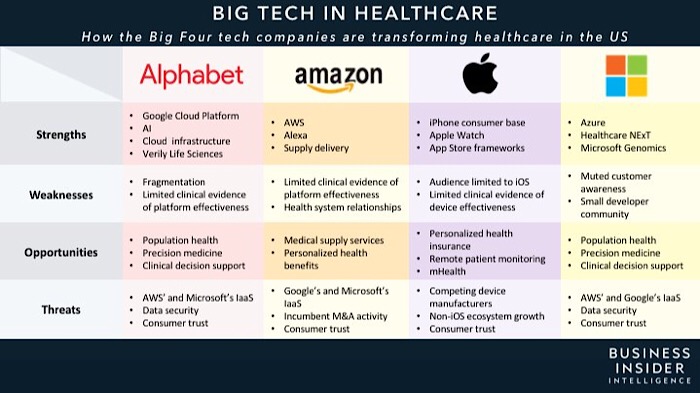
How Alphabet, Amazon, Apple, and Microsoft are shaking up healthcare — and what it means for the future of the industry

220D3A2B-47CC-42B8-895E-A985B8DADBA1

The healthcare industry is undergoing a profound transformation. Costs are skyrocketing, consumer demand for more accessible care is growing rapidly, and healthcare companies are unable to keep up.

Health organizations are increasingly turning to tech companies to facilitate this transformation in care delivery and lower health expenditures. The potential for tech-led digital health initiatives to help healthcare providers and insurers deliver safer, more efficient, and cost-effective care is significant. For healthcare organizations of all types, the collection, analyses, and application of patient data can minimize avoidable service use, improve health outcomes, and promote patient independence, which can assuage swelling costs.

Continue reading… “How Alphabet, Amazon, Apple, and Microsoft are shaking up healthcare — and what it means for the future of the industry”

The end of chemotherapy? Scientists discover all cancerous cells have a KILL CODE that can be triggered without the gruelling treatment

196220F3-0A2A-4543-9A1A-5813CEC18C93

Researchers at Northwestern University found that our cells can kill themselves

Currently, this is triggered by disease itself or the artificial use of chemotherapy

Now, experts believe the ‘kill codes’ could be synthetically duplicated for use

Every cell in the human body contains a ‘kill code’ which can be triggered to cause its own self-destruction.

That’s the discovery made by researchers at Northwestern University, Illinois, who believe it could be utilised for the future fight against cancer.

Continue reading… “The end of chemotherapy? Scientists discover all cancerous cells have a KILL CODE that can be triggered without the gruelling treatment”

The probiotic that kills antibiotic-resistant bacteria

IMG_9442

Infection with the bacterium Staphylococcus aureus can cause many health problems, including sepsis. Certain strains of this bacterium are resistant to antibiotics, so they are particularly dangerous. However, researchers discover that a probiotic bacterium can destroy this superbug.

Researchers are now investigating the potential of a probiotic bacterium in treating MRSA infections.

Methicillin-resistant Staphylococcus aureus (MRSA) is highly resistant to treatment with antibiotics.

These include oxacillin, flucloxacillin, and dicloxacillin.

Continue reading… “The probiotic that kills antibiotic-resistant bacteria”

Scientists grow human retinas and illuminate eye disease targets

IMG_9440

Retinal organoid at 291 days. Red and green cone cells are green in the photo, while blue cone cells are blue.

Scientists were able to grow human retinas from stem cells for 1 year, allowing them to mimic human fetal development of retinas and closely observe how color-detecting cells form.

Why it matters: The information they gathered could be used to prevent or treat eye diseases and disorders like glaucoma, macular degeneration, color blindness and eye problems from premature births, Johns Hopkins University scientists say in a new study published in Science Thursday.

Continue reading… “Scientists grow human retinas and illuminate eye disease targets”

A stretchy stick-on patch can take blood pressure readings from deep inside your body

IMG_9346

The flexible stamp can collect data that usually requires bulky, invasive equipment.

The last time you had your blood pressure checked, it was probably at a doctor’s office with a bulky cuff wrapped around your arm. One day soon, perhaps, you will just need a simple stick-on patch on your neck, no bigger than a postage stamp.

That’s the goal of Sheng Xu and his team at the University of California, San Diego, who are working on a patch that can continuously measure someone’s central blood pressure—the pressure of blood coursing beyond your aorta, the artery in your heart that delivers blood to all the different parts of the body. It could make it a lot easier to monitor heart conditions and keep an eye on other vital organs like the liver, lungs, and brain.

Continue reading… “A stretchy stick-on patch can take blood pressure readings from deep inside your body”

Discover the Hidden Patterns of Tomorrow with Futurist Thomas Frey
Unlock Your Potential, Ignite Your Success.

By delving into the futuring techniques of Futurist Thomas Frey, you’ll embark on an enlightening journey.

Learn More about this exciting program.