UCLA neuroscientists have demonstrated that they can strengthen memory in
human patients by stimulating a critical junction in the brain.
Ever gone to the movies and forgotten where you parked the car? New UCLA research may one day help you improve your memory.
UCLA neuroscientists have demonstrated that they can strengthen memory in human patients by stimulating a critical junction in the brain. Published in the Feb. 9 edition of the New England Journal of Medicine, the finding could lead to a new method for boosting memory in patients with early Alzheimer’s disease…
A meadow of the seagrass plant Posidonia oceanica, which spreads by creating clones of itself.
It’s big, it’s old and it lives under the sea — and now an international research collaboration with The University of Western Australia’s Ocean’s Institute has confirmed that an ancient seagrass holds the secrets of the oldest living organism on Earth…
Ancient giant Posidonia oceanica reproduces asexually, generating clones of itself. A single organism — which has been found to span up to 15 kilometres in width and reach more than 6,000 metric tonnes in mass — may well be more than 100,000 years old.
Once Again Nut Butter produces organic products in upstate New York—it’s a pretty successful company as far as organic food goes, considering you can find it in just about any natural foods store around.
But Once Again is growing increasingly concerned not only for its own future as an organic company, but for the entire state’s organic industry, if plans to develop fracking in the state are allowed to continue…
Obviously, there’s a lot of money to be made from hit pop songs. But can you predict or even make which songs will make it ot the top of the charts?
Bring in the scientists! Artificial Intelligence researcher Tijl De Bie and colleagues analyzed 50 years’ worth of hit songs on Britain’s top 40 charts and came up with a formula.
Stiff muscles definitely benefit from a rub down, but scientists have never quite known why. Now, a team of researchers has shown that it works by changing your gene expression — quite literally, your body is hard-coded to release pain-easing chemicals when you’re massaged.
If you listen to people in the world of alternative medicine, they’ll normally tell you that massage “releases toxins”. That is bull, and scientists know it. But knowing an answer is wrong doesn’t give you the right one. No, doing some science does…
People with certain forms of the CD36 gene may like high-fat foods more than those who have other forms of this gene.
A preference for fatty foods has a genetic basis, according to researchers, who discovered that people with certain forms of the CD36 gene may like high-fat foods more than those who have other forms of this gene.
The results help explain why some people struggle when placed on a low-fat diet and may one day assist people in selecting diets that are easier for them to follow. The results also may help food developers create new low-fat foods that taste better…
I just learned about Ferrofluid today. It can do some amazing things, like this video shows. After the jump is a second video explaining HOW ferrofluid works.
From the YouTube descriptioin:
A steel sculpture with changing magnetisation is coated with ferrofluid.
The fluid is pulled in the direction of increasing flux density and forms peaks, which become smaller in higher flux density. At an accumulation of fluid at ridges, the flux density at the surface decreases. The flow and the distribution of the fluid can be observed at several characteristic locations…
It is now more important than ever to cover your mouth when sneezing.
A flesh-eating bug, which has been known about for years, has gotten so virulent it can now be spread by sneezing and coughing. Doctors suspect new victims caught the virus on buses or trains and enclosed spaces like elevators.
Although the flesh-eating bug has been documented for several decades, most patients suffering from its effects caught the strain in hospitals where treatment contained the spread and was relatively confined and hard to catch.
But the bacteria strain, an MRSA known as USA300, has become so powerful it can now be spread by sneezing. Even worse, the virus is spreading just by shaking hands…
Admittedly, I did spend my childhood playing with explosives. But I certainly never had as much success as 10-year-old Clara Lazen (not pictured), who accidentally created a new energy storing molecule, tetranitratoxycarbon, that could be used as an explosive…
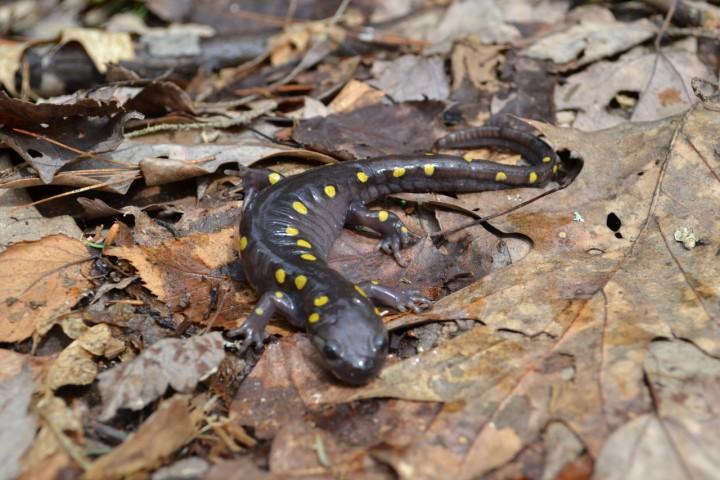
A female spotted salamander gravid with eggs in route to her breeding pool. There she will lay a cluster of approximately 100 eggs. Eight to ten weeks later, those eggs will hatch as larvae. In late summer, if the pool has not already dried, larvae will metamorphose into juveniles that migrate to the adjacent upland habitat.
Spotted salamanders exposed to contaminated roadside ponds are adapting to their toxic environments, according to a Yale paper in Scientific Reports. This study provides the first documented evidence that a vertebrate has adapted to the negative effects of roads apparently by evolving rapidly…
Jenine Shereos’s delicate leaf sculptures look like the real thing from a distance, but they’re actually made of hair. She made them by stitching the hairs together on a backing, then dissolving that backing in water…
A powerful X-ray laser pulse from SLAC National Accelerator Laboratory’s Linac Coherent Light Source comes up from the lower-left corner (shown as green) and hits a neon atom (center). This intense incoming light energizes an electron from an inner orbit (or shell) closest to the neon nucleus (center, brown), knocking it totally out of the atom (upper-left, foreground). In some cases, an outer electron will drop down into the vacated inner orbit (orange starburst near the nucleus) and release a short-wavelength, high-energy (i.e. “hard”) X-ray photon of a specific wavelength (energy/color) (shown as yellow light heading out from the atom to the upper right along with the larger, green LCLS light).
Scientists working at the U.S. Department of Energy’s (DOE) SLAC National Accelerator Laboratory have created the shortest, purest X-ray laser pulses ever achieved, fulfilling a 45-year-old prediction and opening the door to a new range of scientific discovery.
The researchers, reporting in Nature, aimed SLAC’s Linac Coherent Light Source (LCLS) at a capsule of neon gas, setting off an avalanche of X-ray emissions to create the world’s first “atomic X-ray laser.”
“X-rays give us a penetrating view into the world of atoms and molecules,” said physicist Nina Rohringer, who led the research. A group leader at the Max Planck Society’s Advanced Study Group in Hamburg, Germany, Rohringer collaborated with researchers from SLAC, DOE’s Lawrence Livermore National Laboratory and Colorado State University…