New Quantum Computing Partnership Makes 100-Qubit Algorithms a Reality

ColdQuanta, a leader in cold atom quantum technology, and Classiq, which provides the leading software platform for Quantum Algorithm Design, today announced a partnership to make 100-qubit quantum circuits a reality for companies and researchers that crave quantum computing solutions to their most pressing problems. The partnership combines the power of two industry-leading platforms: ColdQuanta’s cold atom quantum computers and Classiq’s quantum algorithm design software.

Together, this combined solution provides customers the unique ability to create, simulate and execute unique quantum circuits to address a wide range of finance, material science, supply chain and machine learning challenges.

Continue reading… “New Quantum Computing Partnership Makes 100-Qubit Algorithms a Reality”

Researchers develop new method embedding atoms one-by-one to build quantum chip

The new technique paves way for the development of large-scale devices that are more affordable and reliable.

Written by Aimee Chanthadavong

A team of researchers have developed a new silicon construction technique that could potentially improve the affordability and reliability of building quantum computers. 

The new technique — jointly developed by researchers from Australia’s University of Melbourne, University of New South Wales (UNSW) and RMIT, and Germany’s Helmholtz-Zentrum Dresden-Rossendorf and Leibniz Institute of Surface Engineering — involves precisely embedding single atoms one-by-one in silicon wafers. 

According to the researchers, the technique, which has been published in an Advanced Materials paper, takes advantage of the precision of the atomic microscope, which has a sharp cantilever that “touches” the surface of a chip with a positioning accuracy of just half a nanometre, which is about the same space between atoms in a silicon crystal. 

The researchers described how a tiny hole was drilled in the cantilever, so that when it was showered with phosphorous atoms, one would occasionally drop through the hole and embed in the silicon substrate. 

A key aspect of this was knowing precisely when an atom was embedded in the substrate so the cantilever could move to the next precise position on the array. 

Continue reading… “Researchers develop new method embedding atoms one-by-one to build quantum chip”

Quantum computing companies to see real-world use cases in 2022

According to a survey report, 69% of of global enterprises have already adopted, or plan to adopt, quantum computing in the near term.

By Aaron Raj

  • 69% of global enterprises have already adopted or plan to adopt quantum computing
  • Germany is the most bullish on achieving a competitive advantage with quantum computing
  • Machine learning and data analytics problems are the top use cases for early and more advanced adopters of quantum computing

Quantum computing is finally making its presence felt among companies around the world. Over the last few years, companies have shown interest in quantum computing but often couldn’t make definitive decisions on using the technology, as there was not enough research on its practical applications beyond the theoretical.

Nevertheless, 2021 has been a remarkable year for the quantum computing industry. Not only has there been more research on the potential use cases for the technology, but investments in quantum computing have shot up globally to boot.

While the US and China continue to compete with each other for supremacy in this evolving branch of computing, other countries and organizations around the world have slowly been playing catch up as well. And now, 2022 is expected to be the year whereby companies can start seeing quantum computing breakthroughs that could result in practical uses.

According to the first annual Enterprise Quantum Computing Adoption Reportby Zapata Computing, 69% of global enterprises have already adopted, or plan to adopt quantum computing solutions in the near term. The report, which involved over 300 leaders at large multinational enterprises, also showed that 74% of them agreed that those who fail to adopt quantum computing will fall behind.

Continue reading… “Quantum computing companies to see real-world use cases in 2022”

Quantum computing: Forget about qubits, here come qutrits

Rigetti unveils 80-qubit processor quantum computer consisting of two 40-qubit computers, and experiments with ‘third state’ in quantum processors.

By Liam Tung

US quantum computer outfit Rigetti Computing has announced the Aspen-M, an 80-qubit processor quantum computer that consists of two connected 40-qubit chips. 

The Aspen-M, available in a private beta, is the culmination of Rigetti’s particular take on large-scale quantum computers. 

The firm is pursuing multi-chip quantum processors and announced plans earlier this year to offer it to customers through its Quantum Cloud Services platform.

Instead of scaling up a single quantum processor, it’s been linking smaller chips to create a modular processor with a larger number of qubits – the quantum version of bits in classical computers, characterized by 1s and 0s, which can achieve superposition where a bit can be both 1 and 0 or any combination inbetween those states. 

Continue reading… “Quantum computing: Forget about qubits, here come qutrits”

Rigetti Computing Announces Next-Generation 40Q and 80Q Quantum Systems

Rigetti’s 80-qubit Aspen-M: a commercial multi-chip quantum processor.

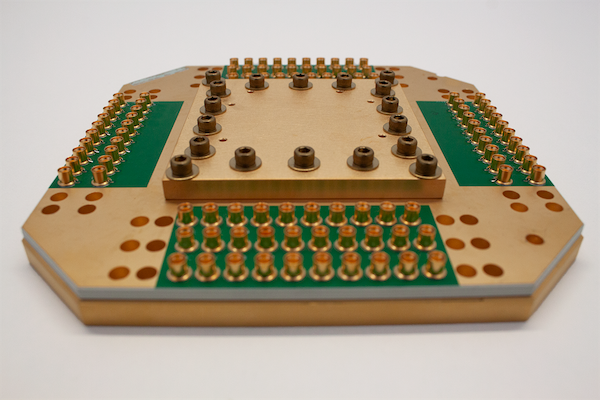
BERKELEY, Calif., Dec. 15, 2021 — Rigetti Computing, a pioneer in hybrid quantum-classical computing, today introduced its next-generation “Aspen-M” 80-qubit quantum computer into private beta. Aspen-M is the world’s first commercial multi-chip quantum processor, solving a critical scaling challenge in the race toward fault-tolerant quantum computing. The Aspen-M processor leverages Rigetti’s proprietary multi-chip technology and is assembled from two 40-qubit chips.

Separately, a new Aspen system based on a single-chip 40-qubit processor will be released today for general availability on Rigetti Quantum Cloud Services, the Strangeworks Ecosystem, and Amazon Braket.In addition, Rigetti announced it is collaborating with Deloitte, a multinational professional services company, and Strangeworks, a leading managed quantum service provider, to explore quantum applications in material simulation, optimization, and machine learning using Rigetti’s new scalable processors.

These latest Rigetti Aspen superconducting processors incorporate improvements in scale, speed, and fidelity—three metrics critical to unlocking broad commercial value. In addition to more than doubling the processor size over its previous generation, the systems powered by these processors deliver a 2.5x speedup in quantum processing times and reduce readout errors by up to 50 percent, drastically improving the reliability of quantum program results.

“With these systems, we’ve reached a critical milestone in the emerging quantum advantage era,” said Chad Rigetti, founder and CEO of Rigetti Computing. “Our machines are now at a scale and speed where they can process the real-world data sets that underpin high-impact applications. We believe these systems give researchers and enterprises the best platform to pursue quantum advantage on real problems.”

Continue reading… “Rigetti Computing Announces Next-Generation 40Q and 80Q Quantum Systems”

ROLE OF QUANTUM COMPUTING AND AI IN HEALTHCARE INDUSTRY

QUANTUM COMPUTING AND AI HELP THE HEALTHCARE INDUSTRY TRANSFORM BIG TIME

by Madhurjya Chowdhury

One of our age’s major achievements in healthcare. Medical research has advanced rapidly, extending life expectancy around the world. However, as people live longer, healthcare systems face increased demand, rising expenses, and a staff that is straining to meet the needs of the patient.

Population aging, changing patients’ needs, a change in life choices, and the never-ending loop of innovation are just a few of the relentless forces driving demand. The consequences of an aging population stand out among these. Healthcare is one of our generation’s main achievements. Medical research has progressed at a breakneck pace, extending life expectancy all around the world.

Continue reading… “ROLE OF QUANTUM COMPUTING AND AI IN HEALTHCARE INDUSTRY”

Quantum computers to explore precision oncology

Quantum processors can potentially tackle massive calculations at speed

By Alison Abbott 

Life scientists are preparing to test quantum computers for applications beyond computational chemistry, such as selecting responders to cancer therapies.

Cancer researchers will be among the first to test the potential of Europe’s first IBM quantum computer, which was unveiled in Germany this summer. The 27-qubit IBM Q System One is among the most powerful commercial quantum computers in Europe. Based at IBM’s German headquarters in Ehningen, near Stuttgart, it is jointly operated by IBM and the Fraunhofer Society, Germany’s multidisciplinary applied research organization headquartered in Munich. The Fraunhofer Society is making the quantum computer available to researchers wishing to test ideas for practical applications of quantum computers, including in life sciences.

Continue reading… “Quantum computers to explore precision oncology”

Exotic New Material Could Be Two Superconductors in One – With Serious Quantum Computing Applications

Work has potential applications in quantum computing, and introduces new way to plumb the secrets of superconductivity.

MIT physicists and colleagues have demonstrated an exotic form of superconductivity in a new material the team synthesized only about a year ago. Although predicted in the 1960s, until now this type of superconductivity has proven difficult to stabilize. Further, the scientists found that the same material can potentially be manipulated to exhibit yet another, equally exotic form of superconductivity.

The work was reported in the November 3, 2021, issue of the journal Nature.

The demonstration of finite momentum superconductivity in a layered crystal known as a natural superlattice means that the material can be tweaked to create different patterns of superconductivity within the same sample. And that, in turn, could have implications for quantum computing and more.

The material is also expected to become an important tool for plumbing the secrets of unconventional superconductors. This may be useful for new quantum technologies. Designing such technologies is challenging, partly because the materials they are composed of can be difficult to study. The new material could simplify such research because, among other things, it is relatively easy to make.

Continue reading… “Exotic New Material Could Be Two Superconductors in One – With Serious Quantum Computing Applications”

‘Giant atoms’ May Create All-in-One Quantum Processing and Communication

By Matt Swayne

MIT News reports that researchers have introduced a quantum computing architecture that can perform low-error quantum computations while also rapidly sharing quantum information between processors. The work represents a key advance toward a complete quantum computing platform.

Before, small-scale quantum processors have successfully performed tasks at a rate exponentially faster than that of classical computers. However, it has been difficult to controllably communicate quantum information between distant parts of a processor. In classical computers, wired interconnects are used to route information back and forth throughout a processor during the course of a computation. In a quantum computer, however, the information itself is quantum mechanical and fragile, requiring fundamentally new strategies to simultaneously process and communicate quantum information on a chip.

“One of the main challenges in scaling quantum computers is to enable quantum bits to interact with each other when they are not co-located,” says William Oliver, an associate professor of electrical engineering and computer science, MIT Lincoln Laboratory fellow, and associate director of the Research Laboratory for Electronics. “For example, nearest-neighbor qubits can easily interact, but how do I make ‘quantum interconnects’ that connect qubits at distant locations?”

The answer lies in going beyond conventional light-matter interactions.

Continue reading… “‘Giant atoms’ May Create All-in-One Quantum Processing and Communication”

A New Quantum Computing Method Is 2,500 Percent More Efficient

And it’s ‘absolutely amazing.’

By  Brad Bergan

We just moved years closer to viable quantum computers.

A company has revealed the results of benchmarking experiments that demonstrate how an advanced error-suppression method increased the probability of success for quantum computing algorithms to succeed on real hardware, according to a press release shared with Interesting Engineering via email.

And the new method increased the likelihood of success by an unprecedented 2,500%.

Continue reading… “A New Quantum Computing Method Is 2,500 Percent More Efficient”

China’s New Quantum Computer Has 1 Million Times the Power of Google’s

And they say it’s the world’s fastest.

By  Brad Bergan

It appears a quantum computer rivalry is growing between the U.S. and China.

Physicists in China claim they’ve constructed two quantum computers with performance speeds that outrival competitors in the U.S., debuting a superconducting machine, in addition to an even speedier one that uses light photons to obtain unprecedented results, according to a recent study published in the peer-reviewed journals Physical Review Letters and Science Bulletin.

China has exaggerated the capabilities of its technology before, but such soft spins are usually tagged to defense tech, which means this new feat could be the real deal.

Continue reading… “China’s New Quantum Computer Has 1 Million Times the Power of Google’s”

A Simple Crystal Could Finally Give Us Large-Scale Quantum Computing, Scientists Say

By lenexweb

Vaccine and drug development, artificial intelligence, transport and logistics, climate science – these are all areas that stand to be transformed by the development of a full-scale quantum computer. And there has been explosive growth in quantum computing investment over the past decade.

Yet current quantum processors are relatively small in scale, with fewer than 100 qubits – the basic building blocks of a quantum computer. Bits are the smallest unit of information in computing, and the term qubits stems from “quantum bits”.

While early quantum processors have been crucial for demonstrating the potential of quantum computing, realizing globally significant applications will likely require processors with upwards of a million qubits.

Our new research tackles a core problem at the heart of scaling up quantum computers: how do we go from controlling just a few qubits, to controlling millions? In research published today in Science Advances, we reveal a new technology that may offer a solution.

Continue reading… “A Simple Crystal Could Finally Give Us Large-Scale Quantum Computing, Scientists Say”
Discover the Hidden Patterns of Tomorrow with Futurist Thomas Frey
Unlock Your Potential, Ignite Your Success.

By delving into the futuring techniques of Futurist Thomas Frey, you’ll embark on an enlightening journey.

Learn More about this exciting program.