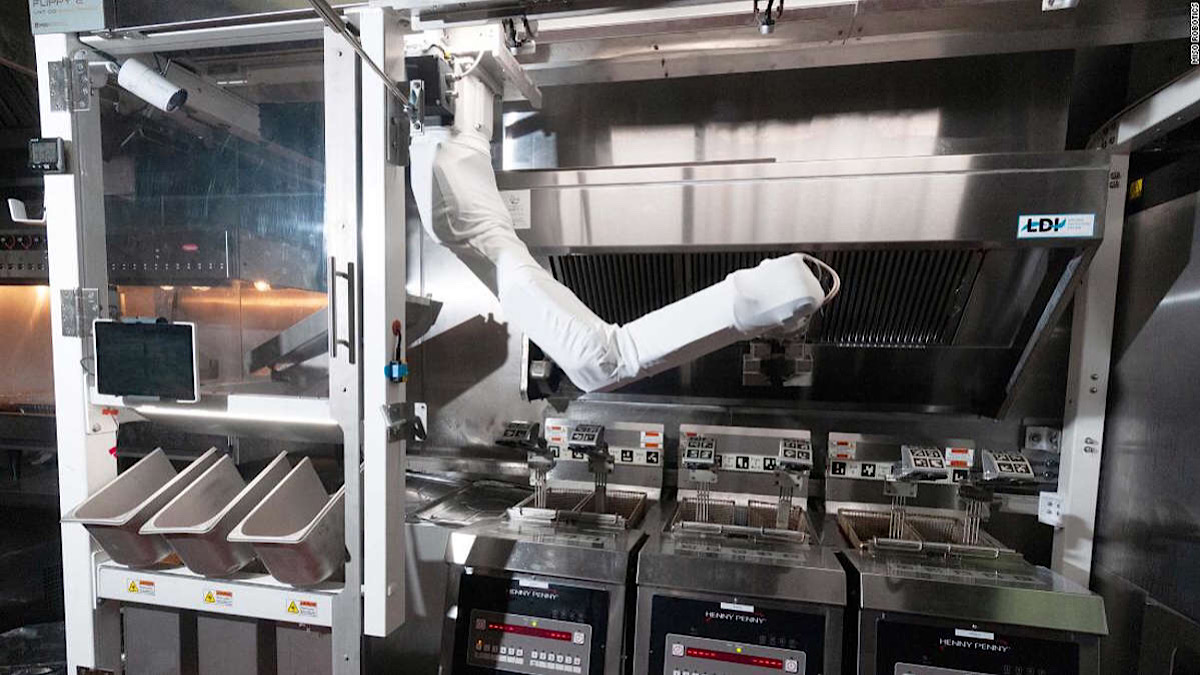
Ford Invents The Ultimate Barbeque Robot

It’s the Terminator of cooked meats.

BY MICHAEL BUTLER

As the world becomes increasingly automated, car manufacturers, who have historically been innovators in the field of automation, are taking things to the next level. Hyundai’s newest employees are all robots, and even Honda plans on employing an army of delivery robots in the near future. Ford has also shown some serious advancement in the world of automation, with its most impressive being this robotic grilling machine, complete with a Ford Ranger front-end. The robot operates from Ford’s Silverton assembly plant in South Africa, and is blowing people away with its ability to flip a burger better than SpongeBob could ever dream of. Welcome to the future ladies and gentleman.

Ford calls this wondrous machine the TCF BBQ (Braai Boerewors Quickly), which refers to a type of South African sausage cooked on open coals. The TCF BBQ was salvaged from decommissioned tooling used in the Silverton Assembly Plant, and was dreamt up by Claude Roux, an area manager from the trim and chassis and final (TCF) line. The robot was programmed as part of a competition held by Ford South Africa to design something unique from decommissioned tools sitting at the plant.

Continue reading… “Ford Invents The Ultimate Barbeque Robot”
Autonomous Two-Legged Robot Ascento Pro Has Motorized Wheels, Jumps Like a True Athlete

by Cristina Mircea

Wheeled robots are really starting to catch on, as this design makes them suitable for a variety of applications. The Ascento Pro is a good example of versatile mobile bots and it combines both the flexibility of the legs and the speed of wheels. 6 photos

Developed by Swiss company Ascento Robotics, the Ascento Pro is an upgraded version of the previous Ascento 2 machine, which was launched in 2020. That robot was already impressive in terms of motor skills, but the Pro version brings even more features to the table.

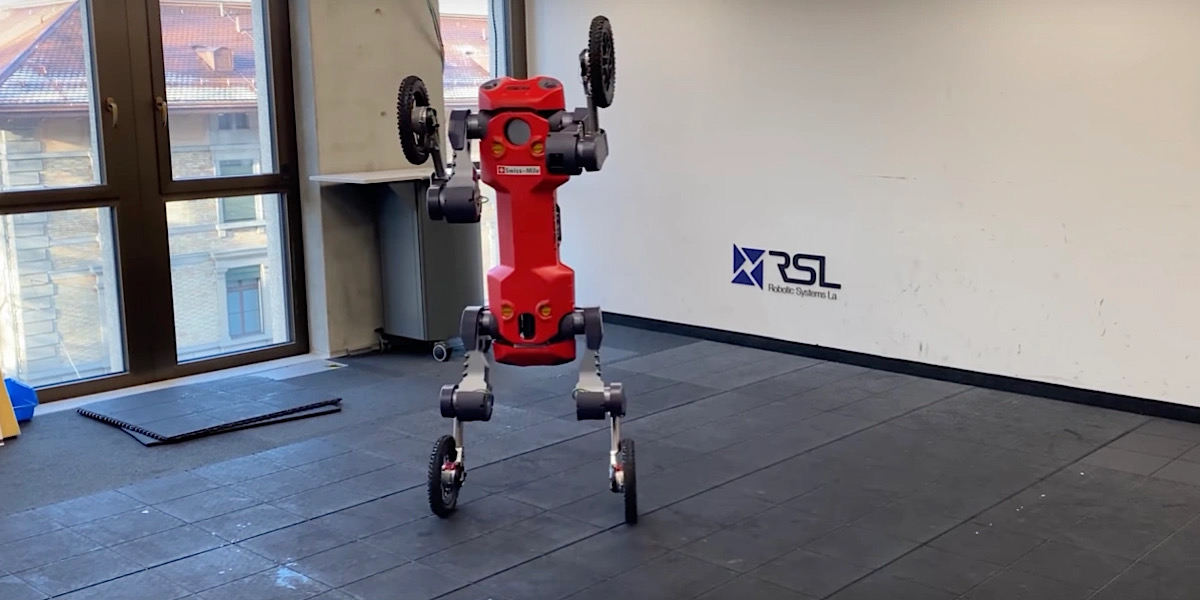
With a simple, compact, and modular design, the Ascento Pro is designed in a way that leaves enough space for custom sensors and various payloads. It has two legs, each with a motorized wheel, and a tensional spring in the knees, which compensates for the bot’s own weight. It can bend its knees to get even smaller, it can walk on any surface, climb stairs, jump up and forward, and hop over obstacles.

Continue reading… “Autonomous Two-Legged Robot Ascento Pro Has Motorized Wheels, Jumps Like a True Athlete”

Courier service Glovo to use robots for Madrid deliveries

MADRID – The decision of the Madrid City Council to allow self-driving vehicles on the street is an excellent opportunity for Glovo to start with robot deliveries. The courier service has now applied for approval for a trial in the chic Salamanca district. 

If it is up to Glovo, the robots will take to the streets after approval in January. This represents a major challenge for the city council of the Spanish capital. On one hand, it wants to make Madrid an attractive location for innovative companies. However, on the other hand, it must continue to monitor safety on the street. 

In addition to Glovo, the Madrid start-up Goggo Network has also requested approval for putting self-driving vehicles on the road. The intention is that these vehicles, like Glovo’s robots, will be deployed in the Salamanca district. It will then be the first time that automated vehicles will drive around the city. 

Continue reading… “Courier service Glovo to use robots for Madrid deliveries”

Grocery Robot Specialist Simbe Robotics Patents System to Detect Produce Freshness

by Michael Wolf

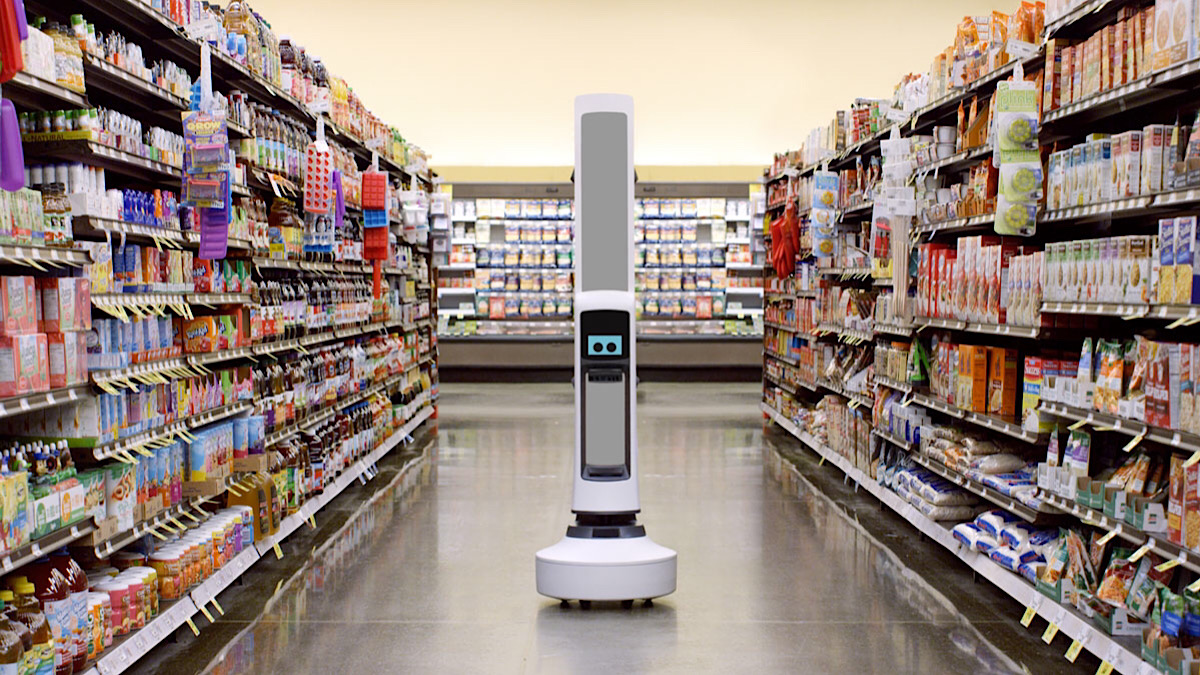
Whether it’s to carry groceries around the store or to deliver them to our front door, it won’t be too much longer before everyday shoppers see robots both in and around the grocery store.

But one potential interesting new use-case for in-store robotics we haven’t heard much about is for detection of produce freshness. That may change soon, as Simbe Robotics, the maker of the Tally 3.0 robot, has just been issued a patent for spectral imaging of produce and meats and detect how fresh they are.

The US patent, which is number 11,200,537 and titled “Method for tracking and characterizing perishable goods in a store,” uses computer vision to record images across a period of time and derive a set of characteristics specific to the type of food. For produce, it can assign a percentage of ripeness, determine whether it is under, over, or at peak ripeness, and determine if there is other biological matter such as a contaminant on the food. It can also determine whether a fruit or vegetable is rotten, damaged, or bruised. 

Continue reading… “Grocery Robot Specialist Simbe Robotics Patents System to Detect Produce Freshness”

Asylon Robotics Set to Unveil New Security Robotics Capabilities With DroneDog

The release event showcases next-generation hardware and software that enables the DroneDog security robot to conduct teleoperated patrols and response missions.

By Ryan Hodgens

Asylon, Inc., the only full-service American robotic perimeter security company, is set to demonstrate DroneDog live on December 15. During the demonstration, two guests will have complete control over the DroneDog — physically located in Norristown, Pennsylvania —without leaving their respective offices around the country.

Earlier this year, Asylon partnered with Boston Dynamics, creators of the Spot quadruped unmanned ground vehicle (Q-UGV), to create the DroneDog system. Boston Dynamics has focused on creating robots with advanced mobility for 30 years and their Spot robot has been purposefully designed to be a platform. The complete DroneDog system includes additional hardware and software components that are set to be unveiled during the event.

The hardware and software Asylon developed enable capabilities that include live video monitoring, teleoperation, 20x optical zoom, infrared (thermal) vision for nighttime operations, and automated charging for a set-and-forget system. And, while most ground robots run on wheels or tracks, DroneDog’s leg design allows it to travel over uneven and unpredictable terrain with organic, life-like motion. Organizations can even have multiple DroneDogs working in combination to employ an automated security task force to guard their locations 24/7.

Continue reading… “Asylon Robotics Set to Unveil New Security Robotics Capabilities With DroneDog”

Swiss delivery robot walks, drives, stands, but doesn’t fly (yet)

By Bruce Crumley

A major Swiss update of a previously developed robot has yielded a car, quadruped, humanoid delivery vehicle that may rival aerial drones in getting goods to destinations – apart from the flying trick, that is.

Initially trotted out as the ANYmal in 2018, the new, wheel-outfitted iteration was rolled out recently as the Swiss-Mile Robot, whose driving, climbing, and standing capacities make it a tough delivery vehicle competitor to autonomous cars and aerial drones. Those development improvements were the work of the Swiss Mile, which adopted the bot concept from creator ANYbotics. Named for the distance the machine can cover in an hour (13.8 miles), the upgraded Swiss Mile robot can operate for 90 minutes on a single charge, and reach transport speeds of up to 14 mph.

Continue reading… “Swiss delivery robot walks, drives, stands, but doesn’t fly (yet)”

AES launches ‘first-of-its-kind’, AI-driven solar installation robot

The robot will aid in construction by performing the lifting, placing and attachment of solar panels. Image: AES promotional video

By Sean Rai-Roche

Energy technology company AES has launched an artificially intelligent (AI) robot to support the construction of new solar projects. 

The company said the “first-of-its-kind” machine will make it faster, more efficient and safer to construct new solar facilities.

The product of a multi-year innovation process, the robot, dubbed Atlas, was designed by AES and built in cooperation with Calvary Robotics as well as other third parties at Calvary’s New York headquarters.

AES teams will use Atlas as a tool in the construction of new solar projects. Atlas will support AES’ workforce by performing the heavy lifting, placing and attachment of solar modules, while adding new high-tech jobs, AES said.

“The… Atlas robot automates the construction of new solar resources, enabling a safer work environment, shorter project timelines and lower overall energy costs,” said Chris Shelton, AES senior vice president and chief product officer.

Continue reading… “AES launches ‘first-of-its-kind’, AI-driven solar installation robot”

S’pore team turning cockroaches into life-saving cyborg bugs at disaster sites

The cockroaches can distinguish between human and non-human subjects with 87 per cent accuracy.

By Clara Chong

SINGAPORE –  COCKROACHES ARE KNOWN TO INFILTRATE HOMES THROUGH THE TINIEST OF GAPS, AND THIS INNATE ABILITY NOW HAS ENGINEERS IN SINGAPORE WORKING TO TURN THE PESKY INSECT INTO AN ALLY OF RESCUERS AT DISASTER SITES.

ONE VARIETY OF THE INSECT, IN PARTICULAR, HAS THE TEAM AT NANYANG TECHNOLOGICAL UNIVERSITY (NTU) EXCITED – THE MADAGASCAR HISSING COCKROACH.

ON AVERAGE, AN ADULT IS 6CM LONG, 2CM LONGER THAN THE LOCAL VARIETY.

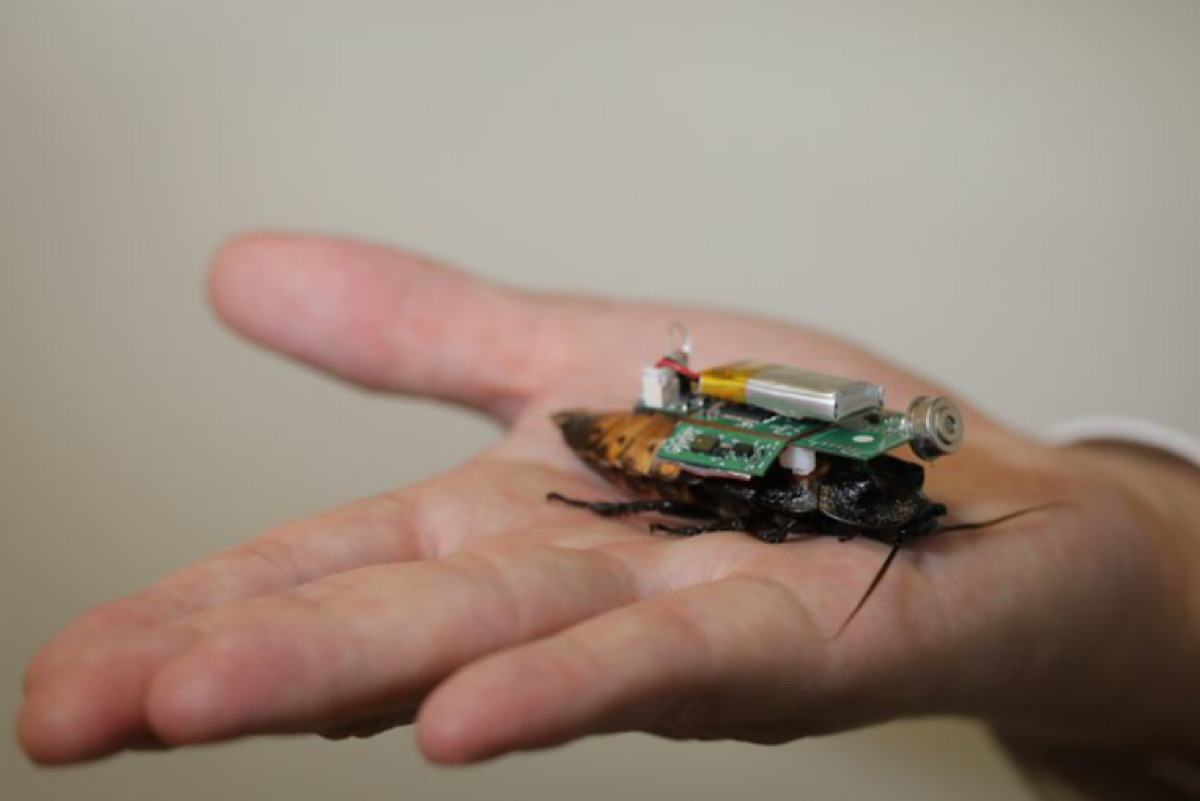
THE SPECIES IS LARGE ENOUGH FOR ASSOCIATE PROFESSOR HIROTAKA SATO AND HIS TEAM AT THE SCHOOL OF MECHANICAL AND AEROSPACE ENGINEERING TO EQUIP THE BUG WITH A 5.5G “BACKPACK” CONSISTING OF SEVERAL SENSORS, INCLUDING THOSE THAT CAN WARN OF THE PRESENCE OF GASES SUCH AS CARBON DIOXIDE.

THE CYBORG BUGS ALSO CARRY A SMALL INFRARED CAMERA THAT CAN DETECT LIFE BY PICKING UP TEMPERATURE SIGNATURES. THE IDEA IS TO RELEASE A TEAM OF THEM AT A DISASTER SITE.

PROF SATO’S RESEARCH, WHICH STARTED FOUR YEARS AGO, IS BEING CONDUCTED IN PARTNERSHIP WITH SINGAPORE’S HOME TEAM SCIENCE AND TECHNOLOGY AGENCY (HTX) AND ENGINEERING FIRM KLASS ENGINEERING AND SOLUTIONS.

Continue reading… “S’pore team turning cockroaches into life-saving cyborg bugs at disaster sites”

Segway makes its first foray into sidewalk robot delivery with Coco partnership

By Rebecca Bellan

Segway sees a future for sidewalk delivery robots and is now preparing to be the burgeoning industry’s go-to manufacturer.

The company, which has supplied electric scooters for almost all of the major shared micromobility operators, is partnering with Los Angeles-based delivery robot startup Coco to build 1,000 partially automated, remotely piloted sidewalk robots. Coco will begin deploying the robots in Los Angeles and two other U.S. cities during the first quarter of 2022.

This new shipment of Coco 1 robots, as the company is branding them, will add to its existing fleet of 100 Coco 0 units, a “box on wheels” that the company first built to prove out its business model. Coco has also placed an order for an additional 1,200 vehicles, which it expects to be able to deploy by May or June 2022, pending potential contracts, according to Sahil Sharma, SVP of vehicles at Coco.

Segway has been conducting R&D on robotics for years, and even formed a dedicated division in 2016. That was the same year the company unveiled its Loomo robot, which is basically a scooter base with a little robotic head that includes an Intel RealSense RGB-D camera, speech recognition and self-driving capabilities.

Continue reading… “Segway makes its first foray into sidewalk robot delivery with Coco partnership”

Team builds first living robots—that can reproduce

AI-designed Xenobots reveal entirely new form of biological self-replication—promising for regenerative medicine

By Joshua Brown, University of Vermont Communications

(BURLINGTON, Vermont) – To persist, life must reproduce. Over billions of years, organisms have evolved many ways of replicating, from budding plants to sexual animals to invading viruses.

Now scientists at the University of Vermont, Tufts University, and the Wyss Institute for Biologically Inspired Engineering at Harvard University have discovered an entirely new form of biological reproduction—and applied their discovery to create the first-ever, self-replicating living robots.

The same team that built the first living robots (“Xenobots,” assembled from frog cells—reported in 2020) has discovered that these computer-designed and hand-assembled organisms can swim out into their tiny dish, find single cells, gather hundreds of them together, and assemble “baby” Xenobots inside their Pac-Man-shaped “mouth”—that, a few days later, become new Xenobots that look and move just like themselves.

And then these new Xenobots can go out, find cells, and build copies of themselves. Again and again.

“With the right design—they will spontaneously self-replicate,” says Joshua Bongard, Ph.D., a computer scientist and robotics expert at the University of Vermont who co-led the new research.

The results of the new research were published November 29, 2021, in the Proceedings of the National Academy of Sciences.

Continue reading… “Team builds first living robots—that can reproduce”

Alphabet is putting its prototype robots to work cleaning up around Google’s offices

Though the machines are still very much a work in progress

By James Vincent  

What does Google’s parent company Alphabet want with robots? Well, it would like them to clean up around the office, for a start. 

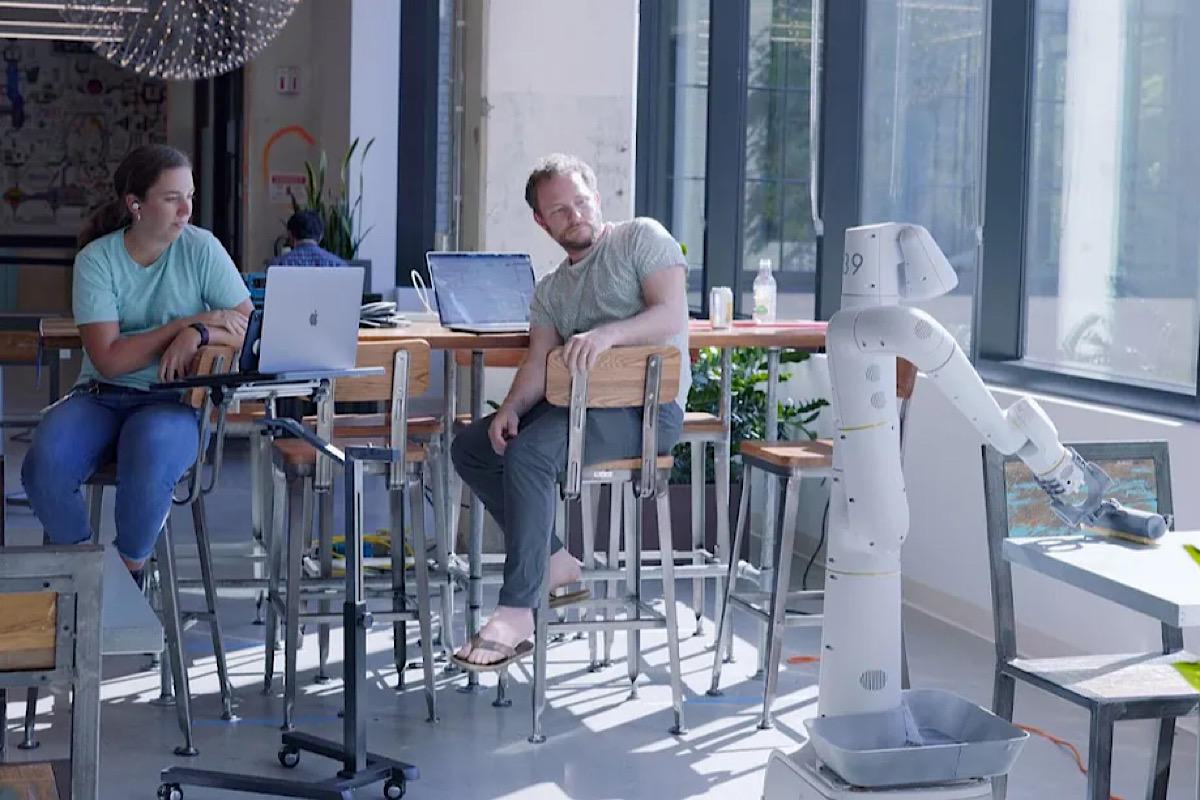
The company announced today that its Everyday Robots Project — a team within its experimental X labs dedicated to creating “a general-purpose learning robot” — has moved some of its prototype machines out of the lab and into Google’s Bay Area campuses to carry out some light custodial tasks. 

“We are now operating a fleet of more than 100 robot prototypes that are autonomously performing a range of useful tasks around our offices,” said Everyday Robot’s chief robot officer Hans Peter Brøndmo in a blog post. “The same robot that sorts trash can now be equipped with a squeegee to wipe tables and use the same gripper that grasps cups can learn to open doors.”

These robots in question are essentially arms on wheels, with a multipurpose gripper on the end of a flexible arm attached to a central tower. There’s a “head” on top of the tower with cameras and sensors for machine vision and what looks like a spinning lidar unit on the side, presumably for navigation.

Continue reading… “Alphabet is putting its prototype robots to work cleaning up around Google’s offices”

America is hiring a record number of robots

Companies in North America added a record number of robots in the first nine months of this year as they rushed to speed up assembly lines and struggled to add human workers.

Factories and other industrial users ordered 29,000 robots, 37% more than during the same period last year, valued at $1.48 billion, according to data compiled by the industry group the Association for Advancing Automation. That surpassed the previous peak set in the same time period in 2017, before the global pandemic upended economies.

The rush to add robots is part of a larger upswing in investment as companies seek to keep up with strong demand, which in some cases has contributed to shortages of key goods. At the same time, many firms have struggled to lure back workers displaced by the pandemic and view robots as an alternative to adding human muscle on their assembly lines.

Continue reading… “America is hiring a record number of robots”
Discover the Hidden Patterns of Tomorrow with Futurist Thomas Frey
Unlock Your Potential, Ignite Your Success.

By delving into the futuring techniques of Futurist Thomas Frey, you’ll embark on an enlightening journey.

Learn More about this exciting program.