Cardboard bicycle can change transportation habits around the world

Israeli inventor Izhar Gafni holds his cardboard bicycle

Izhar Gafni, an Israeli inventor, says that a bicycle made almost entirely of cardboard has the potential to change transportation habits from the world’s most congested cities to the poorest reaches of Africa.


Continue reading… “Cardboard bicycle can change transportation habits around the world”

Inventing the Future

Futurist Thomas Frey: When Charles Corry walked onto the stage of the Shark Tank-like Piranha Pit at Saturday’s DaVinci Inventor Showcase, his iExpander product was still $6,000 away from making the goal of $125,000 on Kickstarter. As of this morning, he has not only passed his goal, now exceeding $140,000, but still has 6 more days to go.


Continue reading… “Inventing the Future”

Within 10 years college could be totally free

Online courses will revolutionize higher education and cut the cost to near zero for most students over the next decade.

In as little as ten years a quality higher education couldl be largely free—unless, of course, nothing much has changed. It all depends on whom you believe. But one thing is clear: The debate about financing education grows louder by the day.


Continue reading… “Within 10 years college could be totally free”

Why the whole history of the web is wrong

About 43.5 percent of our social traffic are social networks we know.

In the early days of the web, pages of information linked to each other. Then along came web crawlers that helped you find what you wanted among all that information. Around 2003 or 2004, the social web really kicked into gear, and thereafter the web’s users began to connect with each other more and more often. Hence Web 2.0, Wikipedia, MySpace, Facebook, Twitter, etc. This is the dominant history of the web as seen, for example, in this Wikipedia entry on the ‘Social Web.’


Continue reading… “Why the whole history of the web is wrong”

Big data needs to be fast and diverse or it’s useless

Companies need to focus on making this big data fast, intuitive and easy to manipulate.

In the past year big data has become one of the most buzzed about topics, and potentially overhyped, phrases of the year. Big data has huge disruptive potential and the flood of attention should be no surprise. A recent IDC report stated that the business analytics software market grew by 14.1 percent in 2011 and will continue to grow to reach $50.7 billion in 2016, all driven by the focus on big data.


Continue reading… “Big data needs to be fast and diverse or it’s useless”

Announcing the Winners – DaVinci Inventor Showcase 2012


Winner of the 2012 “Inventor of the Year Award” – Power Practical

There was no shortage of creativity on display at this year’s DaVinci Inventor Showcase. Inventors came from all across the U.S. to be part of one of the nation’s most prestigious inventor events.

Winning top prize at this years event was Power Practical for their ingenious Power Pot. Using the magic of thermoelectric power generation, the PowerPot is a cooking pot generator that uses the heat from cooking to run a 5W generator that can power up to 2-3 USB devices at a time. With 5 watts of output and a USB interface, the product is designed to supply the power necessary to charge devices anywhere.

The complete list of inventors receiving awards and honorable mentions included:

Continue reading… “Announcing the Winners – DaVinci Inventor Showcase 2012”

The trade-off between meaning and money in today’s economy

The point of a “capitalist” economy is to minimize the trade-off between meaning and money.

Why is an average investment banker worth much more than an average teacher? And why does a top hedge fund manager “earn” enough to pay for thousands of teachers?  Is there a trade-off between meaning and money? And if there is, how does one master — and perhaps — resolve it? Can it be resolved?


Continue reading… “The trade-off between meaning and money in today’s economy”

When businesses become power players with much less manpower

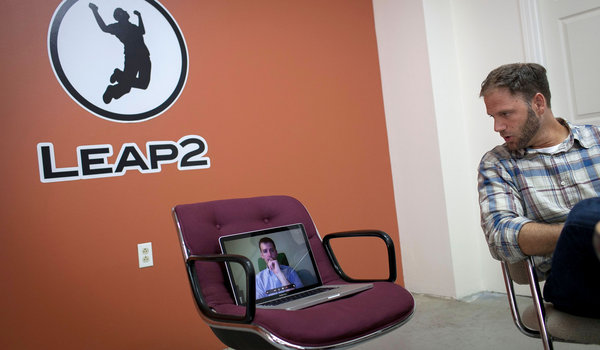
Mike Farmer is C.E.O. of the start-up Leap2. He has one employee: himself, aided by seven contractors.

Mike Farmer had a staff of ten when he started a digital search company in 2004.  He is now on his third start-up and he has one employee: himself, aided by seven contractors working more or less part time. His budget, like his head count, is smaller, and by his account the new model is much more sustainable.


Continue reading… “When businesses become power players with much less manpower”

Discover the Hidden Patterns of Tomorrow with Futurist Thomas Frey
Unlock Your Potential, Ignite Your Success.

By delving into the futuring techniques of Futurist Thomas Frey, you’ll embark on an enlightening journey.

Learn More about this exciting program.