
Of anti-protons! While it’s not as visually cool as what Saturn has going for it, this is still an important development, even if we can’t technically “see” the ring with our primitive Earthling eyes…
Continue reading… “The Earth has a ring”

Of anti-protons! While it’s not as visually cool as what Saturn has going for it, this is still an important development, even if we can’t technically “see” the ring with our primitive Earthling eyes…
Continue reading… “The Earth has a ring”

We have known for a while now that ice exists on Mars. We have seen a lot of suggestions that liquid water may have once existed on the surface in huge rivers and oceans. But NASA has announced for the first time, they may have actually spotted some flowing, liquid water.
Continue reading… “NASA discovers there may be flowing water on Mars”

This diagram shows a simulation of four stages of a collision between the Moon and a companion moon.
There may have been a tiny second moon that had once orbited Earth before catastrophically slamming into the other one. The clash of the two moons could explain why the two sides of the surviving lunar satellite are so different from each other, according to a new study.
Continue reading… “Earth had two moons that collided to form one: study”

If sea levels rose to where they were during the Last Interglacial Period, large parts of the Gulf of Mexico would be under water (red areas),
Melting ice sheets contributed much more to rising sea levels than thermal expansion of warming ocean waters during the Last Interglacial Period, a UA-led team of researchers has found. The results further suggest that ocean levels continue to rise long after warming of the atmosphere has leveled off.
Continue reading… “Is it too late to turn the tides on rising sea levels?”
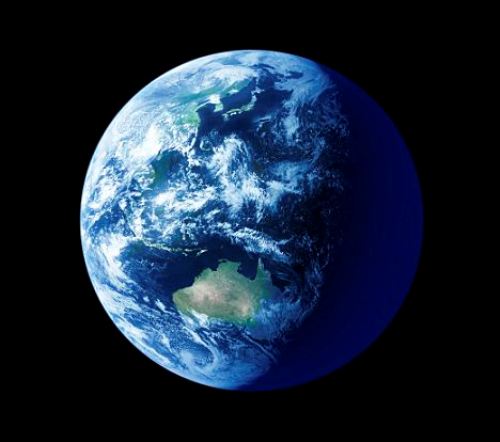
The Earth had been ‘slimming down’ by just under a millimetre a year following the Ice Age, but global warming is reversing this process.
Is global warming to blame for the Earth putting on ‘weight’ around its ‘midriff’? According to scientists, melting ice in Antarctica and Greenland due to global warming is adding volume to the oceans and this extra water is being pulled towards the Equator, adding to the girth at the widest part of our planet.
Continue reading… “Melting ice at the North and South Poles is adding to the Earth’s girth”

Scientists are thinking about starting a new geological era: The Anthropocene.
Anthropologist Félix Pharand has made a visualization of Earth that shows urban areas, shipping routes, global roads and air networks. It also gives a very good idea on how big our species’ physical impact on the planet really is.
Continue reading… “Visualization of the human impact on Earth”

The ability to see Earth’s magnetic field may also reside in human eyes.
Humans might be able to innately detect Earth’s magnetic field without even realizing it, thanks to a compound found in our eyes. Or we may have been able to do so some time in the past.
Continue reading… “Humans can sense the Earth’s magnetic field”

Albert Einstein
Huge objects in the universe distort space and time with the force of their gravity, scientists said on Wednesday after a NASA probe confirmed two key parts of Albert Einstein’s theory of general relativity.
Continue reading… “Einstein’s Theory of General Relativity Proven”

There are about 7 billion human beings on the planet.
Earth is in the middle of a population crisis. While countless species have seen their numbers plummet in recent decades, with more than a few going extinct entirely, humans have seen theirs grow and grow — and the two trends are hardly unrelated. But incredibly, when considering the indelible impact we’ve had on the planet and the creatures we share it with in our brief time here, everyone alive today accounts for a whopping 12 percent of all the humans that have lived, ever.

Futurist Thomas Frey: Over the next year I will be proposing a series of eight major prize competitions, competitions designed to pit the countries of the world against each other in a series of extraordinary tests of skills and abilities.
Continue reading… “Prize Competition #1: The Race to the Core”

Scientists could get their first glimpse of the dawn of the universe from a telescope buried up to half a mile underground. This new device is designed to detect gravitational waves. Gravitational waves are an elusive phenomena created by some of the most violent events in the universe such as black holes, neutron stars and the Big Bang.

An atomic clock in Berlin. Scientists have developed an ‘optical lattice’ clock so sensitive it can detect changes in Earth’s gravity
Professor Hidetoshi Katori and his team at the University of Tokyo with the help of Professor Victor Flambaum have conceived a state-of-the-art atomic clock, which is actually so sensitive that it can detect changes in Earth’s gravity and will allow scientists to measure time to a whopping 17 digits! Not only that, the ‘optical lattice’ clock is also touted to remarkably improve GPS tracking systems and will be able to detect insignificant height differences to the range of 10cm.

By delving into the futuring techniques of Futurist Thomas Frey, you’ll embark on an enlightening journey.
Learn More about this exciting program.