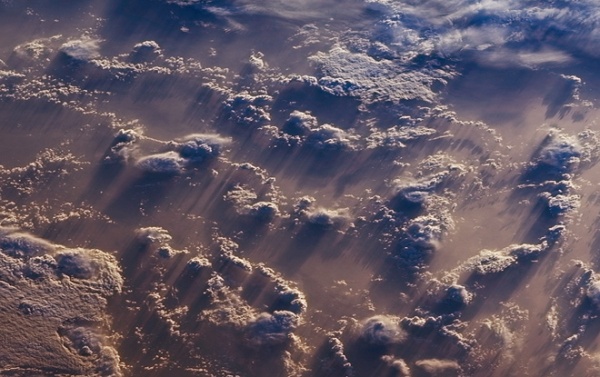
Cloud-top height fell one percent on average between March 2000 and February 2010.
Call Chicken Little, the sky really is falling. NASA satellite data has shown that the Earth’s cloud tops have been lowering over the last 10 years.
Cloud-top height fell one percent on average between March 2000 and February 2010.
Call Chicken Little, the sky really is falling. NASA satellite data has shown that the Earth’s cloud tops have been lowering over the last 10 years.

Understanding the chemistry of phytoplankton is key to controlling Earth’s climate.
Tiny ‘phytoplankton’ in the oceans have a huge impact on Earth’s climate – and understanding them could be key to the planet’s future health.
Continue reading… “Ocean plankton the key ingredient that decides the future of Earth’s climate”

An “intensitygram” from the Helioseismic and Magnetic Imager on NASA’s Solar Dynamics Observatory shows the double-barreled sunspot active region 1416.
As solar activity builds toward an expected peak in 2013, a double-barreled sunspot has been doubling in size over the past couple of days and now has the potential to shoot significant eruptions in our direction. (video)
Continue reading… “Double-barreled sunspot points toward Earth”

Leap seconds are necessary to prevent atomic clocks from speeding ahead of solar time.
Governments are headed for a showdown after ten years of talks as they vote this week on an issue that pits technological precision against nature’s whims. The United States, France and others are pushing for countries at a U.N. telecom meeting to abolish the leap second, which for 40 years has kept computers in sync with the Earth day.
Continue reading… “Global showdown over push to abolish leap second”

Artist’s conception depicts the rover Curiosity.
A nuclear-powered rover as big as a compact car is set to begin a nine-month journey to Mars this weekend to learn if the planet is or ever was suitable for life.
Continue reading… “NASA nuclear-powered rover to search for life’s habitats on Mars”

Settlement on the Moon
It’s been a dream for a long time to have a human settlement on the Moon, but in this age of budget cuts and indecisive plans for NASA’s future, a Moon base may seem too costly and beyond our reach. But a noted lunar scientist, Dr. Paul Spudis from the Lunar and Planetary Institute and a colleague, Tony Lavoie from the Marshall Space Flight Center, have come up with a plan for building a lunar settlement that is not only affordable but sustainable. It creates a Moon base along with a type of ‘transcontinental railroad’ in space which opens up cislunar space – the area between Earth and the Moon – for development.
Continue reading… “Lunar scientists’ plan for sustainable and affordable Moon base”

Global map showing major road and rail networks over land, along with transmission line and underwater cable data superimposed over satellite images of cities illuminated at night
The images show silvery threads stretching around the dark globe that create a dramatic spider’s web showing the patterns of our global sprawl. (Pics)
Continue reading… “Man-mad world – diagrams show how technology has taken over Earth”

The world temperature should have risen more than it did but where was the heat going?
The mystery of Earth’s missing heat may have been solved: it could lurk deep in oceans, temporarily masking the climate-warming effects of greenhouse gas emissions, researchers reported on Sunday.
Continue reading… “Earth’s ‘missing’ heat may be hiding deep in oceans”

An artist’s impression of the super-Earth HD 85512 b
Astronomers in Europe have discovered 50 new planets beyond our solar system, including 16 which are a similar size to Earth.

Space junk: a conceptual artwork representing defunct satellites, failed missions, and shrapnel orbiting Earth.
“A tipping point” for collisions has been reached with the amount of debris orbiting the Earth, which would in turn generate more of the debris that threatens astronauts and satellites, according to a U.S. study released on Thursday.

There are approximately 8.7 million different types of plant and animal on Earth.
About 90% of the plant and animal species on Earth have yet to be discovered or classified according to scientists. Earth is estimated to be home to just under 9 million species, a study says.
Continue reading… “90% of plant and animal species on Earth not yet discovered”

This cluster of cells is one example of the spheroidal and ellipsoidal microfossils found at the 3.4-billion-year-old.
Scientists say life thrived on Earth 3.4 billion years ago even though the world still had no oxygen. But now they say they have the world’s oldest fossils to prove it.
Continue reading… “World’s oldest fossils could give clues about life on Mars”