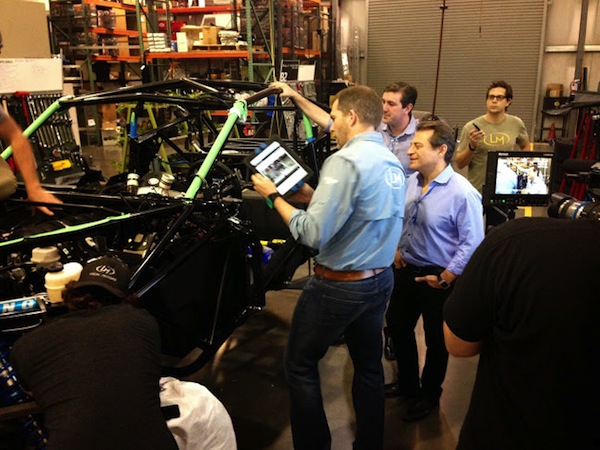
3D printers are slow. They are so slow that in the time it would take to print a screwdriver, you could just drive to the store and pick one up with a half hour to spare. And that’s a problem when a manufacturing job calls for creating units as quickly as possible. (Video)
Jay Rogers and his team at +Local Motors in Phoenix, Arizona have plans to 3D print an entire car in just one day at the Int’l Manufacturing & Technology Show in Chicago this September. The electric drive car will be built out of carbon fiber reinforced thermo plastic (CFRP), which has a strength-to-weight ratio twice that of aluminum.
A 20-year-old Indonesian student has helped General Electric save considerable sums of money in development and manufacturing costs by designing a critical aircraft part that was 83 percent lighter and yet still met the safety and design criteria, according to GE’s general manager for technology Christine Furstoss.
The Maker Movement Encompasses all kinds of activity from traditional crafts to high-tech electronics.
In recent years, one of the more significant trends is the impact of technology on homemade manufacturing. The Maker Movement, a diffuse entrepreneurial community, has been using open source design to drive a telling resurgence in American manufacturing. Encompassing all kinds of activity from traditional crafts to high-tech electronics, linked by the adoption of digital tools, not just for design, but increasingly for manufacture through 3-D printing, technology has transformed DIY enthusiasts operating on their own at home into real communities.
In the United States the industrial sector is rebounding. Manufacturers are boosting output, building new plants, increasing exports, and creating better-paying jobs that require precise skills—and in the process are helping lead the U.S. out of the long, stubborn slump that followed the market disruptions of 2007.
Floridians working at a variety of mostly small manufacturers make everything from bottle caps and handmade knives to fishing reels and personal submarines. (Photos)
The report describes how technological innovation, particularly as it relates to the Internet of Everything (IoE), could lead America’s economy out of a “slow-growth rut.”
The Internet of Things could be just what the U.S. economy needs. The Progressive Policy Institute released a report today titled “Can the Internet of Everything bring back the High-Growth Economy?” The PPI is a public policy think tank that conducts research and promotes liberal economicand political policies.
Patents have been holding back 3D printing, the technology that’s supposed to revolutionize manufacturing and countless other industries. In February 2014, key patents that currently prevent competition in the market for the most advanced and functional 3D printers will expire, says Duann Scott, design evangelist at 3D printing company Shapeways.
Business in China are swamped with job applications from college graduates but have few jobs to offer.
The headline in he New York Times read “Degrees, but No Guarantees.”However, the story was not about the students graduating from American universities this season. Instead, it was about Chinese grads. Chinese businesses are swamped by job applications from graduating students but have few jobs to offer. As bad as our economy seems for our own grads, their prospects are better than China’s.
Researchers at the Palo Alto Research Center (PARC) have been taking significant strides in developing a new technology that makes it possible to print electronic components like sensors, transistors, light-emitters, smart tags, flexible batteries, memory, smart labels, and more.
How do we prepare for this manufacturing revolution in the making?
You can now print your own gun. And there are plenty of ways to do so, legal and otherwise. A group called Defense Distributed offered you a new one last week: It published instructions for creating a plastic firearm using a 3-D printer. One guy even fired a real bullet with it.
Apple released a list of its 748 suppliers last month. According to a new data visualization by ChinaFile, more than 600 of them are in Asia, and more than half of those are in China.