Today, the single most prominent, and telling, feature of bitcoin is its massive controversy in the media. Not a single day goes by without an article or televised mention about its dangers, risks, and dubious mainstream appeal.
How much personal data are we willing to give up for the convenience of prediction?
The biggest change in years in how we interact with computers is happening now. It will mean less input from you. Apps like Google Now, Tempo AI, and others represent the first wave of “predictive technology.” These are apps and services that are smart enough to fetch information for you — before you realize you even need it.
The geometry of the plastic sheets and placement of the holes interact with sound waves to make it (and objects beneath it) appear as if they are not there.
Duke University engineers have demonstrated the world’s first three-dimensional acoustic cloak using a few perforated sheets of plastic and extensive computation. The new device reroutes sound waves to create the impression that both the cloak and anything beneath it are not there. (Video)
“What if you could scoop the air? Scoop it and move it downward, amplifying its kinetic energy along the way, concentrate it to a single point of intensity, the way a magnifying glass concentrates sunlight to a single incendiary point?”
The less invasive a surgical procedure is, the better. Less invasive surgeries reduce patient discomfort, foster faster recoveries, and limit the risk of infection. Problem is, you have to get your eyes on a problem to solve it.
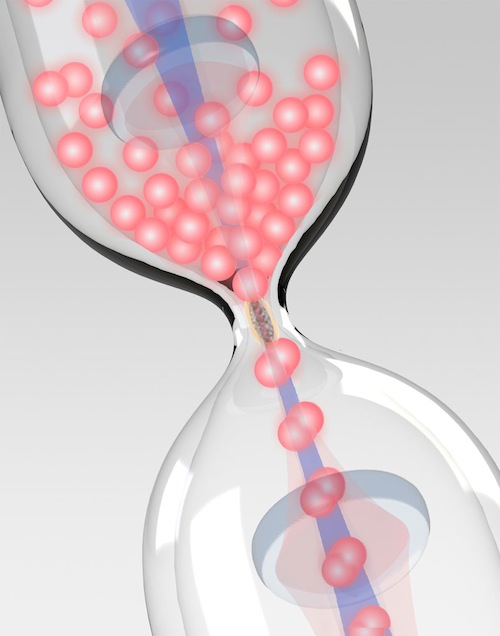
Physicists create a device that binds photons together to form “light molecules.”
A vacuum chamber the size of a shoebox has made history in Cambridge, Massachusetts. Harvard physicist Ofer Firstenberg has created a new form of matter: a pair of photons, stuck together.
In the fourth quarter of 2013 was the turning point in which the U.S. mobile industry started making more money off of data than from voice. Data became a bigger revenue source for carriers than voice services. From this point on data will be the primary growth driver for the U.S. mobile industry, while voice will recede in the rearview mirror.
Fifteen vehicles left a starting gate in the desert outside of Barstow, Calif., to make history in the DARPA Grand Challenge on March 13, 2004, a first-of-its-kind race to foster the development of self-driving ground vehicles. The goal of the race was to autonomously navigate a 142-mile course that ran across the desert to Primm, Nev. The longer-term goal was to accelerate development of the technological foundations for autonomous vehicles that could ultimately substitute for men and women in hazardous military operations, such as supply convoys.
U.N. will begin to lay the groundwork for the role robots will play in war.
People are promised their quality of life will improve with the advances of technology, and what could be a better example of that than sending robots instead of humans into dangerous situations? Robots can help conduct research in deep oceans and harsh climates, or deliver food and medical supplies to disaster areas. (Video)
Dr Rahul Nair demonstrates a graphene-based membrane device.
Many of us struggle to satisfy our thirst even though we live on a water world. That is because the Earth’s oceans are salty. Just 2.5% of the Earth’s water is freshwater, and of that, 60% is trapped in glaciers, 30% in groundwater (not all of which is accessible), and just 10% is on the surface in lakes and rivers.
A startup says it has a more efficient process to use carbon dioxide for making valuable chemical feedstocks.
Liquid Light startup has developed an electrochemical process to use waste carbon dioxide as a starting ingredient for chemicals. The company says its method is significantly cheaper than conventional methods for converting CO2 into chemicals.