Traffic fatalities are down despite the fact that vehicle miles traveled is up.
Highway deaths have plummeted to their lowest levels in more than 60 years, helped by more people wearing seat belts, better safety equipment in cars and efforts to curb drunken driving.
The steering wheel of the McLaren Mercedes MP4-26.
It wouldn’t be Formula 1 without some kind of constant friction between racers, team owners and organizers, and this year’s kerfuffle involves steering wheels that force drivers to push more buttons than a 747 pilot having a seizure. (video)
Fifty-one percent of shoppers are more likely to buy from retailers with mobile-specific websites.
Retailers must answer the call to make mobile shopping easier and more engaging or they risk getting disconnected from the majority of mobile device users. While 89.7 percent of the U.S. population aged 18 to 64 have mobile phones, only 49.1 percent are using their phones to shop, according to Arc Worldwide, the marketing services arm of advertising agency Leo Burnett.
This crisis map, created using Ushahidi software, is keeping track of unfolding events in Libya.
From Libya to Japan, a Web-reporting platform called Ushahidi has helped human rights workers and others document and make sense of fast-moving crises. The platform allows reports from cell phones and Web-connected devices to be collected and displayed on Web-based maps.
Teens don’t want to miss emergency texts, even late-arriving ones.
10th-grader Ashley Olafsson sleeps with her cellphone under her pillow so she doesn’t miss “emergency’’ texts — “like if a friend broke up with her boyfriend.’’ Stephanie Kimball of Waltham, 14, is also available for urgent overnight correspondence, such as, “Hey, seeing if you’re awake.’’ Dedham ninth-grader Courtney Johnson gets as many as 100 texts while in bed. “I just don’t feel like myself if I don’t have my phone near me or I’m not on it,’’ she said.
Firefighters could someday snuff out flames by zapping them with pulses of electric current.
In some respects, firefighting technology has come a long way over the past several decades–we now have flame suppressing foams and powders for instance, as well as new ways of delivering them to the fire. But fundamentally, we’re still fighting fires the old fashioned way: point hose/bucket/ pressurized container and drench. But a team of Harvard researchers envisions a day when firefighters will snuff out flames not with a physical suppressant but with a blast of electric current.
Consumers would wave their phones instead of swiping credit cards at the checkout counter.
The cellphone has been more than a cellphone for years, but soon it could take on an entirely new role — standing in for all of the credit and debit cards crammed into wallets. Instead of swiping a plastic card at the checkout counter, consumers would merely wave their phones.
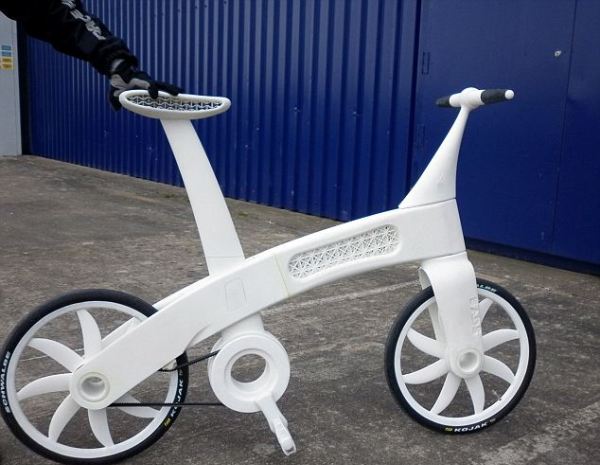
The fully-working cycle, which is made of nylon, is the result of an extraordinary project and is as strong as steel and aluminium but weighs 65 per cent less.
This bicycle is the first in the world to be created simply by printing it out on a computer, using groundbreaking new technology.
If you find yourself looking in the mirror at the end of a long day only to see the bloodshot eyes of a crackhead staring back at you, it may be because you are addicted to something —your digital devices.
Piston engines are big, heavy, dirty, complicated, and expensive pieces of machinery that have been around for a century. It’s about time for something better, and one option could be wave disk engines, which are small, light, clean, simple, and cheap pieces of machinery that aren’t around yet. But they’re close.
“If reading becomes dependent on technology that must be purchased, then I think we may see the literacy divide persist and even widen.”
The rapid rise of e-books could lead to a “reading divide” as those unable to afford the new technology are left behind, even as U.S. reading and writing skills decline still further.