Barbara Barclay of Tobii Technology, Inc. demonstrates a prototype laptop that tracks and can be controlled by the eye movements.
Ever wish your eyes were lasers? A laptop prototype brings that wish closer to reality. It tracks your gaze and figures out where you’re looking on the screen. That means, among other things, that you can play a game where you burn up incoming asteroids with a laser that hits where you look.
Ormia ochracea is a small parasitic fly best known for its strong sense of directional hearing.
It’s no surprise that many bugs have excellent hearing thanks to finely honed antenna. Checking out the giant antenna on the tiny bug above, it seems no surprise that they can hear surprisingly well. In fact, some insect antennae are so powerful, engineers haven’t yet been able to come close to mimicking nature. And that’s especially when it comes to small, directional antennae. It’s one thing to have whip-like “ears” like the bug above, but what stumps engineers is making very small, but very acute sound sensors. Yet a minute fly — with minute antenna — is about to change that, and help revolutionize how we built these structures.
Most U.S. adults wished people practiced better mobile etiquette and found the lack of cellphone manners extremely annoying.
Whether is it texting during dinner, talking on a cellphone in a public restroom or using a laptop while driving, most people think mobile etiquette is getting worse, not better.
The quest for better fuel economy has General Motors cribbing from headphone technology.
Can technology used in headphones really improve gas mileage? GMC’s Terrain crossover is proving that yes, it can — or at least, it improves the experience of getting more miles per gallon.
A hand-held scanner that can detect cancer at a patient’s bedside using just a speck of tissue has been created by scientists from Harvard University and Massachusetts Institute of Technology.
It’s not quite Professor Xavier-level mind control, but researchers at AutoNOMOS Labs in Germany have developed a system that drives a vehicle by reading a person’s brain waves. So this is what it feels like to watch the future.
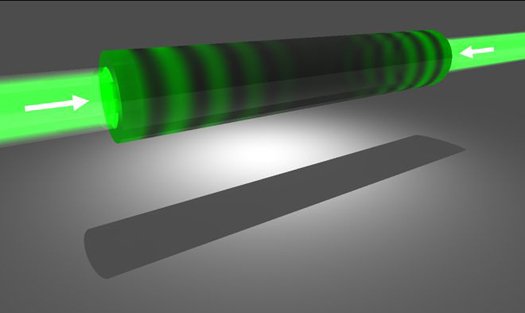
The laser — a 50-year-old invention now used in everything from CDs to laser pointers — has met its match in the “antilaser,” the first device capable of trapping and canceling out laser beams.
Contact lenses with built-in electronics and an LED, powered wirelessly by RF.
A new generation of contact lenses built with tiny circuits and LEDs could make bionic eyesight a reality. Researchers at the University of Washington in Seattle have created contact lenses with built-in electronics and an LED, powered wirelessly by RF.
Who could have guessed that 4.3 billion Internet connections wouldn’t be enough? Certainly not Vint Cerf.
In 1976, Mr. Cerf and his colleagues in the R.& D. office of the Defense Department had to make a judgment call: how much network address space should they allocate to an experiment connecting computers in an advanced data network?