
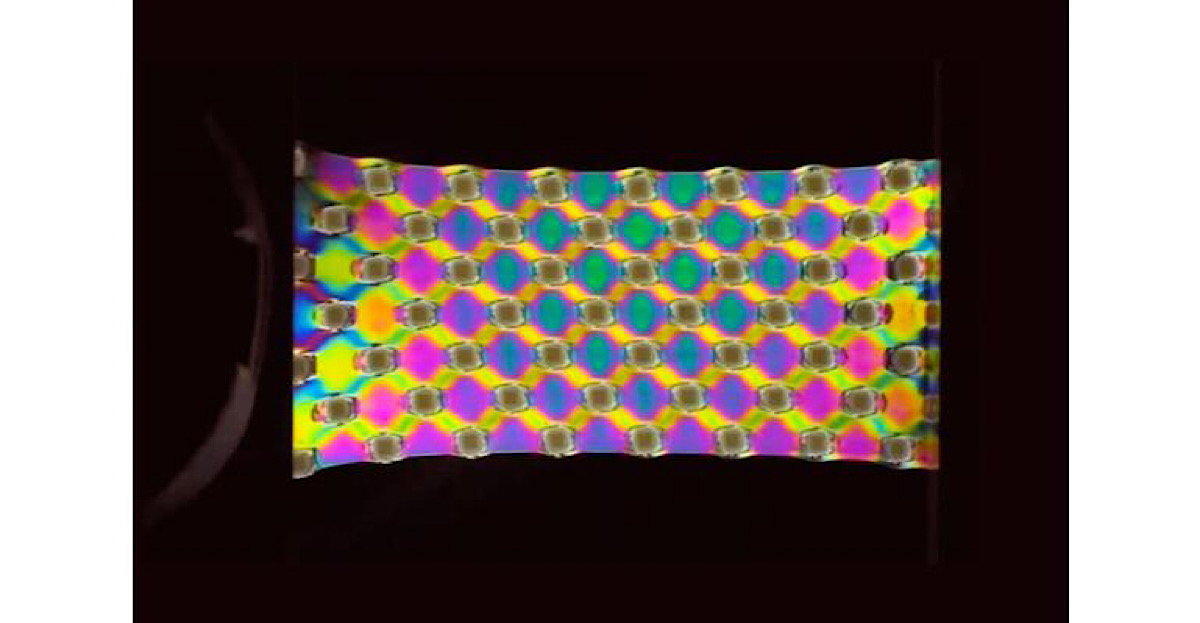
Researchers at The University of Texas at Austin created a new plastic-like material developed that can be manipulated to change its properties. It can be soft and stretchy or hard and rigid with only the application of a catalyst and visible light.
Researchers used light to create a polymer that is 10 times more durable than natural rubber.
Researchers have taken inspiration from living things such as trees and shellfish to create a new plastic material that is both flexible and strong, showing a toughness that’s 10 times more than that of natural rubber, they said.
A team at The University of Texas at Austin (UT Austin) used a unique process that involved applying light and a catalyst to change the properties of a material. Their aim was to mimic natural materials that can be hard and rigid in some places and soft and flexible in others, they said. Indeed, while naturally occurring materials such as skin and muscle easily combine properties such as strength and flexibility, it’s been historically difficult for scientists to recreate this in synthetic materials, said Zachariah Page, a UT Austin assistant professor of chemistry, who led the research.
In the past, when using a mix of different synthetic materials to mimic these attributes, materials would come apart or rip at the places where the different materials met, he said. In this case, Page and his team could control and change the structure of a plastic-like material, using light to alter how firm or stretchy the material would be. “This is the first material of its type,” he said in a post on UT News.
Where these researchers had success while others failed is in their ability to control crystallization, and therefore the physical properties of the material, particularly using the application of light, which “is potentially transformative for wearable electronics or actuators in soft robotics,” he said.
Continue reading… “Smart Plastic Material Eyed for Next-Gen Soft Robots, Electronics”


