Diver X, the Startup Behind HalfDrive Headsets, Launches VR Haptic Gloves

ByDisha Chopra

Diver X, a Japanese VR startup that pitched HalfDrive VR Headsets earlier this year, has launched a new Kickstarter campaign for a pair of Diver X VR haptic gloves that contain flexing and compressing membranes to mimic touch sensations. 

The HalfDrive Kickstarter fame saw the light in January as the campaign secured enough cash to be fully funded. However, the Diver X team decided against it and returned the funds as the device that clearly took inspiration from Sword Art Online failed the scalability test. 

Now, the company is back with another Kickstarter campaign with ContactGlove, a pair of Diver X VR haptic gloves that tracks fingers and positions with SteamVR and offers input emulation via buttons. 

Continue reading… “Diver X, the Startup Behind HalfDrive Headsets, Launches VR Haptic Gloves”

Meet the autonomous Moon robots about to change space travel forever

By Stuart Clark

If we want to explore the Solar System even further, we’ll need self-sufficient robots to help us do it. And that’s why scientists are putting futuristic bots through their paces on the lunar-like landscape of Mount Etna.

Anyone who has followed our efforts to explore other planets over the last few decades will have realised the importance of robots. They’re our mechanical eyes and ears on distant worlds, and have allowed us to see places that would have otherwise remained shrouded in mystery. Perhaps this is why the landing of each new NASA rover on Mars draws millions of viewers online.

Recently, however, most of the headlines have been about the imminent return of humans to the Moon. So with people once again venturing further out into space, will robotic explorers start to fade in importance?

Not at all. The fact is robotic explorers are set to become more important than ever. “There are some places in the Solar System you can’t send humans, Venus, for example, or some moons of Jupiter or Saturn,” says Prof Alin Albu-Schäffer from the Institute of Robotics and Mechatronics at the German Aerospace Center, Munich. “They’re just too far away and too hostile for humans. So, you know, robots will be very important.”

Continue reading… “Meet the autonomous Moon robots about to change space travel forever”

MIT researchers create implantable robotic ventilator

Ellen Roche with the soft, implantable ventilator designed by her and her team.

By Brianna Wessling 

Researchers at MIT have designed a soft, robotic implantable ventilator that can augment the diaphragm’s natural contractions. 

The implantable ventilator is made from two soft, balloon-like tubes that would be implanted to lie over the diaphragm. When inflated with an external pump, the tubes act as artificial muscles that push down the diaphragm and help the lungs expand. The tubes can be inflated to match the diaphragm’s natural rhythm. 

The diaphragm lies just below the ribcage. It pushes down to create a vacuum for the lungs to expand into so they can draw air in, and then relaxes to let air out. 

The tubes in the ventilator are similar to McKibben actuators, a kind of pneumatic device. The team attached the tubes to the ribcage at either side of the diaphragm, so that the device was laying across the muscle from front to back. Using a thin external airline, the team connected the tubes to a small pump and control system. 

This soft ventilator was designed by Ellen Roche, an associate professor of mechanical engineering and member of the Institute for Medical Engineering and Science at MIT and her colleagues. The research team created a proof-of-concept design for the ventilator. 

“This is a proof of concept of a new way to ventilate,” Roche told MIT News. “The biomechanics of this design are closer to normal breathing, versus ventilators that push air into the lungs, where you have a mask or tracheostomy. There’s a long road before this will be implanted in a human. But it’s exciting that we could show we could augment ventilation with something implantable.”

According to Roche, the key to maximizing the amount of work the implantable pump does is by giving the diaphragm an extra push downwards when it naturally contracts. This means the team didn’t have to try to mimic exactly how the diaphragm moves, just create a device that is capable of giving that push. 

Continue reading… “MIT researchers create implantable robotic ventilator”

Virtual reality games, eye tracking and machine learning can be used to detect ADHD

By Emily Henderson, B.Sc.

Researchers have used virtual reality games, eye tracking and machine learning to show that differences in eye movements can be used to detect ADHD, potentially providing a tool for more precise diagnosis of attention deficits. Their approach could also be used as the basis for an ADHD therapy, and with some modifications, to assess other conditions, such as autism.

ADHD is a common attention disorder that affects around six percent of the world’s children. Despite decades of searching for objective markers, ADHD diagnosis is still based on questionnaires, interviews and subjective observation. The results can be ambiguous, and standard behavioral tests don’t reveal how children manage everyday situations. Recently, a team consisting of researchers from Aalto University, the University of Helsinki, and Åbo Akademi University developed a virtual reality game called EPELI that can be used to assess ADHD symptoms in children by simulating situations from everyday life.

Now, the team tracked the eye movements of children in a virtual reality game and used machine learning to look for differences in children with ADHD. The new study involved 37 children diagnosed with ADHD and 36 children in a control group. The children played EPELI and a second game, Shoot the Target, in which the player is instructed to locate objects in the environment and “shoot” them by looking at them.

Continue reading… “Virtual reality games, eye tracking and machine learning can be used to detect ADHD”

This robot will soon deliver food from airport restaurants to your gate

Ottobot is an autonomous robot will be used for food delivery at airports next year. 

By Ishita Banerjee

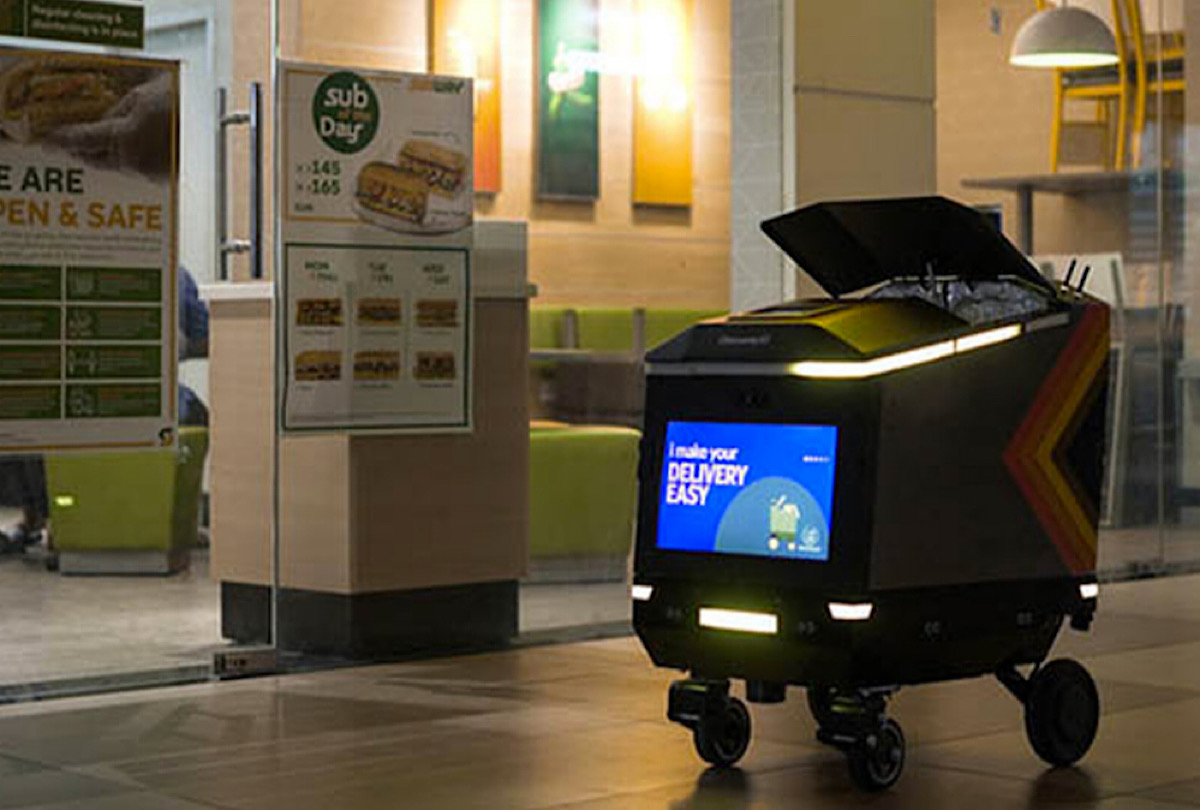
Food delivery is expected to reach a whole new level with Ottobot- a self-manoeuvring that will deliver food from airport eateries to your gate. With the help of Ottobot, you can get your food delivered to the gate through which you board your flight.

Ottobot is an autonomous robot for delivery of small hand-held items. Around next year, it may be put into use and it might be seen delivering airport restaurant and cafe food right to customers’ tables. As of now the areas that it is being explored in are the restaurant terrains, airports, groceries and postal services.

Ritukar Vijay, Ashish Gupta, Pradyot Korupolu and Hardik Shama are the four founders of the Ottonomy company which they have been working on since 2020. It has around 40 employees across India and the US.

Continue reading… “This robot will soon deliver food from airport restaurants to your gate”

3D Printed Heart Valves Can Form New Tissue

A close-up of a printed scaffold for a heart valve. The different structures that ensure the appropriate biomechanics are clearly visible.

Researchers from the Technical University of Munich (TUM) and the University of Western Australia used melt electrowriting have created the first-ever 3D printed heart valve with a heterogeneous structure as is seen in human heart valve tissue. This heterogeneous property is essential to the proper opening and closing of valves, so the development holds great potential for the future of artificial valve replacement, especially in children who need adaptability as they grow.

The team developed a platform that precisely prints customized patterns and pattern combinations, allowing the team to perfect various mechanical properties within a single scaffold, as well as created software that eased the difficulty in creating complex heart valve structures.

“Our goal is to engineer bioinspired heart valves that support the formation of new functional tissue in patients,” says Petra Mela, Professor of Medical Materials and Implants at TUM and a leader of the study. “Children would especially benefit from such a solution, as current heart valves do not grow with the patient and therefore have to be replaced over the years in multiple surgeries. Our heart valves, in contrast, mimic the complexity of native heart valves and are designed to let a patient’s own cells infiltrate the scaffold.”

Continue reading… “3D Printed Heart Valves Can Form New Tissue”

Hive Launches HiveMind to Supercharge Project Planning with AI

Hive, the productivity platform provider, announced the public release of HiveMind that uses Artificial Intelligence (AI) to automatically create a project plan in a matter of seconds.

As Artificial Intelligence models are increasingly being integrated into content and note-taking platforms, Hive is pioneering the usage of the models’ capacity for continuous learning and logical decision-making based on in-depth data.

Modeled on six years of successful customer projects, HiveMind automatically sets out the steps to accomplish any goal, expediting project planning and execution. It has the ability to create project tasks based on simple suggestions, set next steps from received emails and reply based on the inbound email’s content.

“Today, superior performance in the marketplace comes from the depth of data you possess, and the ability to apply it quickly,” said John Furneaux, Hive co-founder and CEO. “HiveMind places the wealth of collective wisdom and team experience at our customers’ fingertips. It can play a vital role in training staff better, acquiring new skills and improving decision making.”

In addition to increasing efficiencies in project planning, HiveMind can speed up market research by providing facts, statistics, competitive intelligence and new ideas for brainstorms without having to reference internet searches. Hive customers reported experiencing immediate benefits when using HiveMind.

Continue reading… “Hive Launches HiveMind to Supercharge Project Planning with AI”

ABM Deploys Knightscope Autonomous Robots in Major Parking Facility

ABM Deploys Knightscope Autonomous Robots in Major Parking Facility (Photo: Business Wire)

Knightscope Introduces Innovative New Automated Monitoring Measures and Parking Infrastructure Improvements in Partnership with ABM, One of the Nation’s Largest Parking Service Providers

MOUNTAIN VIEW, Calif.–(BUSINESS WIRE)– Knightscope, Inc. (Nasdaq: KSCP), a developer of advanced physical monitoring technologies focused on enhancing U.S. facility operations, and ABM (NYSE: ABM), a leading provider of integrated facility services, parking and transportation management solutions, and electric vehicle (“EV”) charger installations, today announced the deployment of three Autonomous Robots at an international airport parking facility in the US.

The Knightscope self-driving robots will navigate and monitor ABM’s parking facility without any human intervention to gather and deliver unprecedented levels of data and actionable intelligence for the airport operations team to assist in making smarter, safer, and faster decisions. With the ability to see a full 360-degrees (even in the dark), stream video directly to airport staff, and keep a high-definition record of its observations for up to 30 days, the powerful analytics embedded within the Autonomous Robots can even detect a person that the human eye may not be able to see under certain conditions. Each Autonomous Robot also features a sensitive 16-microphone array with two-way audio functionality, allowing airport staff to have a live conversation with a person within the garage using the robot itself as the communication medium.

Continue reading… “ABM Deploys Knightscope Autonomous Robots in Major Parking Facility”

Lockheed Martin is Bursting the Bubble with Inflatable Habitats – Literally

Lockheed Martin Nextstep concept

By Keith Cowing

When developing new technology, rarely is having it explode a good thing.

Unless you’re demonstrating that an inflatable habitat is capable of surviving environments beyond the extremes of space.

As part of NASA’s NextSTEP program, Lockheed Martin is developing an inflatable structure technology to support human space habitation in low-Earth orbit, at the Moon and beyond.

Last week, Lockheed Martin reached a critical milestone in developing this next-generation technology (completely in-house) by successfully completing an ultimate burst pressure test, achieving a burst at 285 psi and more than six times the max operating pressure.

What’s a burst test? Pretty close to what it sounds like: a test that pressurizes a subscale or full-scale inflatable habitat until it literally bursts. The goal of the burst is to test the strength of the habitat many times beyond what it will experience in space to validate its design – similar to the structural loads testing typically done on other spacecraft like Orion.

Continue reading… “Lockheed Martin is Bursting the Bubble with Inflatable Habitats – Literally”

Turning Science Fiction Into Science Fact: Space Solar Power Beaming

An artistic rendering showing the concept of collecting solar energy in space and beaming converted RF energy to a terrestrial rectenna.

By Keith Cowing

In the 1940s, science fiction author Isaac Asimov theorized the concept of collecting the sun’s energy in space, then beaming that energy down to Earth.

Today, Northrop Grumman’s Space Solar Power Incremental Demonstrations and Research (SSPIDR) Project team is making that science fiction a reality with steady progress towards transmitting solar energy from space to anywhere on Earth. SSPIDR technology can be especially useful in forward operating and contested areas where warfighters need steady power to maintain mission operations.

Harnessing solar power for use on Earth has enormous potential for communities where energy is scarce. For example, when military personnel establish a forward operating base one of the most dangerous parts of the ground operation is getting power. Convoys and supply lines, which are major targets for adversaries, are the usual methods to supply power. However, solar-powered beaming energy technology can provide constant, consistent and logistically agile power to expeditionary forces operating in hard-to-reach areas – assuring power is transmitted via radio frequency (RF) from space and reducing reliance on fuel convoys and other energy generation methods.

Utilizing one of the company’s test chambers specifically designed for RF at its Baltimore manufacturing and test campus, the SSPIDR team successfully demonstrated the transmission of directed RF energy to a ground-based rectifying antenna (rectenna) – a critical milestone in the development of this pioneering technology. In this demonstration, engineers steered RF energy to rectenna hardware, energizing a series of lights that indicated successful formation of an energy beam and conversion to useful electrical current.

Continue reading… “Turning Science Fiction Into Science Fact: Space Solar Power Beaming”

New ‘Cellular Glue’ Concept Could Heal Wounds, Regrow Nerves

The team’s new “cellular glue” molecules helped these cells assemble into a structure.


By Monisha Ravisetti

Researchers from the University of California, San Francisco announced a fascinating innovation on Monday. They call it “cellular glue” and say it could one day open doors to massive medical achievements, like building organs in a lab for transplantation and reconstructing nerves that’ve been damaged beyond the reach of standard surgical repair.

Basically, the team engineered a set of synthetic molecules that can be manipulated to coax cells within the human body to bond with one another. Together, these molecules constitute the so-called “cellular glue” and act like adhesive molecules naturally found in and around cells that involuntarily dictate the way our tissues, nerves and organs are structured and anchored together. 

Only in this case scientists can voluntarily control them. 

“The properties of a tissue, like your skin for example, are determined in large part by how the different cells are organized within it,” Adam Stevens, a researcher at UCSF’s Cell Design Institute and first author of a paper in the journal Naturesaid in a statement. “We’re devising ways to control this organization of cells, which is central to being able to synthesize tissues with the properties we want them to have.” 

Doctors could eventually use the sticky material as a viable mechanism to mend patients’ wounds, regrow nerves otherwise deemed destroyed and potentially even work toward regenerating diseased lungs, livers and other vital organs. 

That last bit could lend a hand in alleviating the crisis of donor organs rapidly running out of supply. According to the Health Resources and Services Administration, 17 people in the US die each day while on the waitlist for an organ transplant, yet every 10 minutes, another person is added to that list.

“Our work reveals a flexible molecular adhesion code that determines which cells will interact, and in what way,” Stevens said. “Now that we are starting to understand it, we can harness this code to direct how cells assemble into tissues and organs.”

Continue reading… “New ‘Cellular Glue’ Concept Could Heal Wounds, Regrow Nerves”

New biomaterial for 3D Printing can regenerate bones and prevent infections

New biomaterial can regenerate bones and prevent infections

Scientists at the Universidad Católica de Valencia’s (UCV) Bioengineering and Biomaterials Laboratory in Spain have created a new porous biomaterial for 3D printing that can regenerate bones while also preventing infections. The biotech creations, which are custom-made for each case using 3D printing, include a bioactive alginate coating. This coating promotes bone regeneration and kills bacteria that can prevent bone formation from being completed.

Because the material is biodegradable, it eventually disappears from the body after the bone has been regenerated. The research was conducted on small animals, specifically rabbits. The following step will be to test larger animals and, eventually, humans.

The American Chemical Society’s ACS Applied Materials & Interfaces journal published the UCV study (ACS). The work was done in collaboration with a number of institutions.

Continue reading… “New biomaterial for 3D Printing can regenerate bones and prevent infections”
Discover the Hidden Patterns of Tomorrow with Futurist Thomas Frey
Unlock Your Potential, Ignite Your Success.

By delving into the futuring techniques of Futurist Thomas Frey, you’ll embark on an enlightening journey.

Learn More about this exciting program.