Boots becomes first pharmacy to deliver prescriptions by drone

By Paige West 

Boots has become the first community pharmacy in the UK to transport prescription-only medicines by drones.

The flight departed from the British Army’s Baker Barracks on Thorney Island near Portsmouth and arrived at St. Mary’s Hospital on the Isle of Wight. The medicines were collected by Boots and transported to its pharmacies across the island, where they will be dispensed to patients with prescriptions for them.

Boots worked with medical drone start-up Apian to facilitate the test flight and is now assessing the future potential for drones in medicines delivery.

Rich Corbridge, Chief Information Officer at Boots, said: “Drones have huge potential in the delivery of medicines, and it is incredibly exciting to be the first community pharmacy in the UK to transport them in this way. An island location like the Isle of Wight seemed like a sensible place to start a trial of drones and their value to the delivery of medicines to more remote locations is very clear. 

“In this trial, we will be looking at how much time we can save, as well as how we can incorporate drones into our medicines supply chain to create economic efficiencies too. We want to prepare now for the wider use of this technology in the future.”

Continue reading… “Boots becomes first pharmacy to deliver prescriptions by drone”

Should self-driving cars come with black box recorders?

Every commercial airplane carries a “black box” that preserves a second-by-second history of everything that happens in the aircraft’s systems as well as of the pilots’ actions, and those records have been priceless in figuring out the causes of crashes.

Why shouldn’t self-driving cars and robots have the same thing? It’s not a hypothetical question.

Federal transportation authorities are investigating a dozen crashes involving Tesla cars equipped with its “AutoPilot” system, which allows nearly hands-free driving. Eleven people died in those crashes, one of whom was hit by a Tesla while he was changing a tire on the side of a road. 

Yet, every car company is ramping up its automated driving technologies. For instance, even Walmart is partnering with Ford and Argo AI to test self-driving cars for home deliveries, and Lyft is teaming up with the same companies to test a fleet of robo-taxis.

But self-directing autonomous systems go well behind cars, trucks, and robot welders on factory floors. Japanese nursing homes use “care-bots” to deliver meals, monitor patients, and even provide companionship. Walmart and other stores use robots to mop floors. At least a half-dozen companies now sell robot lawnmowers.  (What could go wrong?)

Continue reading… “Should self-driving cars come with black box recorders?”

Second-life EV batteries market expected to reach $34.7B by 2027

By Johnna Crider

Second-life EV batteries are expected to reach over $34 billion by 2027, according to a new report by Research and Markets.

The global second-life EV battery market is projected to reach a total of $34,758.46 million by 2027, up from $19,717.47 million in 2021 at a compound annual growth rate (CAGR) of 9.90% during the forecast period.

The report provides both the market sizing and forecasts across seven major currencies which are USD, EUR, JPY, GBP, AUD, CAD, and CHF.

It also emphasized that the years 2019 and 2020 are considered historical while listing 2021 as the base year and 2022 as the estimated year. The years 2023-2027  are the forecast period.

Continue reading… “Second-life EV batteries market expected to reach $34.7B by 2027”

A radical vision for reinventing the suburbs

Nicknamed the Orbit, the plan would turn a rural suburb into a transit-oriented commuter city.

Outside Toronto, in a field surrounded by farmland, the seeds of a seemingly implausible high-density, transit-oriented community are taking root.

The community is the Orbit, a futuristic-sounding name for a new district on the edge of the town of Innisfil, Ontario, a commuter city about a half-hour drive north of Toronto. The plan for the Orbit is a grid of streets radiating around a dense central district, with proposed mid-rise towers, plentiful open spaces, and a mix of residential, commercial, and civic buildings. The center point of the plan is a commuter rail station that links Innisfil and other suburban communities to Toronto.

Continue reading… “A radical vision for reinventing the suburbs”

In world first, artificial mouse ’embryos’ were grown without the need for a womb, sperm, or egg

Synthetic mouse embryos are shown in the container where they are grown. 

By Marianne Guenot

  • Scientists were able to grow “synthetic embryos” without the need sperm, eggs, or a womb.
  • Studying these structures in mice could teach us how to grow organs for transplantation.
  • Making human babies that way remains a distant prospect, fraught with ethical problems.

Scientists grew “synthetic embryos” from mice cells without using sperm, eggs, or a womb. 

The process, a world first, was described in an issue of the peer-reviewed journal Cell on August 1.

 The technology could be a starting point to grow organs from scratch, Jacob Hanna of Weizmann’s Molecular Genetics Department, who headed the research team, said in a statement.

Independent experts said a lot more research would be needed before even considering growing a human embryo this way.

Still, this research makes this possibility a little more feasible, adding urgency to the ethical question, they said.

Continue reading… “In world first, artificial mouse ’embryos’ were grown without the need for a womb, sperm, or egg”

Hearing aids are getting smarter. Think AI, health tracking

Traditional hearing aid makers and the likes of Bose and Harman are pouring resources into augmented hearing and “hearable” devices that do more than improve sound.

By Shara TibkenRoger Cheng

People with hearing problems have more options than ever before. Getty Images 

This is part of CNET’s “Tech Enabled” series about the role technology plays in helping the disability community.

When Shannon Conn puts her hearing aids in her ears in the morning, a few things happen.

The lights in her bathroom turn on.

The coffee maker starts brewing.  

When someone rings the doorbell, the chime streams straight into her ear.

Conn, a 43-year-old special education advocate from College Grove, Tennessee, wears the Oticon Opn, which features the ability to link up with other connected devices. She’s put that capability to good use, connecting her Opn to her smart home and setting up commands that allow her hearing aids to trigger her house’s morning routine.

“I can’t live without them,” Conn says. “I haven’t said that in a really long time about anything.”

Continue reading… “Hearing aids are getting smarter. Think AI, health tracking”

A bartending robot that can engage in personalized interactions with humans

The robot created by the researchers.

by Ingrid Fadelli

A widely discussed application of social robots that has so far been rarely tested in real-world settings is their use as bartenders in cafés, cocktail bars and restaurants. While many roboticists have been trying to develop systems that can effectively prepare drinks and serve them, so far very few have focused on artificially reproducing the social aspect of bartending.

Researchers at University of Naples Federico II in Italy have recently developed a new interactive robotic system called BRILLO, which is specifically designed for bartending. In a recent paper published in UMAP ’22 Adjunct: Adjunct Proceedings of the 30th ACM Conference on User Modeling, Adaptation and Personalization, they introduced a new approach that could allow their robot to have personalized interactions with regular customers.

“The bartending scenario is an extremely challenging one to tackle using robots, yet it is also very interesting from a research point of view,” Prof. Silvia Rossi, one of the researchers who carried out the study and the scientific coordinator of the project, told TechXplore. “In fact, this scenario combines the complexity of efficiently manipulating objects to make drinks with the need to interact with the users. Interestingly, however, all current applications of robotics for bartending scenarios ignore the interaction part entirely.”

Silvia Rossi and her colleagues Alessandra Rossi and Nitha Elizabeth John believe that to effectively take on the role of a bartender, a robot should not only be able to interact with humans, but it should also create a “profile” of users. This would allow it to personalize its interactions with regular customers, increasing the likelihood that they will like and continue using the robotic bartending service.

Continue reading… “A bartending robot that can engage in personalized interactions with humans”

Beyond Imagination receives order for 1,000 humanoid robots

Robotics innovator Beyond Imagination has entered into an agreement with SELF Labs to provide at least 1,000 humanoid robots for use in agricultural “grow boxes”. This is believed to be the largest deal of its kind.

 BY DAVID EDWARDS 

SELF and Beyond are announcing a partnership to develop automated off-the-grid grow boxes. Each box will be equipped with solar panels, windmills, atmospheric water generators, 5G, and an advanced version of Beyond Imagination’s Beomni robot with its Omni-Purpose AI Brain.

By aligning the visions of Milan Cheeks of SELF and Dr Harry Kloor of Beyond, this futuristic take on farming will be made possible through a uniquely powerful combination of Omni-Purpose AI, humanoid robotics, blockchain, and game technology. 

The deal with SELF represents one of the largest agreements to purchase humanoid robots in the world.

Cheeks says: “We are committed to purchasing at least 1,000 robots in the next five years, but if the effectiveness of our combined technology is as we project, that number could easily grow to ten thousand or more.”

Continue reading… “Beyond Imagination receives order for 1,000 humanoid robots”

NASA Space Robotics Dive into Deep-Sea Work

What’s the difference between deep space and the deep sea? For a robot, the answer is: not much. Both environments are harsh and demanding, and, more importantly, both are far removed from the machine’s operator.

By Loura Hall

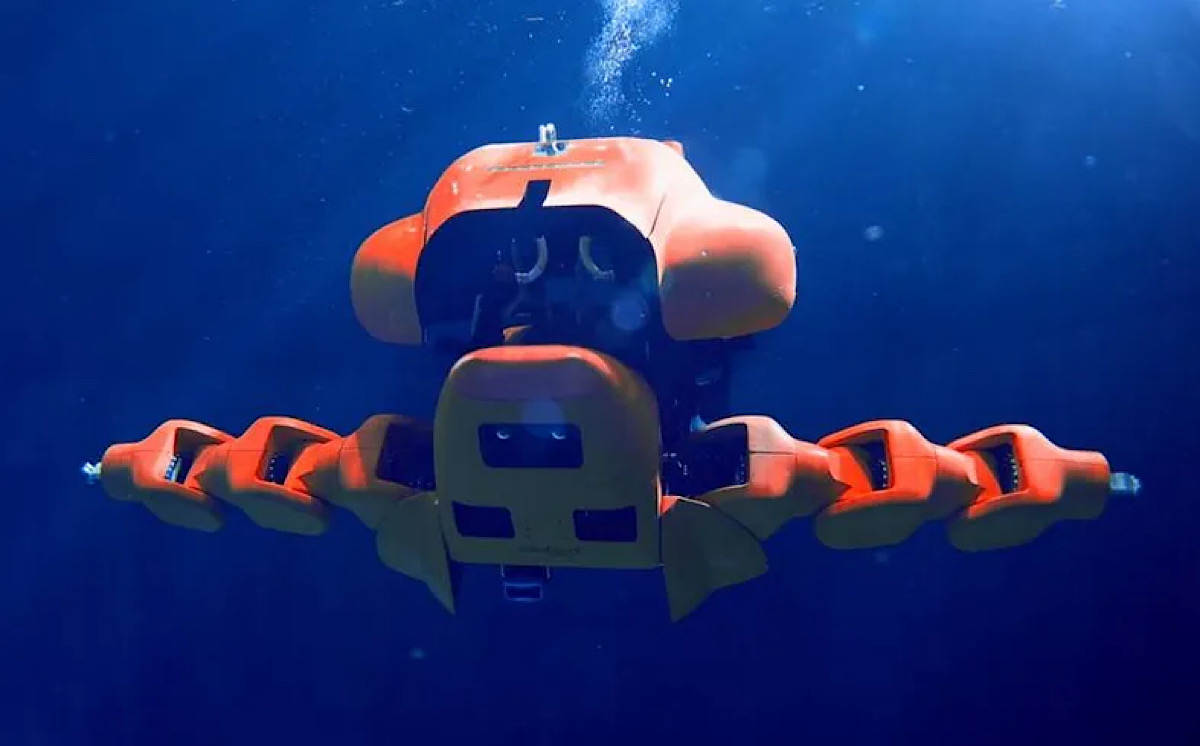
Nauticus Robotics’ Aquanaut robot can swim to a destination and carry out tasks with minimal supervision, saving money for offshore operations from oil wells and wind turbines to fish farms and more. Credits: Nauticus Robotics Inc.

What’s the difference between deep space and the deep sea? For a robot, the answer is: not much. Both environments are harsh and demanding, and, more importantly, both are far removed from the machine’s operator.

That’s why a team of roboticists from NASA’s Johnson Space Center in Houston decided to apply their expertise to designing a shape-changing submersible robot that will cut costs for maritime industries.

Continue reading… “NASA Space Robotics Dive into Deep-Sea Work”

Zenno Astronautics wants to move spacecraft around using electromagnets, not fuel

By Aria Alamalhodaei

It’s easy to think about satellites as a bunch of mini-moons, orbiting the Earth seamlessly and without any (noticeable) movement. But that’s not quite right: satellites and other spacecraft often require fairly continuous tweaks to their positions in orbit.

Historically, the aerospace industry has relied on thrusters, or a combination of reaction wheels and magnetic torque rods, to control a spacecraft’s attitude, control and positioning. But these take up a lot of space and mass, and limit how long a spacecraft can stay in orbit. New Zealand-based Zenno Astronautics has come up with an alternative to these heavy and time-limited propulsion systems. The core technology is an electromagnet that generates a very strong magnetic field, which can interact with other magnetic fields — like those on other spacecraft, or even Earth’s own — to generate torque.

The technology caught the interest of investors, who recently contributed to a NZ$10.5 million ($6.585 million) seed round. New Zealand-based VC firms GD1 (Global From Day One) and Nuance Connected Capital led the round, with additional participation from Shasta Ventures, NZGCP, K1W1, Austrian billionaire Wolfgang Leitner, Alt Ventures, Enterprise Angels, Arkisys and NZVC.

The funding marks the beginning of what Zenno hopes will be a landmark 18 months, culminating in their first launch in the fourth quarter of 2023. Around the same time, the company hopes to have a production facility operating with a massive manufacturing capacity of 1,000 electromagnetic systems per year.

“We can generate a new type of force in space,” founder Max Arshavsky told TechCrunch. “That is really the most fundamental breakthrough that we have.”

Continue reading… “Zenno Astronautics wants to move spacecraft around using electromagnets, not fuel”

Researchers Build Nanoscale Flow-Driven Rotary Motor That Can Generate Mechanical Work

Researchers were puzzled to see the DNA rods organise themselves

THE ROTORS DRAW ENERGY FROM WATER THAT IS INDUCED BY APPLYING VOLTAGE OR BY HAVING DIFFERENT CONCENTRATIONS OF SALT ON EITHER SIDE OF THE MEMBRANE.

  • The team has used a technique called DNA origami for the motor
  • The study was recently published in Nature Physics
  • Development has opened new avenues in the engineering of active robots

Rotary motors that are driven by some flow are in use for a long time in windmills and waterwheels. A similar mechanism is also seen in biological cells where the FoF1-ATP synthase produces the fuel required by cells to function. Drawing inspiration from this, researchers at the Delft University of Technology have developed the smallest ever flow-driven motor from DNA that utilises electrical or salt gradients to generate mechanical energy. For the construction of the motor, the team has used a technique called DNA origami which uses specific interactions between complementary DNA pairs to build 2D and 3D nano-objects.

The rotors draw energy from water that is induced by applying voltage or by having different concentrations of salt on either side of the membrane. From the observations made, researchers have explored more and used the knowledge to build nanoscale turbines.

“Our flow-driven motor is made from DNA material. This structure is docked onto a nanopore, a tiny opening, in a thin membrane. The DNA bundle of only 7-nanometer thickness self-organises under an electric field into a rotor-like configuration, that subsequently is set into a sustained rotary motion of more than 10 revolutions per second,” explained Dr Xin Shi, a postdoc in the department of Bionanoscience at TU Delft. Dr Shi is also the first author of the study published in Nature Physics.

Continue reading… “Researchers Build Nanoscale Flow-Driven Rotary Motor That Can Generate Mechanical Work”
Discover the Hidden Patterns of Tomorrow with Futurist Thomas Frey
Unlock Your Potential, Ignite Your Success.

By delving into the futuring techniques of Futurist Thomas Frey, you’ll embark on an enlightening journey.

Learn More about this exciting program.