Rolls-Royce, Hyundai Motor join hands to fly fuel-cell aircraft in the air by 2025

Rolls-Royce and Hyundai Motor Group have announced their plans to collaborate on bringing all-electric propulsion and hydrogen fuel cell technology to the AAM (Advanced Air Mobility) market. The partnership will leverage the aviation and certification capabilities of Rolls-Royce and the hydrogen fuel cell technologies and industrialisation capability of Hyundai Motor Group.

Both these companies share a vision to lead the way in the AAM market by delivering battery-electric and fuel cell electric solutions to the UAM (Urban Air Mobility) and RAM (Regional Air Mobility) markets and advancing sustainable aviation.

Continue reading… “Rolls-Royce, Hyundai Motor join hands to fly fuel-cell aircraft in the air by 2025”

MetaMundo Launches Pioneering 3D Marketplace for the Metaverse

MetaMundo has launched the first 3D marketplace for collecting metaverse scenes and assets.

By Max Antony Rapkin

Scenes such as 3D galleries, villas, music venues, parks, avatars and vehicles will be sold as NFTs on the marketplace by leading artists, architects, and designers.

Crucially, all 3D NFTs on the marketplace will be compatible with multiple metaverse platforms, such as The Sandbox, Cryptovoxels, Decentraland and Spatial.

“MetaMundo’s vision is to facilitate a beautifully designed, interoperable, and open metaverse – an immersive 3D social internet, where everyone can own and build parts of it through blockchain technology. The marketplace launch is our first major step towards realizing this vision,” said Finn Hansen, co-founder of MetaMundo. “For the first time, we have enabled metaverse users to collect high-quality 3D scenes—minted as NFTs—for use across many virtual environments.

Now, users can visit the marketplace and enjoy an immersive exploration of two scenes built by leading 3D creators Dutchtide, and the American modernist architect Luis Fernandez.

Continue reading… “MetaMundo Launches Pioneering 3D Marketplace for the Metaverse”

A new plasma boring robot can dig tunnels 100 times faster and 98% cheaper

Earthgrid plans to re-wire grids across the U.S. at record speed and at a fraction of the cost.

By Chris Young

San Francisco-based startup Earthgrid is developing a plasma boring robot that is capable of digging tunnels 100 times faster, and up to 98 percent cheaper than existing boring systems, a report from New Atlas reveals.

The company plans to use its technology to re-wire energy, internet, and utility grids in the U.S.

Meet Earthgrid’s Rapid Burrowing Robot.

Unlike conventional boring machines, which typically use massive cutting wheels to slowly excavate tunnels, Earthgrid’s robot blasts rocks with high temperatures to break and even vaporize them via a process called spallation. 

The machine can run on electricity, meaning it can also be emissions-free, depending on how energy is sourced. Earthgrid also claims that its system, which doesn’t need to come into contact with the rocks directly as it excavates, is so fast and cheap it will open up a whole host of possibilities. In other words, projects that were once deemed economically unfeasible will now be possible.

Earthgrid is currently operating on pre-seed funding, and it is developing its “Rapid Burrowing Robot (RBR)”, a spallation boring robot with several 48,600 °F (27,000 °C) plasma torches mounted on large discs.

When operational, the RBR will fire up those torches and rotate the discs to blast the rocky surface in its way. The torches on the discs are arranged in a Fibonacci spiral, meaning they widen out away from the center for full coverage. Debris is collected in small pushcarts.

Continue reading… “A new plasma boring robot can dig tunnels 100 times faster and 98% cheaper”

[FUTURATI PODCAST] Ep. 97: Could bitcoin mining fix climate change? | Troy Cross

Listen on the Futurati Podcast website (or wherever you get podcasts!)

If you enjoy this interview please help us grow by subscribing to the podcast and sharing it with your friends!

It’s become commonplace to hear politicians and commentators bemoaning the energy expenditure of bitcoin mining, noting that it consumes more power than certain industries or countries and confidently proclaiming that the bitcoin network performs no useful work.

But recently, an emerging group of scholars has pushed back on this narrative, arguing that in fact bitcoin mining has certain special properties that make it ideal for subsidizing renewable energies. If this is true, it could become an important part of mitigating the effects of climate change.

Tonight we’re joined by one of the original scholars advancing this thesis. Troy Cross is a professor of philosophy at Reed University, where he focuses on questions of knowledge and reality. In addition, he is a fellow at the Bitcoin Policy Institute, where you can find his work on energy economics, bitcoin mining, and the environment.

For more crypto content check out our playlist.

A 5-minute EV charging startup raises $59 million

A Cambridge University professor’s ultrafast EV battery startup has raised $59 million in Series B funding. Nyobolt aims to develop a battery that can achieve 5-minute EV charging time.

By Michelle Lewis

Goslar, Germany-based H.C. Starck Tungsten Powders (HSC), a wholly owned subsidiary of Hanoi-headquartered Masan High-Tech Materials, the largest manufacturer of mid-stream tungsten products outside of China, led the funding for Cambridge, UK-based Nyobolt.

EV charging in 5 minutes.

H.C. Starck will help Nyobolt scale up its R&D and manufacturing centers in the UK and US, as well as its battery recycling program. 

Nyobolt’s executives say it’s currently focusing on developing batteries for high-performance racing EVs, and that its batteries could be ready for use in mass-market EV models later this decade, according to Reuters.

Hady Seyeda, CEO of H.C. Starck Tungsten Powders, said:

Nyobolt’s technology is a real breakthrough that we can help commercialize based on our vast experience in transferring innovative solutions into large-scale manufacturing. This partnership is also going to accelerate the development toward a circular economy for batteries via enhanced recycling and new models of use.

Continue reading… “A 5-minute EV charging startup raises $59 million”

Microsoft launches Project AirSim to train AI drone systems

Project AirSim is a flight simulator for drones which can be used by companies to develop and train software controlling them.

BySahil Pawar

Microsoft has launched a platform named Project AirSim to train the artificial intelligence systems of autonomous aircraft. Project AirSim is a flight simulator for drones that companies can use to develop and train software controlling them.

The platform makes test flights possible in places that are usually considered risky, such as near power lines. Also, millions of flights can be simulated with this platform in the future, and companies can virtually see how the vehicle flies in the rain or how strong winds might affect its battery life.

In a statement announcing the launch, Microsoft said that the platform would show the power of the industrial metaverse, a virtual world where businesses will build, test, and hone solutions and bring them into the real world. The firm envisages using the technology to train the AI systems which fly autonomous air vehicles, from air taxis to delivery drones.

Continue reading… “Microsoft launches Project AirSim to train AI drone systems”

A New Method for Making Graphene has an Awesome Application: A Space Elevator!

The Space Elevator is one of those ideas that seems to have an endless supply of lives. Originally proposed about a century ago, this concept calls for a tether of supermaterial that connects a station in orbit to Earth’s surface. Our planet’s rotation would keep this tether taut, and a system of “climbers” would transport people and payloads to and from space. The engineering challenges and costs associated with such a structure have always been enormous. But every generation or so, new research comes along that causes engineers and space agencies to reevaluate the concept.

The single-greatest challenge has always been the tether since no known material has ever been strong enough to handle the stresses involved. But as it turns out, this issue may finally be resolved! According to scientists with the International Space Elevator Consortium (ISEC), a cost-effective manufacturing process could produce graphene ribbons that are strong enough to fashion a tether! Their latest findings are detailed in a paper they will present at the upcoming 2022 International Astronomical Congress in Paris.

The research was led by Adrian Nixon, a graphene and 2D materials scientist, a Royal Society of Chemistry member, founder and editor of Nixene Publishing, and a board member of StellarModal and the ISEC. He was joined by Dennis Wright – the Vice President of the ISECIBM and a former researcher with the Stanford Linear Accelerator Center (SLAC) National Accelerator Laboratory – and Dr. John Knapman, a former AI specialist with IBM, a member of the British Interplanetary Society, and the Managing Director of the ISEC. 

Continue reading… “A New Method for Making Graphene has an Awesome Application: A Space Elevator!”

ForSight sees a world without cataracts with its surgery robot

By Haje Jan Kamps

Worldwide, more than a billion people suffer from vision impairment and entirely avoidable blindness. Cataracts — and the surgery to correct them — is one of the most common surgical procedures in the world, with more than 28 million performed worldwide, every year. The problem is, even though the surgery is relatively simple, there aren’t enough surgeons, and not enough money to pay those surgeons, especially in developing countries. ForSight Robotics wants to address that issue and just raised a $55 million Series A to continue develop its surgery robots. The round comes around 18 months after its seed round.

The surgery robot platform is called Oryom,  which means “daylight” in Hebrew. It leverages cutting-edge technologies (pun intended) in microsurgical robotics, computer vision and machine learning. The platform aims to automate ophthalmic surgeries that treat diseases underlying preventable blindness. With the power of robotics on its side, the company claims to be 10 times more accurate than the human hand.

Continue reading… “ForSight sees a world without cataracts with its surgery robot”

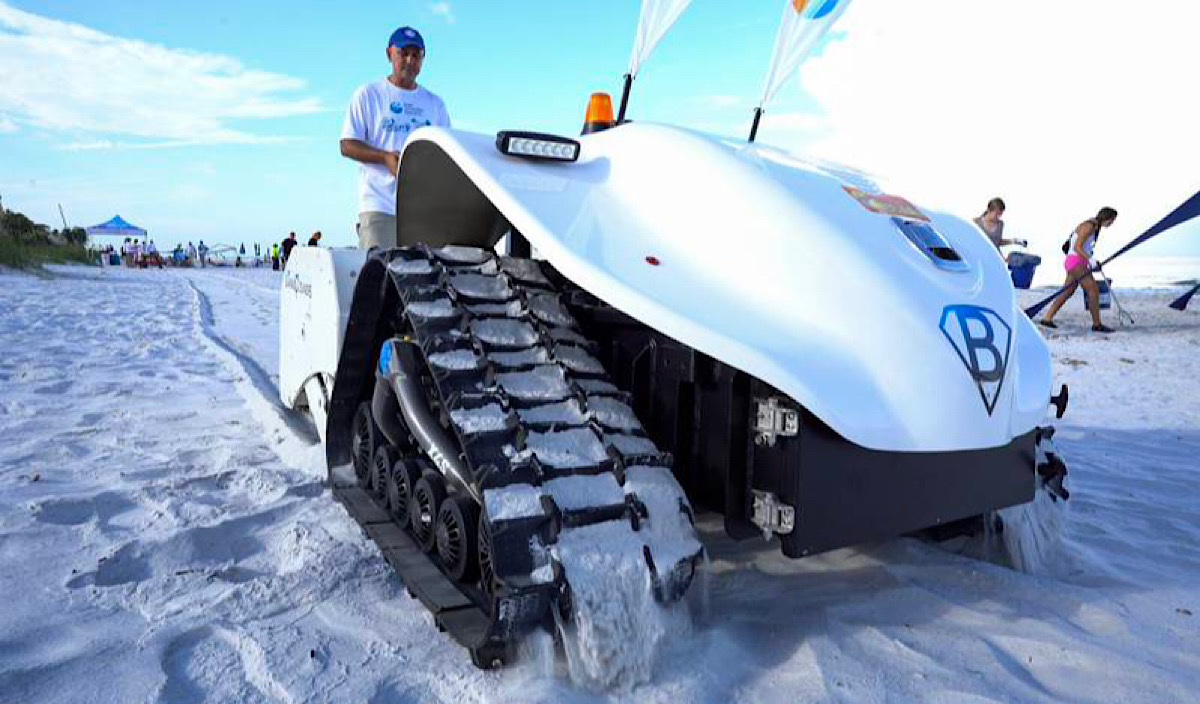
Florida county rolls out BeBot, a beach-cleaning robot with a message for humans

A remote-controlled robot named BeBot rolls over a patch of sand in Indian Shores during a cleanup demonstration on Thursday, July 14, 2022. BeBot is part of a campaign by Keep Pinellas Beautiful to raise awareness about debris left by humans that lurks under the beach surface and eventually winds up in the Gulf of Mexico. (Aya Diab/TNS)

By Chris Kuo, Tampa Bay TimesTribune News Service

A new solar-powered, beach-cleaning robot has arrived in Pinellas County, drawing attention to all the debris lurking just beneath the beach surface.

Overseen by Keep Pinellas Beautiful, BeBot will visit 14 locations this month, from Clearwater to St. Pete Beach. The remote-controlled robot collects small pieces of litter — cigarette butts, plastic straws, bottle caps, food wrappers and more.

“You wouldn’t believe the amount of trash that we found. It’s astonishing,” said Patricia DePlasco, executive director of Keep Pinellas Beautiful, a nonprofit that focuses on environmental cleanup. “We look across the beach and we think we have a nice clean beach and we don’t realize what’s under that top layer of sand.”

DePlasco and a team of about 30 volunteers gathered Thursday at an Indian Shores beach to watch a BeBot demonstration.

Continue reading… “Florida county rolls out BeBot, a beach-cleaning robot with a message for humans”

Scientists aim to grow billions of stem cells aboard the International Space Station

This is the latest effort to overcome one of the key hurdles for widespread stem cell therapies.

By Chris Young

Scientists from Cedars-Sinai Medical in Los Angeles are investigating how to grow large batches of a specific type of stem cell.

Their mission has taken them orbital — to the International Space Station — and it could help unlock a whole host of stem cell therapies to combat deadly diseases.

Stay on top of the latest engineering news just enter your email and we’ll take care of the rest.Sign Up

One of the researchers, Dhruv Sareen, even donated his own stem cells for the experiment, a press statement reveals. If all goes to plan, the scientists hope to eventually grow billions of stem cells in space.

Continue reading… “Scientists aim to grow billions of stem cells aboard the International Space Station”

Dubai is now home to the largest vertical farm in the world

The building will produce 2 million pounds of greens per year, in a country that currently imports nearly all of its food.

BY ADELE PETERS

If you walk into a grocery store in Dubai, the spinach on the shelves will probably be from Europe—or even from as far away as the United States. Because of limited arable land and water, the United Arab Emirates imports about 90% of its food. But inside a warehouse-like building near the Dubai airport, a new vertical farm is now beginning to grow more than 2 million pounds of local leafy greens per year.

Continue reading… “Dubai is now home to the largest vertical farm in the world”
Discover the Hidden Patterns of Tomorrow with Futurist Thomas Frey
Unlock Your Potential, Ignite Your Success.

By delving into the futuring techniques of Futurist Thomas Frey, you’ll embark on an enlightening journey.

Learn More about this exciting program.