EU plans to approve sales of fully self-driving cars

A Vision Urbanetic self-driving van by Mercedes-Benz | John MacDougall AFP via Getty Images

BY JOSHUA POSANER

Europe aims to be the first-mover when it comes to letting so-called Level 4 autonomous cars on the road.

The European Commission is ready to let robots take the wheel.

The EU’s executive plans to propose by the end of September what it reckons will be the world’s first technical legislation that will allow member countries to approve the registration and sale of up to 1,500 vehicles per carmaker model each year installed with advanced self-driving technology, an EU official involved in drafting the rules told POLITICO.

Such vehicles, where motorists are no longer required to supervise driving, are still very much in the development stage. The aim is to fix Europe’s position as a first mover for next-generation cars able to navigate road networks and traffic autonomously, said two officials briefed on the plan.

“We are moving from the experimentation phase to the commercial phase,” the EU official said.

The legislation will include 17 separate pieces of technical rule-making that will amend how EU countries approve vehicles for sale. It’s part of a much broader revamp of car safety standards called the General Safety Regulation (GSR) — part of which enters into force on Wednesday.

The EU aims to reach zero road deaths by 2050, but to do that it has to boost safety features in cars, as human error is estimated to be at fault in 95 percent of vehicular accidents.

Continue reading… “EU plans to approve sales of fully self-driving cars”

Mojo Vision shows off mind-blowing new augmented reality contact lens

By Joshua Hawkins

Smart contact lenses could soon put an augmented reality display directly on your eyeball. At least, that’s the basic idea behind Mojo Vision’s prototype augmented reality contact lens. If successful, and able to do everything the company claims, these smart contact lenses could make a lot of ongoing AR headset development redundant before most of it is even released.

Continue reading… “Mojo Vision shows off mind-blowing new augmented reality contact lens”

Scientists Discover First Effective Drug Treatment Against Hepatitis A

Fluorescence microscopy image of HAV-infected cultured human liver cell. viral RNA targeted by ZCCHC14 appears green, and the virus’s protein red. Credit: Maryna Kapustina, UNC School of Medicine

Scientists Discover Key to Hepatitis A Virus Replication, Show Drug Effectiveness

With no current treatments for hepatitis A, scientists at the University of North Carolina School of Medicine led by Stanley M. Lemon, MD, discovered how a protein and enzymes interact to allow hepatitis A virus to proliferate, and they used a known drug to stop viral replication in an animal model.

The viral replication cycle is essential for a virus to spread inside the body and cause disease. Focusing on that cycle in the hepatitis A virus (HAV), University of North Carolina (UNC) School of Medicine scientists discovered that replication requires particular interactions between the human protein ZCCHC14 and a group of enzymes called TENT4 poly(A) polymerases. They also discovered that the oral compound RG7834 stopped viral replication at a key step, preventing liver cell infection.

These findings are the first to demonstrate an effective drug treatment against HAV in an animal model of the disease. The study was published today (July 4, 2022) in the Proceedings of the National Academy of Sciences.

Continue reading… “Scientists Discover First Effective Drug Treatment Against Hepatitis A”

EP. 94 WITH STEVEN KOTLER


Watch on Youtube

Listen on the Futurati Podcast

Flow is a well-known and valuable psychological state in which time seems to drop away and you become completely immersed in the present moment. Though its usefulness in achieving individual excellence has been studied extensively, much less attention has been paid to how it can aid in cooperation. Well tonight we’re joined by a guest who has tried to fill that gap by writing “The Devil’s Dictionary”, a fascinating novel which also explores topics around climate change, mass extinction, and the future of humanity. Steven Kotler is one of the world’s foremost experts on human peak performance and the New York Times bestselling author of “The Art of Impossible” and “The Rise of Superman”.

Continue reading… “EP. 94 WITH STEVEN KOTLER”

DRIVERLESS CARS NEED SMARTER ROADS: A TALE FROM SAN FRANCISCO

As Jonathan Bartlett notes, the recent Frisco foul-up shows the need for roads adapted to include self-driving cars     

The future was here, briefly at least. The driverless cars of GM’s autonomous driving unit, Cruise, started charging fares early last month in a limited area in San Francisco. Google’s Waymo also operates driverless cars in Frisco but hasn’t yet started charging fares. With the regulators and the tech media, it certainly seemed like all systems were go:

The era of commercial autonomous robotaxi service is here — Cruise officially became the first company to offer fared rides to the general public in a major city as of late Wednesday. The milestone comes after Cruise received official approval from the California Public Utilities Commission in early June to operate driverless in a commercial capacity.

Initially, Cruise’s driverless autonomous offering will operate only between 10 p.m. and 6 a.m., and only on designated streets in the city. 

DARRELL ETHERINGTON, “CRUISE’S DRIVERLESS AUTONOMOUS CARS START GIVING RIDES TO PAYING PASSENGERS” AT TECHCRUNCH (JUNE 24, 2022)

But then, less than a week later,

Continue reading… “DRIVERLESS CARS NEED SMARTER ROADS: A TALE FROM SAN FRANCISCO”

Tesla EVs can now scan the road for potholes and adjust the suspension height

It’ll only work on adaptive suspension vehicles like the Model X and Model Y.

By Steve Dent

Tesla has introduced a software update that allows its vehicles to scan for potholes, broken pavement and other defects, Electrek has reported. It can then use that to generate “rough road map data,” and trigger the adaptive suspension in supported vehicles to adjust the ride height for more comfort. 

Continue reading… “Tesla EVs can now scan the road for potholes and adjust the suspension height”

Celebrity-Backed NotCo Brings Its AI-Developed Vegan Chicken to Burger King

By Jill Ettinger 

Chile’s NotCo expands its presence in its backyard with new vegan chicken options in Burger King Chile.

It’s been a busy year since NotCo, the Chilean food-tech startup known for its AI technology dubbed Giusseppe, raised $235 million in a Series D funding round that included backing from tennis star Roger Federer, F1 Driver Lewis Hamilton, and Oscar-winning musician and filmmaker, Questlove.

Continue reading… “Celebrity-Backed NotCo Brings Its AI-Developed Vegan Chicken to Burger King”

Massless Prototyping with Augmented Reality

Accelerate design cycles. Lower development costs. Reduce waste.

No matter how hard you try to get the design right on the first try in your CAD software, isn’t there always something that you only notice as soon as the object jumps from your 2D screen to your 3D space?

This used to happen to me all the time. I thought I had thought of everything…only to have to head right back to the drawing board after seeing the prototype. 

This still happens to me all the time, only now I can catch these mistakes in a few seconds and fix them without wasting any time or money on making a physical prototype. With augmented reality (AR), I’ve been able to find completely new meaning in the phrase “rapid prototyping”.

Many people use 3D-printing to create these “looks like” prototypes. There is certainly something to be said for holding it in your hands. Then what? The trash? At least there are a few cool companies like re:3D who can chop up your FDM prototypes and re-extrude the plastic.

But what if you didn’t need to make anything at all? Today there are about 4 billion mobile devices on the planet that natively support augmented reality. If you are reading this and you have bought a smartphone or tablet in the last decade – that means you!

Enter the massless prototype. While AR can’t solve all of your prototyping needs, it is a crucial tool for every designer & engineer to have access to. Here are just a few of the ways that you can use AR to accelerate your design workflow, lower your costs, and reduce your carbon footprint – all at the same time.

Continue reading… “Massless Prototyping with Augmented Reality”

China Tests Gigantic Drag Sail for Removing Space Junk

This kite-like space sail will help deorbit a rocket component within two years.

By Passant Rabie

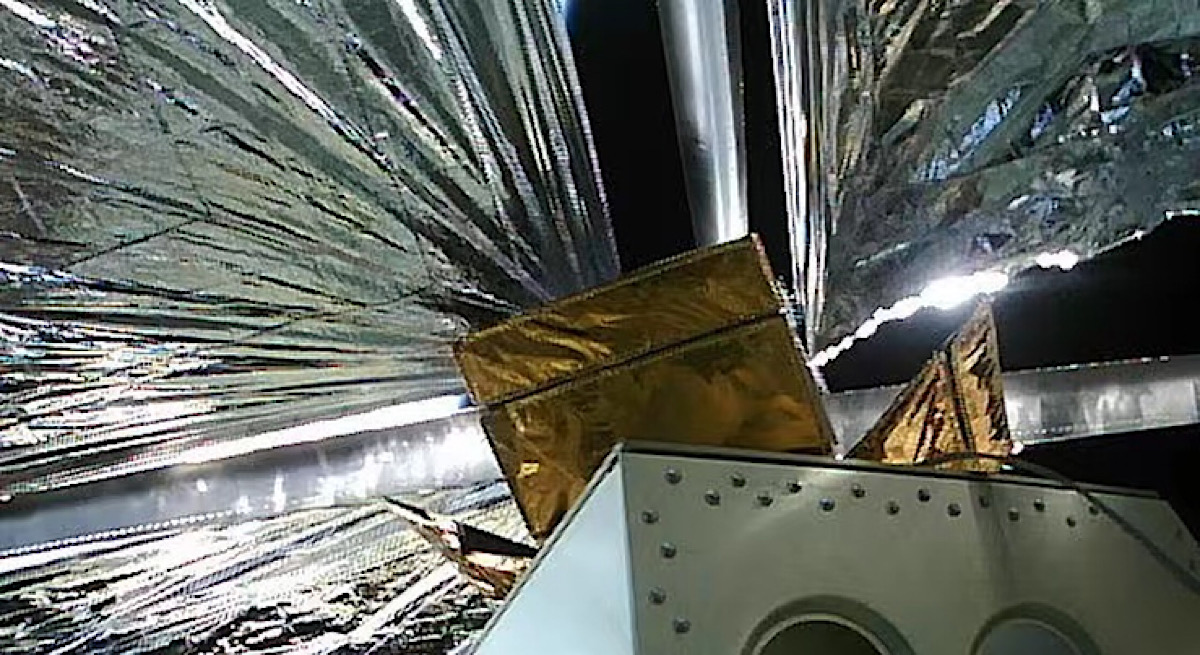
THE 269-SQUARE-FOOT SPACE KITE LAUNCHED ABOARD A LONG MARCH 2D ROCKET IN LATE JUNE.

Engineers in China have successfully deployed an ultra-thin sail attached to a rocket part to expedite its departure from low Earth orbit and reduce the amount of space junk aimlessly floating above our planet. 

The 269-square-foot (25-square-meter) sail unfurled after launching from a Long March 2D rocket on June 24. Although the mission was not publicized beforehand, the Shanghai Academy of Spacecraft Technology (SAST) announced a few days later that the drag sail had been successfully deployed to assist with the deorbiting of the rocket component, which won’t happen for another two years or so. 

When unfurled, the kite-shaped sail increases the atmospheric drag working against the object it’s attached to, thereby accelerating orbital decay. The rocket component will then meet its fate much sooner, deorbiting and burning up in Earth’s atmosphere on its way down. It’s a potential low-cost solution to the ever-growing problem of space debris. 

Continue reading… “China Tests Gigantic Drag Sail for Removing Space Junk”

Here’s What Traveling By Hyperloop Could Look Like

“It’s simple. If it’s not affordable, people won’t use it.”

Virgin Hyperloop has released a new video showing what the experience of being shot inside a pod down a vacuum tube at breakneck speeds could one day look and feel like.

It’s an ambitious vision of the future of transportation. The concept video goes through each step in the travel process, from check-in to disembarking.

The experience seems reminiscent of going to an airport to catch a plane. The interior of the shuttle, however, feels more inspired by rail travel, with wide open cabins and face-to-face seating.

The biggest difference, however, is that there are o windows — except for what appears to be a generous skylight above. That’s because the magnetically levitating pod is racing through an vacuum tube at speeds of up to 760 mph.

To make it feel less claustrophobic, the design team is focusing on bringing the outside in. “Bands of greenery and wood textures subvert the aesthetic of typical mass transit materials with something optimistic and fresh,” John Barratt, CEO and president of design company Teague, which designed the pod interiors, said in a statement.

“All lighting in the pod — including the unassuming information displays — are dynamic and adjust based on traveler activity and journey milestones,” Barratt said.

Continue reading… “Here’s What Traveling By Hyperloop Could Look Like”

Japan Proposes a Wild Concept for Making Artificial Gravity on the Moon

By Jason Dorrier

The list of challenges space explorers will face is formidable. They’ll have to produce breathable air, clean water, and food in extremely hostile environments lacking all of the above. They’ll also have to peacefully coexist with small groups of fellow explorers in tight quarters for long periods of time, all while minimizing exposure to the searing radiation that’s ubiquitous virtually anywhere they go.

Assuming explorers overcome these challenges, there’s another that doesn’t get the love it deserves, according to researchers at Japan’s Kyoto University.

Long-term settlement of Earth orbit, the moon, Mars, and beyond requires explorers forsake Earth’s gravity—the steady downward force every Earthly animal has evolved to navigate over billions of years. Studies of astronauts spending weeks or months in microgravity have shown atrophied muscles, bone loss, vision loss, and changes to immune systems. There have, of course, been no studies of humans living on planetary bodies with low-gravity, but it’s likely adult explorers would contend with health issues—and how all this might affect childbirth and normal development in kids is unknown.

Assuming some kind of artificial gravity would lessen these risks considerably, Kyoto University partnered with construction company, Kajima Corp, to explore futuristic concepts that might one day offer tourists and settlers a healthy dose of good ol’ Earth gravity.

Their far-future vision? A towering sci-fi space cone, called the Glass, that would stand 1,312 feet (400 meters) tall and 656 feet (200 meters) across. This habitat would spin around its axis once every 20 seconds so that people living on its inner walls would enjoy Earth gravity—alongside trees, grass, and a lake that would do MC Escher proud. The plans call for spinning habitats on the moon and Mars, where gravity is notably less than on Earth.

In addition to the habitat itself, the three-part proposal, outlined in a press release and video last week, also sketched out a system for transportation between Earth, Mars, and the moon called Hexatrack, which would include standardized vehicles for travel between habitats on the surface of the planet or moon and base stations in orbit.

Continue reading… “Japan Proposes a Wild Concept for Making Artificial Gravity on the Moon”

Multi-Fingered Robot Hand Developed to Perform Multiple Human Tasks

By Marie Morales 

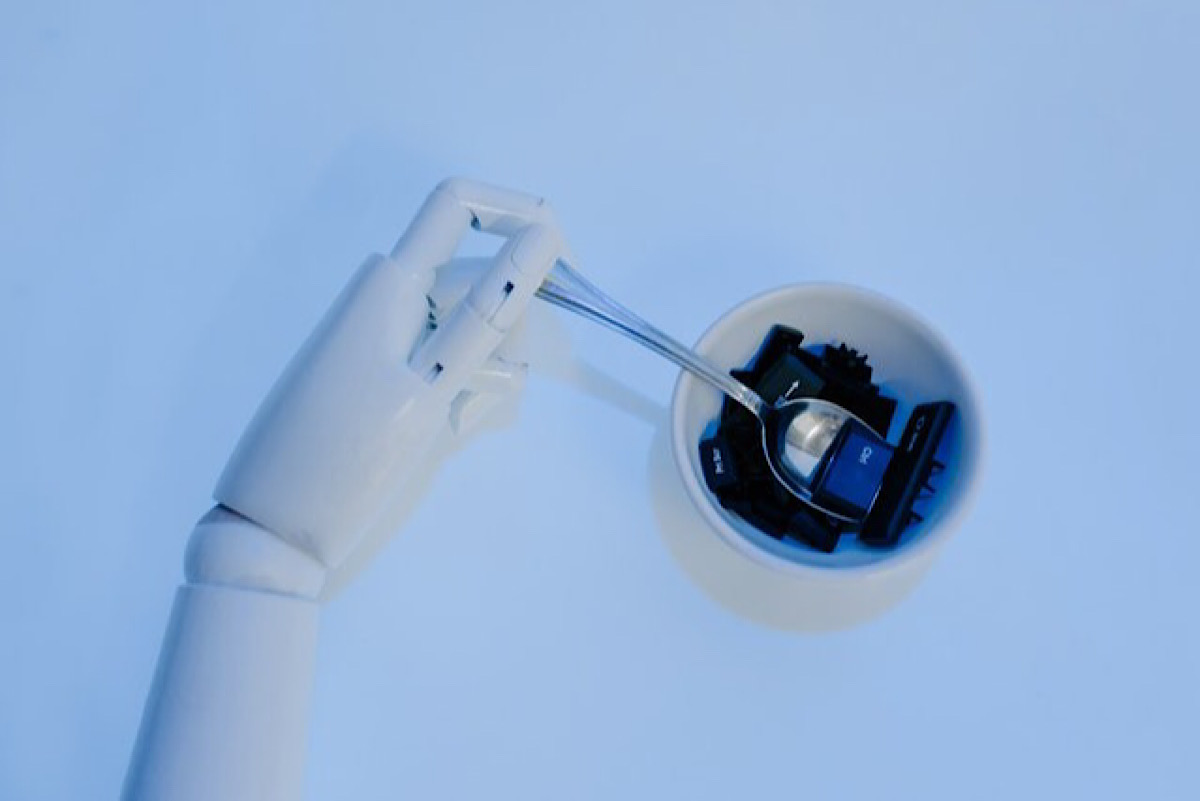
(Photo : Pexels/Tara Winstead) Researchers developed a new technique to teach robots to grasp objects and manipulate them through the use of the multi-fingered robotic hand.

Researchers at Universität Hamburg have recently developed a new technique to teach robots to grasp objects and manipulate them using the multi-fingered robotic hand.

In recent years, as specified in a Tech Xplore report, robotics has developed growingly advanced robotic systems, many of which have artificial hands or robot hands that have multiple fingers.

To complete daily tasks in both public settings and homes, there is a need for robots to be able to use their hands to grasp and maneuver objects effectively.

Enabling dexterous manipulation that involves multiple fingers in robots, though, has thus far proven challenging. This is mainly because it is an advanced skill that encompasses adjusting objects’ shape, configuration, and shape.

Continue reading… “Multi-Fingered Robot Hand Developed to Perform Multiple Human Tasks”
Discover the Hidden Patterns of Tomorrow with Futurist Thomas Frey
Unlock Your Potential, Ignite Your Success.

By delving into the futuring techniques of Futurist Thomas Frey, you’ll embark on an enlightening journey.

Learn More about this exciting program.