A Sensor Sniffs for Cancer, Using Artificial Intelligence

Biomedical engineer Daniel Heller leads the Cancer Nanomedicine Laboratory at MSK.

Researchers at Memorial Sloan Kettering Cancer Center (MSK) have developed a sensor that can be trained to sniff for cancer, with the help of artificial intelligence.

Although the training doesn’t work the same way one trains a police dog to sniff for explosives or drugs, the sensor has some similarity to how the nose works. The nose can detect more than a trillion different scents, even though it has just a few hundred types of olfactory receptors. The pattern of which odor molecules bind to which receptors creates a kind of molecular signature that the brain uses to recognize a scent.

Like the nose, the cancer detection technology uses an array of multiple sensors to detect a molecular signature of the disease. Instead of the signals going to the brain, they are interpreted by machine learning — a type of computer artificial intelligence.

MSK researchers led by Kravis WiSE Postdoctoral Fellow Mijin Kim and biomedical engineer Daniel Heller, head of the Cancer Nanomedicine Laboratory at MSK, built the technology using an array of sensors composed of carbon nanotubes. Carbon nanotubes are tiny tubes, nearly 100,000 times smaller than the width of a human hair. They are fluorescent, and the light they give off is very sensitive to minute interactions with molecules in their environment.

Each nanotube sensor can detect many different molecules in a blood sample. By combining the many responses of the sensors, the technology creates a unique fluorescent pattern. The pattern can then be recognized by a machine-learning algorithm that has been trained to identify the difference between a cancer fingerprint and a normal one.

In experiments conducted on blood samples obtained from patients with ovarian cancer, the researchers found that their nanosensor detected ovarian cancer more accurately than currently available biomarker tests. (A biomarker is a particular chemical produced by tumors and spread through the blood circulation that indicates the presence of disease. In this case, the biomarker tests were ones for the ovarian cancer-related proteins CA125, HE4, and YKL40.)

The hope for patients is that researchers will develop the technology further so that it can eventually be used in the clinic to rapidly screen for early-stage ovarian cancer and many other cancers.Molecular Pharmacology ProgramOur research program serves as a conduit for bringing basic science discoveries to preclinical and clinical evaluation.

Continue reading… “A Sensor Sniffs for Cancer, Using Artificial Intelligence”

SCIENTISTS INVENT “PROFOUND” QUANTUM SENSOR THAT CAN PEER INTO THE EARTH

“THIS IS AN ‘EDISON MOMENT’ IN SENSING THAT WILL TRANSFORM SOCIETY.”

A major breakthrough in quantum sensing technology is being described as an “Edison moment” that could, scientists hope, have wide-reaching implications.

A new study in Nature describes one of the first practical applications of quantum sensing, a heretofore largely theoretical technology that marries quantum physics and the study of Earth’s gravity to peer into the ground below our feet — and the scientists involved in this research think it’s going to be huge.

Known as a quantum gravity gradiometer, this new sensor developed by the University of Birmingham under contract with the United Kingdom’s Ministry of Defense is the first time such a technology has been used outside of a lab. Scientists say it’ll allow them to explore complex underground substructures much more cheaply and efficiently than before.

While gravity sensors already exist, the difference between the traditional equipment and this quantum-powered sensor is huge because, as Physics World explains, the old tech takes a long time to detect changes in gravity, has to be recalibrated over time, and can be thrown off by any vibrations that occur nearby.

This new type of highly sensitive quantum sensor, on the other hand, is able to measure the minute changes in gravity fields from objects of different sizes and compositions that exist underground — such as human-made structures buried by the eons, tantalizingly — much faster and more accurately.

Continue reading… “SCIENTISTS INVENT “PROFOUND” QUANTUM SENSOR THAT CAN PEER INTO THE EARTH”

MIT proposes using a ‘space bubble’ shield the size of Brazil to cool the Earth

A radical new form of solar geoengineering.

By  Chris Young

A team of MIT researchers is investigating a radical method for countering the effects of climate change, a press statement reveals.

They propose to use a fleet of “space bubbles” to reflect sunlight away from Earth.

As we all know, such crazy ideas wouldn’t even be on the table if humans had drastically curbed their use of fossil fuels years ago — but here we are.

While some scientists warn that geoengineering is a dangerous distraction from the true work needed to cut emissions, others say we need to assess all options. That’s where the MIT team’s space bubbles come in. 

Continue reading… “MIT proposes using a ‘space bubble’ shield the size of Brazil to cool the Earth”

REVO FOODS’ FIRST 3D-PRINTED VEGAN SALMON FILETS WILL LAUNCH IN STORES IN 2023

Revo Foods’ first whole-cut vegan salmon filet, made from algae and pea protein, will be available in stores next year.

by NICOLE AXWORTHY

Vienna-based vegan food technology company Revo Foods recently unveiled its first “ultra realistic” whole-cut plant-based salmon, which is expected to launch in stores in early 2023. The new product is made using 3D food printing technology and aims to replicate the eating experience of whole-cut fish filets without the need to harm a single fish.

While the majority of conventional fish is consumed in whole-cut filets, few alternative seafood products have been able to mimic the experience. Revo Foods’ scientific team worked for more than two years researching new process technology and ingredient compositions to develop its first whole-cut vegan salmon filet, dubbed “generation 2.0.” Unlike the products of the first generation, which were mostly made with tofu, the new whole-cut salmon uses pea protein and algae extracts, making it rich in protein and omega-3 fatty acids. It was developed using 3D food printing technology to create a taste and texture that mimics conventional salmon and can be prepared (fried, cooked, and steamed) just like conventional fish. The startup has already filed two patents for new technologies to produce such whole-cut vegan fish products.

Last year, Revo Foods unveiled its first 3D-printed vegan smoked salmon product during a tasting event that took place at Budapest Bagels in Vienna. Called “Salmon With Attitude,” the product looked just like real smoked salmon and was also developed using 3D food printing to recreate the texture and appearance of seafood. Similarly, ingredients such as pea protein, algae extracts, and dietary fibers are combined to create a base that is high in protein, omega 3, and B12. Revo showcased its revolutionary vegan fish in a creamy smoked salmon spread. These first products are already available in 16 European countries, including supermarkets in Austria and Germany.

Continue reading… “REVO FOODS’ FIRST 3D-PRINTED VEGAN SALMON FILETS WILL LAUNCH IN STORES IN 2023”

Einride’s Driverless Electric Pod Approved for US Public Roads

The Swedish startup’s electric trucks will carry out a test on public roads in Q3 this year.

By Stephanie MlotStephanie Mlot

Swedish transport company Einride got the green light to operate autonomous electric trucks without a driver present on US public roads.

The National Highway Traffic Safety Administration approved the company’s “Pod” for public roads, which counts as an industry first for this type of driverless truck.

A sleek black-and-white box on wheels, the Einride Pod doesn’t have room for a human driver. Instead, a remote operator monitors and can step in to control the vehicle if necessary. As these are effectively electric trucks and will be transporting heavy goods, it comes as no surprise that the range is estimated to be 124 miles on a fully-charged battery.

Continue reading… “Einride’s Driverless Electric Pod Approved for US Public Roads”

Novel Tissue Model May Help Harness the Liver’s Regenerative Abilities

If up to 70% of the liver is removed, the remaining tissue can regrow a full-sized liver within a couple of months. MIT engineers sought to take advantage of this regenerative ability to help treat chronic liver disease. The team reported that they have created a novel liver tissue model that allows them to trace the steps involved in regeneration more precisely than seen before.

Their findings are published in the journal Proceedings of the National Academy of Sciences(PNAS) in an article titled, “A vascularized model of the human liver mimics regenerative responses.”

“The new model can yield information that couldn’t be gleaned from studies of mice or other animals, whose biology is not identical to that of humans,” explained Sangeeta Bhatia, MD, PhD, the leader of the research team.

Continue reading… “Novel Tissue Model May Help Harness the Liver’s Regenerative Abilities”

JHU Applied Physics Lab’s Dragonfly drone is heading to Saturn’s largest moon

A rendering of JHU APL’s Dragonfly on Saturn’s moon Titan.

By Stephen Babcock 

NASA’s next bold mission: To put a drone on a moon — the largest moon of Saturn, to be precise.

This week, the U.S. space agency picked a project led by Johns Hopkins Applied Physics Lab (APL) that would send a rotorcraft lander to Titan as the next mission for its New Frontiers Program.

The 10-ft. by 10-ft. robotic lander, called Dragonfly, will have eight rotors and fly like a large UAV. The mission is the first of its kind for NASA, both in the type of vehicle being used to land on another world, and its approach to landing at multiple sites.

Dragonfly will be tasked with exploring dozens of locations across the moon. Titan holds special appeal for scientists, as it’s considered to be the world in our solar system that’s most like Earth, especially the planet’s early development. So with Dragonfly, they’ll look to take measurements and samples with an eye toward exploring how what’s happening there could improve understanding of how life came to inhabit our own planet.

Continue reading… “JHU Applied Physics Lab’s Dragonfly drone is heading to Saturn’s largest moon”

United Therapeutics unveils advanced 3D printed human lung scaffolds

 A lung-mimicking air sac that was 3d printed in water-based gel.

By Davide Sher

United Therapeutics Corporation (Nasdaq: UTHR), a public benefit corporation working in partnership with 3D Systems Corporation (NYSE: DDD) has produced the world’s most complex 3D printed object – a human lung scaffold – and demonstrated it at the LIFE ITSELF Conference in San Diego. The event was organized and hosted by Dr. Sanjay Gupta and Marc Hodosh and was sponsored by CNN, United Therapeutics, and other prominent corporate leaders in healthcare.

Dr. Martine Rothblatt, United Therapeutics’ Chairperson and Chief Executive Officer and Chuck Hull, 3D Systems’ Co-Founder, Executive Vice President, and Chief Technology Officer for Regenerative Medicine, explained to conference attendees during a presentation entitled What’s the Future of Organ Transplantation? that these 3D printed human lung scaffolds designs consisted of a record 44 trillion voxels that layout 4,000 kilometers of pulmonary capillaries and 200 million alveoli.

Scientists at United Therapeutics plan to cellularize these 3D printed human lung scaffolds with a patient’s own stem cells to create tolerable, transplantable human lungs that should not require immunosuppression to prevent rejection. This latest achievement represents the latest milestone of an ongoing research project that was first made public in 2018.

“Last week, it was exciting to show the public our 3D printed human lung scaffold, but we’re thrilled to share that our 3D printed lung scaffolds are now demonstrating gas exchange in animal models. We are regularly printing lung scaffolds as accurately as driving across the United States and not deviating from a course by more than the width of a human hair,” said Dr. Rothblatt. “With the continued hard work of dedicated scientists and engineers at United Therapeutics and 3D Systems, we hope to have these personalized, manufactured lungs cleared for human trials in under five years.”

Continue reading… “United Therapeutics unveils advanced 3D printed human lung scaffolds”

World’s fastest electric ‘flying’ ferry to make commuting in Stockholm faster than cars and metros

By Camille Bello  

The world’s fastest electric ship will soon navigate the archipelago around Stockholm in a bid to make public transport by water more attractive.

The Candela P-12 Shuttle will begin operating in Sweden’s capital next year with its makers claiming the vessel to be not only the fastest of its kind with a speed of 30 knots, but also the most energy-efficient electric ship ever.

It’s hoped it will make marine public transport in the city more attractive than trains, buses and cars.

Continue reading… “World’s fastest electric ‘flying’ ferry to make commuting in Stockholm faster than cars and metros”

This Warehouse Robot Reads Human Body Language

Machines that understand what their human teammates are doing could boost productivity without taking jobs.

RODNEY BROOKS KNOWS a fair bit about robots. Besides being a pioneer of academic robotics research, he has founded companies that have given the world the robot vacuum cleaner, the bomb disposal bot, and a factory robot anyone can program.

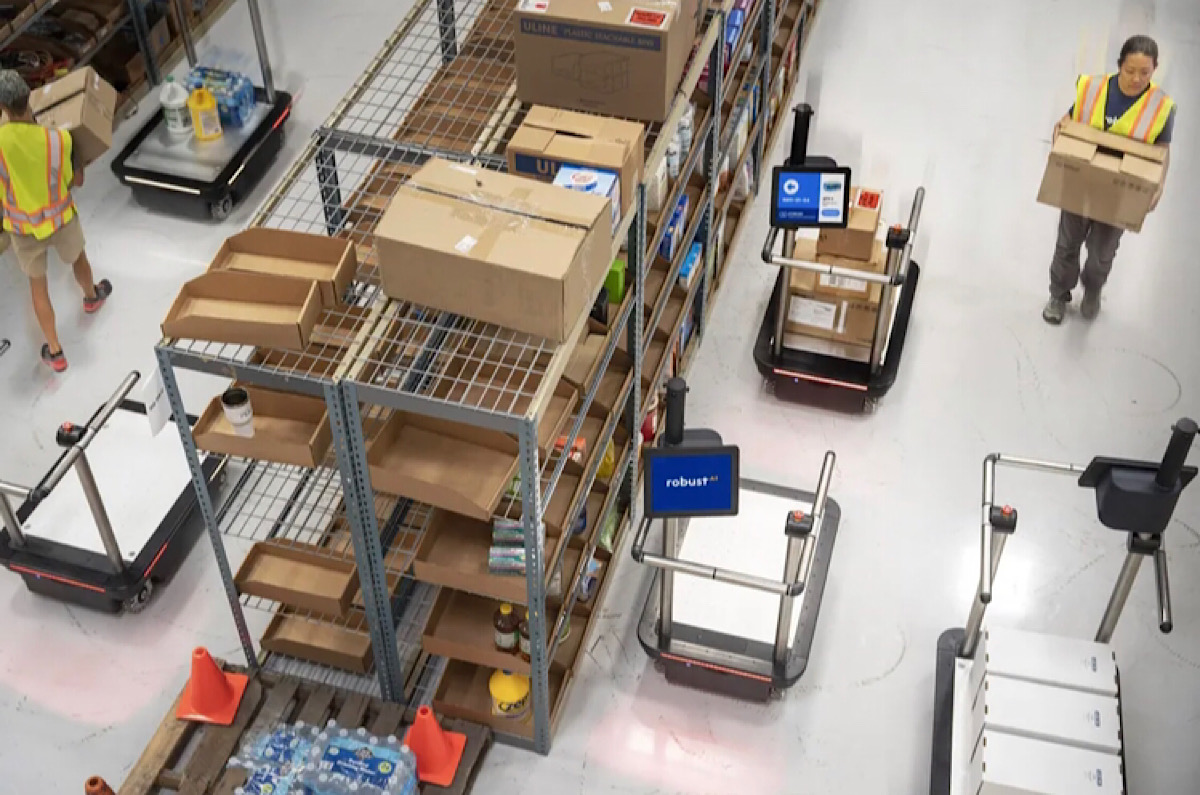
Now Brooks wants to introduce another revolutionary type of robot helper—a mobile warehouse robot with the ability to read human body language to tell what workers around it are doing. Robots are increasingly working in close proximity to humans, and finding ways to maximize human-machine teamwork could help companies boost productivity and perhaps lead to new kinds of jobs rather than robots replacing people. But giving robots the ability to read human cues is far from easy.

Brooks’ new company, Robust AI, unveiled its mobile robot, Carter, designed to work in warehouse facilities, last week. “The analogy here is a service dog,” Brooks says via video call. “It obeys you; you can modify its behavior, and it’s there to help you.”

Robust AI’s robot, Carter, looks like the kind of dolly you’d find at a home improvement store, but it has a motorized base, a touchscreen mounted above its handlebar, and a periscope with several cameras. It uses these cameras to scan the surrounding scene, allowing its software to identify workers nearby, and it attempts to infer what they are doing from their pose and how they are moving. If a human worker needs to move several boxes, for example, they can approach a Carter robot moving autonomously and, by grabbing the handlebar, take manual control. The robot can be configured to perform a variety of different tasks using a “no code” graphical interface—for example, to follow a person around a warehouse, carrying items that are picked from shelves.

Continue reading… “This Warehouse Robot Reads Human Body Language”

Watch the nuclear-powered flying hotel that can stay airborne for years with 5,000 passengers

A video of ‘Flytanic’ has the internet divided

By  Ameya Paleja

A concept video of Sky Cruise, a giant flying machine that can carry 5,000 passengers and has all the luxuries of the world, has gone viral on the internet. The maker of the video claims that such an aircraft built in the future would have no carbon footprint, The Independent reported.

The concept of a floating world in itself is not new and has been described even in Jonathan Swift’s works from the 18th century, much before the Wright Brothers made their first flight. Fans of animated movies might have also come across the concept in 1986 Japanese movie, Castle in the Sky.  

While such references in the past have relied on the ‘virtues of materials’ which make up the world to give them such flying powers, the concept, as shown above, borrows from modern-day technology to project a possible future.

Continue reading… “Watch the nuclear-powered flying hotel that can stay airborne for years with 5,000 passengers”
Discover the Hidden Patterns of Tomorrow with Futurist Thomas Frey
Unlock Your Potential, Ignite Your Success.

By delving into the futuring techniques of Futurist Thomas Frey, you’ll embark on an enlightening journey.

Learn More about this exciting program.