Ford Accomplishes Lights-out Manufacturing with Javier, an Autonomous Robot

David Mantey 

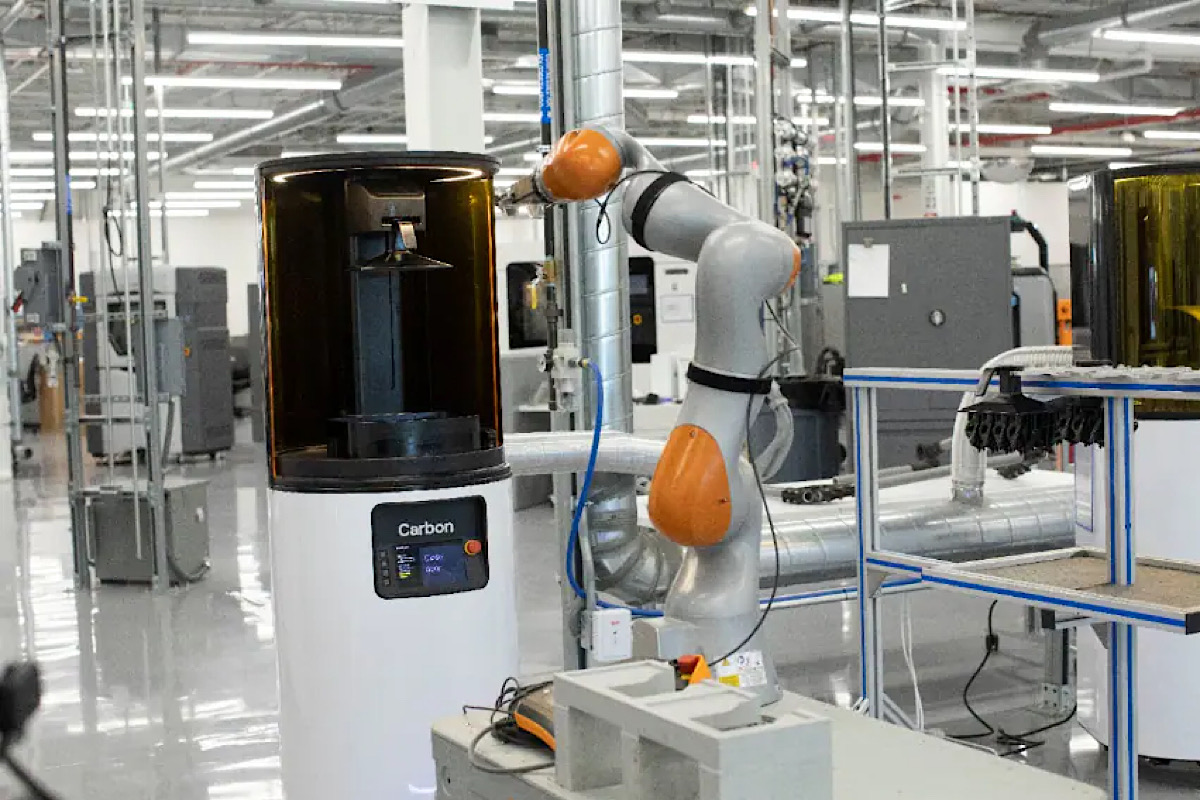
Javier is an autonomous mobile robot, specifically a KUKA robot on wheels. Named by Ford’s additive manufacturing operators, the mobile robot autonomously operates 3D Carbon printers without any human interaction. 

Ford has filed several patents over the technology, which, unlike traditional stationary robots that tend a lone machine, can service multiple. 

According to Jason Ryska, director of global manufacturing technology development at Ford, Javier is going to change the way the carmaker uses robotics in its manufacturing facilities. The robot will not only scale 3D printing operations but the technology will be moved into other parts of the manufacturing and assembly processes. 

Ford is learning from the robot; improving accuracy by using Javier’s feedback to reduce errors. Ford has filed several patents regarding the robot’s communication interfaces and positioning. For example, Javier doesn’t need a camera vision system to see.

Continue reading… “Ford Accomplishes Lights-out Manufacturing with Javier, an Autonomous Robot”

California Startup Bionaut Labs Wants to Send Tiny Robots Inside Human Skull to Treat Brain Disorders

Tiny robots can be carefully guided through the brain using magnets

By Agence France-Presse

BIONAUT LABS PLANS ITS FIRST CLINICAL TRIALS ON HUMANS IN JUST TWO YEARS.

  • The robit is a metal cylinder in the shape of a bullet
  • It will follow a pre-programed trajectory through a gel-filled container
  • Robots could offer advantages over existing treatments for brain disorder

Sending miniature robots deep inside the human skull to treat brain disorders has long been the stuff of science fiction — but it could soon become reality, according to a California start-up.

Bionaut Labs plans its first clinical trials on humans in just two years for its tiny injectable robots, which can be carefully guided through the brain using magnets.

“The idea of the micro robot came about way before I was born,” said co-founder and CEO Michael Shpigelmacher.

“One of the most famous examples is a book by Isaac Asimov and a film called ‘Fantastic Voyage,’ where a crew of scientists goes inside a miniaturised spaceship into the brain, to treat a blood clot.”

Just as cellphones now contain extremely powerful components that are smaller than a grain of rice, the tech behind micro-robots “that used to be science fiction in the 1950s and 60s” is now “science fact,” said Shpigelmacher.

“We want to take that old idea and turn it into reality,” the 53-year-old scientist told AFP during a tour of his company’s Los Angeles research and development center.

Continue reading… “California Startup Bionaut Labs Wants to Send Tiny Robots Inside Human Skull to Treat Brain Disorders”

Abundant “Secret Doors” on Human Proteins Could Be Game-Changer for Drug Discovery

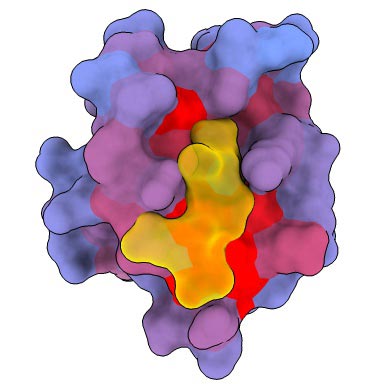
A three-dimensional animation of the human protein PSD95-PDZ3 showing the binding partner CRIPT (yellow) in the active site with the blue-to-red color gradient indicating increasing potential for allosteric effects. Based on PDB accession 1BE9.

By CENTER FOR GENOMIC REGULATION

Identification of hidden vulnerabilities on surface of ‘undruggable’ proteins could transform treatment of disease.

The number of potential therapeutic targets on the surfaces of human proteins is much greater than previously thought, according to the findings of a new study in the journal Nature.

A ground-breaking new technique developed by researchers at the Center for Genomic Regulation (CRG) in Barcelona has revealed the existence of a multitude of previously secret doors that control protein function and which could, in theory, be targeted to dramatically change the course of conditions as varied as dementia, cancer and infectious diseases.

The method, in which tens of thousands of experiments are performed at the same time, has been used to chart the first ever map of these elusive targets, also known as allosteric sites, in two of the most common human proteins, revealing they are abundant and identifiable.Official HCP Treatment Website – Partial-Onset Seizure InfoA Therapy Option May Reduce Your Patient’s Seizures. Learn Treatment Info Now.Prescription Treatment Website

The approach could be a game-changer for drug discovery, leading to safer, smarter and more effective medicines. It enables research labs around the world to find and exploit vulnerabilities in any protein – including those previously thought ‘undruggable’.

Continue reading… “Abundant “Secret Doors” on Human Proteins Could Be Game-Changer for Drug Discovery”

Maker of $1 million flying motorbike prepares for IPO in Japan

The US$777,000 (S$1.1 million) single-person transporter can hit a max speed of 80kmh and travel up to 40 minutes per charge. 

TOKYO (BLOOMBERG) – A former Merrill Lynch derivatives trader with a passion for Star Wars is preparing to take his flying motorbike start-up public in Japan.

Tokyo-based ALI Technologies was founded by Mr Shuhei Komatsu as a drone maker in 2016 before moving on to more ambitious ventures, opening sales of its Xturismo Limited bike in October. The US$777,000 (S$1.1 million) single-person transporter can hit a maximum speed of 80kmh and travel up to 40 minutes per charge, according to the company.

The motorbike has so far largely figured as a curio at public events such as a recent baseball game, but ALI president Daisuke Katano said there is strong interest in it from Middle Eastern nations.

“The need for these bikes will be higher in places with desert or other difficult terrain,” Mr Katano said in an interview. “The vehicle will enable people to travel where roads are bad and inaccessible to cars, as well as across bodies of water.”

The company has selected lead underwriters for an initial public offering (IPO) on Tokyo’s Mothers market for start-ups in what will be the country’s first debut of its kind. It is presently engaged in discussions with the Tokyo Stock Exchange, Mr Katano said, declining to specify an estimated valuation or a timeline for the offering.

Flying personal vehicles have been the stuff of science fiction for decades before Star Wars, which featured a famous racing scene with pods zooming along close to ground level.

Continue reading… “Maker of $1 million flying motorbike prepares for IPO in Japan”

FRACTAL NEURON GROWTH COULD LEAD TO BIONIC EYES

BY U. OREGON

Researchers have grown rodent retinal neurons on a fractal-patterned electrode, one that mimics the repeating branching pattern in which neurons naturally grow.

It’s a step closer to making a bio-inspired bionic eye, a longstanding goal for University of Oregon physicist Richard Taylor.

Taylor hopes the tiny electrodes could someday be implanted into the eye to restore sight in people with macular degeneration or other vision disorders.

The new work provides experimental evidence supporting a hunch his team has been pursuing for years, that neurons, which themselves are fractals, will connect better to a fractal-patterned electrode than they do to more traditionally shaped electrodes, allowing better signal transmission between the implant and the brain.

Continue reading… “FRACTAL NEURON GROWTH COULD LEAD TO BIONIC EYES”

Delivering genetic material with MOFs for new therapies

In biomedicine, metal-organic frameworks can be used to deliver pharmaceuticals around the human body. A KAUST-led team has developed a MOF-based system for getting DNA across cell membranes into target cells.

by  King Abdullah University of Science and Technology

An emerging type of material called a metal-organic framework (MOF) could help improve the delivery of genetic material for treating disease.

MOFs are hybrid materials constructed from metal ions linked by organic molecules. In biomedicine, they have mostly been used as delivery vehicles for small-molecule pharmaceuticals, but now a KAUST-led team has developed a MOF-based system for getting DNA across cell membranes into target cells.

The researchers built their MOFs using a collection of nucleic acid and unnatural amino acid building blocks tethered together by zinc atoms, assembled in a pyramid-like array. They loaded up the resulting materials with single-stranded DNA. The structures protected the genetic cargo from enzymatic degradation and helped ferry the single-stranded DNA into cells, where it ended up inside the nucleus—the cell’s inner sanctum where all gene activity takes place.

Continue reading… “Delivering genetic material with MOFs for new therapies”

Pentagon wants SpaceX delivering cargo around the globe — and a live test could come next year

A SpaceX Falcon 9 rocket carrying the company’s Crew Dragon spacecraft is seen in this false color infrared exposure as it is launched on NASA’s SpaceX Demo-2 mission to the International Space Station on May 30, 2020.

By Aaron Mehta 

WASHINGTON — U.S. Transportation Command is taking the potential for cargo delivery via orbit seriously enough that it hopes to test the concept with SpaceX as soon as next year, the command’s head said Wednesday.

In what he called a “provocative thought,” Gen. Stephen Lyons said: “I’m really excited about the team that’s working with SpaceX on an opportunity, even perhaps in as early as ’21, to conduct a joint proof of principle” for space-based delivery.

The dream, Lyons told the National Defense Transportation Association, is to be able to move 80 tons of cargo — the equivalent of a C-17 transport — via a space-based vehicle anywhere on the globe within one hour.

“Think about the speed associated with that, whether a small force element or other capability,” he said. “I can tell you [SpaceX is] moving very, very rapidly in this area.”

A TRANSCOM spokesman said details of the potential “proof of principle” are being worked out with SpaceX, and it will involve “delivering cargo from one place to another through space.”

Continue reading… “Pentagon wants SpaceX delivering cargo around the globe — and a live test could come next year”

Mojo Vision’s New Contact Lens Brings Seamless Augmented Reality a Step Closer

By Edd Gent 

Blending the digital and real worlds could have a host of applications, from entertainment to training, but current augmented and virtual reality headsets are bulky and limited. Now a startup is promising a more seamless experience thanks to smart contact lenses.

Despite the recent buzz around the metaverse, the idea that we will soon be using VR headsets to spend large amounts of our lives in virtual worlds still seems somewhat fantastical given the current state of the technology. However, augmented reality (AR), in which digital elements are overlaid on a user’s view of the real world, could have more practical and near-term possibilities.

AR headsets like Microsoft’s Hololens 2 and Google’s Glass are already being used by companies like Toyota and Boeing to help repair cars or build planes faster. More recently, startup Magic Leap pivoted away from building a consumer-focused headset to targeting medical and defense applications.

But although they are already proving useful, AR headsets struggle with some common problems. They’re bulky and expensive, they offer a limited field of view, and perhaps most importantly, no one wants to be seen wearing them in public.

Silicon Valley startup Mojo Vision thinks it can solve these problems with a smart contact lens that sits inconspicuously on the eye and beams images directly into wearers’ retinas. The company’s latest prototype finally has all the ingredients to make its vision a reality.

Continue reading… “Mojo Vision’s New Contact Lens Brings Seamless Augmented Reality a Step Closer”

Controlling this robotic excavator is like playing a video game

This machine can be operated remotely through augmented reality. 

BY SHI EN KIM

When I dig, you dig—a robotic excavator follows the motions of a remote user to execute digging from afar.

Digging in the dirt is tough business. An excavator will speed up the work, but operating one is tricky and requires years of experience. One that is operable remotely, and comes with an augmented reality system, could make the process easier, more convenient, safer—and, perhaps, more fun. 

“We have made a system that can take someone with no real skills of excavation and make them into an expert operator, way sooner than would normally be possible,” says Reuben Brewer, a roboticist who led the project. His team at SRI International, a non-profit research institute headquartered in California, has transformed an unwieldy excavator into a smart one with a gamified feel. 

Traditional excavators have non-intuitive controllers. To move the scooper up and down, the operator needs to execute a right-left motion on the joysticks and levers from within the vehicle. “There’re so many joints, and they don’t really map up in the right direction,” says Brewer. “It gets so confusing.” Operators also need intensive training to learn how to dodge buried gas lines, water lines, and internet cables to make precise holes in the ground. 

So, the researchers at SRI International have given excavators a robotification upgrade. Their smart digger can now be operated with more intuitive controls, and the operator does not even need to be in the driver’s seat. Users can perform maneuvers on these excavators right next to the vehicle, if they wish, or they can manipulate the machinery from the comfort of home or anywhere around the world, as long as they are connected to the internet. 

Continue reading… “Controlling this robotic excavator is like playing a video game”

Elephant Robotics Launches Mass Production of Bionic AI Robot Pet — MarsCat to Provide Comfort During Pandemic

SHENZHEN, China

Elephant Robotics has begun mass producing its bionic Al robot pet, the MarsCat, to provide comfort to more people confined to their homes during the pandemic. The long-term home office due to COVID-19 continues to amplify people’s sense of loneliness and isolation. In the absence of human contact, more people are turning to robots for mental healing and social comfort. However, due to technical barriers, most companion robots in the market act more like robot than companion, as they are not emotionally responsive.

With the advancement of AI technology, robot pets have becoming more bionic and intelligent. An AI-powered robot has the ability to understand and respond to human emotion. In 1998, Sony introduced the world’s first robotics dog, AIBO, a dog-like smart robot pet with the capability of interacting with humans. The cloud-based AI engine not only empowers the robot with advanced features such as facial recognition and deep learning, but also allows users to name the robot, witness their growth and add new tricks. Despite a growing use of smart robot as home companions for kids or senior, the price of an AI robot pet like AIBO is still prohibitive.

Back in 2020 at CES, a bionic AI robot pet MarsCat caught the attention of journalists and cat lovers worldwide for its highly forward-looking concept, and its vivid design and received unanimous praises and recognition. Likewise, this robot pet can walk, run, sit, stretch, express meows and other gestures independently. After two years’ ongoing R&D, MarsCat has started mass production to meet the increasing demand from the community, especially those with cat allergies and sense of isolation.

Continue reading… “Elephant Robotics Launches Mass Production of Bionic AI Robot Pet — MarsCat to Provide Comfort During Pandemic”

Kodiak Robotics & U.S. Xpress to Pilot Continuous Autonomous Freight Operations Between Dallas-Fort Worth & Atlanta

Kodiak Robotics Autonomous Truck

Kodiak Robotics, Inc., a self-driving trucking company, has teamed up with U.S. Xpress, one of America’s largest carrier fleets, to launch continuous Level 4 autonomous freight service between Dallas-Fort Worth and Atlanta using Kodiak’s self-driving trucks. This strategic partnership also marks the launch of the first commercial autonomous trucking lane to the East Coast.

In late March, a Kodiak truck and U.S. Xpress trailers completed a pilot, hauling freight four round-trips (eight segments), approximately 6,350 miles, delivering eight commercial loads between Dallas and Atlanta.

The truck ran 24 hours a day for 131 total hours, or nearly five-and-a-half full days.

As part of this partnership, a Kodiak autonomous tractor picked up and delivered U.S. Xpress pre-loaded trailers.

Continue reading… “Kodiak Robotics & U.S. Xpress to Pilot Continuous Autonomous Freight Operations Between Dallas-Fort Worth & Atlanta”
Discover the Hidden Patterns of Tomorrow with Futurist Thomas Frey
Unlock Your Potential, Ignite Your Success.

By delving into the futuring techniques of Futurist Thomas Frey, you’ll embark on an enlightening journey.

Learn More about this exciting program.