Developing a crowd-friendly robotic wheelchair

Diego Paez, post-doctoral researcher at LASA, tests the Qolo robotic wheelchair in the heart of Lausanne.

by  Ecole Polytechnique Federale de Lausanne

Robotic wheelchairs may soon be able to move through crowds smoothly and safely. As part of CrowdBot, an EU-funded project, EPFL researchers are exploring the technical, ethical and safety issues related to this kind of technology. The aim of the project is to eventually help the disabled get around more easily.

Shoppers at Lausanne’s weekly outdoor market may have come across one of EPFL’s inventions in the past few weeks—a newfangled device that’s part wheelchair, part robot. It’s being used by researchers at EPFL’s Learning Algorithms and Systems Laboratory (LASA) to test technology they’re developing under CrowdBot, a project led by INRIA and involving a consortium of seven research organizations, including EPFL.

The project has received funding from the EU’s Horizon 2020 program in the Information and Communication Technology (ICT) section. CrowdBot aims to test the technical and ethical feasibility of having robots move through crowded areas. These robots could be humanoids, service robots or assistive robots. “You hear a lot about self-driving cars, but not about robots that could be moving around among pedestrians,” says Aude Billard, the head of LASA. “However, robotics technology is clearly going in that direction, so we have to start thinking now about all that will imply.”

Continue reading… “Developing a crowd-friendly robotic wheelchair”

Researchers develop sound-controlled bacteria to fight cancer

by Emily Velasco,  California Institute of Technology

Since its invention, chemotherapy has proven to be a valuable tool in treating cancers of many kinds, but it has a big downside. In addition to killing cancer cells, it can also kill healthy cells like the ones in hair follicles, causing baldness; and those that line the stomach, causing nausea.

Scientists at Caltech may have a better solution: genetically engineered, sound-controlled bacteria that seek and destroy cancer cells. In a new paper appearing in the journal Nature Communications, researchers from the lab of Mikhail Shapiro, professor of chemical engineering and Howard Hughes Medical Institute investigator, show how they have developed a specialized strain of the bacteria Escherichia coli (E. coli) that seeks out and infiltrates cancerous tumors when injected into a patient’s body. Once the bacteria have arrived at their destination, they can be triggered to produce anti-cancer drugs with pulses of ultrasound.

“The goal of this technology is to take advantage of the ability of engineered probiotics to infiltrate tumors, while using ultrasound to activate them to release potent drugs inside the tumor,” Shapiro says.

Continue reading… “Researchers develop sound-controlled bacteria to fight cancer”

This Korean smart city is a testing ground for robots, AR, and AI

Interview with Hwang Jong Sung, Lead Researcher of the National Information Society Agency and the former Master Planner of the Busan Eco Delta Smart City. 

By Liew Ming En

At a seaside town in South Korea, science fiction meets reality. At 7 am, your home greets you and reminds you to stretch. As you get dressed, smart mirrors keep you updated on the day’s news. Outside, tiny robots zip through the streets, keeping the roads clean.

This is the Busan Eco Delta Smart City, as described by the New York Times. A pilot project first announced in 2018, the city was designed to be smart from the onset. It will feature cutting-edge tech like robots, AR, and AI that hopes to bring greater convenience to its residents.

Hwang Jong Sung, Lead Researcher of the National Information Society Agency and the former Master Planner of the city, shares more about the tech and mission of the city.

Continue reading… “This Korean smart city is a testing ground for robots, AR, and AI”

Meta AI Labs Introduces BuilderBot, a Voice Control Builder for Virtual Worlds

By Daniel Dominguez

Meta’s latest AI research introduces BuilderBot, a new tool to fuel creativity in the metaverse capable of generating immersive objects through voice commands only.

Building for the metaverse will require major breakthroughs in artificial intelligence. Meta AI labs is already making advancements in research and development as part of a long-term effort to enable the next era of computing.

According to Meta, BuilderBot enables you to describe a world and then it will generate aspects of that world for you, adding that as we advance this technology further, you’re going to be able to create nuanced worlds to explore and share experiences with others with just your voice.

BuilderBot is part of a larger AI project called Project CAIRaoke, which focuses on developing the conversational AI necessary to create these virtual worlds.

Continue reading… “Meta AI Labs Introduces BuilderBot, a Voice Control Builder for Virtual Worlds”

The first robot burger chef in the world is slinging meat near NYC

It makes a delicious burger in less than 6 minutes.

By Anna Rahmanan

Ladies and gentlemen, meet RoboBurger, the first fully autonomous robot burger chef in the whole world.

The culinary wunderkid currently sits inside a vending machine at the Simon mall at the Newport Centre in Jersey City, New Jersey—a mere 15 minutes from Times Square!—but it’s about to dispatch similar robot friends across other locations, including a college in NYC and a giant tech company in Seattle.

To create a piping hot burger in less than six minutes, the patented invention actually uses a five-step cooking process that is similar to what chefs rely on at quick-service restaurants. RoboBurger first grills the patty then toasts the bun. Step three includes the dispensation of selected condiments, followed by the assembly and delivery of the food. Pretty cool, huh? 

Continue reading… “The first robot burger chef in the world is slinging meat near NYC”

US poised to release 2.4bn genetically modified male mosquitoes to battle deadly diseases

Some advocates have raised alarms about the experiments, suggesting that hybrids could develop that might be even more difficult to control.

By Gabrielle Canon

The future isn’t female, at least not for the invasive Aedes aegypti: the altered males are engineered to produce only male offspring.

Genetically modified male mosquitoes may soon be buzzing across areas of California, in an experiment to stop the spread of invasive species in a warming climate.

Earlier this month, the EPA cleared the UK-based biotech company Oxitec to release a maximum of roughly 2.4bn of its genetically modified mosquitoes through 2024, expand its existing trial in Florida and start a new pilot project in California’s Central Valley, where mosquito numbers are on the rise.

Oxitec’s modified mosquitoes are male, and therefore don’t bite. They were developed with a special protein so that when they pair with a female mosquito the only viable offspring they produce are also non-biting males. The project specifically targets the Aedes aegypti mosquito, one of more than 3,500 mosquito species and a dangerous invasive insect that has spread diseases like dengue, Zika, Chikungunya, and yellow fever in other countries.

Continue reading… “US poised to release 2.4bn genetically modified male mosquitoes to battle deadly diseases”

The University in Ruins

The “innovations” that promise to save higher ed are a farce.

By Johann N. Neem

Universities might be facing a moment similar to what befell early modern English monasteries under Henry VIII. For generations, Ronald G. Musto explains in The Attack on Higher Education (2021), monasteries were the center of English intellectual and religious life. They were innovators that developed new ideas. But, following the dissolution acts of 1535 and 1539, “the monasteries’ daily routines, chants, liturgical hours, processions, rituals, instructions, and labors concentrated in particular places simply ceased to exist.”

Could the same happen to universities?

It’s already happening. Today, we walk among the ruins of an institution that once had a larger purpose. It’s not clear what role universities should play in society, and to what or to whom they are accountable, other than their corporate interests.

To some, that’s not a problem, at least according to Arthur Levine and Scott J. Van Pelt in The Great Upheaval (2021). They see higher education undergoing the same transformation that reshaped the music, film, and newspaper industries. Rather than place-based education overseen by tenured professors, they anticipate “the rise of anytime, anyplace, consumer-driven content and source agnostic, unbundled, personalized education paid for by subscription.”

Continue reading… “The University in Ruins”

NVIDIA’s New Tech Can Turn A Set of Photos into 3D Scenes in Seconds

By JARON SCHNEIDER

NVIDIA’s Instant NeRF is a neural rendering model that can produce a 3D scene from 2D data inputs in seconds and can render images of that scene in milliseconds. 

The process is known as inverse rendering and allows AI to approximate how light behaves in the real world, which can be used to turn a collection of still images into a digital 3D scene in seconds. NVIDIA’s research team has developed an approach that accomplishes the task extremely rapidly — almost instantly — which makes it one of the first models of its kind that can combine ultra-fast neural network training and rapid render.

What is a NeRF?

NVIDIA simplifies this explanation and says that NeRFs use neural networks to represent and render 3D scenes based on an input collection of 2D images. The neural network requires a few dozen images taken from multiple positions around the scene as well as the camera’s position of each of those shots.

“In a scene that includes people or other moving elements, the quicker these shots are captured, the better. If there’s too much motion during the 2D image capture process, the AI-generated 3D scene will be blurry,” NVIDIA says.

Continue reading… “NVIDIA’s New Tech Can Turn A Set of Photos into 3D Scenes in Seconds”

Foodverse: World’s First Food Metaverse Where NFTs Can buy Food IRL

Foodverse: For the first time, chefs, food brands, and restaurants have their own foodverse. The potential for product placement is endless.

By Nicole Buckler 

  • A food metaverse is being launched that brings together the food and beverage industry and foodies
  • The commercial potential for in-metaverse advertising is bright
  • Users can swap NFTs from in the foodverse for real-life food rewards

Gaurav Gupta and Supreet Raju are a husband and wife team. They have created OneRare, the world’s first food metaverse. The Foodverse pulls together the food and beverage industry, and puts it on Web3.

The foodverse is the first-ever foodie platform on the blockchain. It is an opportunity for food businesses to explore new technology and leverage it for marketing, growth and social impact. In other words, the commercial potential for this metaverse is noteworthy.

Users of the foodverse can have virtual experiences, trade food NFTs, play games, and interact with foodies from around the world.

Continue reading… “Foodverse: World’s First Food Metaverse Where NFTs Can buy Food IRL”

Nasa’s SPHEREx spacecraft to scan entire sky to create cosmic map

SPHEREx will scan over 99 per cent of the sky every six months. 

LOS ANGELES (XINHUA) – Nasa’s upcoming SPHEREx mission will be able to scan the entire sky every six months and create a map of the cosmos unlike any before, according to a plan the agency unveiled on Thursday (March 24).

Scheduled to launch no later than April 2025, the SPHEREx mission will probe what happened within the first second after the big bang, how galaxies form and evolve, and the prevalence of molecules critical to the formation of life, according to Nasa.

Continue reading… “Nasa’s SPHEREx spacecraft to scan entire sky to create cosmic map”

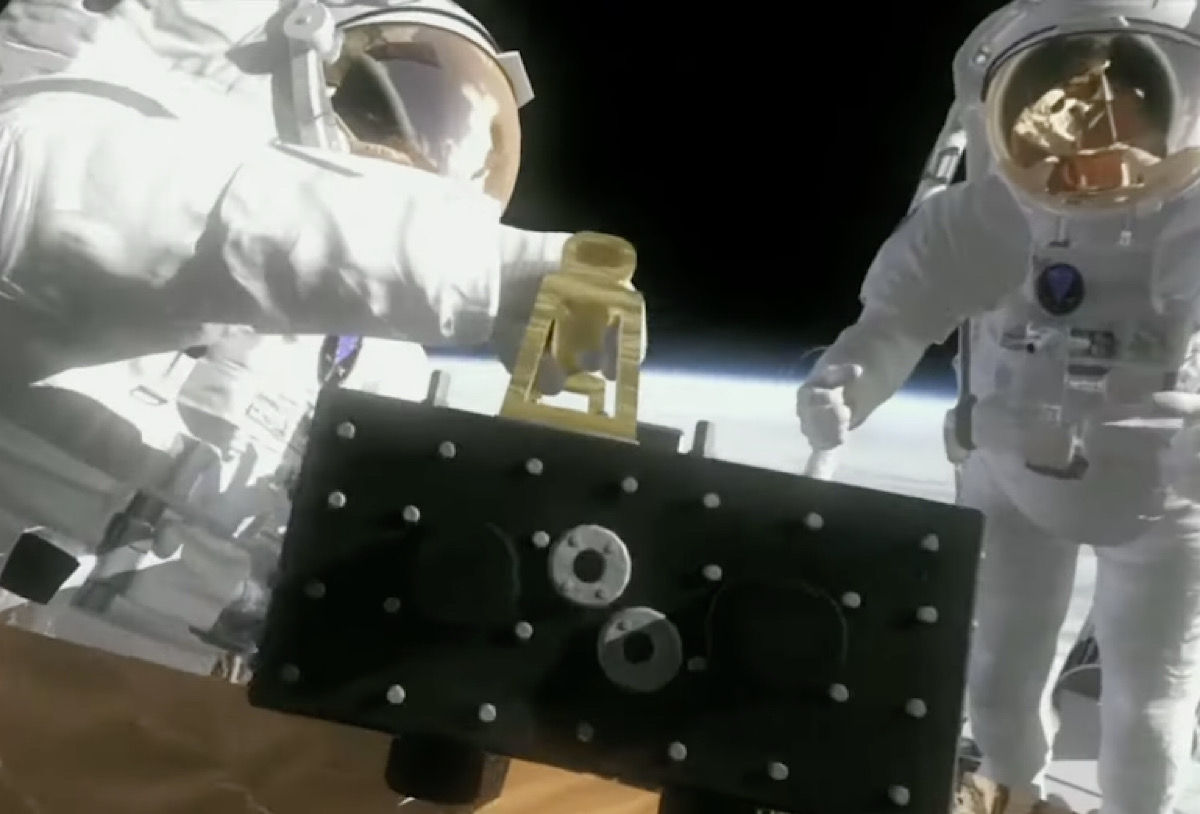
ADDUP-BUILT L 3D PRINTER TO UNDERGO MICROGRAVITY TESTING ON THE ISS

A rendering of a mocked-up Metal3D system being used by astronauts.

By PAUL HANAPHY 

French industrial 3D printer manufacturer AddUp has revealed that a new system it has been helping develop is set to be launched into orbit for testing onboard the International Space Station (ISS). 

Working as part of the European Space Agency’s (ESA’s) ‘Metal3D’ project, AddUp has built the internal structure and mechanisms of a machine, designed specifically to 3D print metal parts in space. As opposed to regular powder bed-based systems, the demonstrator is said to process wire feedstock affixed to its frame, stopping it floating away, and allowing the unit to operate in microgravity conditions.

Continue reading… “ADDUP-BUILT L 3D PRINTER TO UNDERGO MICROGRAVITY TESTING ON THE ISS”

Google helps develop AI-driven lab machine to diagnose Parkinson’s

Robo-worker manipulates test tubes and pipettes, images skin cells to classify disease

By Katyanna Quach 

A robotic system armed with AI-powered cameras can grow and image skin cells from test tubes to diagnose Parkinson’s disease with minimal human help, according to researchers from Google and the New York Stem Cell Foundation.

Parkinson’s disease is estimated to affect 2 to 3 percent of the population over the age of 65. Nerve cells located deep within the basal ganglia region of the brain slowly die over time, impacting motion. Patients find it difficult to control their movements; their limbs may shake or feel stiff. Scientists aren’t sure what causes the disease, and it is currently incurable.

“Traditional drug discovery isn’t working very well, particularly for complex diseases like Parkinson’s,” NYSCF’s CEO Susan Solomon explained in a statement. “The robotic technology NYSCF has built allows us to generate vast amounts of data from large populations of patients, and discover new signatures of disease as an entirely new basis for discovering drugs that actually work.”

Continue reading… “Google helps develop AI-driven lab machine to diagnose Parkinson’s”
Discover the Hidden Patterns of Tomorrow with Futurist Thomas Frey
Unlock Your Potential, Ignite Your Success.

By delving into the futuring techniques of Futurist Thomas Frey, you’ll embark on an enlightening journey.

Learn More about this exciting program.